By Marc S. Sanders
I love when a movie can teach me about an industry. Network and Broadcast News dive deep into television news. Boogie Nights lends a sneaky and empathetic eye to the porn industry. The Big Short explores the pains of mortgage lending and investments. Spotlight reveals unwelcome truths within the Catholic Church by way of the press. The Devil Wears Prada offers brilliant wit that often will leave you uncomfortable while emphasizing the importance of high-end fashion at its centrally located heart in New York City.
I recall watching an episode of Judge Judy. The cranky magistrate was making light over the dispute between two comic book collectors. The Incredible Hulk #181, which features the introduction of Wolverine (famously played by Hugh Jackman in the movies). Judy Scheindlin could not fathom the need for an argument over this item, nor how a mint first edition copy could demand an asking price in excess of $5,000. The best scene in The Devil Wears Prada parallels this circumstance as the new temp assistant, Andy Sachs (Anne Hathaway in her forever breakaway leading role) scoffs at a meeting run by the infamous Miranda Priestly (Meryl Streep in probably her most memorable performance).
An underling cannot decide which of two blue belts complement a new outfit. Andy just doesn’t understand “this stuff.” Miranda uses her response as a means to explain the purpose a fashion meeting stretches far beyond a belt selection. The reason they are standing there is detrimental to the outcome of tens of thousands of jobs and a blue sweater is never just a blue sweater. In fact, Crayola, in case you didn’t know, Andy’s sweater is cerulean. Cerulean is never just blue, just as a particular Marvel Comic Book is never just 60 cent magazine you roll up and buy at the candy store.
It’s during this moment that director David Frankel provides a visual demonstration. A dress is not a dress without a belt. A dress and belt are nothing without a jacket. A dress, a belt and a jacket are not necessarily enough without a hat. A process is assembled.
I know Prada was a book first (which I’ve yet to read), but how better to show why the visual medium of film is so vital to exploring what many of us may never be familiar with? Just as you might not comprehend the importance of the comic book industry, I do not have an appreciation for the fashion industry, but the people who work under Miranda Priestly’s Runway magazine better do so because it represents a “beacon of hope” for millions of women, aspiring designers, and industrialists worldwide. The items on display may have asking prices in the thousands, but they dictate what all of us wear casually and formally and how affordable all “this stuff” is for our respective demographics.
Andy is a twenty-something Northwestern graduate striving to become a successful journalist in the city. To make ends meet with her live-in boyfriend Nate (a miscast Adrian Grenier, looking like Hathaway’s little brother despite the midnight shadow), she accepts a temp offer to be second assistant for Miranda Priestley, the devil of this film’s title.
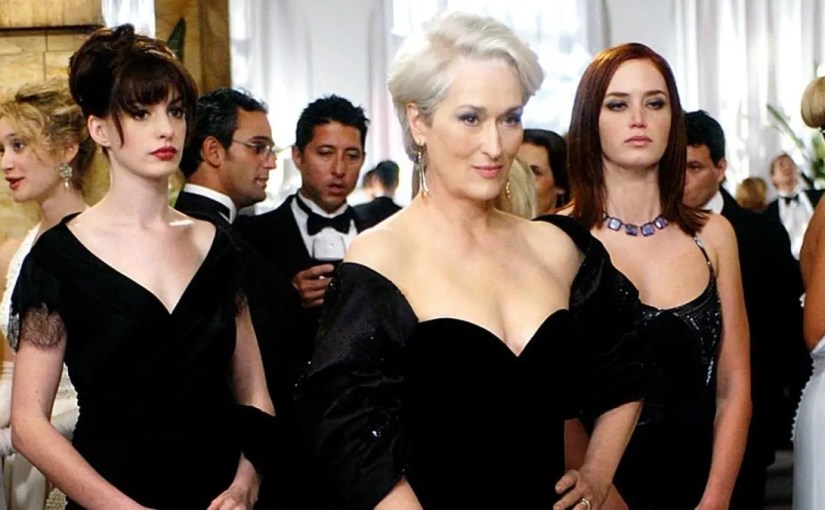
The first assistant is Emily (Emily Blunt in her breakout role), a nervous and low tolerant British trainer for Andy. Emily gets twenty minutes for lunch and the prospect of accompanying Miranda for fashion week in Paris. Andy gets fifteen minutes, and if she’s lucky an invitation to a hideous skirt convention. Andy is also a size 6, which is now the new 14. Seriously, what is Andy doing here?
Nigel (Stanley Tucci, who should have been Oscar nominated for this performance) is the top fashion selector keeping up with trends that Miranda will support and approve in the Runway catalogue.
Miranda, Emily and Nigel – they might as well be speaking a foreign language to Andy. Perhaps that should be vice versa?
The Devil Wears Prada is a best-selling novel by Lauren Weisberger inspired by her experiences in the Andy role when she worked for Anna Wintour, the famed editor in chief of Vogue. Weisberger’s story lacks a mentor for the novice. Andy has no choice but to find her way through the endless challenges of meeting insurmountable expectations while trying to balance a personal relationship and friendships as she holds out for a prized opportunity in journalism. Working for Miranda Priestley or Anna Wintour and living to talk about it can only open doors to some of the most esteemed publications out there.
The characters of this film, standing on the heels of comedy, are sketched beautifully with genuine realism. Meryl Streep is so focused on being a demanding, unrelenting, quietly intolerant heathen who knows her job better than anyone. She is the toughest and most intimidating. Yet, there is no denying she never stops reading the pulse of updated trends and fashion sense. Miranda knows every significant designer and clothing manufacturer the world over. If a brand needs to break through, they must know Miranda Priestly and only hope to earn her attention. Success is earned especially by affiliation with Runway. Miranda never tumbles from the mountain she stands upon while so few can even intrude within her shadow. It goes further when you see Streep enter any room, building or show in the entire film. She doesn’t belong in the settings. Rather the settings race to surround her.
I also recognize the expanse of the script by exposing this ultimate power’s concealed weakness. A late scene in the film goes against the familiar current of Streep’s character and the actress pulls it off with utter heartbreak. How often do we get to feel sorry for the villain? Miranda is stripped of confidence, makeup, and fashion, simply at a loss to just be as human as those beneath her. It’s a shocking and beautifully written scene that Streep shares with Hathaway, devoid of any other kind of familiar armor.
It’s important that Anne Hathaway runs with a looser and more scattered persona. Andy must be so much more than just opposite of Miranda. For this story to work, the two women cannot even communicate in the same way or ever share similar perspectives. Andy has to fail if she is to succeed. How can anyone be expected to fly Miranda out of south Florida during a hurricane? How can anyone obtain a copy of the unpublished manuscript of the latest Harry Potter novel? To keep from drowning in any line of work you have to absorb yourself in its environment. Function with its nature. The crux of the film is observing if Andy can follow through.
A spin off film focusing on Stanley Tucci’s character would absolutely work. Nigel comes off like a sidekick, but with a few choice pieces of dialogue. In a third act revelation, the film paints the picture of Nigel as an endearing sore thumb in a home he was completely uncommon with while growing up. Tucci plays this man of confidence and knowledge under the radar. A friend to Andy while never being so overt. The impression seems quite obvious that Nigel is gay, but his career is his main priority. The argument has come up that only homosexual actors should play gay characters. Stanley Tucci’s performance is the best, most assured response to turn off that debate. (He’s married to Emily Blunt’s sister.) How he dresses, walks, talks and carries himself through every scene demonstrates a man of expertise who lives above any prejudice. He lends purpose to high end fashion, and his service builds the confidence of women who are meant to have power and authority.
Emily Blunt is the antagonist to Andy but her panicked hysteria is also the comedy found in the film. Anything Andy considers is unheard of in Emily’s eyes. While Miranda is short on words, Emily exposes how fearful this devil truly is ranging from pouring a glass of Perrier to hanging a coat in the correct closet.
David Frankel assembles this film with energy. I especially love the filler montages that start at the opening credits and drive the transitions of the story. He captures Andy, the lovable ugly duckling, in contrast to every model attired woman making a career for themselves in New York and it works to show how much a fish out of water she is. Later, after Nigel delivers a complete makeover to desperately hopeless Andy, a new montage of seamless edits has Hathaway’s character walking with utter confidence and determination. Frankel applies sweeping edits showing Andy walking behind a city bus or building, reemerging on the other side in another fitting outfit of color and vibrancy. All of these moments define the world of The Devil Wears Prada. Frankel truly creates a darling visual masterpiece.
The Devil Wears Prada focuses on career opportunities and building poise in a niched industry that is constantly evolving while never waiting for the troops to catch up with the fleet. It studies the interactions that not only occur in an office but beyond, with high end social gatherings where the best of the best must be caught up with people’s personal dramas while circumventing around competitors who look to reign and cut throats. Designers intersect with publishers and writers, and we see the back-and-forth responses, especially when the acerbic Miranda frowns at a presentation. Someone with power and influence has the means of success or failure for the next person who comes through a door.
As the film moves past its exposition, Andy, the protagonist, is ready to be tested. I might be describing a fantasy, unfamiliar to any of us, but David Frankel and Lauren Weisberger, with an adapted screenplay by Aline Brosh McKenna, choose to take every bar or gallery or on-site location seriously. Because they go in a direction where morals, ethics and loyalties can be probed and embraced by an audience. Personal values and priorities can be questioned either at home, in the field or in the office.
The Devil Wears Prada goes beyond the clothes these people wear. Its story justifies why these four primary characters adorn themselves in the garb selected for them, allowing them to command or earn authority.
The newly released sequel, The Devil Wears Prada 2, demonstrates that after twenty years much of the environments and practices of the original are outdated though the world of fashion is unmistakably necessary. In a post Me Too era where the internet makes the world so much smaller, the industries of journalism and clothing design do not feel as global and exotic. A tyrant dressed in Prada cannot be so demanding. She must rely upon herself, and not so much her underlings to get her Starbucks or hang up her coat. Flying coach, not even first class, might make for a good gag, but…well…that might be pushing it. Yet, this latest installment offers good ideas and inventive challenges for Miranda Priestly to contend with.
Elsewhere, Andy Sachs might be a well recognized, award winning journalist but with print and article submissions becoming extinct at the mercy of second to second social media news, it’s never enough to hold on to a job.
Runway is in trouble for being associated with sweatshop practices overseas. Miranda is the scapegoat. That’s about all you see of that problem because it’s important to speed along to Andy and Miranda working together again. The writer is quickly recruited for an image repair of the famed magazine and its editor.
Even though the sequel follows similar beats to its predecessor, there are an overabundance of narratives, and they are scattered brained. It begins with the blemish to Runway’s reputation, then on to getting the gang back together again. These episodes quickly fix themselves and now the magazine becomes an affected constituent to corporate controls and seizures for the remainder of the film.
Side dishes are too overloaded as well with an unwelcome romance storyline for the career driven Andy. This bit screams of a producer insisting that Anne Hathaway have a love interest. Never have the scenes with Hathaway and actor Patrick Bramell, as a high end city property owner, felt like opportunistic bathroom breaks.
Andy is also given a peer to cope with by the name of Mack (I had to look up the name) played by Larry Mitchell. He wears a Yankees cap. Otherwise, what is he doing here? Other than Hathaway, he does not share a scene with any other cast member, and he’s there for Andy to commiserate with. Couldn’t moments like these be shared with Nigel or Emily? It would only strengthen the script and the appearance of the four returning principal characters. Tracie Thoms makes a welcome return as Andy’s art gallery friend. Additional moments with her seem inviting but not relied upon.
Kenneth Branagh is here to cash a paycheck as Miranda’s new husband. I don’t think Meryl Streep ever makes eye contact with him. The famed, Oscar winning actor/director/writer only serves as a reactionary post for Streep. Again, a producer who wanted to feel relevant likely insisted that Miranda have a love interest.
These elements are disappointing to me. Often we see the leading man drive through a career without the need for family or relationships. Especially in the world of The Devil Wears Prada, where women are never held back from achieving their goals, why are these two self made ladies of influence anchored to answering to a man in their life? There’s enough material to further their fulfillments without these useless characters.
Emily Blunt returns with nothing to do as well. Even with a twist, that serves no surprise to her character as the stuck-up Emily, she steps into Miranda and Andy’s paths when the film has to wind down with a last button to push. She’s also wasted in dumbed down tryst with an airhead played by Justin Theroux. This accomplished actor who has an impressive line of work, deserves better. With practically nothing to do, Blunt should have insisted on a rewrite because her character has become entirely unappealing.
BJ Novack (actor and writer of The Office) does okay with what the script deals to him as oil to water antagonist for Streep’s role. Yet, he’s also an unnecessary new character; one which could have been covered by Blunt’s character.
Stanley Tucci is also not given much to do. However, the new film is wise not to experiment with new angles for Nigel. What works should be upheld. It was smart just to let this supporting character remain as is. Tucci is always wonderful and the film lights up when it circles back to him.
I’ve heard some are disappointed with deviations applied to the Miranda character. In the first film, she truly is the one you love to hate. Here, Meryl Streep is ready to respond to a change of climate and thus, Miranda is not as free to be the uncompromising slave driver while also revealing some genuine feelings. This is the best part of The Devil Wears Prada 2. It exposes the humanity of a notoriously cold person. Yet, a wiser choice would have been to dismiss the Branagh character and have Miranda share moments with her twin daughters briefly touched on in the first film but never mentioned here.
Though I never cared for Adrian Grenier in the role of Andy’s boyfriend Nate, the first film leaves open possibilities for their relationship to survive. Nate was a budding chef which on principle opens a lot of doors for the Prada world. The new iteration could have circled back to Nate being requested to cater one of the many events that occurs in this film, even when the story diverts to Miranda’s Hampton getaway. Instead, a forgettable guy fills that void for Andy’s perspective. What was to gain from that?
I was skeptical a follow up movie would work. Prada doesn’t demand new adventures like Indiana Jones or Batman. Yet, the new film offers a lot of potential to apply Miranda and Andy to a new internet culture of harassment boundaries to contend with two decades after they first met. A lot of good seeds left about in the first film are abandoned in lieu of newly irrelevant material and characters. Had The Devil Wears Prada 2 condensed its ideas the pace and drive would have been much more novel and adorably reminiscent at the same time. Alas, it’s a size 14 when it should be a size 6. The Blu Ray release should have a special edition that excises all of this unwanted fabric and size up a dress that’s more sleek and form fitting.