by Miguel E. Rodriguez
DIRECTOR: Leo McCarey
CAST: Cary Grant, Deborah Kerr, Richard Denning, Neva Patterson
MY RATING: 8/10
ROTTEN TOMATOMETER: 65% Fresh
PLOT: A couple, both attached to other people, falls in love and agrees to meet in six months at the Empire State Building – but will it happen?
First, a word to devotees of this film:
No, I have not yet watched Sleepless in Seattle. Yes, I am aware of the deep connection between the two films. No, Sleepless is not currently on my watchlist radar, but rest assured I will post a review of it if or when I finally watch it. Today is not that day. Tomorrow’s not looking good, either.
All good? Okay, let’s move on.
Leo McCarey’s An Affair to Remember is a grand old melodrama that would have been a perfect example of its genre if only it had ended differently. As it happens, McCarey’s filmography does include a perfect example of melodrama: Make Way for Tomorrow (1937), not quite as romantic as An Affair to Remember, but packing a devastating gut-punch of an ending that other films can only aspire to. If Affair had had the nerve to stick to that kind of an ending, I would absolutely have given it a perfect 10 out of 10. But, while I don’t believe it’s perfect, it still belongs on your watchlist.
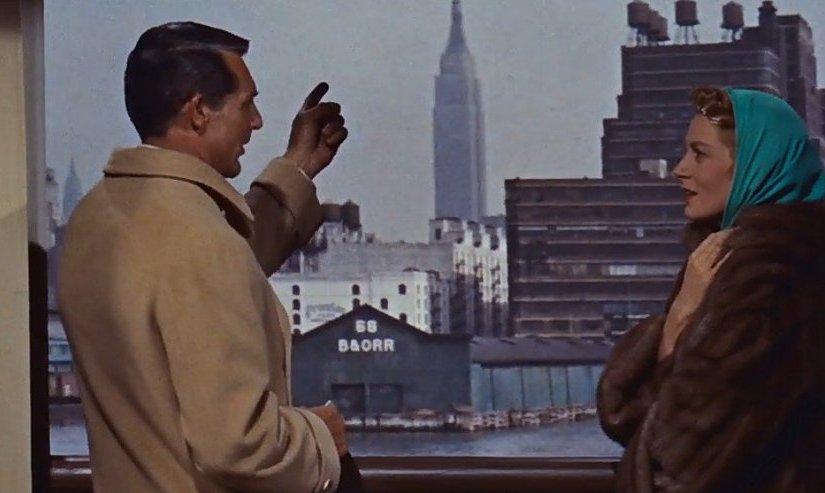
Cary Grant plays Nickie Ferrante, an incurable playboy who is nevertheless engaged to be married to an industrial heiress. Deborah Kerr is Terry McKay, an “everywoman” type – or as everywoman as one can be while looking like Deborah Kerr. She is also romantically attached to another man (NOT engaged, which plays a crucial factor later in the film). The two have a pleasantly non-contrived meet-cute aboard a transatlantic cruise to Europe. As fate would have it, they are both traveling solo for various reasons.
Their connection is immediate and unforced, reminding me a bit of two of my favorite films, Lost in Translation (2003) and Dodsworth (1936). Grant and Kerr have a wonderful, breezy onscreen chemistry. Their conversations, especially when they’re alone in her stateroom, are positively gravid with subtext, but they are careful not to let things get out of hand, even when it’s clear they would both like that very much. It’s a wonderful balancing act that is rarely successful, so it’s a pleasure to watch when it is.
The development of their relationship unfolds perfectly, so I won’t spoil it. As their ship pulls back into New York Harbor, they make a hasty, almost teenager-esque pact: meet in six months to see if their connection is still as strong as it is now. The location: the top of the Empire State Building, still the tallest building in the world in 1957. “It’s the nearest thing to heaven we have in New York,” gushes Terry. It’s a tribute to how pervasive this movie is in the pop culture zeitgeist that I knew exactly what would happen just prior to that fateful appointment, but I nevertheless gave a little gasp when it happened.
For me, it’s the second half of An Affair to Remember that shines. The first half is no slouch, but I masochistically perked up when the possibilities of a tragic romance reared its head. There’s something about heartbreaking tragedy that makes for a sensational film. There’s nothing wrong with happy endings, don’t get me wrong, but my favorite Broadway musical of all time isn’t My Fair Lady…it’s Jesus Christ Superstar. When done right, tragedy is strangely cathartic. I’m thinking of movies like Atonement (2007) or The Remains of the Day (1993) or Brokeback Mountain (2005), movies that will never top anyone’s list of feel-good films, but which are somehow more powerful because…well, I find myself unable to articulate why. They just are.
And that’s why An Affair to Remember does not quite reach the level of perfection attained by Make Way for Tomorrow. There was a moment in the final reel when I thought it would, but it goes for the happy ending instead. That’s right, I begrudge the movie’s happy ending just a little bit. Sue me. I fully acknowledge that the moment when Nickie sees a particular item in a particular room during the final scene is a thing of brilliance and beauty. (Treading carefully here…) It’s a lovely moment capping a sensationally written and performed scene. …but it just didn’t strum my heartstrings. I wanted it to, I really did. I wanted my heart to swell and feel like it’s going to burst, but it never happened.
(For the record, I also could have done without the multiple musical interludes, especially the two with the kids singing…although I did enjoy Nickie’s flashback/memory when he revisits his grandmother’s house in France.)
Does this make me a curmudgeon? I don’t think so. I just feel there was an opportunity here to pull out all the stops for some real reach-for-the-hanky moments. But, hey, what do I know? See it and judge for yourself. An Affair to Remember is a pleasure to watch and listen to, just like the stars themselves. And, hey, if the ending reduces you to a blubbering mess like Meg Ryan in Sleepless in Seattle, then it did its job. I won’t judge. Promise.