THE DEVIL WEARS PRADA/THE DEVIL WEARS PRADA 2

By Marc S. Sanders

I love when a movie can teach me about an industry.  Network and Broadcast News dive deep into television news.  Boogie Nights lends a sneaky and empathetic eye to the porn industry.  The Big Short explores the pains of mortgage lending and investments.  Spotlight reveals unwelcome truths within the Catholic Church by way of the press.  The Devil Wears Prada offers brilliant wit that often will leave you uncomfortable while emphasizing the importance of high-end fashion at its centrally located heart in New York City.

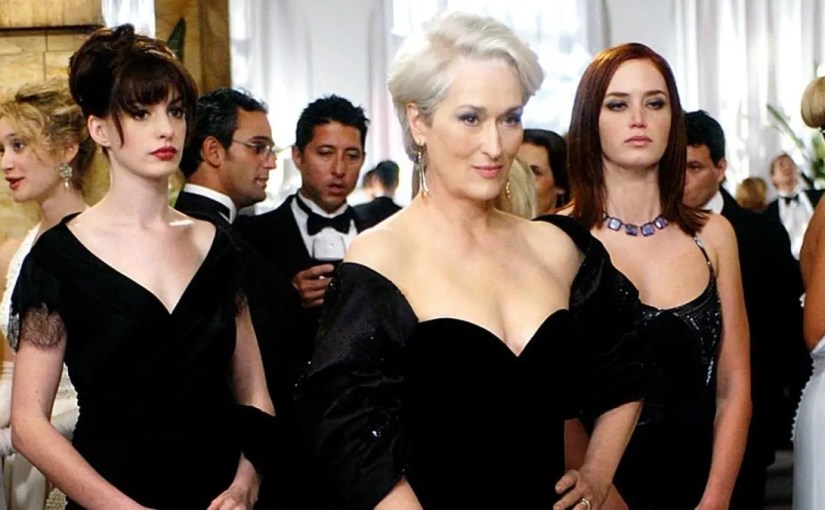
I recall watching an episode of Judge Judy.  The cranky magistrate was making light over the dispute between two comic book collectors.  The Incredible Hulk #181, which features the introduction of Wolverine (famously played by Hugh Jackman in the movies).  Judy Scheindlin could not fathom the need for an argument over this item, nor how a mint first edition copy could demand an asking price in excess of $5,000.  The best scene in The Devil Wears Prada parallels this circumstance as the new temp assistant, Andy Sachs (Anne Hathaway in her forever breakaway leading role) scoffs at a meeting run by the infamous Miranda Priestly (Meryl Streep in probably her most memorable performance).  

An underling cannot decide which of two blue belts complement a new outfit.  Andy just doesn’t understand “this stuff.”  Miranda uses her response as a means to explain the purpose a fashion meeting stretches far beyond a belt selection.  The reason they are standing there is detrimental to the outcome of tens of thousands of jobs and a blue sweater is never just a blue sweater.  In fact, Crayola, in case you didn’t know, Andy’s sweater is cerulean.  Cerulean is never just blue, just as a particular Marvel Comic Book is never just 60 cent magazine you roll up and buy at the candy store.

It’s during this moment that director David Frankel provides a visual demonstration. A dress is not a dress without a belt.  A dress and belt are nothing without a jacket.  A dress, a belt and a jacket are not necessarily enough without a hat.  A process is assembled.  

I know Prada was a book first (which I’ve yet to read), but how better to show why the visual medium of film is so vital to exploring what many of us may never be familiar with?  Just as you might not comprehend the importance of the comic book industry, I do not have an appreciation for the fashion industry, but the people who work under Miranda Priestly’s Runway magazine better do so because it represents a “beacon of hope” for millions of women, aspiring designers, and industrialists worldwide.  The items on display may have asking prices in the thousands, but they dictate what all of us wear casually and formally and how affordable all “this stuff” is for our respective demographics.

Andy is a twenty-something Northwestern graduate striving to become a successful journalist in the city.  To make ends meet with her live-in boyfriend Nate (a miscast Adrian Grenier, looking like Hathaway’s little brother despite the midnight shadow), she accepts a temp offer to be second assistant for Miranda Priestley, the devil of this film’s title.  

The first assistant is Emily (Emily Blunt in her breakout role), a nervous and low tolerant British trainer for Andy.  Emily gets twenty minutes for lunch and the prospect of accompanying Miranda for fashion week in Paris.  Andy gets fifteen minutes, and if she’s lucky an invitation to a hideous skirt convention.  Andy is also a size 6, which is now the new 14.  Seriously, what is Andy doing here?

Nigel (Stanley Tucci, who should have been Oscar nominated for this performance) is the top fashion selector keeping up with trends that Miranda will support and approve in the Runway catalogue.  

Miranda, Emily and Nigel – they might as well be speaking a foreign language to Andy.  Perhaps that should be vice versa?

The Devil Wears Prada is a best-selling novel by Lauren Weisberger inspired by her experiences in the Andy role when she worked for Anna Wintour, the famed editor in chief of Vogue. Weisberger’s story lacks a mentor for the novice.  Andy has no choice but to find her way through the endless challenges of meeting insurmountable expectations while trying to balance a personal relationship and friendships as she holds out for a prized opportunity in journalism.  Working for Miranda Priestley or Anna Wintour and living to talk about it can only open doors to some of the most esteemed publications out there.  

The characters of this film, standing on the heels of comedy, are sketched beautifully with genuine realism.  Meryl Streep is so focused on being a demanding, unrelenting, quietly intolerant heathen who knows her job better than anyone.  She is the toughest and most intimidating. Yet, there is no denying she never stops reading the pulse of updated trends and fashion sense.  Miranda knows every significant designer and clothing manufacturer the world over.  If a brand needs to break through, they must know Miranda Priestly and only hope to earn her attention.  Success is earned especially by affiliation with Runway.  Miranda never tumbles from the mountain she stands upon while so few can even intrude within her shadow.  It goes further when you see Streep enter any room, building or show in the entire film.  She doesn’t belong in the settings.  Rather the settings race to surround her.  

I also recognize the expanse of the script by exposing this ultimate power’s concealed weakness.  A late scene in the film goes against the familiar current of Streep’s character and the actress pulls it off with utter heartbreak.  How often do we get to feel sorry for the villain?  Miranda is stripped of confidence, makeup, and fashion, simply at a loss to just be as human as those beneath her.  It’s a shocking and beautifully written scene that Streep shares with Hathaway, devoid of any other kind of familiar armor.

It’s important that Anne Hathaway runs with a looser and more scattered persona.  Andy must be so much more than just opposite of Miranda.  For this story to work, the two women cannot even communicate in the same way or ever share similar perspectives.  Andy has to fail if she is to succeed.  How can anyone be expected to fly Miranda out of south Florida during a hurricane?  How can anyone obtain a copy of the unpublished manuscript of the latest Harry Potter novel? To keep from drowning in any line of work you have to absorb yourself in its environment.  Function with its nature.  The crux of the film is observing if Andy can follow through.

A spin off film focusing on Stanley Tucci’s character would absolutely work.  Nigel comes off like a sidekick, but with a few choice pieces of dialogue.  In a third act revelation, the film paints the picture of Nigel as an endearing sore thumb in a home he was completely uncommon with while growing up.  Tucci plays this man of confidence and knowledge under the radar.  A friend to Andy while never being so overt.  The impression seems quite obvious that Nigel is gay, but his career is his main priority. The argument has come up that only homosexual actors should play gay characters.  Stanley Tucci’s performance is the best, most assured response to turn off that debate.  (He’s married to Emily Blunt’s sister.) How he dresses, walks, talks and carries himself through every scene demonstrates a man of expertise who lives above any prejudice.  He lends purpose to high end fashion, and his service builds the confidence of women who are meant to have power and authority. 

Emily Blunt is the antagonist to Andy but her panicked hysteria is also the comedy found in the film.  Anything Andy considers is unheard of in Emily’s eyes. While Miranda is short on words, Emily exposes how fearful this devil truly is ranging from pouring a glass of Perrier to hanging a coat in the correct closet.  

David Frankel assembles this film with energy.  I especially love the filler montages that start at the opening credits and drive the transitions of the story.  He captures Andy, the lovable ugly duckling, in contrast to every model attired woman making a career for themselves in New York and it works to show how much a fish out of water she is.  Later, after Nigel delivers a complete makeover to desperately hopeless Andy, a new montage of seamless edits has Hathaway’s character walking with utter confidence and determination.  Frankel applies sweeping edits showing Andy walking behind a city bus or building, reemerging on the other side in another fitting outfit of color and vibrancy.  All of these moments define the world of The Devil Wears Prada.  Frankel truly creates a darling visual masterpiece.

The Devil Wears Prada focuses on career opportunities and building poise in a niched industry that is constantly evolving while never waiting for the troops to catch up with the fleet.  It studies the interactions that not only occur in an office but beyond, with high end social gatherings where the best of the best must be caught up with people’s personal dramas while circumventing around competitors who look to reign and cut throats.  Designers intersect with publishers and writers, and we see the back-and-forth responses, especially when the acerbic Miranda frowns at a presentation.  Someone with power and influence has the means of success or failure for the next person who comes through a door.  

As the film moves past its exposition, Andy, the protagonist, is ready to be tested.  I might be describing a fantasy, unfamiliar to any of us, but David Frankel and Lauren Weisberger, with an adapted screenplay by Aline Brosh McKenna, choose to take every bar or gallery or on-site location seriously.  Because they go in a direction where morals, ethics and loyalties can be probed and embraced by an audience.  Personal values and priorities can be questioned either at home, in the field or in the office.  

The Devil Wears Prada goes beyond the clothes these people wear.  Its story justifies why these four primary characters adorn themselves in the garb selected for them, allowing them to command or earn authority.

The newly released sequel, The Devil Wears Prada 2, demonstrates that after twenty years much of the environments and practices of the original are outdated though the world of fashion is unmistakably necessary.  In a post Me Too era where the internet makes the world so much smaller, the industries of journalism and clothing design do not feel as global and exotic.  A tyrant dressed in Prada cannot be so demanding.  She must rely upon herself, and not so much her underlings to get her Starbucks or hang up her coat.  Flying coach, not even first class, might make for a good gag, but…well…that might be pushing it.  Yet, this latest installment offers good ideas and inventive challenges for Miranda Priestly to contend with.

Elsewhere, Andy Sachs might be a well recognized, award winning journalist but with print and article submissions becoming extinct at the mercy of second to second social media news, it’s never enough to hold on to a job.

Runway is in trouble for being associated with sweatshop practices overseas.  Miranda is the scapegoat.  That’s about all you see of that problem because it’s important to speed along to Andy and Miranda working together again.  The writer is quickly recruited for an image repair of the famed magazine and its editor.

Even though the sequel follows similar beats to its predecessor, there are an overabundance of narratives, and they are scattered brained.  It begins with the blemish to Runway’s reputation, then on to getting the gang back together again.  These episodes quickly fix themselves and now the magazine becomes an affected constituent to corporate controls and seizures for the remainder of the film.

Side dishes are too overloaded as well with an unwelcome romance storyline for the career driven Andy.  This bit screams of a producer insisting that Anne Hathaway have a love interest.  Never have the scenes with Hathaway and actor Patrick Bramell, as a high end city property owner, felt like opportunistic bathroom breaks.  

Andy is also given a peer to cope with by the name of Mack (I had to look up the name) played by Larry Mitchell. He wears a Yankees cap. Otherwise, what is he doing here?  Other than Hathaway, he does not share a scene with any other cast member, and he’s there for Andy to commiserate with.  Couldn’t moments like these be shared with Nigel or Emily?  It would only strengthen the script and the appearance of the four returning principal characters. Tracie Thoms makes a welcome return as Andy’s art gallery friend.  Additional moments with her seem inviting but not relied upon.

Kenneth Branagh is here to cash a paycheck as Miranda’s new husband.  I don’t think Meryl Streep ever makes eye contact with him.  The famed, Oscar winning actor/director/writer only serves as a reactionary post for Streep.  Again, a producer who wanted to feel relevant likely insisted that Miranda have a love interest.

These elements are disappointing to me.  Often we see the leading man drive through a career without the need for family or relationships.  Especially in the world of The Devil Wears Prada, where women are never held back from achieving their goals, why are these two self made ladies of influence anchored to answering to a man in their life? There’s enough material to further their fulfillments without these useless characters.

Emily Blunt returns with nothing to do as well.  Even with a twist, that serves no surprise to her character as the stuck-up Emily, she steps into Miranda and Andy’s paths when the film has to wind down with a last button to push.  She’s also wasted in dumbed down tryst with an airhead played by Justin Theroux. This accomplished actor who has an impressive line of work, deserves better.  With practically nothing to do, Blunt should have insisted on a rewrite because her character has become entirely unappealing.

BJ Novack (actor and writer of The Office) does okay with what the script deals to him as oil to water antagonist for Streep’s role.  Yet, he’s also an unnecessary new character; one which could have been covered by Blunt’s character.  

Stanley Tucci is also not given much to do.  However, the new film is wise not to experiment with new angles for Nigel.  What works should be upheld.  It was smart just to let this supporting character remain as is.  Tucci is always wonderful and the film lights up when it circles back to him.

I’ve heard some are disappointed with deviations applied to the Miranda character.  In the first film, she truly is the one you love to hate.  Here, Meryl Streep is ready to respond to a change of climate and thus, Miranda is not as free to be the uncompromising slave driver while also revealing some genuine feelings.  This is the best part of The Devil Wears Prada 2.  It exposes the humanity of a notoriously cold person.  Yet, a wiser choice would have been to dismiss the Branagh character and have Miranda share moments with her twin daughters briefly touched on in the first film but never mentioned here.

Though I never cared for Adrian Grenier in the role of Andy’s boyfriend Nate, the first film leaves open possibilities for their relationship to survive.  Nate was a budding chef which on principle opens a lot of doors for the Prada world. The new iteration could have circled back to Nate being requested to cater one of the many events that occurs in this film, even when the story diverts to Miranda’s Hampton getaway.  Instead, a forgettable guy fills that void for Andy’s perspective.  What was to gain from that?

I was skeptical a follow up movie would work.  Prada doesn’t demand new adventures like Indiana Jones or Batman.  Yet, the new film offers a lot of potential to apply Miranda and Andy to a new internet culture of harassment boundaries to contend with two decades after they first met.  A lot of good seeds left about in the first film are abandoned in lieu of newly irrelevant material and characters.  Had The Devil Wears Prada 2 condensed its ideas the pace and drive would have been much more novel and adorably reminiscent at the same time.  Alas, it’s a size 14 when it should be a size 6.  The Blu Ray release should have a special edition that excises all of this unwanted fabric and size up a dress that’s more sleek and form fitting.  

THE FALL GUY

By Marc S. Sanders

Indulge me please while I spout off a number of movie titles. 

I am big fan of Emily Blunt.  She justifiably earned her first Oscar nomination for Oppenheimer.  She was Mary Poppins – a damn good one.  She’s good in her husband John Krasinski’s A Quiet Place monster movies.  Have you seen Sicario? The first one?  You should!  As well, there’s the role that put her on the map with The Devil Wears Prada.  Just a great actress with a huge repertoire of sensational performances under her belt.

I am also a big admirer of Ryan Gosling.  Magnificent in the long-awaited Blade Runner sequel.  He’s a dancing wunderkind and musical genius as well with films like La La Land.  You ever seen The Nice Guys where he partnered with Russell Crowe?  Another one you should see.  Also find him in The Ides Of March, directed by George Clooney.  He got his umpteenth nomination for Barbie recently, but let’s face it, after that Oscar show performance for Best Song the man only overshadowed what he blew our eyes out with, and now I believe they should bow to his dancing feet for hosting duties.  Plus, the guy is now the pinnacle live action Beavis to go with Mikey Day’s Butthead.  Is there nothing this guy can’t do?

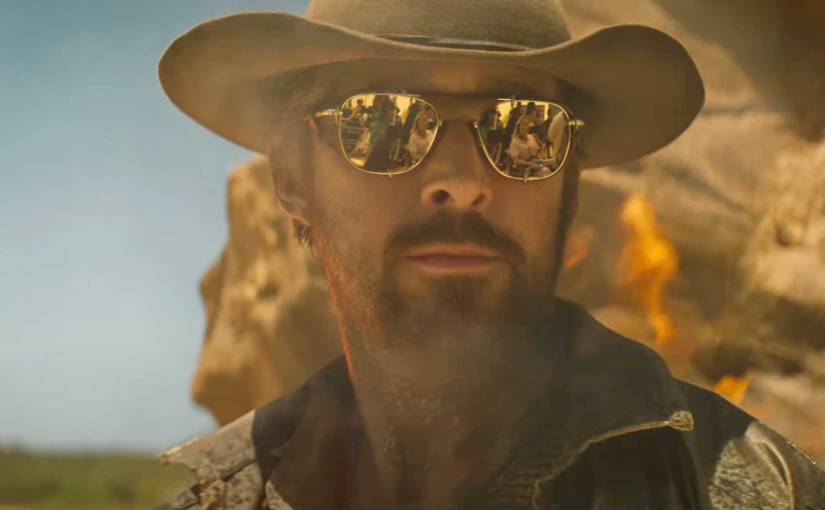
I think back to all of these sensational cinematic achievements, and I am dumbfounded that when this pair finally, at long last, team up it is for wasteful bash up/smash up junk like a television adaptation of the Lee Majors’ ABC action series The Fall Guy.  It’s been a long time since I was so bored watching a stunt filled two-hour flick with zero spice or flavor.  There are fire balls aplomb in this movie and I don’t think Gosling ever feels the burn.

I’ve seen the Die Hards and the Lethal Weapons with the fight scenes and car chases and bombastic explosions. Amid all nine of those pictures (well maybe not the last Die Hard movie) the action usually drove at least some semblance of story, suspense and amazement.

The Fall Guy, directed by former stuntman David Leitch, proudly declares itself a stunt movie because the hero, Colt Seavers (Gosling) is a stunt man for action movies.  However, the audience is shortchanged on…well…the stunts.  I remember Miguel and I watching The Fast And The Furious for the first time.  We both agreed the movie failed because it did not provide what it was selling, namely car chases and car stunts.  At least not enough of them.  Instead, we got Paul Walker and Vin Diesel getting all Terms Of Endearment like and we asked ourselves, when are they going to get in a car and drive.

Consider the opening sequence of The Fall Guy.  First I’m dazzled by a well-done Steadicam shot the runs at least four minutes as it follows Colt talking on his cell phone as he struts from his movie set trailer then on into the lobby of a sky rise building, through a crowd of movie extras, crew and cameras, up an elevator and then over to a platform ledge where a harness is strapped to his uniform and he is suspended high above the ground below, while facing up.  A fall is gonna happen, right? And it does, but then we do not see the finish of the fall.  This one shot walk for Gosling cuts the legs out from under us. Just as the fall is about to finish, it cuts to the guy in a stretcher being wheeled into an ambulance. 

Now you can insist to me that is the start of the story.  Colt breaks his back in a stunt fall gone wrong and thus he’s now retired and surely 18 months later, he will be called back to do his best bidding and set the wheels in motion for the rest of the movie.  Okay.  Fine.  I’m with you.  The hero comes out of retirement for one last job. Yet, THE RYAN GOSLING just did the actual fall and we couldn’t see THE RYAN GOSLING finish the fall.  This wasn’t a stunt double as far as I could tell.  I’ve used this analogy before, but this is like Moe throwing the cream pie at Curly, only you don’t get to see the pie make impact with Curly’s face.  I feel cheated, and I felt cheated during most of The Fall Guy.

This approach is done often during Leitch’s film.  He’ll put Colt into a stunt sequence but then cut away to something else.  Later in the movie, Colt gets into a fist fight with some bad dudes while trying to hang on to a runaway truck and trailer careening through the streets of Sydney, Australia.  Colt throws punches.  He gets punched.  He falls.  He hangs on.  He gets up again.  Wash, dry, repeat.  The problem is that Leitch opts to cut away after each punch or fall to Emily Blunt doing a rendition of “Against All Odds” in a karaoke bar.  This whole action scene is chopped up for no purpose that keeps me in the film.  It’s like when I would have to ask my kid to stop interrupting while the grown ups are still talking.  I love watching Emily Blunt sing.  I love watching Ryan Gosling do his version of what a kamikaze Mel Gibson used to do in his younger years.  Can we just have one thing at a time though?  This kind of juxtaposition is not intriguing or beguiling or whatever the filmmaker wants it to be, and it does no favors for either lead.

The story is pretty simple and pedestrian. Nor does it follow the theme of the TV show that everyone has forgotten or that this generation has ever heard of.  Blunt plays Jody Moreno, a maybe former flame/middle school crush of Colt’s.  Unbeknownst to her, the producer (Hannah Waddingham) of the science fiction film Jody is directing has reached out to Colt a year and a half after his broken back accident to come to Australia and not only work on the set but also track down the star (Aaron Taylor-Johnson) of the picture who has disappeared without a trace.  Colt is not very bright and he’s especially not a detective of any sort. 

Once this is all set up, The Fall Guy flip flops from the search, over to Colt getting set on fire repeatedly on the set, and then back to the search, followed by the inevitable twist, which is in no way a twist because the surprise seems known as soon as movie begins. 

I was not expecting utter brilliance here, but I was hoping for substance.  Gosling and Blunt are two of the biggest stars out there right now and can have their pick of the litter in what they do next.  It only makes sense that these two should pair up for a movie, but this is what they choose?  The script has less wit or intelligence than a coloring book that has yet to be scribbled in by a four-year-old.  I remember the hype around a picture called The Mexican with Julia Roberts and Brad Pitt, the biggest stars of the time finally teaming up, and just like it is with The Fall Guy, they had zero chemistry, and they barely shared any scenes together.  When they did, they hardly acknowledged each other.  Filmmakers cannot just stop working when they get the marquee names to sign a contract for the film.  They gotta work to live up to the hype that comes with these capably appealing actors.

In his pursuit, Colt gets drugged and then we see a unicorn standing next to him for a long sequence.  The audience sees the unicorn, but Colt hardly acknowledges it.  I don’t get where the ha ha ha is supposed to come from this bit.  I think the writers were maybe going for an Airplane!/Naked Gun gag.  Colt gets thrown through glass walls.  He tells us he was part of the Miami Vice stunt show at Universal Studios by simply wearing a jacket that says it, but so what?  There’s no dimension to any of this. (I did appreciate hearing the theme song during a very brief nighttime boat chase.)

Aaron Taylor-Johnson (Avengers: Age Of Ultron, Kick Ass, and one time James Bond candidate) is another fine actor, not doing his best work.  He’s a jerk here with bleach blond locks and nothing to do.  He’s just unlikable and unfunny.  Hannah Waddingham?  Never heard of her, but I can only imagine she’s got something better lined than this obnoxious movie producer role with an annoying over the top Australian accent.  If she’s really Australian, then I’ll have to surrender to the fact that I just don’t know the down under dialect.  Frankly, she’s just terrible. 

Never thought I’d say this but Gosling and Blunt had a thousand times more chemistry when they did that presentation at the 2024 Oscars jabbing at the Barbenheimer trend and shamelessly promoting the upcoming release of this film.  In this movie, they look like they are not making eye contact with one another or listening to what the other actor is saying. I don’t blame them, though.  I call foul on David Leitch for lousy directing.

The most interesting thing about the film adaptation of The Fall Guy are post credit behind the scenes footage where I got to see all of these stunts in their uninterrupted entirety, but without the glossy cinematography finish.  However, an Easter egg scene shows up with THE LEE MAJORS and the other blond Heather from the 1980s, THE HEATHER THOMAS.  She is given blond wig and probably an unseen muzzle because she has no dialogue to say except stand there in a cop’s uniform with her butt and boobs sticking out.  Majors is left to be dull, like he probably was in the final season of the show when it was jumping the shark.  If the writers of this movie just used a tenth of their imagination, they could have kept Lee Majors as the original Colt Seaver who mentors Gosling into being THE FALL GUY of today.  Why couldn’t Lee Majors have a substantial role in this picture?  It would have worked.  However, that is not likely because there’s barely a plot, character, or even stunt scene that implies the makers of this movie have that kind of capable imagination. 

Find another movie for Emily Blunt and Ryan Gosling. STAT! They are so much more worthy then the building they jumped off of only to land in this fire ball blasted junk resting below.

OPPENHEIMER

By Marc S. Sanders

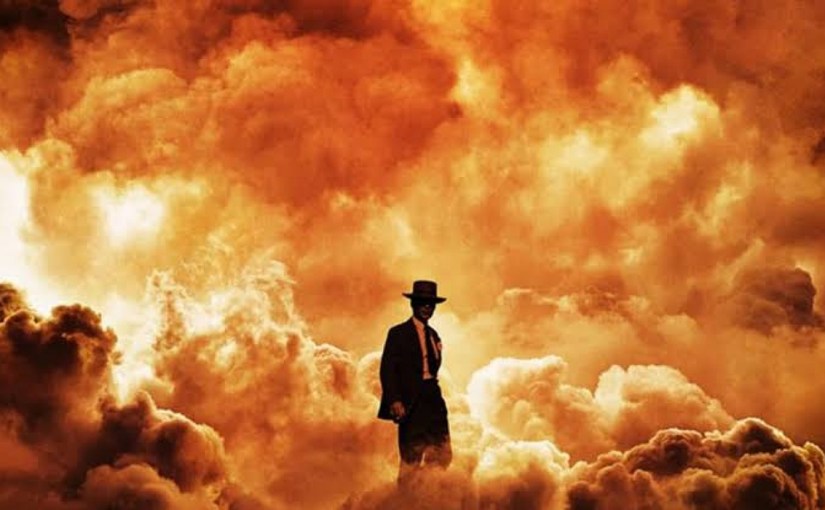
Christopher Nolan is one of the modern-day directors that you can rely on for brainy science fiction whether they are in embedded in dream subconsciousness, intergalactic space travel, transcendences of time, or even putting a fresh polish on a favorite superhero.  With Oppenheimer, he triumphs with exploring the actual prophets of science in the twentieth century, particularly its title character J Robert Oppenheimer, the brilliant physicist played convincingly well by Cillian Murphy.  Nolan doesn’t just stop at the assembly and discovery of science though.  He uncovers the consequences of Oppenheimer’s innovation and genius insight.  Dr. Oppenheimer might have been the man who knew too much and arguably that cost him quite a bit, personally.  Additionally, the so-called lab rat of his atomic bomb, namely the planet Earth, suffered the expense of a, at the time, troubling present day, and a still ongoing future. 

This movie seems to start right in the middle of its story and as a viewer you need to claw your way through the dense foliage to find its beginnings and what comes afterwards.  The first two scenes of the movie are titled “Fission” and “Fusion.”  There are no time periods specified by a font caption, however.  The differences in various points in history are distinguished by where J Robert Oppenheimer is located during select points in his life.  For seconds at a time, the film will change its photography from vibrant color to black and white, for example.  The characters will either look more aged with grey hair and some wrinkles or during more youthful time in their lives.  At one point Oppenheimer is being recruited by Lewis Strauss (Robert Downey, Jr) to head the department of a new kind of weapon development.  Work the science to make a difference.  There’s another time period where he’s being interrogated in a small room by a governmental suit and tie committee.  Oppenheimer is also in his classroom or debating and working with colleagues.  Another story observes his progress with building the atomic bomb among a collection of other engineers and scientists in a desert town, Los Alamos, specifically built at his own request, under the order of the nothing but militant Colonel Leslie Groves (Matt Damon), to conduct his work and research while hiding in plain sight. 

The film also covers Oppenheimer’s association with possible suspects of the Communist Party during the stressful pre-cold war era of McCarthyism.  Questions arise if his reliable brother Frank (Dylan Arnold) is a communist or even his mistress (Florence Pugh).  Does that in turn make Oppenheimer a communist as well?  If that is the case is J Robert Oppenheimer, the man tasked with ultimately ending World War II in favor of the Allies, sharing secrets with Russia and/or the Communist Party?

Nolan’s film gets easier to watch as it moves along, but you must get used to his pattern of filmmaking.  If you have never seen a Christopher Nolan film, I do not recommend you start with Oppenheimer.  His work is recognized for fast paced edits of different time periods and conversations.  There is much information to decipher. As well, there’s a very large collection of welcome characters to sort through, who worked with or against Oppenheimer.  Having only seen it once, I was captivated with the picture, but I know that I need to see it again.  The quick edits, working beautifully against the soundtrack orchestrations of Ludwig Göransson (nominate him for an Oscar, please), happen a mile a minute.  I appreciated this method because it enhanced the urgency of Dr. Oppenheimer in the eyes of the world, first as the savior of the united Allies against the last remaining superpower of the Axis countries, Japan. Then later focus is on whether it is in the United States’ best interests for the regarded physicist to have security access to the country’s most secret weapons and technological progress in a post war age.

People have been cajoling about how they know the ending to Oppenheimer.  They drop the bomb, of course!  (Twice actually.)  However, they do not know the entire story adaptation that Christopher Nolan as director and screenwriter presents. 

Cillian Murphy is perfectly cast. Give him an Oscar nomination.  He serves the confident, assured scientific leader who becomes envious of competing powers who achieve the impossible, like splitting the atom, while also admiring peers and mentors like Niels Bohr and Albert Einstein (Kenneth Branagh, Tom Conti).  All these men are interested only in what can be accomplished.  The superpowers that fight in war, though, are interested in how these accomplishments of modern science can be used to their advantage at a cost of collateral damage.  It is these conflicts of interests that Nolan admirably demonstrates over the course of the film. 

A telling scene for me, that I won’t forget, is when Robert Oppenheimer meets Harry Truman (Gary Oldman, doing an unforgettable cameo).  As the physicist exits the Oval Office, having shared his concerns and scruples with the Commander in Chief, Nolan includes a throwaway line delivered by the President, that I won’t soon forget.  It will not be spoiled, here.  Yet, the dialogue speaks volumes of what the United States held important regarding the servants who did the country’s bidding.  The scene closes like a stab in the heart, and suddenly science is no longer just facts within our planet.  Science is now questioned on whether it should ever be acted upon. Those questions certainly have remained as long as I’ve been alive to read about our never-ending world climate.  These inquiries will be here for many generations after I’m gone as well; that is if men and women’s recklessness with science doesn’t destroy the Earth before then.  At one point, Oppenheimer shares a small fraction of possibility for the end of the world when they activate and test their first atomic bomb. Matt Damon’s Colonel Groves’ asks for a reiteration of that observation.  Is this finding worth even the smallest, most minute risk?

Emily Blunt portrays Kitty Oppenheimer.  She’s marvelous as a lonely alcoholic wife to Robert, and a mother minding a home built in the desert while her husband serves an important purpose.  I didn’t take to her presence in the film until her grand moment arrives during an interrogation scene.  As the character gives her testimony regarding Oppenheimer’s communist ties, Blunt locks herself in for a wealth of awards in late 2023/early 2024.  Once you’ve watched the movie, you’ll likely know which scene I’m referring to and you can bet it’ll be that sample clip shown on all the awards programs.  This might not be Blunt’s best role, because it is rather limited within crux of the film, but I’d argue it is her greatest scene on film that I can remember.

Oppenheimer is a three-hour film, and it demands its running time.  There are so many angles to the man that few really know about.  Many know it was he who instrumentally built the atomic bomb that to date has only been used twice within a period of four days.  Thankfully never since.  Nolan emphasizes how unaware we are of how carefree the doctor’s government supervisors performed with the weapon he agreed to build.  Don’t just drop the bomb once.  Send a message to Japan by dropping it twice so they know to no longer engage in this ongoing war.  Choose the area where an army/government official didn’t honeymoon though.  It’s too beautiful a region.  Tens of thousands of men, women and child civilians perished immediately following the strikes.  Many others died weeks later following exposure to the nuclear effects that followed.  All issued as a horrifying cost to end a war that was already being won now that Hitler was dead.

Mechanically, Christopher Nolan does not disappoint either.  I watched Oppenheimer in a Dolby theater and I highly recommend it over a traditional one.  However, beware of the sound.  It is a LOUD!!!!!  Your seat will rattle early in the film when Cillian Murphy is shown in close up imagining the collision of atoms, protons, and neutrons.  How a star naturally dies in space runs through Oppenheimer’s consciousness as well, and then we see how a black hole forms.  Nolan offers a Cliff’s Notes edit of science doing its job.  Murphy performs so well when he’s not speaking and cut against the quick edits of Nolan’s visual and sound effects of science at play.  It shows how an educated scientist thinks beyond what is documented on a chalkboard or in a textbook.  J Robert Oppenheimer used to teach about the building blocks and natural destruction that occurs within the universe.  Regrettably, what he learned about natural function soon becomes manufactured capability when the professor accepts the task of building scientific destruction with his bare hands. Man stole fire from the Gods.

Oppenheimer is so dense in the scope of science and the scientist behind it.  That’s a huge compliment.  It’s an engaging film with much to tell, and a lot more to think about afterwards.  It accomplishes what the best movies do.  It leaves you thinking long after the film has ended.  More importantly, it’ll leave you frightened for the future based on the behavior of this planet’s past. 

Oppenheimer is one of the best films of the year.

RED DRAGON

By Marc S. Sanders

So this may be director Brett Ratner’s best film, but that doesn’t make it a great film. Ratner directs Anthony Hopkins as Hannibal “The Cannibal” Lechter in this prequel film to The Silence of The Lambs.

Hopkins does his best with a script that lacks the wit of the original Lambs script. The puns are lacking this time as he plays mind games with Edward Norton’s FBI agent who is trying to apprehend “The Tooth Fairy,” a deranged killer of families played by a disturbing Ralph Fiennes.

Red Dragon boasts a who’s who of a great cast; Hopkins, Norton, Fiennes, Harvey Keitel, Emily Blunt, Mary Louise Parker and Phillip Seymour Hoffman. Yet, every player is incredibly boring. It’s as if they memorized their lines and just recited them at the call of action. There are no nuances. No fear or fascination within their interactions, and thus what’s at stake seems awfully minimal. We get a LOT of Norton just talking to himself or a tape recorder. It’s all very flat.

Ratner’s art director should be commended for effectively duplicating Hannibal’s prison from Lambs. That’s where the eye-popping stops, however. Hannibal’s infamous muzzle mask also makes a return.

I remember loving this book by Thomas Harris. It was so imaginative and descriptive. Very fast reading. Ratner gets all the important scenes in his film as well as some additional fodder for Hopkins but it’s all color by numbers. Nothing is here to carry a swell of emotion. No close ups. No lighting technique.

The best that Ratner comes up with is to chain Hannibal to a steel cable like a wild animal. He lunges for Norton and the chain rattles. Meh. A cat jumping out of nowhere has given me worse nightmares. Ratner forgot to cast the cat, however.

A QUIET PLACE

By Marc S. Sanders

M Night Shamylan is kicking himself right now for not thinking of this story.  All it took for director/co-writer John Krasinski was very, very minimal dialogue, some well skilled young actors and his brilliantly, talented wife Emily Blunt to pull off one of the best pictures of 2018.

Another desolate, post-apocalyptic future has occurred and thankfully this story does not feature tired zombies or vampires.  Krasinski uses old fashioned techniques to hide or mistakenly reveal his characters to the boogie men with no other agenda except to shut out all of the noise. A silo, a basement, a waterfall, fire, a nail, a hearing-impaired character, bare feet, a toy space shuttle, sand, lights and fireworks. I accepted every plot device used in the film, and each element is a miniature story in and of itself.  As well, when there are moments that allow the four main characters to actually talk, there stands to be good reason for it and I bought all of it.

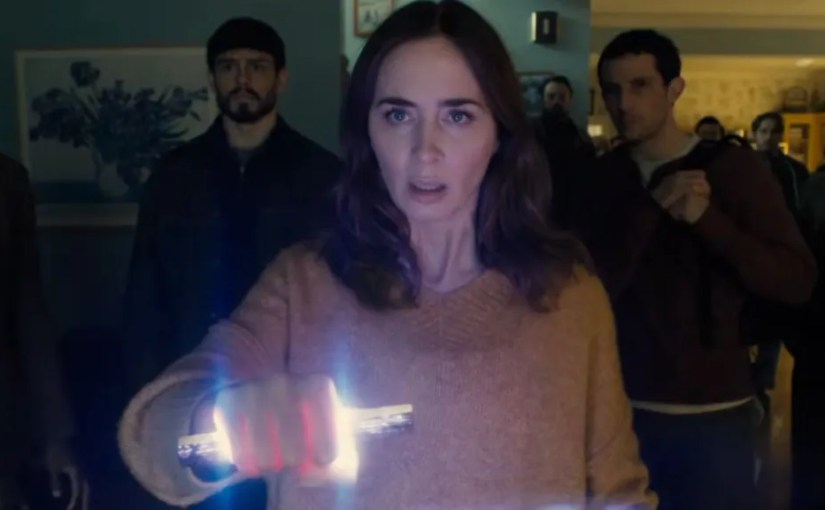
Emily Blunt is an incredible actress full of hard concentration and Krasinski does not let up on long running close ups to heighten her tension of isolation surrounded by the most terrifying threats, all while enduring a physical emergency.  She stares without a blink.  She effortlessly shakes with paranoia, and she evokes pain of the worst kind; all without uttering a sound or saying a word.  This is the same actress who played a snobby diva in The Devil Wears Prada, and later went on to portray the most popular nanny of all time, Mary Poppins.  This performance should not be overlooked.  It’s incredible.  You don’t need monsters in your face to be afraid.  All you need is Emily Blunt to carry you along.  

Krasinski springboards his terror off the best horror films from Jaws to The Shining to Alien to The Blair Witch Project and the original Paranormal Activity.  Yet, he does manage to pioneer his craft with A Quiet Place.  This is not something you have seen before. Hiding in silent fear has been done to death.  The girl always hides in the closet from the killer.  Here, you can hide, but staying out of sight won’t necessarily save you or do you any favors.  These creatures just might be prepared for that.  So, now you have something new to wrestle with.  Can you keep quiet?  This script does not make that easy. If ever a movie was to justify the need for Oscar categories like Sound and Sound Effects Editing, then this is the film to turn to.  These tools give reason for the storyline more overtly than any other that I can imagine.  You do not take the sound for granted, and you do not take the lack of sound for granted either.

Miguel Rodriguez and I originally saw this picture in a Dolby theatre.  It’s a telling film that gives reason for a Dolby theatre in the first place.  A film like this is worthy of the upgraded ticket price. (By the way, Mig, you still owe me $11.00.)

Put John Krasinski up as a top-notch director.  I believe this film was granted a very small budget, but like the best directors to come before him, he has managed to put up big screams and the best in dramatic storytelling with little expense. He even manages to tug at your heartstrings if you allow it. The ending was a huge pay off for me personally.  John Krasinski gives you a horror film, but he’ll make sure you have something to think about while you’re watching it, and long after you have left the theatre.

MARY POPPINS RETURNS

By Marc S. Sanders

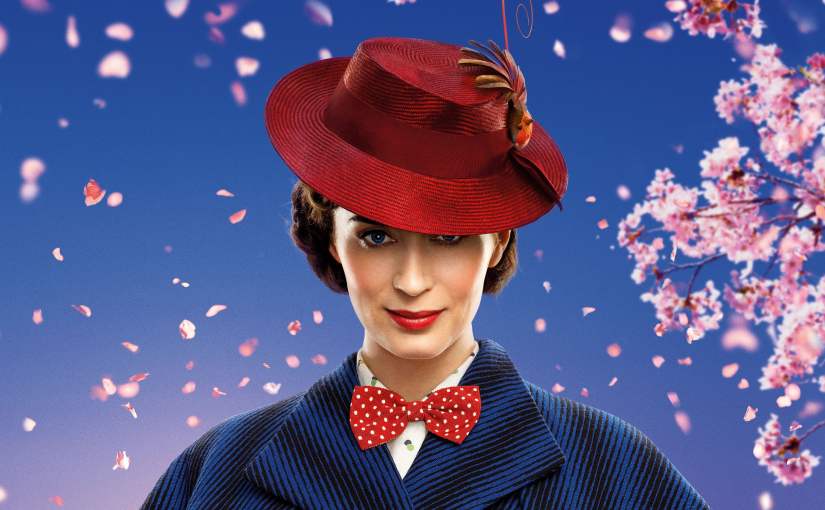
PL Travers’ character Mary Poppins is synonymous with the flavor of Disney. You may visit a Disney Theme Park or Cruise Ship or watch a classic film, and you might think to yourself this sidewalk, this room, this cast member’s uniform appears like something out of Mary Poppins. Walt Disney Studios and all its products would be something entirely different without the exactness of the most popular nanny in film. Ironically, until now, since 1964, has there been only one Mary Poppins film…and, well one PL Travers biography.

Director Rob Marshall (Oscar winning director of Chicago) has been recruited to bring the magical character back complete with her bottomless bag and her umbrella in Mary Poppins Returns. Perfectly cast is Emily Blunt in the role. Because this new installment that jumps to the next generation of Banks children is not a franchise reinvention, Blunt beautifully carries on the rigid mannerisms and casual magic that Julie Andrews effortlessly brought to the part. Blunt is not mimicking Andrews however. I think she takes the purpose of Mary more seriously actually. Andrews would smile at the fantasy. Blunt responds as if animated dog carriage drivers are seemingly normal. I also detected another dimension of maybe sadness or melancholy from Blunt as she observes the anguish of the children’s father Michael (Ben Whishaw, a great performer) now all grown up and reluctant to accept fantasy as a means to save the Banks’ home from foreclosure. When this Mary Poppins has to depart this family at the end, for a moment, I felt like she didn’t want to, like she needed this family as much as they needed her; not something I got from the first installment. Alas, this is 2018 and people are more attuned to the harshness of the world. Maybe Mary Poppins is as well.

Lin-Manuel Miranda adopts a cockney accent and fills the role of Jack, a street lamp vendor, all too familiar with Mary. What Dick Van Dyke brought to the original, as Bert, the chimney sweep, Jack offers to this film. Miranda is great. The best musical performer of the last five years (Hamilton, In The Heights). He opens the film with the whimsical new song “Under The Lovely London Sky” and Marshall and company make sure the audience catches on quick. It’s not “Chim Chim Cheree” but it’s a fun tune that provides a little mystery to the legendary nanny and the goings on at Cherry Tree Lane. Miranda is the only one I can think of to play this role today. Ten or fifteen years ago, it might have been a younger Hugh Jackman.

Cameo appearances abound from Meryl Streep showing another side of her not seen before as a gypsy like cousin of Mary’s, Angela Lansbury, so fortunate she is still performing, and best of all Dick Van Dyke who can still provide a little tap and two step in his spring.

Amidst an entirely new and well versed soundtrack that feels comfortably familiar, the film includes imaginative scenes like diving into an ocean through the bathtub, spinning into the animated (CLASSIC ANIMATION) world of a priceless porcelain bowl and soaring into the sky with a balloon that is just right for you. These are great scenes because they are so silly but Emily Blunt as Mary encourages you to take all this fantasy seriously. “Everything is possible,” she says. “Even the impossible.”

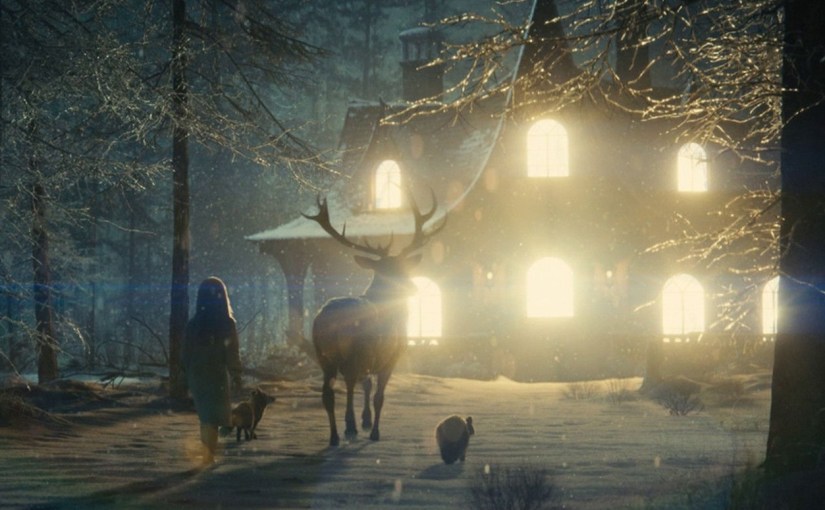
Walt Disney felt that way too. So without Mickey Mouse or Mary Poppins, there really is no institution called Disney. With these brands however, they are all practically perfect in every way.