GOOD WILL HUNTING

By Marc S. Sanders


I went to a prestigious private high school.  I was never a genius but I primarily got As and Bs.  However, when I reflect on my four years there, I believe I always had to bust my ass for those grades simply to keep up with the rest of the class, comprised of sixty students.  The majority of my classmates never looked like they overexerted themselves.  With my dad hammering at me to turn a 96 into a 100, disguised as sarcasm that painfully bit me every time, I was a very insecure kid among this community of students primed for Ivy League.  One student could look at the page of a book for seven seconds and absorb all of the information in print. There’s a quick transitional moment where Will Hunting, Good Will Hunting, exponentially accomplishes such a feat.  Only difference is he reads a renowned therapist’s best selling book from cover to cover in minutes.  Thereafter, he’s able to conclude that the author likely conceals his homosexuality due to shame.  Will Hunting has one of the most gifted minds in history, but hides it beneath what he says with his fists in the Southie schoolyards of Boston accompanied with a brutal vernacular, telling anyone who challenges him to “f’ack off.”

The title character is magnificently played by Matt Damon, who co-wrote this script with his childhood best friend and Harvard classmate, Ben Affleck.  The film was directed by Gus Van Sant and went on to earn Oscars for the original screenplay, and for Robin Williams in a supporting role.  Seven other nominations were also applauded for the film.  

In the year that Titanic ruled the box office, it was Damon and Affleck’s little project that stayed afloat with $220 million in worldwide revenues on a $10 million dollar budget.  I consider their achievements as great as what Sylvester Stallone accomplished when he sold his script for Rocky.  Collectively, they have at least inspired me to follow through with writing my own original plays.

Will is an orphaned twenty-year-old janitor who mops the floors of the mathematics building at M.I.T.  The esteemed and self-confident Professor Gerald “Gerry” Lambeau (Stellan Skarsgård) posts an extremely complex math problem on the hallway blackboard allowing his students the opportunity for “greatness” if any of them can solve it before the end of the semester.  Overnight, it has been solved but no one takes credit for it.  It’s only later when Gerry and his faithful assistant Tom (Tom & Jerry!  HA!) realize that Will, the foul-mouthed janitor, is the kid with all the answers.  Amazingly though, he’s serving time for assaulting a police officer while starting a neighborhood gang brawl.  

Gerry has to groom this kid and shape him so that he can take credit for sharing Will’s brilliance with the world.  A judge agrees to release Will under the condition that he routinely meets with a therapist to deal with his anger issues.  Gerry eventually turns to his estranged friend and college roommate Sean (Robin Williams) who grew up in the same neighborhood as Will. Will might discover that he has more in common with Sean than he realizes.

No matter how many times I watch Good Will Hunting, I visualize a strong structure to its character make up, and that gives enforcement to the story.  In the center of this nucleus is Will.  Lines are connected to people who have a concern for him and his future.  

First, there is his pal Chuckie (Affleck).  With their buddies Morgan and Billy (Casey Affleck, Cole Hauser), the guys routinely drive around all day into the night drinking, smoking, and hanging around batting cages and bars.  Eventually, Chuckie will not be able to hold his tongue anymore and will have to lay out what Will should be doing beyond the nowhere life he leads now.

Next is Skylar played by Minnie Driver in a career turning portrayal as a sweet, sensitive and fun Harvard medical student. She shares a love story with Damon’s character that stands apart from so many other movies.  Their relationship builds as Skylar tries to understand all that Will is capable of while he hides behind the biggest of lies, like expecting her to believe that he has twelve older brothers, three of whom he currently lives with. He’s not proud of his super intelligence.  So, he resorts to making up what she might find impressive and unique about him.  

Gerry is proudly pompous as he carries his award-winning mathematical accolades with his designer scarves and sports coats, ensuring that Tom is always his follower, literally pacing a step behind.  Gerry may have Will’s best interests at heart, but it’s only because of his fascination with grooming the next Albert Einstein located within his own town.  As long as he can lay claim to the success of Will, then Gerry wants what is best for his discovery.  The question is whether Will wants what Gerry pursues.

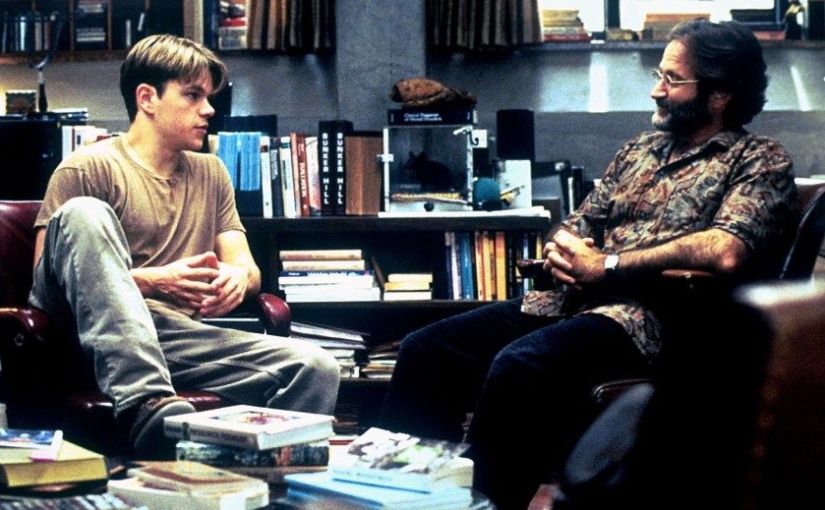
Lastly, maybe the most important connection belongs to Sean.  A therapist and professor at Bunker Hill Community College who still mourns the death of his wife following an agonizing eight-year illness. Following an introduction where Will completely disarms Sean by examining a watercolor painting, Sean realizes that he must find a way to taper the patient’s super powered aptitude.  Will knows everything.  However, Sean must remind Will that he hasn’t experienced anything. Namely, love, responsibility and purpose.  Will’s weakness though is his “what-if” response to any opportunity that comes his way.  That weakness stems from his ability to foreshadow possibilities that he’d rather not face and overcome.  His nature is to see thirty steps ahead where everything derails for him and therefore undoes Will with opportunities for success and love.

Affleck and Damon carved a fully realized subject in their title character.  Their script runs episodically for Will with a different person in nearly every scene.  If Will is physically not in a scene, at the very least the moment still has something specifically to do with him.  In the second half of the movie, Gerry and Sean share moments where they debate and insist upon what they think is best for the prodigy.  Yet, the argument stems from their personal history together long before this kid entered their lives.  There’s a lot of deep thought and sensitivity written for Stellan Skarsgård and Robin Williams to rely upon for their performances.  

Apparently, the role of Skylar was not supposed to be British.  Yet, Minnie Driver delivers an Oscar nominated role by using her native tongue.  I like it because it shows Will encountering someone right for him who originates from outside of Boston, which is all he truly knows beyond the books he quickly skims through.  Skylar is an instinctual person.  She’d have to be to attend Harvard, but unlike Will with the untrained genius capabilities, she wants to learn about people who enter her life. Afar of therapy, mathematics and getting drunk with his buddies, Skylar is a pure, non-judgmental person for Will to share in his life.  He must figure out if he’s ready to take the gamble that she’s up for.  More importantly, as Sean will remind him, Skylar is not perfect and neither is Will.  

Chuckie may just be who Will has to sacrifice for any means of a promising future. I never thought Affleck was given much to do with his role until a concluding scene arrives in the third act.  He and Damon share a magnificent moment that seals the success of their script when the partnered screenwriters finally have to deliver an epiphany to their genius creation who carries a wealth of faults and personal demons. I like to think the context of this scene relies upon the real-life history of the two actors.  Harvey Weinstein, the producer, wanted Brad Pitt and Leonardo DiCaprio in these roles.  Tell me, do you think that would have worked as effectively?

Good Will Hunting allows for so much to think about.  Will is portrayed more of a curse to himself and the world than anything else.  The role of Tom played by a real mathematician, John Mighton, has at best ten to fifteen lines in the whole picture, but it’s his presence and disapproving response to Will’s behavior that say so much about the overachievers who attend schools like M.I.T. and Harvard.  

One of my favorite parts occurs when an accomplished professor insists to Gerry that a problem cannot be resolved.  Will bellows the answer as easy as breathing and the middle-aged professor is destroyed instantly.  Tom tries to console the poor man before he storms out of the room in unnerving frustration.  As well, Stellan Skarsgård’s character operates with earned conceit but gradually crumbles as his newfound apprentice minimizes all that he’s acquired over his lifetime.  

The only one who can overcome Will’s involuntary penchant for personal destruction is Robin Williams’ Sean who knows that academia and knowledge must not be what truly defines Will Hunting.  Compared to Will’s background, Sean has experienced similar childhood trauma. Chuckie stems from a similar environment.  So, it’s just as well that both Sean and Chuckie are likely the most appropriate to guide Will in the best, most appropriate direction.

Wait!!!! Look at me!!!! 

I’m dissecting the characters of Good Will Hunting and I’ve hardly critiqued the picture.  I’m sorry.  I guess the film does not invite much criticism when it covers so many dimensions related to mentality and environment, strengths and talents, and the side effects which spawn weakness.

Good Will Hunting is not a perfect movie. One particular moment irritates me to no end.  If you’ve seen the film, then maybe you feel the same as I do with the “Retainer!” scene.  Chuckie dons a ridiculous three-piece suit and goes as Will to a prestigious job interview where he capably corners the interviewers into a bribe.  I cannot fathom why this part made the final cut.  It comes off entirely silly and unrealistic and it pulls me out of the movie every time I watch it.  What interviewers for a prestigious firm would literally take cash out of their wallets and lay it dumbfounded on the table for a kid to collect?  I passionately hate this scene because, by comparison, I love the rest of the movie so much.

Anyway…

Robin Williams demonstrates how effective he is with drama and pain.  Perhaps his own personal hurt lent to his performance.  Watch the first scene when Sean meets Will.  The conversation moves from small talk sarcasm to unexpected anger that gets physical.  Watch how seamlessly Williams diverts from broad range describing a World Series game and then into something that his character treasures personally a watercolor painting.  Most importantly, take in his nearly five-minute monologue where Sean evaluates Will on a park bench and deflates the ego that comes with the boy’s natural talent.   He talks about the ceiling of the Sistine Chapel and being in love and later mourning a loss.  Williams, with Affleck and Damon’s words, paints one picture after another to demonstrate what Will has no business discussing at all.  Not yet at least. (My wife and I sat on that bench in Boston.  Just to be there in that spot was exhilarating for us.)

Matt Damon delivered the third of a trifecta of super talented young characters who had to mold their best traits.  See Rounders and The Rainmaker.  This leading performance sealed the success of his outstanding career.  Think about it though.  Matt Damon is such a wise, studious actor.  He learns the unique languages and behaviors of his characters.  Look at these movies, but also look back on his portrayal of super spy Jason Bourne, another kind of savant with extraordinary talents that get beyond his personal control.  Parts like these seemed catered for Damon, not fellow actors like DiCaprio, Wahlberg, or Affleck.  Damon’s characters go through similar arcs, but each is entirely unique.

Good Will Hunting was a new kind of coming-of-age film, far ahead of the James Dean and John Hughes fare from prior decades.  For the film to effectively work, its script had to speak as smart as its characters.  Gus Van Sant recognized the insight and internal conflicts of guys like Sean, Gerry and Will.  All three men are incredibly smart, but they never found a way to live with each other nor had they yet to uncover inner peace.  By the end of this movie, perhaps you’ll agree they all have, especially good Will Hunting.

GONE BABY GONE

By Marc S. Sanders

Ben Affleck’s directorial debut, Gone Baby Gone, is crime drama mystery thriller that never offers easy answers and concludes with great debate.  You’ll ask yourself if right decisions were made.  You will argue with your best friend or significant other about the endings.  What’s undeniable though is that the film, adapted from Dennis Lehane’s novel, is full of an array of characters, most operating with the best of intentions, and yet they wind up doing everything wrong or against their sworn principles.  In order to work the problem, these people will have to betray themselves. 

One of Affleck’s many best decisions was casting his brother Casey Affleck in the lead role of private detective Patrick Kenzie.  With his girlfriend, Angie Gennaro (Michelle Monaghan), they specialize in tracking down missing persons in and around the Southeastern Boston area.  The brothers’ pairing is especially effective as Boston, Massachusetts is where they were born and raised.  They know this setting intimately. Unpolished multi-floored tenement neighborhoods near seedy watering holes are where the crimes of Gone Baby Gone occur.  Casey can ensure that his character, Patrick, can speak the slang, use the thick dialect, and feel comfortable amid a crowded and overpopulated area. As director, Ben ensures the setting is captured in great detail from Red Sox caps to beat up cars and dirty unkept apartments and secret hang outs.

In the middle of the night a little girl has gone missing and her deadbeat, drug addicted, careless mother Helene (Amy Ryan) is unmotivated to offer the police much to go on. Helene’s brother and sister-in-law (Titus Weliver, Amy Madigan) take it upon themselves to hire Patrick and Angie to find their niece.  The only leads that Patrick, Angie and the police (Ed Harris, John Ashton and occasionally Morgan Freeman) have to go on are Helene’s contacts within the drug peddling underground.  Someone within that community might have taken the girl or know someone who did.

Gone Baby Gone may feel like a Law & Order episode where red herrings are offered early and then dismissed for the actual truth.  However, Lehane’s story twists much deeper beneath the surface.  Not one character is wasted in this film.  Each serves a purpose to how and why this crime ever occurred.  Mysteries get resolved but the answers are not simple because they are multi-layered with many different people spinning twice as many plates.

Ben Affleck seems nothing like an amateur director here.  He does not always rely on dialogue to describe a scenario because he films quite a bit of a disheveled room or kitchen, or an outdoor area.  A daylight scene will take place in a darkly lit bar where only people need to hide from their troubles on an ordinary workday, or maybe they are in there to suppress something uglier.

The cast is outstanding.  While the characters belonging to Freeman, Harris and Ashton seem familiar from much of their other career films, they look like they lived within this environment of three-story houses bordering the harbor, across town from Fenway.  You believe these guys know every alleyway, street corner or contact among the city’s small-time deadbeats. 

Amy Ryan was nominated, and perhaps should have won, for her trashy Bostonian performance as Helene, the missing girl’s mother.  This actress is buried so deep in this role, from her worn out facial features to her New England dialect that blends so well.  She is completely believable, which is why you would not be able to stand sharing the same space with her.

Titus Welliver dons a thick, wide Irish mustache.  I read he had to keep it because he was shooting his HBO series, Deadwood, at the same time.  Nonetheless, it builds his character into the blue-collar working man whose greatest achievement is getting out of the life of small-time crime in order to put food on the table, while his sister could not.  His wife played by the great Amy Madigan, an actress that does not get enough coverage, is perfect.  Just her facial expressions with a pale, freckled complexion, tight chin and pinched lips show her biting her tongue while in the same room as her loser sister-in-law.  It sickens her that a sweet little girl like her niece is missing.  Everything is read on her face.  I know Madigan best as Kevin Costner’s midwestern cheerful wife in Field Of Dreams.  She played this role almost two decades later and she absolutely hides herself.  You forget you are watching her.  An outstanding character actress.  (I’m glad she’s getting new recognition with 2025’s hit horror movie Weapons.)

Michelle Monaghan as the girlfriend Angie is the sidekick to Casey Affleck’s Patrick.  Yet, she makes the horror of this movie convincingly real.  Early on, Angie is reluctant to accept the case because she doesn’t “want to find a kid in a dumpster.”  Now this isn’t some Dirty Harry or Lethal Weapon cop showcase.  It’s not glamourized with Hannibal Lecter glee.  This has not become much further materialized.  I don’t want to see a horrifying outcome for a child either, but Ben Affleck’s direction does not make any promises.  There are some repulsive, scary people in this world, right outside the front doors where people listen to the game on the radio and kids play stickball in the street.  Monaghan seems like that young woman who came from another place in the country with a fine upbringing and fell in love with Affleck’s character. With her brains, instincts and empathy, Angie took up the cause as a fellow crusader.  None of this is spelled out in the film and I have not read Lehane’s books, but I can see it in Michelle Monaghan’s performance.

Casey Affleck is a perfect surprise.  He dons the appearance of a thin, shrimpy kind of kid (supposedly age 31), and yet no matter who he is coming face to face with he never shows any sort of apprehension.  I truly believe that Patrick is not afraid of his work or the people he has to confront while trying to solve his various mysteries.  If a large gun is introduced into a scene, Patrick’s reaction is an act of “whoa, what’s this?”  Another character in another film would tighten up and hold their breath, or they would knock the weapon out of the way for an action scene.  Patrick has put this kind of act on before to outlast a situation.  Angie has definitely seen it before. 

Casey Affleck is great at just listening.  Shortly after he accepts the case, Patrick and Angie are in one of these darkened bars trying to collect information.  Ben Affleck shoots his camera above Casey sitting in a booth with a beer.  The actor keeps his head tilted as if he is listening to nothing spewing from a possible lead sitting across the table.  When a gun is pulled though, Casey stands three feet taller than his posture implies and controls the scene.  That is Dennis Lehane’s character Patrick Kensie completely defined because Casey Affleck has a full understanding of this guy.  Someone like Patrick knew that if he was going to take this kind occupation on full time, he had better be aware he would not survive on brawn that he cannot show.  It’s a confidence that has to come through. 

Gone Baby Gone is a gripping and engaging thriller shown with varying degrees of light and perfect cinematography to offer genuine on-site locations of Boston and the surrounding areas.  Ben Affleck chose not to compromise any of his set pieces.  With handheld cameras, when a missing person’s search is happening, it feels like a documentary of procedure is being shown. 

The various directions and endings are entirely unexpected and yet very, very plausible.  This is a smart, sensational crime drama that deserves a resurgence of attention nearly twenty years after its release.

OPPENHEIMER

By Marc S. Sanders

Christopher Nolan is one of the modern-day directors that you can rely on for brainy science fiction whether they are in embedded in dream subconsciousness, intergalactic space travel, transcendences of time, or even putting a fresh polish on a favorite superhero.  With Oppenheimer, he triumphs with exploring the actual prophets of science in the twentieth century, particularly its title character J Robert Oppenheimer, the brilliant physicist played convincingly well by Cillian Murphy.  Nolan doesn’t just stop at the assembly and discovery of science though.  He uncovers the consequences of Oppenheimer’s innovation and genius insight.  Dr. Oppenheimer might have been the man who knew too much and arguably that cost him quite a bit, personally.  Additionally, the so-called lab rat of his atomic bomb, namely the planet Earth, suffered the expense of a, at the time, troubling present day, and a still ongoing future. 

This movie seems to start right in the middle of its story and as a viewer you need to claw your way through the dense foliage to find its beginnings and what comes afterwards.  The first two scenes of the movie are titled “Fission” and “Fusion.”  There are no time periods specified by a font caption, however.  The differences in various points in history are distinguished by where J Robert Oppenheimer is located during select points in his life.  For seconds at a time, the film will change its photography from vibrant color to black and white, for example.  The characters will either look more aged with grey hair and some wrinkles or during more youthful time in their lives.  At one point Oppenheimer is being recruited by Lewis Strauss (Robert Downey, Jr) to head the department of a new kind of weapon development.  Work the science to make a difference.  There’s another time period where he’s being interrogated in a small room by a governmental suit and tie committee.  Oppenheimer is also in his classroom or debating and working with colleagues.  Another story observes his progress with building the atomic bomb among a collection of other engineers and scientists in a desert town, Los Alamos, specifically built at his own request, under the order of the nothing but militant Colonel Leslie Groves (Matt Damon), to conduct his work and research while hiding in plain sight. 

The film also covers Oppenheimer’s association with possible suspects of the Communist Party during the stressful pre-cold war era of McCarthyism.  Questions arise if his reliable brother Frank (Dylan Arnold) is a communist or even his mistress (Florence Pugh).  Does that in turn make Oppenheimer a communist as well?  If that is the case is J Robert Oppenheimer, the man tasked with ultimately ending World War II in favor of the Allies, sharing secrets with Russia and/or the Communist Party?

Nolan’s film gets easier to watch as it moves along, but you must get used to his pattern of filmmaking.  If you have never seen a Christopher Nolan film, I do not recommend you start with Oppenheimer.  His work is recognized for fast paced edits of different time periods and conversations.  There is much information to decipher. As well, there’s a very large collection of welcome characters to sort through, who worked with or against Oppenheimer.  Having only seen it once, I was captivated with the picture, but I know that I need to see it again.  The quick edits, working beautifully against the soundtrack orchestrations of Ludwig Göransson (nominate him for an Oscar, please), happen a mile a minute.  I appreciated this method because it enhanced the urgency of Dr. Oppenheimer in the eyes of the world, first as the savior of the united Allies against the last remaining superpower of the Axis countries, Japan. Then later focus is on whether it is in the United States’ best interests for the regarded physicist to have security access to the country’s most secret weapons and technological progress in a post war age.

People have been cajoling about how they know the ending to Oppenheimer.  They drop the bomb, of course!  (Twice actually.)  However, they do not know the entire story adaptation that Christopher Nolan as director and screenwriter presents. 

Cillian Murphy is perfectly cast. Give him an Oscar nomination.  He serves the confident, assured scientific leader who becomes envious of competing powers who achieve the impossible, like splitting the atom, while also admiring peers and mentors like Niels Bohr and Albert Einstein (Kenneth Branagh, Tom Conti).  All these men are interested only in what can be accomplished.  The superpowers that fight in war, though, are interested in how these accomplishments of modern science can be used to their advantage at a cost of collateral damage.  It is these conflicts of interests that Nolan admirably demonstrates over the course of the film. 

A telling scene for me, that I won’t forget, is when Robert Oppenheimer meets Harry Truman (Gary Oldman, doing an unforgettable cameo).  As the physicist exits the Oval Office, having shared his concerns and scruples with the Commander in Chief, Nolan includes a throwaway line delivered by the President, that I won’t soon forget.  It will not be spoiled, here.  Yet, the dialogue speaks volumes of what the United States held important regarding the servants who did the country’s bidding.  The scene closes like a stab in the heart, and suddenly science is no longer just facts within our planet.  Science is now questioned on whether it should ever be acted upon. Those questions certainly have remained as long as I’ve been alive to read about our never-ending world climate.  These inquiries will be here for many generations after I’m gone as well; that is if men and women’s recklessness with science doesn’t destroy the Earth before then.  At one point, Oppenheimer shares a small fraction of possibility for the end of the world when they activate and test their first atomic bomb. Matt Damon’s Colonel Groves’ asks for a reiteration of that observation.  Is this finding worth even the smallest, most minute risk?

Emily Blunt portrays Kitty Oppenheimer.  She’s marvelous as a lonely alcoholic wife to Robert, and a mother minding a home built in the desert while her husband serves an important purpose.  I didn’t take to her presence in the film until her grand moment arrives during an interrogation scene.  As the character gives her testimony regarding Oppenheimer’s communist ties, Blunt locks herself in for a wealth of awards in late 2023/early 2024.  Once you’ve watched the movie, you’ll likely know which scene I’m referring to and you can bet it’ll be that sample clip shown on all the awards programs.  This might not be Blunt’s best role, because it is rather limited within crux of the film, but I’d argue it is her greatest scene on film that I can remember.

Oppenheimer is a three-hour film, and it demands its running time.  There are so many angles to the man that few really know about.  Many know it was he who instrumentally built the atomic bomb that to date has only been used twice within a period of four days.  Thankfully never since.  Nolan emphasizes how unaware we are of how carefree the doctor’s government supervisors performed with the weapon he agreed to build.  Don’t just drop the bomb once.  Send a message to Japan by dropping it twice so they know to no longer engage in this ongoing war.  Choose the area where an army/government official didn’t honeymoon though.  It’s too beautiful a region.  Tens of thousands of men, women and child civilians perished immediately following the strikes.  Many others died weeks later following exposure to the nuclear effects that followed.  All issued as a horrifying cost to end a war that was already being won now that Hitler was dead.

Mechanically, Christopher Nolan does not disappoint either.  I watched Oppenheimer in a Dolby theater and I highly recommend it over a traditional one.  However, beware of the sound.  It is a LOUD!!!!!  Your seat will rattle early in the film when Cillian Murphy is shown in close up imagining the collision of atoms, protons, and neutrons.  How a star naturally dies in space runs through Oppenheimer’s consciousness as well, and then we see how a black hole forms.  Nolan offers a Cliff’s Notes edit of science doing its job.  Murphy performs so well when he’s not speaking and cut against the quick edits of Nolan’s visual and sound effects of science at play.  It shows how an educated scientist thinks beyond what is documented on a chalkboard or in a textbook.  J Robert Oppenheimer used to teach about the building blocks and natural destruction that occurs within the universe.  Regrettably, what he learned about natural function soon becomes manufactured capability when the professor accepts the task of building scientific destruction with his bare hands. Man stole fire from the Gods.

Oppenheimer is so dense in the scope of science and the scientist behind it.  That’s a huge compliment.  It’s an engaging film with much to tell, and a lot more to think about afterwards.  It accomplishes what the best movies do.  It leaves you thinking long after the film has ended.  More importantly, it’ll leave you frightened for the future based on the behavior of this planet’s past. 

Oppenheimer is one of the best films of the year.

MANCHESTER BY THE SEA

By Marc S. Sanders

Whether it is Gone Baby Gone, or The Assassination Of Jesse James By The Coward Robert Ford, or even Good Will Hunting, Casey Affleck is an actor who never compromises for glamour or grandeur in his roles. He will look ugly, dress down or be the most unlikable of characters to preserve the authenticity of a movie’s script. I imagine good directors just let him loose and film him with whatever he comes up with on the spot. It would be a tribute to his talent to do so. Here, in this Best Picture nominee, he is incredibly moving and quietly unhinged. He’s excellent.

Manchester By The Sea is a heavy, dramatic script held together by a simple story. Affleck plays Lee Chandler who will probably be destined to endure one unspeakable tragedy after another for the rest of his life; hammered away until it seems there’s no way to ever recover from inner demons of guilt and sadness.

At best, his recently departed brother (the always reliable Kyle Chandler) blesses him with an opportunity by making Lee the guardian to his 16 year old son, Patrick, played by Lucas Heges in one of the best screen debuts I can remember. He’s an eerie doppelgänger for a young Matt Damon.

Patrick needs Lee, and Lee, who doesn’t know it yet needs Patrick.

Manchester By The Sea takes its time to set up story and character, and maybe that is its downfall. People get in their cars, they shovel snow, they get out of their cars, they shovel more snow. All this set up for a 2 hour and 15-minute film might handicap the pacing, but I can’t think of a better way to improve upon its heart wrenchingly real narrative. The tragedy at the center of Lee’s turmoil is difficult to accept.

Michelle Williams as Lee’s wife is proves once again that she is an amazing actor finding her own unique method for a penultimate crying scene. She is underused. I would have liked to see more of her in this film.

Manchester By The Sea was nominated for Best Picture, Actor, Director, Screenplay and Supporting Actress. All well-deserved but maybe not worthy of the awards. (Affleck won the award, actually, and so did Kenneth Lonergan for his screenplay.) I think there were a few better nominees in each of these categories. Still, had it not been for the Oscar nods I probably wouldn’t have watched it. All I can say is, I’m glad I did.