
TO DIE FOR

By Marc S. Sanders

Gus Van Sant’s To Die For has to be one of the most wickedly delicious satires of the last thirty years.  Buck Henry adapts Joyce Maynard’s novel that takes a bite out of the juicy apple that savors fame and popularity.  Nicole Kidman delivers my favorite performance of her extensive career with one of the few comedies on her resume.  The film stands the test of time because in an age of social media influence and YouTube stardom, it perfectly reflects the vanity that our modern cultures strive to uphold.  It’s a proud demonstration of exaggerated egotism.

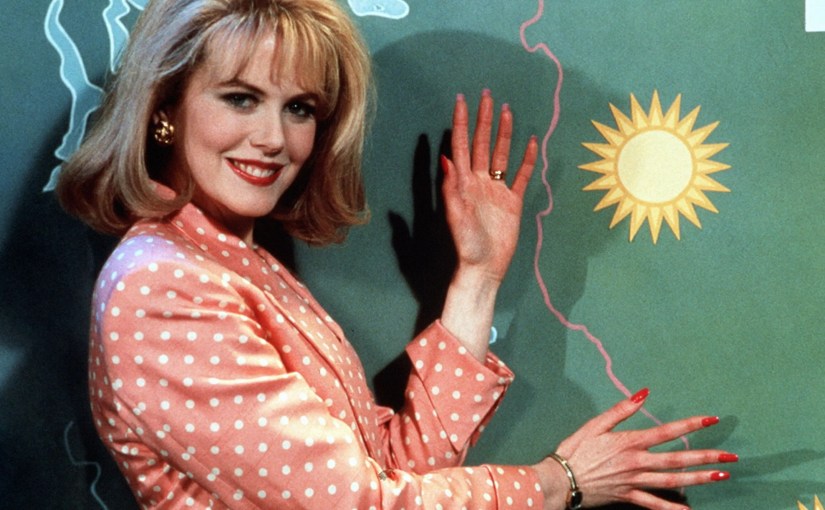
Kidman portrays Suzanne Stone, a peach of a preppy gal who costumes herself in candy colored business suits and wardrobes.  Suzanne aspires to become the next Jane Pauley, minus the flab or Connie Pauvich – sorry Chung, Connie Chung.  Therefore, she’ll stick with Suzanne Stone and not her married name Suzanne Maretto, adopted following her nuptials to her sweetheart of a guy, Larry (Matt Dillon). Maretto does not have the roll of the tongue stage name that the alliterative SS of Susan Stone provides. Larry is a sweet and naive guy who helps run his Italian family’s restaurant with mom and dad (Dan Hedaya, Maria Tucci) and sister, Janice (Illeana Douglas, always an amazing character actress, normally in smaller roles than what she offers here.)

Suzanne’s rise to the top has to start somewhere in the small hometown of Little Hope, New Hampshire.  So, it’s best to seek out an opportunity at the local public access TV station run by Ed Grant (Wayne Knight) delivering magnificent facial expressions of puzzlement and uncertainty in response to Suzanne’s onslaught of ideas and suggestions.  Eventually, Ed surrenders to Suzanne and gives her a short section at 9:00 PM to deliver the weather report complete with cardboard cutouts of the sun, and clouds.  Her mom, dad and sister (Holland Taylor, Kurtwood Smith, Susan Traylor) are gleefully proud to watch from the comfort of their home.  So are Larry and his folks.  Janice is suspicious and concerned, though. 

When Suzanne recruits three burnout high school students, Jimmy, Lydia and Russel, (Joaquin Phoenix, Allison Foland, Casey Affleck) for a documentary project, things may become murderous as a means to fuel the engine of ambition.

Buck Henry’s script outline works partially as a documentary.  Between staged scenes among all of the characters, the perfectly coifed Suzanne is speaking directly towards the camera eager to share everything that’s wonderful about her.  She does offer a moment to shed a tear for her dearly departed Larry though, but the chin quickly pops back up and the white teeth shine between the pinky lip gloss. 

Caught while casually ice skating at the Little Hope rink, Janice reflects on Suzanne’s short marriage to her brother.  Jimmy is dressed in a prison jumpsuit, with a mop in hand and a buzzcut while offering a perplexed recollection of his time with her.  Poor white trash Lydia reminisces about her fondness for Suzanne.  This “starlet” of the public access airwaves with a perfect figure, and a glistening smile with a saccharine sweet inflection in her voice had an impact on all of these people.  Both sides of the family go on a daytime talk show to share their points of view.  Suzanne’s dad was especially concerned about his little girl marrying Larry because his family feels like an extension of the mafia.  By the way, dad opposite dad, Kurtwood Smith vs Dan Hedaya, is casting brilliance.

Shortly after Suzanne begins speaking directly to me, I cannot help but think about Erica Kirk, Charlie Kirk’s widow, who bravely headlined speaking engagements in front of tens of thousands of people, dressed in the finest glittered outfits with the perfect shades of blush, mascara and lipstick and every strand of hair perfectly in place.  She has notoriously been questioned if her grief for her assassinated husband is genuine.  Regardless of where your politics stand or how you regarded Charlie Kirk, there’s no denying the false advertising of Erica’s anguish amidst the pompous display of fireworks and showmanship in the aftermath of her husband’s violent death.  Suzanne Stone is unquestionably the precursor to, former fashion model, now mother of three, Erica Kirk’s campaign to stay relevant.  It’s uncanny, and Joyce Maynard’s character invention is a very frank reflection of people’s yearning to be known above all the rest. 

With news cameras present at Larry’s gravesite funeral and then on the steps of the courthouse, there is Suzanne ready to speak directly to the camera, adorned in her Easter pastel colored best, ready to declare her innocence and sorrow after she’s considered suspect number one in Larry’s unexpected murder.  How the crime is carried out is salacious beyond just another burglarized home shooting.  For Suzanne, however, it’s perfect fodder for showmanship.  Suzanne is much more interesting as a murder suspect than a cutesy weather girl in a mini skirt and high heels.

Gus Van Sant recruited composer Danny Elfman to score the film and while his easily recognizable notes and chorus harmonies sound like they have been pulled from his other works in Beetlejuice and Edward Scissorhands, it works as the most appropriate accompaniment over the opening credits that play over a series of front-page newspaper articles.  Much of the exposition is covered by quickly glancing over these headlines that imply something sinister has occurred with this “pure as the driven snow” young girl and her newlywed husband whose worst mistake was to fall head over heels in love at first site.

Buck Henry echoes some themes of a May/December seduction that sent The Graduate into the pop culture stratosphere to amplify the shocking drama of crime in a small town.  The aftereffects are altogether different in To Die For, though.  Beyond Suzanne’s immediate family, most adults can see right through her act.  On the other hand, Larry, along with the three high school students, are susceptible to her conniving web.  Suzanne knows just how to pull at the heartstrings. 

In a YouTube world, Suzanne Stone would be at the very top of the food chain.  No one would be able match her.  Nicole Kidman is masterful at her timing.  She’s hypnotizing with her assertiveness and confidence.  She may not have a journalism major, but Suzanne Stone believes she has the skills and assets to dethrone the Barbara Walters of the world. 

Like Paddy Chayefsky’s Network appears uncannily prophetic, To Die For equally has achieved that plateau.  I recently watched a Netflix documentary called The Crash that focuses on a social media addict who was found guilty for killing her boyfriend and a friend after crashing her car into a brick wall.  It was not challenging to determine that the act was certainly intentional and the egotistical young girl was sentenced to fifteen years to life in prison.  Now, the debate rages about how much is this convicted murderer entitled to for the newfound fame and attraction this documentary has generated to her advantage while unforgivingly resurfacing unwanted heartache for the victims’ families.  The girl is interviewed in prison with makeup on and a false and overly dramatic sense of “regret” and “grief.”  It’s no surprise that she is reportedly the “It Girl” in the prison where she is serving time.  With a societal zest for reality television and true life crime stories, even stemming back to the OJ Simpson bruhaha, so many people shamelessly carry the Suzanne Stone gene.

Other stories came to mind while watching To Die For, including the musical Chicago which follows a very similar trajectory – fame might be the one factor that could exonerate you for murder.  Heathers explored the need for popularity, attention, and public sympathy by only just attempting suicide. Faye Dunaway’s character in Network (still the best satire, in my opinion) pounces on a man’s mental ailment to generate viewership and ratings climbs for programming success.  Notoriety can be a terrible sin. Yet, notoriety offers a wealth of advantages.

To Die For is shocking, hilarious, and likely much more relatable than it ever was when released in 1995.  It’s a comedy of ridiculous truths that will leave you thinking. Wisely, Gus Van Sant runs the closing credits of the film over an ice-skating routine performed by Illeana Douglas which is likely one of the most inspiring closing scenes you could ever find in a movie.  As insightful as Joyce Maynard might have been with her published novel, there’s no way her final pages could equate to how karmic Van Sant and Henry opted close out their film. Larry’s sister, Janice finally gets her moment in the spotlight for all the world to see.
GOOD WILL HUNTING

By Marc S. Sanders


I went to a prestigious private high school.  I was never a genius but I primarily got As and Bs.  However, when I reflect on my four years there, I believe I always had to bust my ass for those grades simply to keep up with the rest of the class, comprised of sixty students.  The majority of my classmates never looked like they overexerted themselves.  With my dad hammering at me to turn a 96 into a 100, disguised as sarcasm that painfully bit me every time, I was a very insecure kid among this community of students primed for Ivy League.  One student could look at the page of a book for seven seconds and absorb all of the information in print. There’s a quick transitional moment where Will Hunting, Good Will Hunting, exponentially accomplishes such a feat.  Only difference is he reads a renowned therapist’s best selling book from cover to cover in minutes.  Thereafter, he’s able to conclude that the author likely conceals his homosexuality due to shame.  Will Hunting has one of the most gifted minds in history, but hides it beneath what he says with his fists in the Southie schoolyards of Boston accompanied with a brutal vernacular, telling anyone who challenges him to “f’ack off.”

The title character is magnificently played by Matt Damon, who co-wrote this script with his childhood best friend and Harvard classmate, Ben Affleck.  The film was directed by Gus Van Sant and went on to earn Oscars for the original screenplay, and for Robin Williams in a supporting role.  Seven other nominations were also applauded for the film.  

In the year that Titanic ruled the box office, it was Damon and Affleck’s little project that stayed afloat with $220 million in worldwide revenues on a $10 million dollar budget.  I consider their achievements as great as what Sylvester Stallone accomplished when he sold his script for Rocky.  Collectively, they have at least inspired me to follow through with writing my own original plays.

Will is an orphaned twenty-year-old janitor who mops the floors of the mathematics building at M.I.T.  The esteemed and self-confident Professor Gerald “Gerry” Lambeau (Stellan Skarsgård) posts an extremely complex math problem on the hallway blackboard allowing his students the opportunity for “greatness” if any of them can solve it before the end of the semester.  Overnight, it has been solved but no one takes credit for it.  It’s only later when Gerry and his faithful assistant Tom (Tom & Jerry!  HA!) realize that Will, the foul-mouthed janitor, is the kid with all the answers.  Amazingly though, he’s serving time for assaulting a police officer while starting a neighborhood gang brawl.  

Gerry has to groom this kid and shape him so that he can take credit for sharing Will’s brilliance with the world.  A judge agrees to release Will under the condition that he routinely meets with a therapist to deal with his anger issues.  Gerry eventually turns to his estranged friend and college roommate Sean (Robin Williams) who grew up in the same neighborhood as Will. Will might discover that he has more in common with Sean than he realizes.

No matter how many times I watch Good Will Hunting, I visualize a strong structure to its character make up, and that gives enforcement to the story.  In the center of this nucleus is Will.  Lines are connected to people who have a concern for him and his future.  

First, there is his pal Chuckie (Affleck).  With their buddies Morgan and Billy (Casey Affleck, Cole Hauser), the guys routinely drive around all day into the night drinking, smoking, and hanging around batting cages and bars.  Eventually, Chuckie will not be able to hold his tongue anymore and will have to lay out what Will should be doing beyond the nowhere life he leads now.

Next is Skylar played by Minnie Driver in a career turning portrayal as a sweet, sensitive and fun Harvard medical student. She shares a love story with Damon’s character that stands apart from so many other movies.  Their relationship builds as Skylar tries to understand all that Will is capable of while he hides behind the biggest of lies, like expecting her to believe that he has twelve older brothers, three of whom he currently lives with. He’s not proud of his super intelligence.  So, he resorts to making up what she might find impressive and unique about him.  

Gerry is proudly pompous as he carries his award-winning mathematical accolades with his designer scarves and sports coats, ensuring that Tom is always his follower, literally pacing a step behind.  Gerry may have Will’s best interests at heart, but it’s only because of his fascination with grooming the next Albert Einstein located within his own town.  As long as he can lay claim to the success of Will, then Gerry wants what is best for his discovery.  The question is whether Will wants what Gerry pursues.

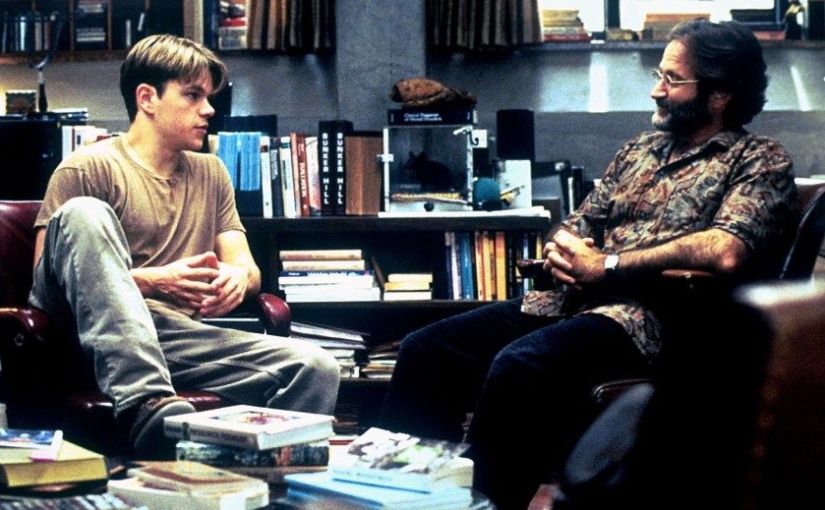
Lastly, maybe the most important connection belongs to Sean.  A therapist and professor at Bunker Hill Community College who still mourns the death of his wife following an agonizing eight-year illness. Following an introduction where Will completely disarms Sean by examining a watercolor painting, Sean realizes that he must find a way to taper the patient’s super powered aptitude.  Will knows everything.  However, Sean must remind Will that he hasn’t experienced anything. Namely, love, responsibility and purpose.  Will’s weakness though is his “what-if” response to any opportunity that comes his way.  That weakness stems from his ability to foreshadow possibilities that he’d rather not face and overcome.  His nature is to see thirty steps ahead where everything derails for him and therefore undoes Will with opportunities for success and love.

Affleck and Damon carved a fully realized subject in their title character.  Their script runs episodically for Will with a different person in nearly every scene.  If Will is physically not in a scene, at the very least the moment still has something specifically to do with him.  In the second half of the movie, Gerry and Sean share moments where they debate and insist upon what they think is best for the prodigy.  Yet, the argument stems from their personal history together long before this kid entered their lives.  There’s a lot of deep thought and sensitivity written for Stellan Skarsgård and Robin Williams to rely upon for their performances.  

Apparently, the role of Skylar was not supposed to be British.  Yet, Minnie Driver delivers an Oscar nominated role by using her native tongue.  I like it because it shows Will encountering someone right for him who originates from outside of Boston, which is all he truly knows beyond the books he quickly skims through.  Skylar is an instinctual person.  She’d have to be to attend Harvard, but unlike Will with the untrained genius capabilities, she wants to learn about people who enter her life. Afar of therapy, mathematics and getting drunk with his buddies, Skylar is a pure, non-judgmental person for Will to share in his life.  He must figure out if he’s ready to take the gamble that she’s up for.  More importantly, as Sean will remind him, Skylar is not perfect and neither is Will.  

Chuckie may just be who Will has to sacrifice for any means of a promising future. I never thought Affleck was given much to do with his role until a concluding scene arrives in the third act.  He and Damon share a magnificent moment that seals the success of their script when the partnered screenwriters finally have to deliver an epiphany to their genius creation who carries a wealth of faults and personal demons. I like to think the context of this scene relies upon the real-life history of the two actors.  Harvey Weinstein, the producer, wanted Brad Pitt and Leonardo DiCaprio in these roles.  Tell me, do you think that would have worked as effectively?

Good Will Hunting allows for so much to think about.  Will is portrayed more of a curse to himself and the world than anything else.  The role of Tom played by a real mathematician, John Mighton, has at best ten to fifteen lines in the whole picture, but it’s his presence and disapproving response to Will’s behavior that say so much about the overachievers who attend schools like M.I.T. and Harvard.  

One of my favorite parts occurs when an accomplished professor insists to Gerry that a problem cannot be resolved.  Will bellows the answer as easy as breathing and the middle-aged professor is destroyed instantly.  Tom tries to console the poor man before he storms out of the room in unnerving frustration.  As well, Stellan Skarsgård’s character operates with earned conceit but gradually crumbles as his newfound apprentice minimizes all that he’s acquired over his lifetime.  

The only one who can overcome Will’s involuntary penchant for personal destruction is Robin Williams’ Sean who knows that academia and knowledge must not be what truly defines Will Hunting.  Compared to Will’s background, Sean has experienced similar childhood trauma. Chuckie stems from a similar environment.  So, it’s just as well that both Sean and Chuckie are likely the most appropriate to guide Will in the best, most appropriate direction.

Wait!!!! Look at me!!!! 

I’m dissecting the characters of Good Will Hunting and I’ve hardly critiqued the picture.  I’m sorry.  I guess the film does not invite much criticism when it covers so many dimensions related to mentality and environment, strengths and talents, and the side effects which spawn weakness.

Good Will Hunting is not a perfect movie. One particular moment irritates me to no end.  If you’ve seen the film, then maybe you feel the same as I do with the “Retainer!” scene.  Chuckie dons a ridiculous three-piece suit and goes as Will to a prestigious job interview where he capably corners the interviewers into a bribe.  I cannot fathom why this part made the final cut.  It comes off entirely silly and unrealistic and it pulls me out of the movie every time I watch it.  What interviewers for a prestigious firm would literally take cash out of their wallets and lay it dumbfounded on the table for a kid to collect?  I passionately hate this scene because, by comparison, I love the rest of the movie so much.

Anyway…

Robin Williams demonstrates how effective he is with drama and pain.  Perhaps his own personal hurt lent to his performance.  Watch the first scene when Sean meets Will.  The conversation moves from small talk sarcasm to unexpected anger that gets physical.  Watch how seamlessly Williams diverts from broad range describing a World Series game and then into something that his character treasures personally a watercolor painting.  Most importantly, take in his nearly five-minute monologue where Sean evaluates Will on a park bench and deflates the ego that comes with the boy’s natural talent.   He talks about the ceiling of the Sistine Chapel and being in love and later mourning a loss.  Williams, with Affleck and Damon’s words, paints one picture after another to demonstrate what Will has no business discussing at all.  Not yet at least. (My wife and I sat on that bench in Boston.  Just to be there in that spot was exhilarating for us.)

Matt Damon delivered the third of a trifecta of super talented young characters who had to mold their best traits.  See Rounders and The Rainmaker.  This leading performance sealed the success of his outstanding career.  Think about it though.  Matt Damon is such a wise, studious actor.  He learns the unique languages and behaviors of his characters.  Look at these movies, but also look back on his portrayal of super spy Jason Bourne, another kind of savant with extraordinary talents that get beyond his personal control.  Parts like these seemed catered for Damon, not fellow actors like DiCaprio, Wahlberg, or Affleck.  Damon’s characters go through similar arcs, but each is entirely unique.

Good Will Hunting was a new kind of coming-of-age film, far ahead of the James Dean and John Hughes fare from prior decades.  For the film to effectively work, its script had to speak as smart as its characters.  Gus Van Sant recognized the insight and internal conflicts of guys like Sean, Gerry and Will.  All three men are incredibly smart, but they never found a way to live with each other nor had they yet to uncover inner peace.  By the end of this movie, perhaps you’ll agree they all have, especially good Will Hunting.