By Marc S. Sanders
Gus Van Sant’s To Die For has to be one of the most wickedly delicious satires of the last thirty years. Buck Henry adapts Joyce Maynard’s novel that takes a bite out of the juicy apple that savors fame and popularity. Nicole Kidman delivers my favorite performance of her extensive career with one of the few comedies on her resume. The film stands the test of time because in an age of social media influence and YouTube stardom, it perfectly reflects the vanity that our modern cultures strive to uphold. It’s a proud demonstration of exaggerated egotism.
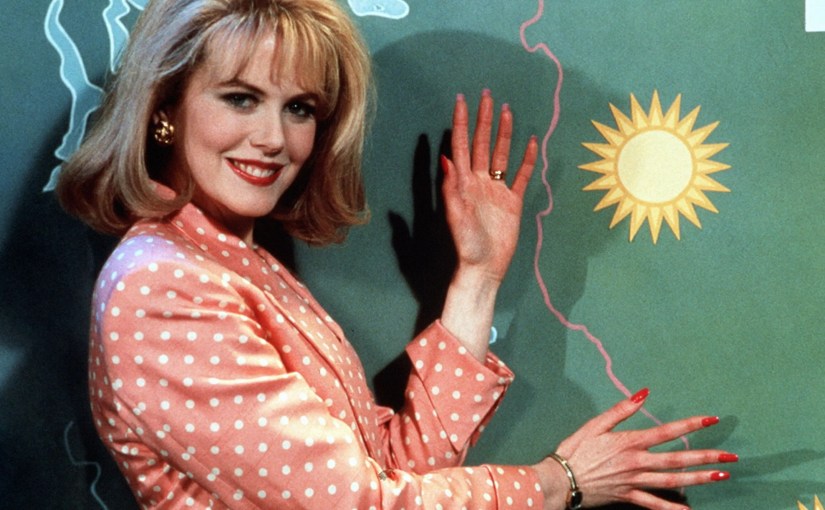
Kidman portrays Suzanne Stone, a peach of a preppy gal who costumes herself in candy colored business suits and wardrobes. Suzanne aspires to become the next Jane Pauley, minus the flab or Connie Pauvich – sorry Chung, Connie Chung. Therefore, she’ll stick with Suzanne Stone and not her married name Suzanne Maretto, adopted following her nuptials to her sweetheart of a guy, Larry (Matt Dillon). Maretto does not have the roll of the tongue stage name that the alliterative SS of Susan Stone provides. Larry is a sweet and naive guy who helps run his Italian family’s restaurant with mom and dad (Dan Hedaya, Maria Tucci) and sister, Janice (Illeana Douglas, always an amazing character actress, normally in smaller roles than what she offers here.)
Suzanne’s rise to the top has to start somewhere in the small hometown of Little Hope, New Hampshire. So, it’s best to seek out an opportunity at the local public access TV station run by Ed Grant (Wayne Knight) delivering magnificent facial expressions of puzzlement and uncertainty in response to Suzanne’s onslaught of ideas and suggestions. Eventually, Ed surrenders to Suzanne and gives her a short section at 9:00 PM to deliver the weather report complete with cardboard cutouts of the sun, and clouds. Her mom, dad and sister (Holland Taylor, Kurtwood Smith, Susan Traylor) are gleefully proud to watch from the comfort of their home. So are Larry and his folks. Janice is suspicious and concerned, though.
When Suzanne recruits three burnout high school students, Jimmy, Lydia and Russel, (Joaquin Phoenix, Allison Foland, Casey Affleck) for a documentary project, things may become murderous as a means to fuel the engine of ambition.
Buck Henry’s script outline works partially as a documentary. Between staged scenes among all of the characters, the perfectly coifed Suzanne is speaking directly towards the camera eager to share everything that’s wonderful about her. She does offer a moment to shed a tear for her dearly departed Larry though, but the chin quickly pops back up and the white teeth shine between the pinky lip gloss.
Caught while casually ice skating at the Little Hope rink, Janice reflects on Suzanne’s short marriage to her brother. Jimmy is dressed in a prison jumpsuit, with a mop in hand and a buzzcut while offering a perplexed recollection of his time with her. Poor white trash Lydia reminisces about her fondness for Suzanne. This “starlet” of the public access airwaves with a perfect figure, and a glistening smile with a saccharine sweet inflection in her voice had an impact on all of these people. Both sides of the family go on a daytime talk show to share their points of view. Suzanne’s dad was especially concerned about his little girl marrying Larry because his family feels like an extension of the mafia. By the way, dad opposite dad, Kurtwood Smith vs Dan Hedaya, is casting brilliance.
Shortly after Suzanne begins speaking directly to me, I cannot help but think about Erica Kirk, Charlie Kirk’s widow, who bravely headlined speaking engagements in front of tens of thousands of people, dressed in the finest glittered outfits with the perfect shades of blush, mascara and lipstick and every strand of hair perfectly in place. She has notoriously been questioned if her grief for her assassinated husband is genuine. Regardless of where your politics stand or how you regarded Charlie Kirk, there’s no denying the false advertising of Erica’s anguish amidst the pompous display of fireworks and showmanship in the aftermath of her husband’s violent death. Suzanne Stone is unquestionably the precursor to, former fashion model, now mother of three, Erica Kirk’s campaign to stay relevant. It’s uncanny, and Joyce Maynard’s character invention is a very frank reflection of people’s yearning to be known above all the rest.
With news cameras present at Larry’s gravesite funeral and then on the steps of the courthouse, there is Suzanne ready to speak directly to the camera, adorned in her Easter pastel colored best, ready to declare her innocence and sorrow after she’s considered suspect number one in Larry’s unexpected murder. How the crime is carried out is salacious beyond just another burglarized home shooting. For Suzanne, however, it’s perfect fodder for showmanship. Suzanne is much more interesting as a murder suspect than a cutesy weather girl in a mini skirt and high heels.
Gus Van Sant recruited composer Danny Elfman to score the film and while his easily recognizable notes and chorus harmonies sound like they have been pulled from his other works in Beetlejuice and Edward Scissorhands, it works as the most appropriate accompaniment over the opening credits that play over a series of front-page newspaper articles. Much of the exposition is covered by quickly glancing over these headlines that imply something sinister has occurred with this “pure as the driven snow” young girl and her newlywed husband whose worst mistake was to fall head over heels in love at first site.
Buck Henry echoes some themes of a May/December seduction that sent The Graduate into the pop culture stratosphere to amplify the shocking drama of crime in a small town. The aftereffects are altogether different in To Die For, though. Beyond Suzanne’s immediate family, most adults can see right through her act. On the other hand, Larry, along with the three high school students, are susceptible to her conniving web. Suzanne knows just how to pull at the heartstrings.
In a YouTube world, Suzanne Stone would be at the very top of the food chain. No one would be able match her. Nicole Kidman is masterful at her timing. She’s hypnotizing with her assertiveness and confidence. She may not have a journalism major, but Suzanne Stone believes she has the skills and assets to dethrone the Barbara Walters of the world.
Like Paddy Chayefsky’s Network appears uncannily prophetic, To Die For equally has achieved that plateau. I recently watched a Netflix documentary called The Crash that focuses on a social media addict who was found guilty for killing her boyfriend and a friend after crashing her car into a brick wall. It was not challenging to determine that the act was certainly intentional and the egotistical young girl was sentenced to fifteen years to life in prison. Now, the debate rages about how much is this convicted murderer entitled to for the newfound fame and attraction this documentary has generated to her advantage while unforgivingly resurfacing unwanted heartache for the victims’ families. The girl is interviewed in prison with makeup on and a false and overly dramatic sense of “regret” and “grief.” It’s no surprise that she is reportedly the “It Girl” in the prison where she is serving time. With a societal zest for reality television and true life crime stories, even stemming back to the OJ Simpson bruhaha, so many people shamelessly carry the Suzanne Stone gene.
Other stories came to mind while watching To Die For, including the musical Chicago which follows a very similar trajectory – fame might be the one factor that could exonerate you for murder. Heathers explored the need for popularity, attention, and public sympathy by only just attempting suicide. Faye Dunaway’s character in Network (still the best satire, in my opinion) pounces on a man’s mental ailment to generate viewership and ratings climbs for programming success. Notoriety can be a terrible sin. Yet, notoriety offers a wealth of advantages.
To Die For is shocking, hilarious, and much more relatable than it ever was when released in 1995. It’s a comedy of ridiculous truths that will leave you thinking. Wisely, Gus Van Sant runs the closing credits of the film over an ice-skating routine performed by Illeana Douglas which is likely one of the most inspiring closing scenes you could ever find in a movie. As insightful as Joyce Maynard might have been with her published novel, there’s no way her final pages could equate to how karmic Van Sant and Henry opted close out their film. Larry’s sister, Janice finally gets her moment in the spotlight for all the world to see.