
TO DIE FOR

By Marc S. Sanders

Gus Van Sant’s To Die For has to be one of the most wickedly delicious satires of the last thirty years.  Buck Henry adapts Joyce Maynard’s novel that takes a bite out of the juicy apple that savors fame and popularity.  Nicole Kidman delivers my favorite performance of her extensive career with one of the few comedies on her resume.  The film stands the test of time because in an age of social media influence and YouTube stardom, it perfectly reflects the vanity that our modern cultures strive to uphold.  It’s a proud demonstration of exaggerated egotism.

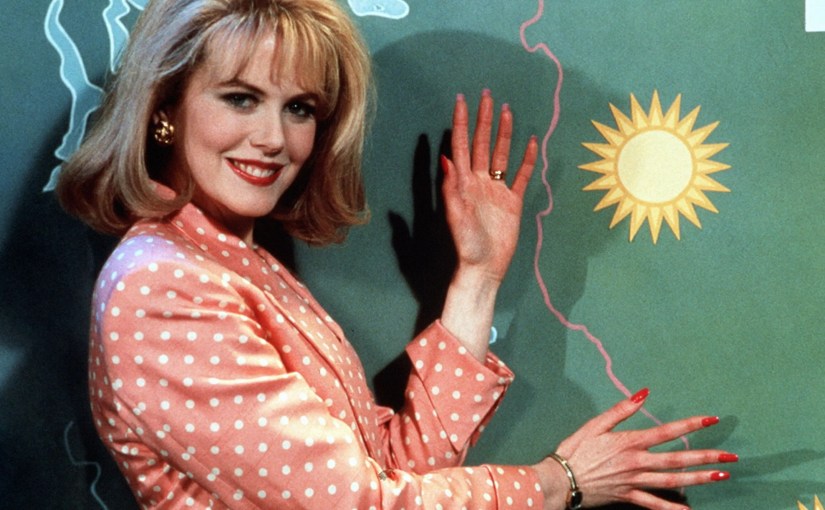
Kidman portrays Suzanne Stone, a peach of a preppy gal who costumes herself in candy colored business suits and wardrobes.  Suzanne aspires to become the next Jane Pauley, minus the flab or Connie Pauvich – sorry Chung, Connie Chung.  Therefore, she’ll stick with Suzanne Stone and not her married name Suzanne Maretto, adopted following her nuptials to her sweetheart of a guy, Larry (Matt Dillon). Maretto does not have the roll of the tongue stage name that the alliterative SS of Susan Stone provides. Larry is a sweet and naive guy who helps run his Italian family’s restaurant with mom and dad (Dan Hedaya, Maria Tucci) and sister, Janice (Illeana Douglas, always an amazing character actress, normally in smaller roles than what she offers here.)

Suzanne’s rise to the top has to start somewhere in the small hometown of Little Hope, New Hampshire.  So, it’s best to seek out an opportunity at the local public access TV station run by Ed Grant (Wayne Knight) delivering magnificent facial expressions of puzzlement and uncertainty in response to Suzanne’s onslaught of ideas and suggestions.  Eventually, Ed surrenders to Suzanne and gives her a short section at 9:00 PM to deliver the weather report complete with cardboard cutouts of the sun, and clouds.  Her mom, dad and sister (Holland Taylor, Kurtwood Smith, Susan Traylor) are gleefully proud to watch from the comfort of their home.  So are Larry and his folks.  Janice is suspicious and concerned, though. 

When Suzanne recruits three burnout high school students, Jimmy, Lydia and Russel, (Joaquin Phoenix, Allison Foland, Casey Affleck) for a documentary project, things may become murderous as a means to fuel the engine of ambition.

Buck Henry’s script outline works partially as a documentary.  Between staged scenes among all of the characters, the perfectly coifed Suzanne is speaking directly towards the camera eager to share everything that’s wonderful about her.  She does offer a moment to shed a tear for her dearly departed Larry though, but the chin quickly pops back up and the white teeth shine between the pinky lip gloss. 

Caught while casually ice skating at the Little Hope rink, Janice reflects on Suzanne’s short marriage to her brother.  Jimmy is dressed in a prison jumpsuit, with a mop in hand and a buzzcut while offering a perplexed recollection of his time with her.  Poor white trash Lydia reminisces about her fondness for Suzanne.  This “starlet” of the public access airwaves with a perfect figure, and a glistening smile with a saccharine sweet inflection in her voice had an impact on all of these people.  Both sides of the family go on a daytime talk show to share their points of view.  Suzanne’s dad was especially concerned about his little girl marrying Larry because his family feels like an extension of the mafia.  By the way, dad opposite dad, Kurtwood Smith vs Dan Hedaya, is casting brilliance.

Shortly after Suzanne begins speaking directly to me, I cannot help but think about Erica Kirk, Charlie Kirk’s widow, who bravely headlined speaking engagements in front of tens of thousands of people, dressed in the finest glittered outfits with the perfect shades of blush, mascara and lipstick and every strand of hair perfectly in place.  She has notoriously been questioned if her grief for her assassinated husband is genuine.  Regardless of where your politics stand or how you regarded Charlie Kirk, there’s no denying the false advertising of Erica’s anguish amidst the pompous display of fireworks and showmanship in the aftermath of her husband’s violent death.  Suzanne Stone is unquestionably the precursor to, former fashion model, now mother of three, Erica Kirk’s campaign to stay relevant.  It’s uncanny, and Joyce Maynard’s character invention is a very frank reflection of people’s yearning to be known above all the rest. 

With news cameras present at Larry’s gravesite funeral and then on the steps of the courthouse, there is Suzanne ready to speak directly to the camera, adorned in her Easter pastel colored best, ready to declare her innocence and sorrow after she’s considered suspect number one in Larry’s unexpected murder.  How the crime is carried out is salacious beyond just another burglarized home shooting.  For Suzanne, however, it’s perfect fodder for showmanship.  Suzanne is much more interesting as a murder suspect than a cutesy weather girl in a mini skirt and high heels.

Gus Van Sant recruited composer Danny Elfman to score the film and while his easily recognizable notes and chorus harmonies sound like they have been pulled from his other works in Beetlejuice and Edward Scissorhands, it works as the most appropriate accompaniment over the opening credits that play over a series of front-page newspaper articles.  Much of the exposition is covered by quickly glancing over these headlines that imply something sinister has occurred with this “pure as the driven snow” young girl and her newlywed husband whose worst mistake was to fall head over heels in love at first site.

Buck Henry echoes some themes of a May/December seduction that sent The Graduate into the pop culture stratosphere to amplify the shocking drama of crime in a small town.  The aftereffects are altogether different in To Die For, though.  Beyond Suzanne’s immediate family, most adults can see right through her act.  On the other hand, Larry, along with the three high school students, are susceptible to her conniving web.  Suzanne knows just how to pull at the heartstrings. 

In a YouTube world, Suzanne Stone would be at the very top of the food chain.  No one would be able match her.  Nicole Kidman is masterful at her timing.  She’s hypnotizing with her assertiveness and confidence.  She may not have a journalism major, but Suzanne Stone believes she has the skills and assets to dethrone the Barbara Walters of the world. 

Like Paddy Chayefsky’s Network appears uncannily prophetic, To Die For equally has achieved that plateau.  I recently watched a Netflix documentary called The Crash that focuses on a social media addict who was found guilty for killing her boyfriend and a friend after crashing her car into a brick wall.  It was not challenging to determine that the act was certainly intentional and the egotistical young girl was sentenced to fifteen years to life in prison.  Now, the debate rages about how much is this convicted murderer entitled to for the newfound fame and attraction this documentary has generated to her advantage while unforgivingly resurfacing unwanted heartache for the victims’ families.  The girl is interviewed in prison with makeup on and a false and overly dramatic sense of “regret” and “grief.”  It’s no surprise that she is reportedly the “It Girl” in the prison where she is serving time.  With a societal zest for reality television and true life crime stories, even stemming back to the OJ Simpson bruhaha, so many people shamelessly carry the Suzanne Stone gene.

Other stories came to mind while watching To Die For, including the musical Chicago which follows a very similar trajectory – fame might be the one factor that could exonerate you for murder.  Heathers explored the need for popularity, attention, and public sympathy by only just attempting suicide. Faye Dunaway’s character in Network (still the best satire, in my opinion) pounces on a man’s mental ailment to generate viewership and ratings climbs for programming success.  Notoriety can be a terrible sin. Yet, notoriety offers a wealth of advantages.

To Die For is shocking, hilarious, and much more relatable than it ever was when released in 1995.  It’s a comedy of ridiculous truths that will leave you thinking. Wisely, Gus Van Sant runs the closing credits of the film over an ice-skating routine performed by Illeana Douglas which is likely one of the most inspiring closing scenes you could ever find in a movie.  As insightful as Joyce Maynard might have been with her published novel, there’s no way her final pages could equate to how karmic Van Sant and Henry opted close out their film. Larry’s sister, Janice finally gets her moment in the spotlight for all the world to see.

CAPE FEAR (1991)

By Marc S. Sanders

Would you ever think that Martin Scorsese could be a master of horror? I do. I thought so ever since I saw his remake of Cape Fear, back in 1991, featuring Robert DeNiro, Nick Nolte, Jessica Lange and Juliette Lewis. This cast of four is an astonishing assemblage of talent, complimented with players from the original film, Robert Mitchum and Gregory Peck, as well as Joe Don Baker, Fred Thompson and Illeana Douglas.

Wesley Strick is credited with this updated screenplay that questions the measure of sin; pot vs heroine, battery vs rape, flirting vs infidelity, as well as the ethics and justifications that we reason with every day.

DeNiro provides one of his greatest roles. He lost the Oscar in 1991 to Anthony Hopkins. Reader, DeNiro should have won for a much more complex, fleshed out part. He plays Max Cady, a man released from prison after a fourteen year stretch. His focus during his time was to learn how to read, build up his body, tattoo his flesh with the principals he inherited from the Almighty Bible and other literary sources, and most importantly reconnect with his defense attorney Sam Bowden (Nick Nolte in one of his best roles, as well). Cady needs to remind Bowden of how he was misrepresented during his trial.

Strick’s screenplay is so smart. Smart because the antagonist never, ever makes an error, not until the end of the story. Cady’s intelligence is always one step above anyone else’s intuition and with the literal mechanics of the law beside him, Cady’s tactics come off very believably. Cady might come off as hokey, hillbilly white trash with ugly polyester clothing, a slicked back mullet and a fat, offensive cigar but he is a smart hunter who will weaken his victims before initiating his attack.

Bowden is a smart lawyer but he’s at a loss, and he does not have the support he needs from his family to protect himself and them, Jessica Lange as his wife and Oscar nominee Juliette Lewis as his daughter. Lange is very good as a wife who has survived marital turmoil of infidelity from her husband. She’s a marketing career woman who does not succumb to Sam as being head of the household. Sam asks that the dog not be put on the table and Lange as Leigh Bowden scoffs at his concern.

Fifteen years old at the time, Lewis is astonishing as a young girl discovering her sexuality but unsure of what is appropriate; almost like a kid finding a loaded weapon in a closet. One of the greatest acting sequences in the last thirty years, occurs between DeNiro and Lewis alone on a stage set against a sinister lighted Hansel & Gretel set. Lewis twitches and stutters like any girl would, as DeNiro assuredly comforts her and seduces her into a touch that leads to a kiss. Scorsese uses this midpoint scene to quiet down an aggressively frighteningly film, meticulously edited by the legendary Thelma Schoonmaker. Before this moment, telephone rings, shutters, racket balls, car engines, aggressive close-up zooms, and Elmer Bernstein’s horn and string sections of his orchestra startle you and scare you when almost nothing terribly vicious has really happened. When we arrive at Lewis and DeNiro’s scene, Scorsese quiets it all down. He needs no devices for this exchange of disturbing, yet researched dialogue by Strick, blended with the performance talents he has at his disposal.

Another stand out performance belongs to Illeana Douglas in a small, early role. She plays a court clerk to Bowden’s lawyer and they are flirtatious. Cady uses this as an opportunity to remind Bowden that he must take his sins seriously. Douglas is supreme in an inebriated scene with DeNiro as she flirts with him and then goes to bed with him. We can sense the danger she’s in. Douglas’ drunken portrayal cannot. Never does she look like she’s foreseeing her immediate future.

It’s ironic, really. I can’t help but compare Cape Fear to any one of the various slasher films featuring Jason, Freddy, Michael, etc. Those guys stalk the house or are seen from the distance at the end of the street. Those are horror films as well where an entity stalks a prey. Scorsese really has that here with Strick’s screenplay. However, Scorsese finds other ways than to just have the menace be…well the menace. He offers up an overabundance of fireworks behind Cady as he sits in Bowden’s backyard. He’s got Bernstein’s blaring horns and squealing strings for soundtrack, of course. He colors the palette of the sky above Bowden’s doomed house in bruised purples and blood reds. He even changes the perception of the Bowden family by showing what they are looking at in a sort of X-ray/black light like state. Are they seeing what they think they are seeing? Sure, Cady is stalking them, but in a given moment, are they just being paranoid by the disturbances Cady has cemented in their consciousness?

I’d imagine these are filmmaking inventions of Scorsese not specifically featured in Strick’s script. That’s what makes Martin Scorsese a director above so many others. He doesn’t just settle for the page. He won’t necessarily manipulate the script, but he won’t settle to just leave it at only what he reads. Cape Fear is a demonstration in unsettling, visual terror, and it’s worth revisiting for a look.

GOODFELLAS

By Marc S. Sanders

Goodfellas is my favorite film by Martin Scorsese. It’s a fast-paced roller coaster narrative of Irish street kid Henry Hill’s experience in the mob, dramatized from his real life as part of the Gambino crime family of New York.

“How am I funny?,” the Lufthansa heist, Spider takes it in the foot and then in the chest, Morrie’s Wigs, the piano montage from Derrick And The Dominos, Billy Batt’s demise followed by an early morning breakfast stopover at mom’s, and Henry’s helicopter paranoia. All of these elements are assembled to depict the perceived glamour and undoing of street level hoods, proud to steal and dress in the finest threads while bedding dames behind their wives’ backs.

Scorsese along with Nicholas Pileggi uncovered something special when they adapted Wiseguy (Pileggi’s book) for the screen. I think they struck a nerve because they showed these guys as men doing a routine living. There was a process to their deeds. Give a cut of your theft to the man above and keep the rest for yourself. Above all else, stay off the fucking phone. Get out of line and get whacked, unless you’re a “made guy.” This is all code, normal to Henry and his cohorts (Robert DeNiro as Jimmy Conway; Joe Pesci as Tommy DiSimone).

Moreover, the wives understood this behavior as well. Henry’s wife Karen (Lorraine Bracco) knew these guys were not 9 to 5 husbands and the more it occurred, the more normal it all seemed. Including when the FBI presented a warrant to search the premises. Just let them in and go back to rocking the baby to sleep while watching Al Jolson on the box.

Scorsese took the best approach by not judging the actions of these raw criminals. They dressed well, but they weren’t reluctant to draw blood if an insult was tossed their way. Pesci, in an Oscar winning best performance, represents that philosophy. Scorsese, with his regular editor, Thelma Schoonmaker, are not shy about the violence. Watch how Jimmy and Tommy beat up a “made guy.” DeNiro just stomps his dress shoes into the guy’s face over and over. Pesci pistol whips him, but before he can shoot him, he breaks the gun…on the guy’s face. The romance of gangster life quickly undoes itself in moments like this. As Henry notes, your friends come at you with smiles before they whack you.

Ray Liotta is Henry, the primary narrator and centerpiece of the film. Most of the story is from his perspective. I’m sorry that Liotta didn’t get much award recognition. He really deserved it. His voiceover narration is superb. It gives a feeling like I’m talking to Henry in a bar with his tales of Mafia code and life in the criminal underworld. His voiceover is conversational. He’s also got great expressions of disregard, anger, and intense, raging fear on screen. When Henry is at his worst, his eyes are dry red, and his skin is pale and craggily. None of that is just makeup at work. That’s Ray Liotta performing with an exhausted energy in character. Watch the scene following his 3rd act incarceration where he argues with Karen over the last of their drug supply being flushed down the toilet. It’s not so much a party anymore. The manic response couldn’t feel more real as he slams his hand against the wall and then crouches up into a weeping ball of helplessness in the corner, on the floor.

Liotta and Bracco have sensational chemistry together in scenes of their courting nature when they first meet, followed by the ongoing, bickering abuse that enters their married life. There’s a great hysteria to them. Bracco got a nomination for her role. She deserved it.

Scorsese is a master at filming basic gestures as well to show the nature of these mob guys and their crimes. A key folded in a paper is then inserted into a knob and a stash is walked off with. A blood-soaked revolver is placed in a tin box and then Schoonmaker cuts over to the customary stomping of a glass at a Jewish wedding. Every prop and detail are connected.

Even better is Martin Scorsese depicting the wise guys’ incarceration midway through the film. Watch how the head mob boss Pauly (Paul Sorvino) slices onion with a razor for dinner complete with steaks broiling, pork sauce bubbling and even lobster ready to be boiled. Scorsese and Pileggi found it important to depict how attractive this life could be, despite a stretch in the joint or the violence that might come. Pay off the right guys and you could live like kings.

The master director doesn’t stop there. His selection of doo wop and rock period music paints the historical palette of the 50s through 80s. Music was being played and life was happening all the while an underhanded way of crime and violence occurred.

One of the best blends of film and song occurs during the classic one-shot steady cam where Henry escorts Karen through the back way of the famed nightclub, Copacabana. It’s one of the greatest scenes ever in movies. The walk journeys downstairs, through the kitchen, past wait staff, cooks, bouncers, people necking and to a front and center table to see Henny Youngman’s stand-up routine. The sequence is accompanied by the song “And Then He Kissed Me.” It’s a great character description to display a young guy, proud of his gangster image, with a whole world ahead of him and everyone offering their respects while he hands out twenty-dollar bills like gift coupons. This young guy had power, and the girl holding his hand couldn’t be more impressed.

Goodfellas is one of the greatest mob movies ever made. It’s one of my favorite films. It’s genuine in its grit and language. Every F-word uttered is necessary to translate the regard for code, or the blatant disregard for the law, loyalty within a crew, or even the ethics of marriage. It astounds me that it didn’t win Best Picture in 1990, losing to Dances With Wolves. Perhaps it got cancelled out with fellow mob nominee The Godfather Part III.

Regardless, the film struck a chord and pioneered a new way of showing criminals in celebration of themselves while sometimes encountering the inconvenience of the law or the women in their lives or worse, the betrayals among themselves. At any given moment you might rat on your friend and not keep your mouth shut.

Without Goodfellas, The Sopranos might not have been as welcomed into the pop culture lexicon. Maybe even the films of Quentin Tarantino or Guy Ritchie or Paul Thomas Anderson, or even other Scorsese projects yet to come.

Goodfellas is an electrifying film of unabashed humor, realistic and shocking violence, and authentic culture within a well established crime syndicate.

Goodfellas is a must see film.