THE ODYSSEY

By Marc S. Sanders

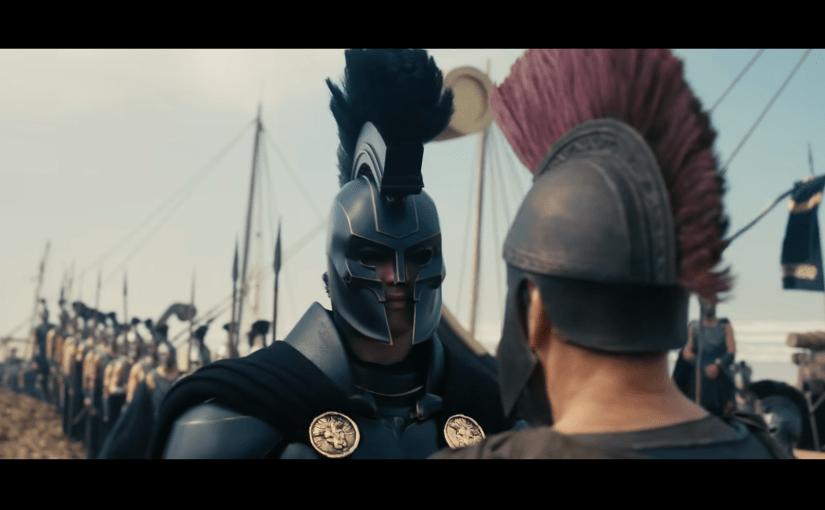
It seems that Christopher Nolan is left challenged by one thing – himself.  In less than thirty years this director/producer/writer has moved from the simplest of filmmaking with limited funds (FollowingMemento) to enormous heights in bonanza showmanship like The Odyssey, the first movie to be completely shot with IMAX cameras.  These devices are expensive and according to Nolan, they are also heavy and overbearingly noisy.  Yet, IMAX accommodated the filmmaker with specialized boxes to contain their equipment and muffle the sound interference.  As such, The Odyssey is a wonder to the eye.  Frankly, as impressed as I was with the film, on the most ideal IMAX screen available, I still didn’t see anything that felt any grander than the latest Dune offerings.  I mean how far are my pair of 20/15 LASIK eyes supposed to decipher?  Don’t get me wrong.  I am impressed.  However, was I as impressed as I was supposed to be? Should I be nitpicking pixels here?

IMAX says it all though.  The landscapes of open desert plains and vast open waters are brilliantly captured.  I could never tell you of any inconsistencies or shortcomings.  Costumes serve just as any sword and sandal picture that came before.  The sound, especially in an IMAX theater, is immersive and deafening as expected. Tidal waves within blinding rainstorms demonstrate this wholeheartedly.  The cast is stacked with some of the best talent available. The Odyssey has everything it demands of its legacy and what’s expected of a Christopher Nolan film.  Yet, I was never emotionally invested in the picture.  Understand that Christopher Nolan knows how to reach an audience on a primordial level of emotions. Think back to Matthew McConaughey’s tearful moment in Interstellar or how he shares scenes with young Mackenzie Foy. Look at Christian Bale’s anguish during the middle section of The Dark Knight. Hugh Jackman and Bale compete for moments of deep rage and sadness within The Prestige.

Nolan wrote his adaptation of Homer’s poetically romantic adventure.  I recall reading it in high school.  The fat, floppy, black paperback that weighed down my book bag has never been forgotten.  The highlights of the story remain in my consciousness from the Trojan Horse to Helen Of Troy (the face that launched a thousand ships), and of course the central plot of having the famed Odysseus making his long awaited journey home.  It’s all here, and then there’s more including the towering Cyclops and Circe, the witch who can turn men into pigs.  Nolan’s film goes from chapter to chapter, beat by beat.  This easily could have been a ten-episode miniseries on HBO MAX, and people would eagerly watch every Sunday night.

I favor Nolan’s choice to rely on modern dialogue, without rooted domestic accents or dialects. It’s a wise choice when delivering a poetic opus to the screen. This movie is a story. It likely would not relate to audiences on a poetic level structured in stanzas. Homer’s work does not lend to dialogue like Shakespeare or Mamet. A friend took issue with referring to Odysseus and Penelope as “mom” and “dad.” I get it. Nolan’s picture is much bigger than Harry Potter. However, the characters are bonded as family. So, it’s a pick your preference kind of situation. You either embrace or it takes you out of the story on occasion.

I’m not sure what I can say that this beast of a film says for itself.  If you’re not dazzled by simply one shred of a moment in this picture, then you are impossible to satisfy. Consider me wowed, but I was not moved.  The same way that I was never absorbed with Homer’s piece.  It was a homework assignment that spanned a long month of my junior year.  As a film lover, it’s inevitable that I see this picture. If it’s the first complete IMAX picture from beginning to end, then yeah, I’m spending the extra money to see it that way.  Am I going to watch it on repeat, on home video 4K? Probably never on a whim.  It’s a chore.

First, the picture seems to presume the viewers have prior knowledge of elements like the battle of Troy and why the war took place before we see how the famed Trojan Horse led to Odysseus’ (Matt Damon) victory with his army.  I don’t recall all that merited the action, but Nolan’s footage is astounding, especially that enormous horse on its hind legs.  On screen, the figure is as towering as the Statue of Liberty. No wonder the thing is being sold as a popcorn bucket.  

As complex as Christopher Nolan’s films can be (InterstellarInception), I always thought he was great at spelling out his unique brands of formula.  It took me a good hour or more to pencil down who everyone is playing and what purpose they serve in The Odyssey.  It boasts a big cast of celebrities who are all given their moments to shine.  I was especially taken with Samantha Morton’s Circe, introduced as a helpless woman grotesquely ready to reveal something more.  Robert Pattinson is Antoninus, a bratty and cowardly adversary ready to assume rule now that Odysseus has not returned.  He truly owns the picture when the focus turns back to him amid the rest of the cast and extras that occupy the room.

Anne Hathaway as Odysseus’ wife Penelope demonstrates nice range away from her Prada films and warm-hug kinds of pictures.  She looks quite unfamiliar while leaning into what you’d expect from Cate Blanchett.  Tom Holland drops the adolescent mischief of Spider-Man to play Telemachus, the son who takes it upon himself to uncover where his father could be after being gone for two decades.

Lupita Nyong’o may not look like she belongs in a story originated in Greek fiction, but she serves her small but significant role(s) with fierceness.  I’m not petty enough to let the appearance or history of an actor diminish my experience of seeing a sensational performance.  The same goes for Elliot Page in a crucial cameo.  As an aside, knock it off with the woke protests. Theatre is theatre and this is centered in mythology with a Cyclops of all things. If the Romans of Gladiator can speak with English accents, then in the fiction of Hollywoodland, casting has no limits.

I do not think the finished product The Odyssey is a new kind of novelty for filmmaking.  Christopher Nolan is taking advantage of the latest advancements that Peter Jackson did with his Lord Of The Rings and Hobbit trilogies.  If Nolan didn’t make this movie, Jackson would likely step up.  The swordplay and battles are as similar as most anything else that’s sent out each year.  Nolan has not reinvented the wheel in that aspect.  Likely he’s done it with how he made this picture.  That’s a blessing and a curse.  

The Odyssey is seamless, but how am I to recognize what’s done better here than what Jackson or Denis Villanelle has accomplished with their works?  I guess I had to be on set.  Matt Damon, Anne Hathaway and company testify to how astounding the experience has been.  I choose to believe them though I can’t compound what was embarked. For example, the actors enthusiastically celebrate the director’s idea to have then perform speaking to the mirror image of their scene partners. The mirror was mounted next to the IMAX lens and thus reduced time and cost for reshoots with the bulky and expensive equipment. Something like that. See, I do not see the advantage of this technique when I’m sitting in the theatre. There it is, though. Amazing! Incredible! It can be the greatest hot dog I’ve ever savored. Yet, I never went to the sausage factory.

I know my enthusiasm does not measure up to what so many others are saying.  The Odyssey is just an overwhelming picture.  The storytelling seems all too familiar, and yet not everything feels completely clear and decipherable.  Visually, it will always be stunning, even on a 55-inch flat screen. I wish Nolan offered more definition to the giant Cyclops (played by the master of mime and body manipulation, famed Ringling performer Bill Irwin who was TARS in Interstellar).  The movie will easily sweep all the technical awards while only earning acting nominations for Morton and maybe Hathaway.  Matt Damon earns recognition for exerting himself like never before in muscle mass. He’s only improved what he’s physically done in the Bourne films, for example.

This is a major hurdle that Christopher Nolan has elevated to, and a new bar has been set at a taller height.  Still, this picture never stayed with me like his Dark Knight trilogy that covered everything from sensational action to questions of morality. His brainy science fiction challenged protagonists to extend themselves towards sheer impossibilities of comprehension like InceptionInterstellar, or The Prestige.  Even a biographical story like Oppenheimer left me more emotionally consumed than The Odyssey, because the title character served as a puppeteered villain to everyone else, including himself internally.  Odysseus leans on Athena for solace, played by Zendaya, serving as an imaginary friend to the hero. He’s marooned with Calypso (Charlize Theron) serving as a sounding board while Odysseus struggles to recollect the memories of his adventures. All the parts are here like a grocery shopping list, but the connections just don’t feel as warm as they were in Nolan’s other pieces.

That’s okay though.  We all have our favorite flavors of ice cream. Just like we all have our favorite efforts of Christopher Nolan.

What’s this guy gonna do next? I cannot wait to find out because it’s never simplistic and always challenging with a sense of thrill and knowledge.

INTERSTELLAR

By Marc S. Sanders

On a rewatch of Christopher Nolan’s Interstellar it is no wonder he eventually went on to adapt Homer’s The Odyssey into a fully realized film.  The classic sci-fi picture, which draws inspiration from Stanely Kubrick’s work while likely springboarding off of Arthur C Clarke’s and Isaac Asimov’s ideas, is an ambitious undertaking.  It’s not Star Wars with lasers and aliens, but it is slightly Star Trek with missions bent on discovery. Its fiction is rooted in true science and that’s precisely why it should be taken seriously; never taken for granted. 

Like The Odyssey, the story from Nolan with his writing partner and brother Jonathan, sets out on a far off journey that will take travelers decades into the future of a fictional future with an uncertainty of survival or a return back to Earth.  Loved ones back home remain in wait and worry.  The Nolans had to be thinking of Homer’s poetic opus while undertaking Interstellar.  The parallels are just so clear, welcoming fresh perspectives for both films.

Matthew McConaughey is Cooper, a former astronaut, now corn crop farmer and widower.  He is raising his son Tom (Timothée Chalamet) and daughter Murphy (Mackenzie Foy) who is choosing to follow in her father’s footsteps of accurate science and astronomy.  His father-in-law (John Lithgow) is tending to the family at the home and likely by default because Cooper was never meant to be a homemaker.  He was meant to soar among the stars.

The children’s school serves to prep them for farming and deny even the simplest theories of science, especially when Murph opts to write reports that back up such conjecture.  Cooper is on her side.  Yet, the school faculty deny any of the historic Apollo missions of the twentieth century and college is not a primary goal for students. Preparation for farm life is what’s needed. Wild legends that propagandize technological competitions in races to space with the Soviet Union lend no use or value to surviving on an Earth stricken with food shortages. Farming is what the world has to focus on.

Interstellar reveals that an interruption in Earth’s gravity is causing punishing sandstorms, more familiarly reminiscent of the dustbowl era from the 1930s. Technology is not cooperative, nor is it tolerable for the government. Even military service is no longer needed. Therefore, farming has become the most necessary industry to rely upon. The world these characters occupy is plagued with an extreme shortage of food while nitrogen is expected to replace the availability of oxygen. If the people of Earth don’t starve, they’ll suffocate.  For example, as the film begins the last crops of okra have run out for the entire planet Earth.  Wheat is also in short supply. Corn is becoming the standard on a planet that gets globally bombarded with punishing sandstorms. 

Through odd circumstances, Cooper and Murph meet up with the last remaining folks at a classified NASA facility, operating from a clandestine nowhere locale, led by leading science expert Professor Brand (Michael Caine) with assistance from his daughter, Amelia (Anne Hathaway).  They urge Cooper to pilot a ship into deep space, past Saturn, beyond the reaches of a black hole, and into another galaxy to locate a new planet that the remaining survivors of Earth can inhabit. That’s Plan A.

Should all else fail, Plan B is prepared with embryos to cargo thereby establishing new generations of mankind to indefinitely prolong the human race.  Specific destinations include attempting to catch up with NASA explorers who left many years before but never returned or provided updates on their progress.  Those astronauts only had the means to search individually and separate from one another. Cooper and Amelia would attempt to rendezvous with those that left before and surmise if they discovered anything that can be habitable. This mission serves the need to leave Earth, not to save it.

Murph resents her dad’s commitment to this new mission, but he sees no other choice.  Personally, Cooper has always been a pilot and astronaut. Farming is not in his blood. He, Amelia, along with two other crew members, Romilly and Doyle (David Gyasi, Wes Bentley), will age slower than those they leave behind on Earth.  Cooper is hoping to at least return by the time Murph’s age matches up to his.  

Accompanying the crew are two robots that possess the personalities of accurate science, with a bit of programable sarcasm mixed in.  Clearly the design of TARS and CASE (Bill Irwin, Josh Stewart) are drawn from Kubrick’s monolith image, but the stand-up rectangles can sectionally move to allow leg and arm use for utility operations.  Very clever fictional engineering work going on here. Irwin is especially impressive as TARS as he put his skills with mime work and body flexibility to work. He’s actually on set, encased in a box, functionally performing as TARS.

Christopher Nolan is filmmaker who knows how to make the exposition of his pictures magnetically curious.  First off, he works best when assembles his stories with a circular narration. Little details are disclosed and then left behind to reveal information about another subject and then another. Nothing may appear connected. However, often his movies will later go back to what’s only been hinted out and uncover an important purpose. Books falling off a shelf in the upstairs bedroom do not say much until you realize that there’s a message there. Dust particles descending in an organized pattern lend to an environment but may also serve a clue. On a first watch, and maybe even on the second and third view, it’s at least a welcome challenge to decipher the time period of the story and why even some of the most minute details serve so importantly. Christopher Nolan prefers to work with some brainy stuff.

Interstellar never feels like a chore even when you try to comprehend the complex debates among its characters.  Hathaway and McConaughey haggle over which planet to visit next.  Their resources far into this new galaxy will not enable them to visit both locations.  So, how important and powerful is love, bent on a personal desire, when the future of mankind is at stake? Should romanticism tip the scale of the crew’s decision? The travels through space offer unusual challenges that hardly mimic anything I’ve ever seen on a Star Trek episode.  

Back on earth, the children grow into adults played by Casey Affleck and Jessica Chastain, both very good at being disagreeable siblings living on a world that is quickly deteriorating while mounting dirt exposure affects the family’s health.  Affleck’s portrayal of Tom is focused on upholding crop supplies to defy worldwide starvation. Chastain’s portrayal of Murph works with Caine’s character, continuing his research that is expected to resolve the last variables of seeking a new planet to relocate the residents of Earth.  Contrary to Tom, Murph is working ahead of an inevitable loss by applying her knowledge of science to pioneer a more sensible solution.

A side story dating back to Murph’s youth revolves around a “ghost” who resides behind the bookshelf upstairs.  Out of nowhere, one book after another will topple off a shelf.  (A nice detail by Nolan is to have Stephen King’s dystopian novel The Stand propped up.) Are Murph and Cooper really willing to accept supernatural phenomena over what can only realistically occur? I mean we are talking about the hard truths of science here. Tom is happy to tease his little sister with the weirdness of a ghost living behind that bookshelf.

Interstellar never allows anything to be easy. Jonathan and Christopher Nolan’s script works harder at offering the unsolvable than what can lead to rescue and resolution. Science of any kind never makes anything easy. Even humanity can unexpectedly betray its best intentions. Things go awry in space and on Earth causing more setbacks and distance apart and therefore presenting less likelihood of success.  Yet, what’s effective is that Christopher Nolan treats his picture like a documentary.  Peppered through the first forty minutes of the film are elderly people offering up interview recollections of what it’s been like to live with meteorological dirt storms that intrude upon their homes and outer environments.  They have to turn their dishes upside down to keep them as clean as possible.  They need to wear masks and goggles. Seven years after this movie came out, ideas like this hardly seem exaggerated. The elderly folks who are being interviewed were real folks who experienced those dirt storms from the early twentieth century and participated in some of Ken Burns’ documentaries. Christopher Nolan operates on science fiction that is anything but far-fetched.

On paper, all of this would likely be the most exciting issue of Popular Science magazine ever published.  Sadly, it would never be read and rest on the coffee table in the lobby of our dentist or primary care physician. Thankfully, Nolan finds a way to thrill us through scenarios. Like 2001: A Space Odyssey (there’s that word, again), the Nolans offer first person, interior window perspectives of looking out over the wing of the space crafts.  You hardly ever get an idea of the whole dimensions of the model ships with only a select few omniscient, external views.  They want you to live within the confines of the space crafts.  Outer exhausts are emitted but when Nolan cuts in footage from the outside, the fumes are not accompanied by sound effects.  The same goes with various collisions or explosions in space.  Planet Earth may be depicted as an unlivable dust bowl, but the constructs of outer space remain unchanged.  Sound never exists in the vacuum of space.  So please have a seat Mr. Spock.

Though I wish his signature whispered twang was a little more enunciated, Matthew McConaughey is touching throughout the entire three-hour film.  Nolan captures an exceptional moment of sadness as he is able to catch up with video feeds submitted by Tom and Murph.  Try to fathom visiting a planet for the equivalent of three hours, measured on Earth, but when you return to the ship, over twenty-three years have gone by.  People back home have passed away.  Babies have been born.  Children have embarked on careers.  You might respond like Cooper does and become a mess of tears and homesickness.  It’s a one take sensational moment, beyond compare.  An absolute highlight of the actor’s career.  

Anne Hathaway is not the central character here, but she works well as a continuous counterpoint to the hypotheticals proposed by Cooper. As a contrast to Cooper the pilot, Amelia operates on exact science and though she’ll reside in an enclosed tin can of a spaceship with three men, she does not want to entertain the luxury of becoming friends. They might have endless amounts of time, journeying to Saturn and then on to another galaxy light years away, but there’s a lot of new science to uncover.   

Following Batman Begins, the director took his team back to Iceland which serves as destinations into the far reaches of outer space.  Nolan’s cameras sweep on and on and overhead to tell us there’s much to look for in these places left mostly untraveled.

Possibilities beyond imagination are treated like realistic outcomes, including ideas like communications traveling back in time by means of gravitational pulls. Things like this I completely buy but could never explain how it connects or operates.  

The Nolans accomplish what so many other pictures neglect or fail to factor including engineering, biology, astrophysics and necessary needs of survival accompanied by the philosophical natures of love.  It might sound romantic, but it’s been a long while since humanity grew out of the slime of the earth.  Love had something to do with us still breathing this air and allowing us to go see the director’s Batman movies.  

Christopher Nolan challenges us to find entertainment and wonder while he speaks on higher plains of intelligence than other standard summer blockbusters.  He’s at the other end of a wide spectrum where he’d never consider nuking an asteroid in space to save the Earth.  Something less glamorous and more overwhelming would take us out in his universe.  It would require his heroes to make bigger sacrifices than what another filmmaker might propose for Bruce Willis.  Nolan is the storyteller who is adamant that we can do better by use of scientific awareness and realistic possibilities.  

Who knows?  Incessant dust clouds might overcome the planet, accelerating its demise and forcing some of us to do things that a man like Cooper would declare “necessary.” When the glaciers finally melt away, I would not be surprised if the scientists at the time reference what Christopher Nolan considered in one of his pictures.

Nothing here feels so otherworldly or foolhardy, anymore.

Interstellar may be that sci-fi flick that’ll become required textbook studying for our children’s children’s children who live beyond the black holes of space and time.

BATMAN BEGINS

By Marc S. Sanders

The merits of a lot of action/adventure films is predicated on how strong the villain is to the story.  Often the hero is the straight character in the heroic garb ready to enter the scene just as the bad guy is on the brink of maniacally destroying the world.  In the early 2000s however, the focus diverted to the hero when big franchises opted to reinvent themselves.  James Bond’s origin was finally offered up in the best film of the series, Casino Royale.  Christopher and Jonathan Nolan served up one of the best cinematic Batman stories on screen.  The title said it all.

Batman Begins gets every note right with the all too familiar back story of Bruce Wayne’s drive to become Gotham City’s Dark Knight vigilante.  The film has its collection of villains but the center of the picture is always circumventing around Bruce Wayne, perfectly played by Christian Bale, with somber truth hidden by handsome playboy disguise.  As a child, he discovers his fear of bats and then attends the theater with his billionaire parents.  Upon their exit through a back alley, he witnesses their death and is left to be raised by his trusty butler, Alfred Pennyworth (Michael Caine, my favorite actor in the role to date).

This film achieves my undivided attention because it paints a full canvas of this character before he ever adopts an alter ego in a black costume.  We explore how he becomes motivated followed by his intense training in the zenith alps, on the Asian continent.  Then we see how he supplies himself with all of the familiar gadgets and costumes when he befriends an ally within his father’s company, Lucius Fox (Morgan Freeman). 

Jonathan Nolan’s script diverts away on occasion to embrace the capable villains of this story with the Scarecrow (Cillian Murphy), Rha’s Al Ghul (Ken Watanabe) and mob boss Carmine Falcone (Tom Wilkinson).  Bruce’s mentor, Ducard (Liam Neeson), is a big factor in the hero’s development as well.  Lastly, there’s Bruce’s childhood friend and legal connection, Assistant D.A. Rachel Dawes (Katie Holmes).  Lt. James Gordon is the uncompromised police detective that Bruce singles out to trust within this dense world of corruption.

Just to read this cast list is impressive as they fall beautifully within the matrix of Nolan’s blueprint.  Everyone is given enough time to make more than one impression as their storylines twist and alter.

Christopher Nolan’s films are always moving like a smooth ride on a never-ending stretch of road with no traffic in the way.  Nothing bears repeating from what was already shown in an earlier scene.  There’s something new to learn as the pace continues.  Nolan is one of the few filmmakers where you do not mind the time jumps he incorporates into his stories.  Bruce will first be seen as a ten-year-old boy, then in his muscular fit thirties in a Chinese prison completely departed from the wealth of Wayne Manor.  A step back before that shows him as a Princeton drop out with a mop top haircut.  Every different appearance of Bruce is interesting and you become intrigued with how he ends up in one place after another. 

Like the first appearance of Daniel Craig in the Bond series, this Batman/Bruce Wayne is repeatedly imperfect.  He’s flawed because he still needs to learn and the characters that enter and exit and reenter his life must teach him.  Alfred will lecture a short-triggered Bruce when he’s on the cusp of risking the reputation of his father’s legacy.  Rachel will slap him when he’s prepared to kill in cold vengeance.  Ducard will teach him the ways of physical survival and will test Bruce’s loyalty and the measures of crime with punishment.  Even the Scarecrow is smarter than Batman when he springs an unexpected trap.

The ongoing education of Bruce Wayne is the theme of Batman Begins, all the way to the end, when he finally learns to mind his surroundings.

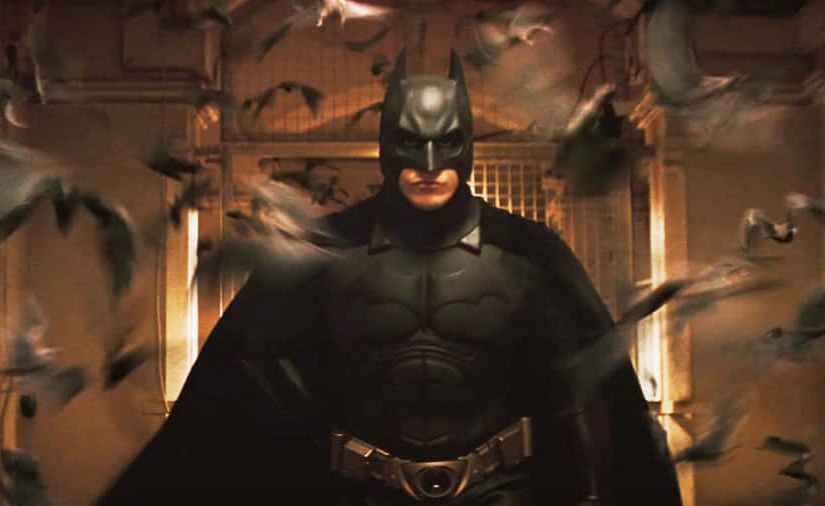
Christopher Nolan made Batman exciting in a new unfamiliar way.  The Batmobile is a not a sporty kind of vehicle.  It’s a tank called The Tumbler and it bears a thunderous series of sound edits as it barrels through Gotham City.  After some slip and falls off rooftops, Batman becomes much more covert than in other interpretations.  You don’t have to physically see Batman to observe him operate.  If a thug gets swallowed into a void of darkness, you know what has ensnared him.  The crusader’s devices which stem from his gold utility belt are demonstrated with explained reason for why he selected them for his fighting advantage.  The Nolans proudly recognize the theatricality of this guy.

Cillian Murphy is unforgettable as he lives up to the name of Scarecrow, also known as Dr. Jonathan Crane, a criminal psychologist.  His choice to put his victims into a hypnotizing sense of fear lend to the back story of Bruce Wayne’s intent to become a frightening figure himself, where his enemies will recognize his dread.  Tom Wilkinson claws his gangster persona straight from a Godfather kind of picture, but he represents an old guard of Gotham City before costumed and makeup identities take over.  Gotham will transition from the sharp dressed mobsters over to the crazed clowns yet to come. 

Gary Oldman invents another unique personality – a strait-laced city guy who might have come from a 1970s ABC cops and robber show like Dragnet.  No two characters of Oldman’s are ever the same.  So much so, you almost wish they would all assemble in a movie for the various personalities to interact.  Morgan Freeman and Michael Caine are like comfort food who are so subtle and relaxed in front of a camera.  Neither one makes big waves with their characters.  Jonathan Nolan wrote their respective purposes for this Bruce Wayne and they execute their techniques of less is more beautifully.

Liam Neeson delivers the second-best performance of his career thus far, after Oskar Schindler.  He adopts the same kind of method that Freeman and Caine work with, but then he sways from that behavior when Ducard has to surprise Bruce as a means for his pupil’s development. Some of what he does comes from nowhere.  Early in the film, his first two scenes could not be more different.  Neeson works like an unpredictable entity.

The next film in this trilogy replaced Katie Holmes with Maggie Gyllenhaal.  I was disappointed because Holmes was maturing as a very formative actor by this time.  She was blessed with a well written character in Rachel Dawes.  When I watch the next film, The Dark Knight, I cannot help but wonder how she would have performed the role for a second and much more developed opportunity. 

There is not one flaw in Batman Begins.  This is the movie that placed Christopher Nolan in the echelon of top blockbuster directors like Spielberg and Hitchcock, along with Lumet and Mann.  Hans Zimmer’s soundtrack is thrilling as it speaks for The Dark Knight who is of few words.  Zimmer’s scores announce the introduction of Bruce Wayne first, and then later Batman. 

Gotham City makes for a sensational character with various rooftops, fire escapes, tunnels, bridges and a gorgeous, elevated train at its center.  The entire city breathes steam amid the distressed decay, wet streets and rusted architecture. 

Wayne Manor has a ghostly effect as Alfred and Bruce climb the large staircases and floors.  Further down under its platforms rests the cave that’ll serve Batman well.  The waterfalls and rocky caverns are immense. 

Batman Begins is not one of the best films of a genre like any other superhero movie.  I refuse to recognize it that way.  Instead, I see a character study where a man accepts a responsibility to fix what scarred him at a young age.  He wants to right a world that once had promise.  I don’t see the costumed protagonist announce himself as a superhero.  I don’t see the costume.  With the cape and the horns on the head and the car and the tools, I see an image, never a superhero.  With Christopher Nolan’s first film in what will become a well-received trilogy, I always see the man underneath the mask. 

INSOMNIA

By Marc S. Sanders

Insomnia is an unusual kind of crazed killer pursuit because the hero is initially implied to be compromised, and before the first act of the picture ends, we see that he truly is not as noble as he is described.  This Christopher Nolan film, one of the few that neither he nor his brother Jonathan wrote, is headlined by three Oscar winners and they beautifully absorb this insightful script from writer Hillary Seitz.

Al Pacino is a celebrated Los Angeles Detective named Will Dormer.  When we see him arriving aboard a propeller plane into the foggy town of Night Mute, Alaska with his partner Hap Eckart (Martin Donovan), he looks weary and worn out.  Greeted with warm welcomes by a fan of his is Ellie Burr (Hilary Swank) and his old friend Chief Nyback (Paul Dooley).  Will has been special requested to investigate the murder of a young girl found in a trash heap, strangled to death.  Happenings like this do not occur often in Night Mute.  So, it is best to use the assistance of an expert.

Right away, Will is ready to get to work by visiting the girl’s boyfriend at school.  What he doesn’t realize is that it is ten o’clock at night. At this time of year, a midnight sun lasts twenty-four hours over this little getaway.  After he’s had a chance to investigate the victim’s body and go over the autopsy notes, the discovery of her bookbag leads to the prime suspect, mystery writer Walter Finch (Robin Williams).  A raid on his home near the beach is initiated and it does not go as planned.  Will screws up while chasing down the guy who gets away. 

While it seems that with some cover up, Will can keep his terrible error in judgment to himself, Walter knows everything. Now, with taunting phone calls in the middle of broad sunlit evenings, Will’s insomnia is becoming a hinderance as he tries to do his job while suppressing his own personal guilt and egregious acts.

The duality of Pacino versus Williams is reminiscent of Eastwood against Malkovich in In The Line Of Fire.  It works very well especially because of the departure that Robin Williams takes from his usual fare.  Ironically, he portrayed another creepy guy in the year of this release with a movie called One Hour Photo.  Williams is just a different kind of cut from Al Pacino and that’s why their conflict works well.  Pacino’s gruff tone, which is all too familiar within the second half of his career, has a roughness against the smooth and calm demeanor that Robin Williams relies on with his dialogue.  Walter Finch appears relaxed, rested and neat.  Will Dormer is wrinkled, tired, and lonely with guilt.  This killer has an inescapable edge over the cop, and thus Insomnia stands apart from the other fare of its time from the likes of Fincher, Demme or the Scott brothers’ respective films.

Christopher Nolan captures a creepy and uncomfortable setting for an environment bright with daylight amid a corner of the world that still embraces the nature of Earth.  He is thorough explorer with his go-to director of photography, Wally Pfister.  Clouds and the blurs of fogs keep moments unclear.  The sun blaring through windows is disorienting.  You can also feel the chill of Alaska, even if you are like me and have never visited the state. 

Though the film was primarily shot in Canada, there are amazing bluish/white overhead shots of snow-capped mountains and expansive rocky lakes surrounded by green woods.  A foot chase midway through the picture uses this unusual environment as Dormer chases after Finch across an expanse of floating logs that trap him underwater.  As Pacino desperately looks for an opening to the surface, Nolan really makes you feel like you are drowning amid this unexpected trap.  (Try to watch Insomnia on with at least a 5.0 surround sound.)

Hilary Swank’s role appears like a forgettable partner early on, but her significance opens up later in the story as more is revealed.  I look at her character of Ellie and it occurs to me that a theme of mentorship builds the backdrop of Insomnia.  Ellie has studied Will’s most famous cases and he’s much like a celebrity in her presence.  Finch is a well-known author that built a connection with the murder victim who avidly read his novels.  This film is a good reference to the adage that perhaps it is best to never meet your heroes.

I was very surprised by the directions that Insomnia takes, and quite early on.  There are unexpected moments that occur very quickly after the exposition is covered.  Nolan’s film is not a carbon copy of the tough cop working to nab the intelligent killer that’s on the loose.  Bodies do not just turn up before the final showdown, and the office Captain does not unleash on the detective threatening to pull him from this case.  What you observe in Insomnia is not what you have seen a thousand times before. 

Will Dormer is in an unsolvable conundrum of doing the right thing, but can he afford to surrender to his own misgivings after a decorated thirty-year career?  I could not predict how he would get himself out of this situation where Walter Finch, his antagonist, has got the clear advantage. 

Insomnia is a well thought out script superbly brought to vision by Christopher Nolan.  A thinker’s thriller.

NOTE: It’s a nice touch to call Pacino’s character “Dormer” which in French and Latin means “to sleep.”

MEMENTO

By Marc S. Sanders

Christopher Nolan’s Memento was Oscar nominated for his screenplay, adapted from a short story by his brother Jonathan, as well as for editing.  You’d be hard pressed to find a better example that lives up to the merits of these categories because without the inventive storytelling and how it’s cut together, Memento would not be so memorable.  

Guy Pearce plays Leonard, but he distinctly remembers that only his wife called him Lenny.  We observe him in two different narratives.  A black and white collection of scenes has him in a hotel room chatting on the phone with an unknown caller.  In modern color, Leonard is wearing a tan suit and driving a dusty Jaguar while traipsing from one place to another.  He’s trying to make progress with uncovering who murdered his wife.  The scenes in color though must be shown in reverse.  In other words, a scene is shown, then it will cut to Leonard back on the phone, and then another scene is revealed showing what occurred literally just prior to the last color scene we saw.

It must be done this way so we can be just as discombobulated as Leonard.  He suffers from a condition where he has no short term memory.  Therefore, if Leonard learns something or meets someone or arrives at a location, he’ll soon forget anything he just encountered minutes ago.  

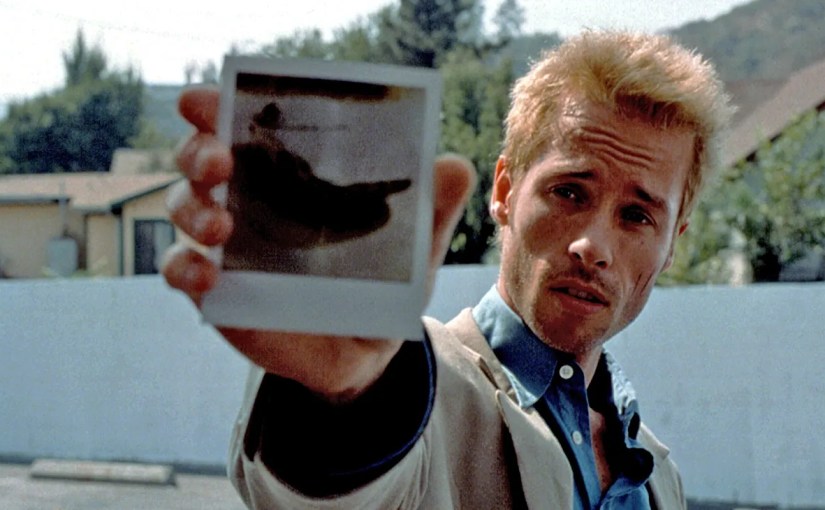
While he pursues the mystery of his wife’s killer, Leonard tattoos his flesh with notes to help guide him when his short attention span can’t. He also takes instant Polaroids of people he meets and the places he goes.  As quick as he can, he’ll jot a note on the photos to aid him as he carries on.

Memento starts at the end of the story and when the film concludes, the viewer arrives at the beginning.  Perhaps the beginning will explain the end that was shown almost two hours before.

Christopher Nolan had a small budget to work with and the California city locales are nothing dazzling.  There’s little to offer with special effects as well.  So, it is impressive that he uses Jonathan’s idea to create a mystery we want to see resolved where the information we get seems to erase itself as quickly as it is told.

Leonard can’t remember anyone he’s recently met, but oddball cases like Teddy (Joe Pantoliano) and Natalie (Carrie-Anne Moss) certainly remember him.  Are these folks working with Leonard or against him?  Even with seeing the ending first, I could never spoil anything, and you’ll find it hard to decipher what these are these characters’ best interests.  

Nolan exercises some neat visuals to keep you on track.  We see a broken car window before we see how it got shattered.  Leonard can’t recall how that happened.  Leonard is also unable to remember why a bar patron is chuckling at him.  Christopher Nolan maintains well placed book marks to aid the viewer in this story that makes an effort at throwing off its protagonist as well as the audience.

What also helps is that when all the secrets are revealed, at least to the viewer, it’s a pretty solid crime set up that does not come off like a stale Murder, She Wrote episode.  It’s clever, tricky and unexpected.

Guy Pearce is really good in his role that eventually reveals some duality, but that’s where I’ll stop.  Carrie-Anne Moss always seems questionable, but what’s her agenda?  Joe Pantoliano is the sleazy guy with the mustache.  So why is he always turning up in Leonard’s way?

Like his future efforts to come, Christopher Nolan layers his films in great depths of dimension.  It never stops thinking. Often, he answers a riddle with one or two or three more conundrums.  What’s especially appreciative is that he eventually reaches a final answer to all of his questions.  Still, that doesn’t mean he ever would want you to stop thinking about what you ascertained from Memento.

FOLLOWING

By Marc S. Sanders

A young filmmaker scraped up six thousand dollars to make a short movie clocking in at just over an hour called Following.  The writer/director is Christopher Nolan.  While he may have been very limited on resources, his reach for imagination was already infinite at the start of his career.  Following is…well…challenging to follow, and I had to watch it twice to grasp the novel curves in time jumps and twists.  However, on my second go round I enthusiastically applaud its brilliance.  The wrap up to this short film is genius.

Gone for nearly fifty years, Alfred Hitchcock’s attempts at pursuing the questionable temptations that people undergo remain wholly intriguing.  His movies are still watched, studied, referenced, and duplicated.  Most importantly, they inspire filmmakers like Christopher Nolan.  Following leaps into its story with parallels from Rear Window and then segues into brief encounters like Strangers On A Train commits.  Mischief is at play which gradually develops into deceit and maybe murder.

Nolan makes an hour and ten minutes feel like a breezy fast moving two hours.  The script for Following throws a lot of information at you at a fast pace, which is something the famed director continued to do with the majority of his later films.  It’s to your advantage to stay alert and explore what’s shown in every frame.  Much of what comes at you will circle back for a twist or two.

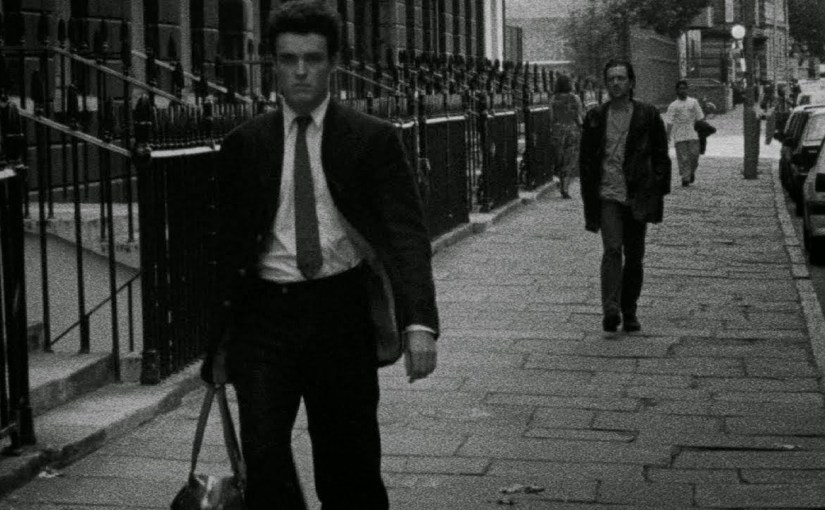
Bill (Jeremy Theobold) is an unemployed writer who occupies his time by simply shadowing random people going about their lives within the streets of London.  There’s no particular reason for his behavior.  He relays to an older man that perhaps he’ll learn or become inspired by what he sees people do during their day-to-day business.  

A man in a suit carrying a large tote bag (Alex Haw) becomes Bill’s latest observation.  Bill keeps his distance and follows the man into a cafe.  As the man gets up to leave, he makes a surprising stop at Bill’s table.  He calls himself Cobb, and he has an unusual habit of his own.

Cobb demonstrates to Bill how he takes interest in learning about random people by entering their flats when they are not home.  He’s not there to necessarily burglarize.  Though he will tease the owners by planting a pair of women’s panties in their laundry or emptying their little box of knick knacks on the desk.  Maybe he’ll hide one earring to turn up later. In particular, he shows Bill how much you can learn about people by looking at how they keep their home, what they collect or what they furnish the place with.  So, how about the gentlemen pop the cork on a bottle of wine and have a chat while they stay a while.

These two strangers build a warped kind of mentality for this behavior, but as Bill becomes more natural at what Cobb has introduced him to, so do the risks become more apparent.

Following has some unusual ideas; the kind that are perverted enough to only see in the movies.  If I were to meet guys like Bill or Cobb at a bar and they started telling me of their derring do, I might excuse myself as subtly as possible.  In Christopher Nolan’s film though, I’m intrigued of what these men gain or how they entrap themselves.  

On occasion, it is hard to follow where the film turns its attention.  There are time jumps that come out of nowhere.  We see Bill with a different haircut.  At another time he has cuts on his face.  His wardrobe is different. Because of the small budget, the editing and cinematography must have suffered making these time jumps feel seamless.  So, on my first watch I was confused and wondered if the movie had some scenes cut or if I dozed off while watching it.  Then again, this is Christopher Nolan who is notorious for not keeping a straight and narrow narrative.  His well-known movies like Memento, Interstellar or Oppenheimer have all of his best tools at play to emulate different periods of time.  Following is presented in black and white and so it’s a challenge to focus on where you are in the story and where you left off.

The second time I watched the movie, it was much clearer to bridge everything together and you recognize when one twist occurs at the halfway mark followed by something else until it reaches its fascinating conclusion where every prop you see or line that was uttered serves their ulterior motives.

Following is a thrilling play on your thought process where one character might be performing a cruel sleight of hand on another.  Do not trust anything you see or hear.

Currently, Following is on You Tube and streaming on TUBI, but I had to watch with some limited commercial interruptions.  I encourage you to deal with it because Christopher Nolan’s first film shows some of the storytelling tricks he’s most appreciated for.  What you see in Memento, The Prestige or Inception was attempted early on with Following.  It was not as flashy, but it was just as inventive and brainy.

At just over an hour, Following is that perfect story to watch just after you’ve crawled under the covers and turned off the lights.  It’s a thrilling bedtime story.

OPPENHEIMER

By Marc S. Sanders

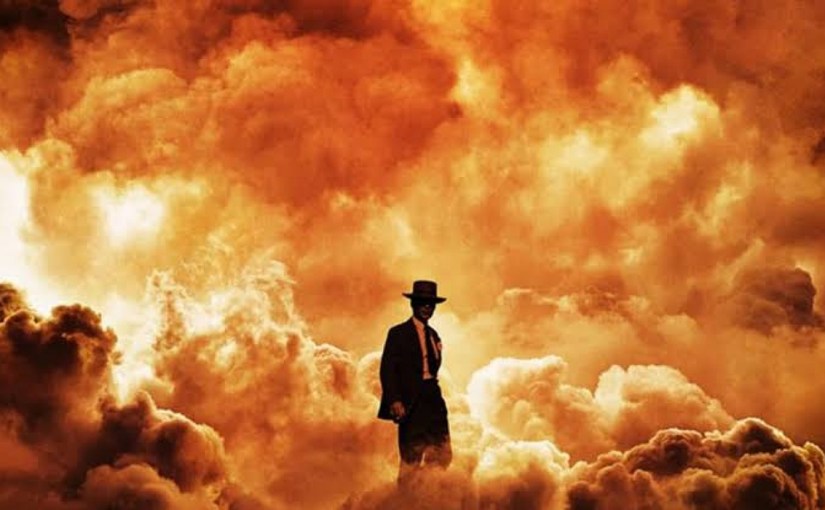
Christopher Nolan is one of the modern-day directors that you can rely on for brainy science fiction whether they are in embedded in dream subconsciousness, intergalactic space travel, transcendences of time, or even putting a fresh polish on a favorite superhero.  With Oppenheimer, he triumphs with exploring the actual prophets of science in the twentieth century, particularly its title character J Robert Oppenheimer, the brilliant physicist played convincingly well by Cillian Murphy.  Nolan doesn’t just stop at the assembly and discovery of science though.  He uncovers the consequences of Oppenheimer’s innovation and genius insight.  Dr. Oppenheimer might have been the man who knew too much and arguably that cost him quite a bit, personally.  Additionally, the so-called lab rat of his atomic bomb, namely the planet Earth, suffered the expense of a, at the time, troubling present day, and a still ongoing future. 

This movie seems to start right in the middle of its story and as a viewer you need to claw your way through the dense foliage to find its beginnings and what comes afterwards.  The first two scenes of the movie are titled “Fission” and “Fusion.”  There are no time periods specified by a font caption, however.  The differences in various points in history are distinguished by where J Robert Oppenheimer is located during select points in his life.  For seconds at a time, the film will change its photography from vibrant color to black and white, for example.  The characters will either look more aged with grey hair and some wrinkles or during more youthful time in their lives.  At one point Oppenheimer is being recruited by Lewis Strauss (Robert Downey, Jr) to head the department of a new kind of weapon development.  Work the science to make a difference.  There’s another time period where he’s being interrogated in a small room by a governmental suit and tie committee.  Oppenheimer is also in his classroom or debating and working with colleagues.  Another story observes his progress with building the atomic bomb among a collection of other engineers and scientists in a desert town, Los Alamos, specifically built at his own request, under the order of the nothing but militant Colonel Leslie Groves (Matt Damon), to conduct his work and research while hiding in plain sight. 

The film also covers Oppenheimer’s association with possible suspects of the Communist Party during the stressful pre-cold war era of McCarthyism.  Questions arise if his reliable brother Frank (Dylan Arnold) is a communist or even his mistress (Florence Pugh).  Does that in turn make Oppenheimer a communist as well?  If that is the case is J Robert Oppenheimer, the man tasked with ultimately ending World War II in favor of the Allies, sharing secrets with Russia and/or the Communist Party?

Nolan’s film gets easier to watch as it moves along, but you must get used to his pattern of filmmaking.  If you have never seen a Christopher Nolan film, I do not recommend you start with Oppenheimer.  His work is recognized for fast paced edits of different time periods and conversations.  There is much information to decipher. As well, there’s a very large collection of welcome characters to sort through, who worked with or against Oppenheimer.  Having only seen it once, I was captivated with the picture, but I know that I need to see it again.  The quick edits, working beautifully against the soundtrack orchestrations of Ludwig Göransson (nominate him for an Oscar, please), happen a mile a minute.  I appreciated this method because it enhanced the urgency of Dr. Oppenheimer in the eyes of the world, first as the savior of the united Allies against the last remaining superpower of the Axis countries, Japan. Then later focus is on whether it is in the United States’ best interests for the regarded physicist to have security access to the country’s most secret weapons and technological progress in a post war age.

People have been cajoling about how they know the ending to Oppenheimer.  They drop the bomb, of course!  (Twice actually.)  However, they do not know the entire story adaptation that Christopher Nolan as director and screenwriter presents. 

Cillian Murphy is perfectly cast. Give him an Oscar nomination.  He serves the confident, assured scientific leader who becomes envious of competing powers who achieve the impossible, like splitting the atom, while also admiring peers and mentors like Niels Bohr and Albert Einstein (Kenneth Branagh, Tom Conti).  All these men are interested only in what can be accomplished.  The superpowers that fight in war, though, are interested in how these accomplishments of modern science can be used to their advantage at a cost of collateral damage.  It is these conflicts of interests that Nolan admirably demonstrates over the course of the film. 

A telling scene for me, that I won’t forget, is when Robert Oppenheimer meets Harry Truman (Gary Oldman, doing an unforgettable cameo).  As the physicist exits the Oval Office, having shared his concerns and scruples with the Commander in Chief, Nolan includes a throwaway line delivered by the President, that I won’t soon forget.  It will not be spoiled, here.  Yet, the dialogue speaks volumes of what the United States held important regarding the servants who did the country’s bidding.  The scene closes like a stab in the heart, and suddenly science is no longer just facts within our planet.  Science is now questioned on whether it should ever be acted upon. Those questions certainly have remained as long as I’ve been alive to read about our never-ending world climate.  These inquiries will be here for many generations after I’m gone as well; that is if men and women’s recklessness with science doesn’t destroy the Earth before then.  At one point, Oppenheimer shares a small fraction of possibility for the end of the world when they activate and test their first atomic bomb. Matt Damon’s Colonel Groves’ asks for a reiteration of that observation.  Is this finding worth even the smallest, most minute risk?

Emily Blunt portrays Kitty Oppenheimer.  She’s marvelous as a lonely alcoholic wife to Robert, and a mother minding a home built in the desert while her husband serves an important purpose.  I didn’t take to her presence in the film until her grand moment arrives during an interrogation scene.  As the character gives her testimony regarding Oppenheimer’s communist ties, Blunt locks herself in for a wealth of awards in late 2023/early 2024.  Once you’ve watched the movie, you’ll likely know which scene I’m referring to and you can bet it’ll be that sample clip shown on all the awards programs.  This might not be Blunt’s best role, because it is rather limited within crux of the film, but I’d argue it is her greatest scene on film that I can remember.

Oppenheimer is a three-hour film, and it demands its running time.  There are so many angles to the man that few really know about.  Many know it was he who instrumentally built the atomic bomb that to date has only been used twice within a period of four days.  Thankfully never since.  Nolan emphasizes how unaware we are of how carefree the doctor’s government supervisors performed with the weapon he agreed to build.  Don’t just drop the bomb once.  Send a message to Japan by dropping it twice so they know to no longer engage in this ongoing war.  Choose the area where an army/government official didn’t honeymoon though.  It’s too beautiful a region.  Tens of thousands of men, women and child civilians perished immediately following the strikes.  Many others died weeks later following exposure to the nuclear effects that followed.  All issued as a horrifying cost to end a war that was already being won now that Hitler was dead.

Mechanically, Christopher Nolan does not disappoint either.  I watched Oppenheimer in a Dolby theater and I highly recommend it over a traditional one.  However, beware of the sound.  It is a LOUD!!!!!  Your seat will rattle early in the film when Cillian Murphy is shown in close up imagining the collision of atoms, protons, and neutrons.  How a star naturally dies in space runs through Oppenheimer’s consciousness as well, and then we see how a black hole forms.  Nolan offers a Cliff’s Notes edit of science doing its job.  Murphy performs so well when he’s not speaking and cut against the quick edits of Nolan’s visual and sound effects of science at play.  It shows how an educated scientist thinks beyond what is documented on a chalkboard or in a textbook.  J Robert Oppenheimer used to teach about the building blocks and natural destruction that occurs within the universe.  Regrettably, what he learned about natural function soon becomes manufactured capability when the professor accepts the task of building scientific destruction with his bare hands. Man stole fire from the Gods.

Oppenheimer is so dense in the scope of science and the scientist behind it.  That’s a huge compliment.  It’s an engaging film with much to tell, and a lot more to think about afterwards.  It accomplishes what the best movies do.  It leaves you thinking long after the film has ended.  More importantly, it’ll leave you frightened for the future based on the behavior of this planet’s past. 

Oppenheimer is one of the best films of the year.

TENET

By Marc S. Sanders

Christopher Nolan is certainly the most imaginative director working today. Films like Inception and Interstellar welcome new kinds of science fiction dissimilar from most any other films. He is an incredibly inventive filmmaker. He’s so inventive, in fact, that I think he might have carried himself too far with his much anticipated sci fi spy thriller Tenet, featuring John David Washington and Robert Pattinson along with Kenneth Branagh in a James Bond villain role. Actually, there’s a lot of Bond inspirations here. Not surprising, as Nolan is a devoted fan with much admiration for The Spy Who Loved Me, in particular.

It’s hard to describe Tenet because it’s hard to fully comprehend Tenet. I don’t even have to worry so much about revealing spoilers because I likely wouldn’t know what I’m unveiling.

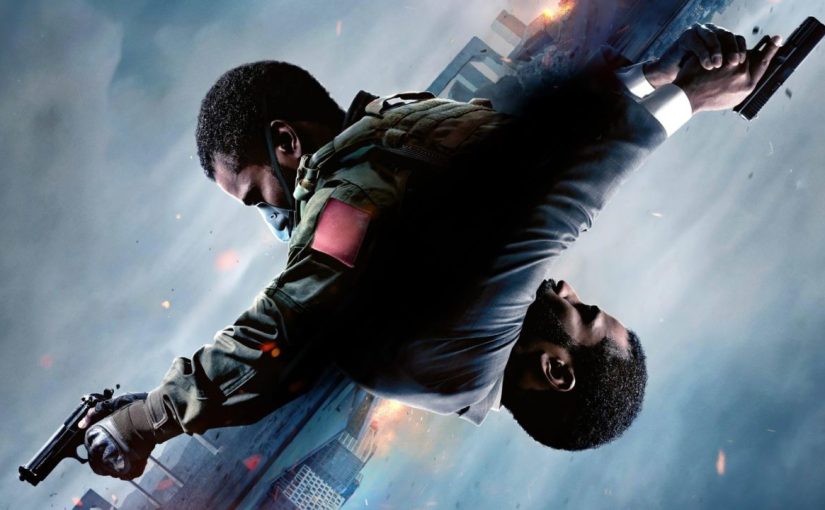
Washington is a good leading actor. This film along with BlackKklansman prove that. He plays The Protagonist (no name revealed) who is extracted from a hostage mission that opens the film at an opera house. Apparently the CIA liked how he handled himself in the field and now they want to assign him to the concept known as Tenet where time moves inversely with itself.

Try and stay with me here. If you fire a bullet out of a gun, the bullet can also be pulled back into the pistol if you are moving through time on a backwards trajectory. Sounds very Nolan, right? Sounds very cool as well and when the science of this is simplified early on it looks cool too. However, as the film moves on and objects and time traveling get more complicated Christopher Nolan seems to lose his way.

There’s a bomb out there made of technology that is unfamiliar yet. Why? Because that tech was perhaps invented in the future and brought backwards through time inversely to be detonated and literally destroy the world. The Protagonist has to prevent this from happening and so he’s partnered up with Neil (Pattinson) who is a handler with more knowledge about this mission and Washington’s character than he should know.

Tenet has some spectacular edits and footage of dazzling camerawork. It’s a contender for an amazing car/truck chase. Washington and Pattinson are good together. Branagh is fine as a vicious wealthy industrialist with a penchant for abusing his beautiful wife (Elizabeth Dibecki). CGI thankfully seems very limited as well. All of the gorgeous locales and vehicles are here. Warner Bros holds so much faith in Nolan’s works that his budget seems to not exist. There’s boats, yachts, helicopters, trucks, a fire engine and a BMW. There’s also a real life jumbo jet crash. It’s a gorgeous looking film and every dollar seems well spent. However, it’s not a well assembled film.

This is the first time I would NOT recommend seeing a movie in a Dolby theatre. The sound is obnoxiously loud. The musical score from Ludwig Göransson is POUNDING bass; so loud that I couldn’t even decipher any semblance of a tune. Much of the sound edits seem that way as well. It’s a headache to sit through this film. A terrible soundtrack and sound edit for sure. To watch Tenet on a technical level is to park your automobile next to that rebuilt Oldsmobile with the new gold rims and the maxed out speakers that shake your car while you’re at a red light. It’s terribly distracting and overly annoying.

Nolan also does not demonstrate his science very well here either. It’s hard to understand when someone is traveling normally through time versus inversely. Somehow it just occurs at times and you lose your way as to when it began. If you consider Inception, Nolan explains the tactical strategies of approaching someone’s mind by means of dreams and in sleep mode. Everything was spelled out nicely. You want to learn more and see more of the tricks. Tenet doesn’t leave you with that curiosity.

I didn’t hate Tenet. My wife did, however. There are close ups of arbitrary things early on that circle back later. So it kept me engaged when I uncovered some significance here and there. Still, it’s not enough.

Nolan conceived another brilliant and brainy idea. I only wish his delivery and the construction work of his crew, especially his sound and music staff, were more up to par.