THE DRAMA

By Marc S. Sanders

A happy couple ends up not so happy when they get a little too honest with each other.  

After watching Kristoffer Borgli’s The Drama, I’m left unsure of what was supposed to be learned or what I’m supposed to take away from his picture.  Is he telling me that when you are on the cusp of walking down the aisle, if you see a red flag, you should hike it and run, or should you literally drop your betrothed’s pants and call do-over? 

After a cold open of meet cute cuts where the characters speak with one another and the film “stylistically” edits sudden breaks so that sentences of dialogue are interrupted for quick cut moments in time (I really don’t know why, because this routine got old really fast.), Borgli’s picture makes itself much clearer by showing that Emma and Charlie (Zendaya, Robert Pattinson) are the meet cute couple with successful careers, a million dollar New York apartment in the Village and a gorgeous wedding on the horizon.  

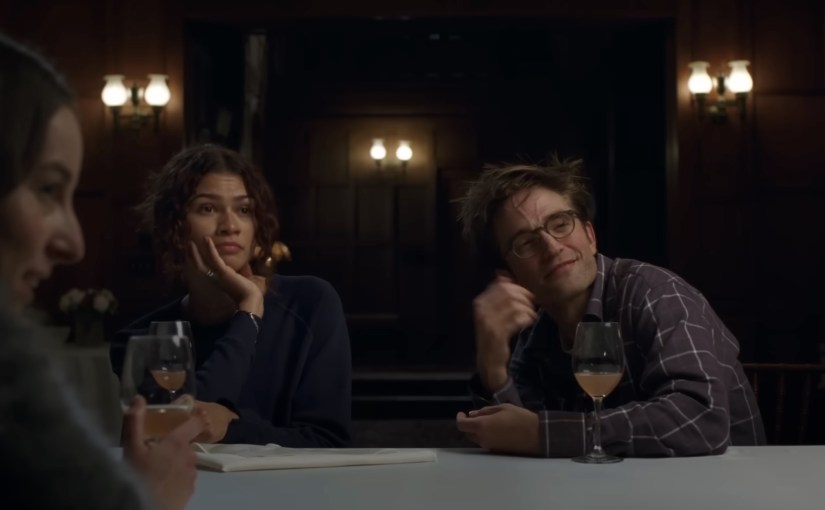
While at a wine tasting evening with the Matron of Honor and Best Man, Rachel and Mike (Alana Haim, Mamoudou Athie), a game is played where the four challenge one another to confess the worst act they have ever committed.  Emma is clearly the most reluctant to participate and thus the last one to go.  Comparatively speaking, Mike’s act is quite tame when measured against what Charlie and Rachel admit, especially Rachel.  The three laugh about it all though.  I found Charlie to be an asshole for giggling over what came of his actions.  I found Rachel to be a heartless fuck for dismissing her sick deed, as well.  These were not immature hang up crank calls.  When Emma admits to only planning her worst act but never following through, the dynamic shifts in the worst way imaginable.  

I will not spoil what she reveals.  What Emma planned when she was teenager is repulsive.  Yet, unforeseen circumstances stopped her from execution, and she explains that her life went in a completely opposite direction of nobility from that point on.  Nevertheless, Charlie cannot look past Emma’s confession, and he randomly grows startled by her while also envisioning his fiancée in unflattering scenarios inconsistent with the woman he thought he knew and loved.

Rachel is even less tolerable or accepting of Emma, and does not hide her bitterness (again) at only what was planned but never happened. Rachel’s mindset goes to a cousin who was a victim of a terrible incident that Emma has nothing to do with.  This allows one of several personal conflicts to remain at the top rather than just drift away.

The Drama runs out of road very fast.  The confessions around the table are interesting and left me curious as each person steps up to share. Afterwards though, when the evening is over, characters have sobered up, and simply because Borgli’s script contrives it to be, the anguish mires on and on and on.  

Borgli thematically uses alcohol consumption as a way to keep his characters repulsed with themselves and each other.  I guess he figures if these people are drunk they can vomit over and over with endless guilt and conflict.  If they sobered up they might start making sense, own up to their faults and move past this with no further judgement or resentment.  

Wouldn’t that be a lousy movie? 

Emma first explains and apologizes when the response does not go over favorably.  Later, she explains to Charlie how she turned her life around and did something positive with herself and the greater good.  Charlie seems to be deaf to what’s told to him.  (Ironically, it’s Emma who is deaf in one ear but remains much more attuned to what’s happening.). Moreover, he never considers relaying Emma’s explanations to Rachel, who really elevated this beyond reason.  If he had, then Borgli’s movie would have ended at the forty-five minute mark.  

With twenty minutes left in the movie, Charlie’s anguish cannot be contained. As the wedding day gets closer, he temporarily lets his guard down and loses a moment of commitment and clarity.  The math adds up to bloody and disastrous proportions at the wedding as toasts are drunkenly made by both Charlie and Rachel.  Poor Mike is delivering the cringe expressions that really belong in a bedroom farce and not in a movie called The Drama that reveals a lot of unwanted, meritless drama for the sake of earning movie ticket admission fees.

None of what you see in Kristoffer Borgli’s film is necessary.  It’s like an episode of Three’s Company.  If just one person would simply stop, think and clarify then all of this would be behind them.  Borgli doesn’t allow his characters to do the most obvious and sensible actions though.  He dumbs his characters down to persist the drama of The Drama.  

The end of the story lacks a payoff.  It’s never clear if all of the truth comes out or if any of these four characters see reason.  All that Borgli does is have Emma and Charlie reunite and try another reset method that they both attempted to do three separate times earlier in the movie.  Am I to believe that this time it’ll work because tears were shed and someone has a bloody nose?

I dunno!

Borgli seems to have painted his screenplay into a corner that he can’t escape.  So, he opts to go in a proverbial loop. If a band aid on a leaky pipe is not going to work the first time, why are you trying to put a new one on after that, and then another, and then another?  
THE ODYSSEY

By Marc S. Sanders

It seems that Christopher Nolan is left challenged by one thing – himself.  In less than thirty years this director/producer/writer has moved from the simplest of filmmaking with limited funds (FollowingMemento) to enormous heights in bonanza showmanship like The Odyssey, the first movie to be completely shot with IMAX cameras.  These devices are expensive and according to Nolan, they are also heavy and overbearingly noisy.  Yet, IMAX accommodated the filmmaker with specialized boxes to contain their equipment and muffle the sound interference.  As such, The Odyssey is a wonder to the eye.  Frankly, as impressed as I was with the film, on the most ideal IMAX screen available, I still didn’t see anything that felt any grander than the latest Dune offerings.  I mean how far are my pair of 20/15 LASIK eyes supposed to decipher?  Don’t get me wrong.  I am impressed.  However, was I as impressed as I was supposed to be? Should I be nitpicking pixels here?

IMAX says it all though.  The landscapes of open desert plains and vast open waters are brilliantly captured.  I could never tell you of any inconsistencies or shortcomings.  Costumes serve just as any sword and sandal picture that came before.  The sound, especially in an IMAX theater, is immersive and deafening as expected. Tidal waves within blinding rainstorms demonstrate this wholeheartedly.  The cast is stacked with some of the best talent available. The Odyssey has everything it demands of its legacy and what’s expected of a Christopher Nolan film.  Yet, I was never emotionally invested in the picture.  Understand that Christopher Nolan knows how to reach an audience on a primordial level of emotions. Think back to Matthew McConaughey’s tearful moment in Interstellar or how he shares scenes with young Mackenzie Foy. Look at Christian Bale’s anguish during the middle section of The Dark Knight. Hugh Jackman and Bale compete for moments of deep rage and sadness within The Prestige.

Nolan wrote his adaptation of Homer’s poetically romantic adventure.  I recall reading it in high school.  The fat, floppy, black paperback that weighed down my book bag has never been forgotten.  The highlights of the story remain in my consciousness from the Trojan Horse to Helen Of Troy (the face that launched a thousand ships), and of course the central plot of having the famed Odysseus making his long awaited journey home.  It’s all here, and then there’s more including the towering Cyclops and Circe, the witch who can turn men into pigs.  Nolan’s film goes from chapter to chapter, beat by beat.  This easily could have been a ten-episode miniseries on HBO MAX, and people would eagerly watch every Sunday night.

I favor Nolan’s choice to rely on modern dialogue, without rooted domestic accents or dialects. It’s a wise choice when delivering a poetic opus to the screen. This movie is a story. It likely would not relate to audiences on a poetic level structured in stanzas. Homer’s work does not lend to dialogue like Shakespeare or Mamet. A friend took issue with referring to Odysseus and Penelope as “mom” and “dad.” I get it. Nolan’s picture is much bigger than Harry Potter. However, the characters are bonded as family. So, it’s a pick your preference kind of situation. You either embrace or it takes you out of the story on occasion.

I’m not sure what I can say that this beast of a film says for itself.  If you’re not dazzled by simply one shred of a moment in this picture, then you are impossible to satisfy. Consider me wowed, but I was not moved.  The same way that I was never absorbed with Homer’s piece.  It was a homework assignment that spanned a long month of my junior year.  As a film lover, it’s inevitable that I see this picture. If it’s the first complete IMAX picture from beginning to end, then yeah, I’m spending the extra money to see it that way.  Am I going to watch it on repeat, on home video 4K? Probably never on a whim.  It’s a chore.

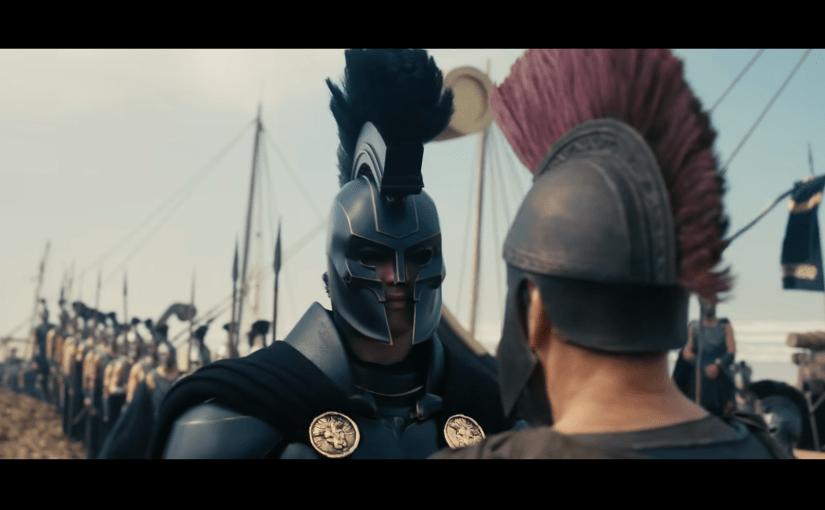
First, the picture seems to presume the viewers have prior knowledge of elements like the battle of Troy and why the war took place before we see how the famed Trojan Horse led to Odysseus’ (Matt Damon) victory with his army.  I don’t recall all that merited the action, but Nolan’s footage is astounding, especially that enormous horse on its hind legs.  On screen, the figure is as towering as the Statue of Liberty. No wonder the thing is being sold as a popcorn bucket.  

As complex as Christopher Nolan’s films can be (InterstellarInception), I always thought he was great at spelling out his unique brands of formula.  It took me a good hour or more to pencil down who everyone is playing and what purpose they serve in The Odyssey.  It boasts a big cast of celebrities who are all given their moments to shine.  I was especially taken with Samantha Morton’s Circe, introduced as a helpless woman grotesquely ready to reveal something more.  Robert Pattinson is Antoninus, a bratty and cowardly adversary ready to assume rule now that Odysseus has not returned.  He truly owns the picture when the focus turns back to him amid the rest of the cast and extras that occupy the room.

Anne Hathaway as Odysseus’ wife Penelope demonstrates nice range away from her Prada films and warm-hug kinds of pictures.  She looks quite unfamiliar while leaning into what you’d expect from Cate Blanchett.  Tom Holland drops the adolescent mischief of Spider-Man to play Telemachus, the son who takes it upon himself to uncover where his father could be after being gone for two decades.

Lupita Nyong’o may not look like she belongs in a story originated in Greek fiction, but she serves her small but significant role(s) with fierceness.  I’m not petty enough to let the appearance or history of an actor diminish my experience of seeing a sensational performance.  The same goes for Elliot Page in a crucial cameo.  As an aside, knock it off with the woke protests. Theatre is theatre and this is centered in mythology with a Cyclops of all things. If the Romans of Gladiator can speak with English accents, then in the fiction of Hollywoodland, casting has no limits.

I do not think the finished product The Odyssey is a new kind of novelty for filmmaking.  Christopher Nolan is taking advantage of the latest advancements that Peter Jackson did with his Lord Of The Rings and Hobbit trilogies.  If Nolan didn’t make this movie, Jackson would likely step up.  The swordplay and battles are as similar as most anything else that’s sent out each year.  Nolan has not reinvented the wheel in that aspect.  Likely he’s done it with how he made this picture.  That’s a blessing and a curse.  

The Odyssey is seamless, but how am I to recognize what’s done better here than what Jackson or Denis Villanelle has accomplished with their works?  I guess I had to be on set.  Matt Damon, Anne Hathaway and company testify to how astounding the experience has been.  I choose to believe them though I can’t compound what was embarked. For example, the actors enthusiastically celebrate the director’s idea to have then perform speaking to the mirror image of their scene partners. The mirror was mounted next to the IMAX lens and thus reduced time and cost for reshoots with the bulky and expensive equipment. Something like that. See, I do not see the advantage of this technique when I’m sitting in the theatre. There it is, though. Amazing! Incredible! It can be the greatest hot dog I’ve ever savored. Yet, I never went to the sausage factory.

I know my enthusiasm does not measure up to what so many others are saying.  The Odyssey is just an overwhelming picture.  The storytelling seems all too familiar, and yet not everything feels completely clear and decipherable.  Visually, it will always be stunning, even on a 55-inch flat screen. I wish Nolan offered more definition to the giant Cyclops (played by the master of mime and body manipulation, famed Ringling performer Bill Irwin who was TARS in Interstellar).  The movie will easily sweep all the technical awards while only earning acting nominations for Morton and maybe Hathaway.  Matt Damon earns recognition for exerting himself like never before in muscle mass. He’s only improved what he’s physically done in the Bourne films, for example.

This is a major hurdle that Christopher Nolan has elevated to, and a new bar has been set at a taller height.  Still, this picture never stayed with me like his Dark Knight trilogy that covered everything from sensational action to questions of morality. His brainy science fiction challenged protagonists to extend themselves towards sheer impossibilities of comprehension like InceptionInterstellar, or The Prestige.  Even a biographical story like Oppenheimer left me more emotionally consumed than The Odyssey, because the title character served as a puppeteered villain to everyone else, including himself internally.  Odysseus leans on Athena for solace, played by Zendaya, serving as an imaginary friend to the hero. He’s marooned with Calypso (Charlize Theron) serving as a sounding board while Odysseus struggles to recollect the memories of his adventures. All the parts are here like a grocery shopping list, but the connections just don’t feel as warm as they were in Nolan’s other pieces.

That’s okay though.  We all have our favorite flavors of ice cream. Just like we all have our favorite efforts of Christopher Nolan.

What’s this guy gonna do next? I cannot wait to find out because it’s never simplistic and always challenging with a sense of thrill and knowledge.

THE LIGHTHOUSE (2019)

by Miguel E. Rodriguez

Director: Robert Eggers
Cast: Robert Pattinson, Willem Dafoe
My Rating: 8/10
Rotten Tomatometer: 90% Certified Fresh

PLOT: Two lighthouse keepers try to maintain their sanity while isolated on a remote New England island in the 1890s.


tone poem
NOUN, a piece of orchestral music typically in one movement, on a descriptive or rhapsodic theme


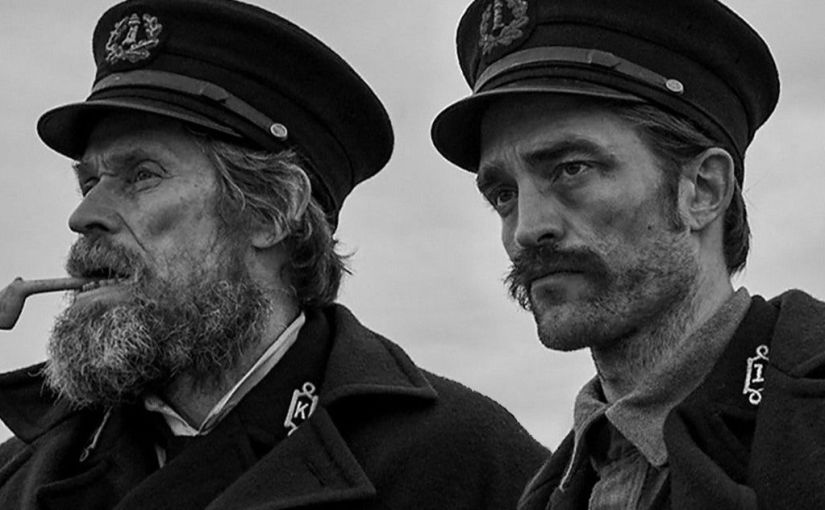
As I watched Robert Eggers’ The Lighthouse, that term “tone poem” kept leaping to my mind.  It’s not told in a standard or familiar fashion.  There are scenes where we’re not sure, until they’re over, whether they’re real or not.  The Willem Dafoe character, Thomas Wake, makes references to behavior in the past by the Robert Pattinson character, Ephraim Winslow, that Winslow never committed…or did he?  We are certain that Wake is the character who is going mad, if he’s not there already.  But what if it’s the other way around?  Or are they both going mad?

The mood or tone of the piece seems to be insanity and how one might get there given the right circumstances.  In many ways, it has quite a bit in common with another sensational tone poem of madness, Stanley Kubrick’s The Shining (1980).

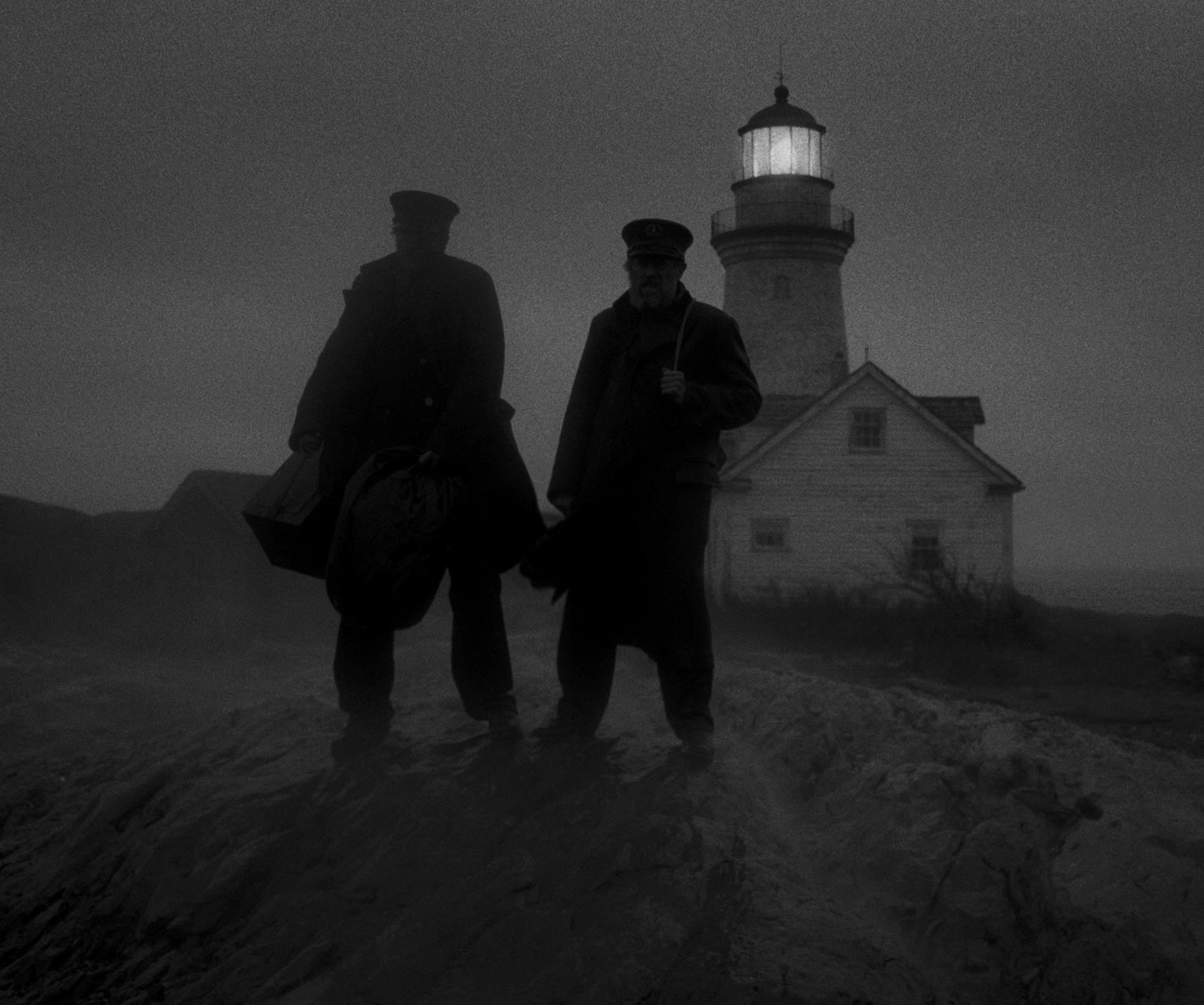
Two men, Wake and Winslow, are lighthouse keepers in the late 19th century.  They are brought to a remote island in the stormy waters off the New England coast and left to fend for themselves for four weeks until the next tender brings supplies.  Wake (Dafoe) is a crusty old veteran lighthouse keeper whose speech and mannerisms appear to be based on Long John Silver, right down to the gimpy leg.  Winslow (Pattinson) is a much younger and, let us be honest, handsomer gentleman who keeps to himself whenever possible.  He tends to his duties, sometimes grudgingly but mostly not, but wonders why Wake flatly refuses to share the duty of tending the actual light source at the top of the lighthouse.  That mystery lies at the heart of the film, but don’t expect all your questions to be answered by the time the credits roll.  Fair warning.

A key decision by director Eggers was to shoot in black-and-white and in a very old screen format, 1:19, so the picture area is a virtually square space in the center of the screen, with black bars on either side.  (The Coen brothers did something similar with their brilliant adaptation of The Tragedy of Macbeth [2021].)  This visual language creates a uniquely claustrophobic atmosphere, especially in scenes taking place in Wake’s and Winslow’s quarters.  The walls are closer together, the ceiling feels lower, and the actors’ faces seem much closer to the screen than normal.  Even exterior shots seem more constricted and confining.  Wide open sky doesn’t look as inviting as it might to someone essentially imprisoned on a storm-lashed island for four weeks.


Like all the best films, The Lighthouse begins its descent into madness slowly and gains momentum as time passes.  Winslow discovers a mermaid figurine stashed inside his mattress.  That night he dreams about a mermaid in the surf.  Or was it a dream?  We glimpse Wake standing naked at the top of the lighthouse, almost as if he’s worshiping the light itself.  When Winslow tries to get a closer look at what Wake is doing up there, he glimpses something…supernatural.  Or does he?  The film is brilliant at not only portraying mounting madness on the screen, but also at conveying the tone of madness in the cinematography and editing.  If we’re not quite sure what is happening, even when we see it happening, that’s on purpose.  The audience is meant to be kept off balance throughout the movie to put us in the heads of the two main characters.

Another factor that I found riveting was the acting workshop on display from both Pattinson and Dafoe.  We’ve seen this kind of thing from Dafoe before.  He chews the scenery with Nicolas Cage-like gusto, spittle flying, prosthetic teeth flashing in manic sneers, and that crazy piratical accent.  If it had been revealed during the film that his character’s last name was Osborne, and that he was a distant relative of Norman Osborne from Spider-Man (2002), I would not have been the least surprised.

But equally impressive is Robert Pattinson’s performance, which must be seen to be believed.  Here is an actor who is set for life after being a part of two of the most profitable film franchises in history (Twilight and Harry Potter) and who has just rebooted a third (The Batman [2022]).  But in this film, he easily keeps pace with Dafoe’s quirkiness, which is not easy.  As his character descends into madness (or does he?), Pattinson dances a jig while singing a sea shanty that devolves into complete gibberish.  He laughs like a loon.  He, ah, takes some time for himself while fondling that mermaid figurine from earlier.  It’s the kind of performance that might be described as “courageous.”  He swings for the fences with abandon.  In so doing, he helps to make The Lighthouse one of the most unique movies I’m ever likely to see.

But what is really going on at the top of that lighthouse?  Why do seagulls pester Winslow so often, seemingly unafraid of him in any way?  Why does he continue to dream about mermaids?  IS he dreaming them?  Is Wake actually a merman?  Did real foghorns sound like that?  Why is one seagull missing an eye?

Well, come on, I’m not actually going to ANSWER those questions, but those are questions that occurred to me.  The movie does answer quite a few of them, but not all.  The point of the movie, like The Shining, isn’t about solving the mystery.  It’s about conveying the mystery, creating a mood of dread, and wallowing in it for a good 110 minutes.  It’s not the happiest movie I’ve ever seen, but it’s definitely one of the most original films of the last ten years or so.

THE BATMAN (2022)

By Marc S. Sanders

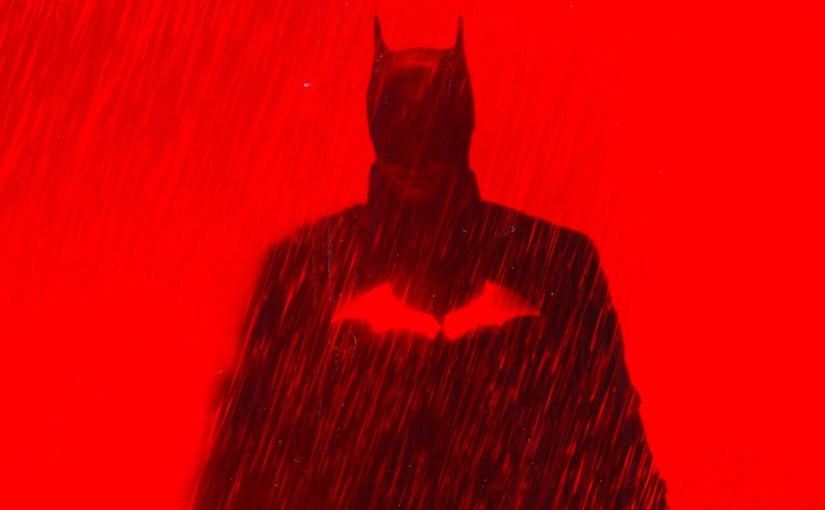
Another year at the movies, means another trip to see Batman on the big screen.  I think we are close to a dozen iterations, no?  Fortunately, the latest reinvention for March 2022, The Batman, is a refreshing interpretation that focuses on the detective skills of the masked vigilante hero who prowls from the rooftops of Gotham City.  Matt Reeves has written and directed a gripping and engaging film that doesn’t rely on simple paint by numbers.  He’s capitalized on using the mysterious Riddler (Paul Dano) as the main villain here, and Batman’s (Robert Pattinson) brains get more exercise than his brawn.   

It is the second year since Batman has introduced himself to the crime ridden city.  The man behind the mask, Bruce Wayne, keeps a journal of his exploits and observations, and through voiceover he questions if his actions have benefitted since it appears that crime has only increased since his first appearance.  A serial killer is taking responsibility for the grisly deaths of important people within the city and he’s leaving greeting cards for “The Batman” with a common scribble of “No More Lies,” along with a “?,” and a riddle for The Batman to solve.  Thanks to a strong partnership with Police Lt. Jim Gordon (Jeffrey Wright), Batman is given easy access to the crime scenes so he can attempt to reveal the mysterious villain and determine exactly what his endgame is. The Riddler doesn’t make it easy, though.

Mobsters like the Penguin (Colin Farrell) and Carmine Falcone (John Turturro) have a grip on the city, as well.  There’s also a possible lead from a woman (Zoe Kravitz) who’s managed to infiltrate the gangsters’ underground headquarters.  She also has the fighting skills and agility that’s comparable to the caped crusader, and maybe she’s a cat burglar as well.  Still, is she pertinent to Batman’s investigation or not?

It’s better not to spoil anything that occurs in Reeves’ film.  The mysteries that are uncovered are part of the fun, and it does take some time and exposition to get there, but I found it worth it.  Barring a few ingredients within the film that I recognized from the Christopher Nolan and Tim Burton films, the picture is worth seeing for a new formula on a character, that although is a favorite of mine, I feel has also been done to death on the big and small screens.  This is a Batman film where I appreciate the thinking approach of its craft, over the action.  When Batman is playing detective with Jim Gordon, it is much more enticing than just another Batmobile chase or another ham-handed fist fight.  This film is a test of Batman’s mental capacity and ability for analysis.

Reeves direction is also appreciated, though I’m expecting the naysayers.  The Batman is a very dark motion picture.  When it’s not dark, the photography is dim and blurred.  There’s lots of rain and dimly lit streets and garages.  There are strobe lit nightclubs.  Windows are blurred, so sometimes you can’t make out the image in front of you.  He makes the viewer work for the focus and that kept me alert.  I believe Matt Reeves was attempting to give the viewer the literal point of view of the characters.  It will not be a surprise, however, to find some movie watchers lose patience with the technique. 

The Riddler especially is most mysterious with a twisted and inspired Zodiac killer approach.  Often, Matt Reeves’ film feels especially reminiscent of David Fincher’s Seven.  I would not be surprised if Reeves wrote his script as a cop/detective story, and then added the Batman flavor to make his final draft.  This is not a picture of grand special effects or superpowers and gadgets. 

It’s definitely not the Batman film that everyone wants.  I foresee the response being very divisive.  Nonetheless, if you’re a Batman devotee like me who grew up on the character in the macabre storied comics (as well as the hammy tongue in cheek material), you’re going to be thankful for this “at last” interpretation.  I’ll definitely be seeing it again.

NOTE: The Batman is not a film for children under age 13. I truly believe that. There are disturbing images and threats within the story, and the violence depicted or left to the imagination is not for celebratory effect and amusement. This is definitely a film for mature audiences. Do not presume it’s meant for all ages based on its misleading marketing approach with companies like Legos and Little Caesars pizza.

TENET

By Marc S. Sanders

Christopher Nolan is certainly the most imaginative director working today. Films like Inception and Interstellar welcome new kinds of science fiction dissimilar from most any other films. He is an incredibly inventive filmmaker. He’s so inventive, in fact, that I think he might have carried himself too far with his much anticipated sci fi spy thriller Tenet, featuring John David Washington and Robert Pattinson along with Kenneth Branagh in a James Bond villain role. Actually, there’s a lot of Bond inspirations here. Not surprising, as Nolan is a devoted fan with much admiration for The Spy Who Loved Me, in particular.

It’s hard to describe Tenet because it’s hard to fully comprehend Tenet. I don’t even have to worry so much about revealing spoilers because I likely wouldn’t know what I’m unveiling.

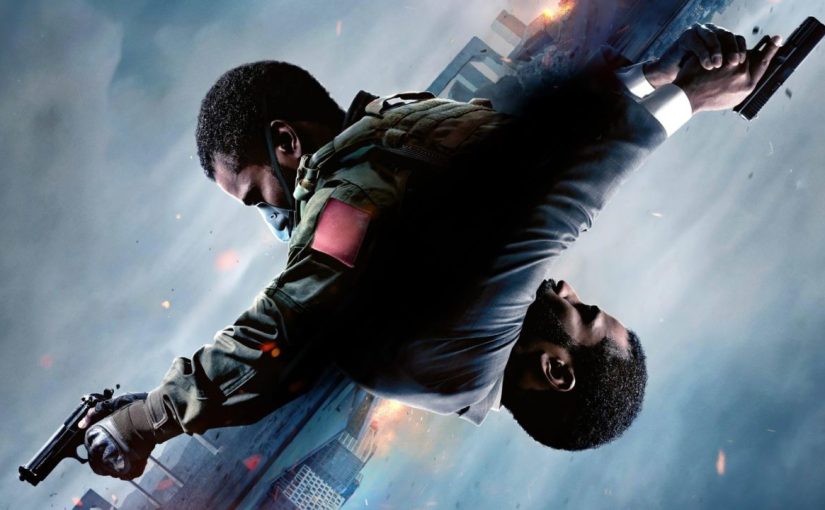
Washington is a good leading actor. This film along with BlackKklansman prove that. He plays The Protagonist (no name revealed) who is extracted from a hostage mission that opens the film at an opera house. Apparently the CIA liked how he handled himself in the field and now they want to assign him to the concept known as Tenet where time moves inversely with itself.

Try and stay with me here. If you fire a bullet out of a gun, the bullet can also be pulled back into the pistol if you are moving through time on a backwards trajectory. Sounds very Nolan, right? Sounds very cool as well and when the science of this is simplified early on it looks cool too. However, as the film moves on and objects and time traveling get more complicated Christopher Nolan seems to lose his way.

There’s a bomb out there made of technology that is unfamiliar yet. Why? Because that tech was perhaps invented in the future and brought backwards through time inversely to be detonated and literally destroy the world. The Protagonist has to prevent this from happening and so he’s partnered up with Neil (Pattinson) who is a handler with more knowledge about this mission and Washington’s character than he should know.

Tenet has some spectacular edits and footage of dazzling camerawork. It’s a contender for an amazing car/truck chase. Washington and Pattinson are good together. Branagh is fine as a vicious wealthy industrialist with a penchant for abusing his beautiful wife (Elizabeth Dibecki). CGI thankfully seems very limited as well. All of the gorgeous locales and vehicles are here. Warner Bros holds so much faith in Nolan’s works that his budget seems to not exist. There’s boats, yachts, helicopters, trucks, a fire engine and a BMW. There’s also a real life jumbo jet crash. It’s a gorgeous looking film and every dollar seems well spent. However, it’s not a well assembled film.

This is the first time I would NOT recommend seeing a movie in a Dolby theatre. The sound is obnoxiously loud. The musical score from Ludwig Göransson is POUNDING bass; so loud that I couldn’t even decipher any semblance of a tune. Much of the sound edits seem that way as well. It’s a headache to sit through this film. A terrible soundtrack and sound edit for sure. To watch Tenet on a technical level is to park your automobile next to that rebuilt Oldsmobile with the new gold rims and the maxed out speakers that shake your car while you’re at a red light. It’s terribly distracting and overly annoying.

Nolan also does not demonstrate his science very well here either. It’s hard to understand when someone is traveling normally through time versus inversely. Somehow it just occurs at times and you lose your way as to when it began. If you consider Inception, Nolan explains the tactical strategies of approaching someone’s mind by means of dreams and in sleep mode. Everything was spelled out nicely. You want to learn more and see more of the tricks. Tenet doesn’t leave you with that curiosity.

I didn’t hate Tenet. My wife did, however. There are close ups of arbitrary things early on that circle back later. So it kept me engaged when I uncovered some significance here and there. Still, it’s not enough.

Nolan conceived another brilliant and brainy idea. I only wish his delivery and the construction work of his crew, especially his sound and music staff, were more up to par.