
By Marc S. Sanders
Olivia Wilde takes a Virginia Woolf approach with her latest film to direct, co-written by Rashida Jones. It’s called The Invite and she may have directed her own leading performance into an Oscar nomination for Best Actress.
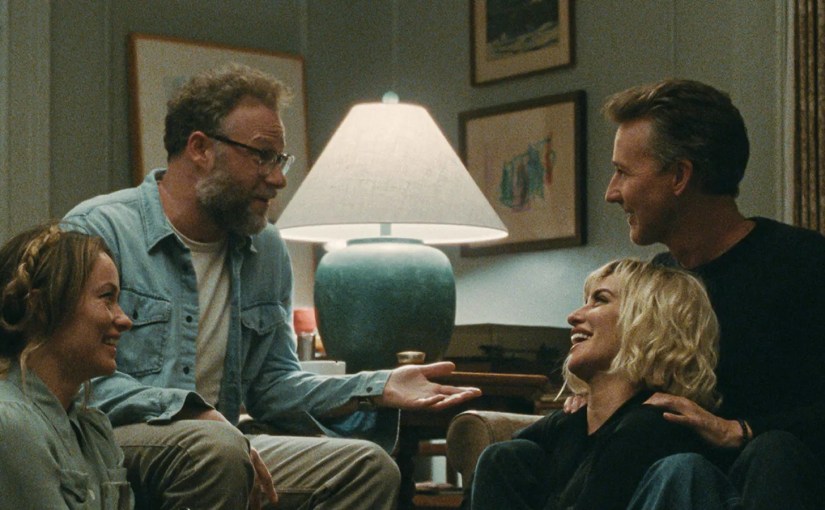
Angela is married to Joe (Wilde with Seth Rogen). He’s a music professor, who clearly feels like he’s past his prime and his talent for music is being wasted on regular school days. Those who can’t be professional musicians, teach! She is a stay-at-home wife. Their marriage is no longer in heaven, even when their twelve-year-old daughter is at a sleepover. They haven’t had sex in over year. Yet, the evening does serve as an opportunity to invite the neighbors over for dinner. Too bad they arrive while the hosts are in mid-argument over who was supposed to get the wine and whatever else has been stewing on their brains for far too long. Dinner is another thing because dietary restrictions get in the way.
Piña and Hawk (Penelope Cruz and Edward Norton, and yes, you read his character’s name correctly) are the opposite of the stressed, overridden Angela and Joe. Through the dark lighting of most of the film, the complexions of Piña and Hawk practically glow. Norton and Cruz look like they swam in the fountain of youth.
It doesn’t take long to learn that Hawk and Piña are sexually active, a lot, and they relish and ravage each other’s company. Perhaps, they enjoy others’ company as well.
It’s best not to reveal too much about what develops during this awkward and unexpected evening. However, it is worth saluting the genuine dialogue of aggravations expressed by a tired married couple who have lost a purpose to remain with each other, while their unmarried upstairs neighbors have every reason to stay together. It also does not help that Joe is over the constant racket that comes from the happy couple’s apartment due to their constant sexual escapades.
The main attraction of The Invite is Olivia Wilde’s inventive direction. Within a claustrophobic New York City apartment, she places her camera in unusual positions to observe the chatter among the four actors. Close ups hardly ever happen. Instead, Wilde will point her camera at a mirror to catch the reflection of Rogen yelling at Wilde who is out of frame on the other side of the room. Joe’s study is cut off by an interior window-paned door. So, Wilde puts the camera on the outside of the window to peak in on Joe and/or who he brings into the room with him. Olivia Wilde’s camera is the fifth wheel as the viewer is given the opportunity to be a fly on the wall, snooping in on this obstinate evening. We might find ourselves standing at the end of the hall, yards away from where the action is happening, or we are looking through a window across to the other side of the apartment where there is another window to see what our spouse is doing with one of the guests. Everything Olivia Wilde does with shooting this film is accompanied with intended, strategic measure. We’ve always wondered what goes on behind closed doors, and now we have the chance to observe, without getting in the way.
The four actors show their training. Seth Rogen might be doing his regular schtick. However, he has not grown old on me yet and at least you witness genuine pain in this hopeless soul. A sort of slapstick moment occurs for the schlub, but it does not upstage other moments for him.
Edward Norton, and especially Penelope Cruz are very good at restraining themselves. You can feel their pulses are not racing like the other couple’s, who are treading a mile a minute. The screenplay allows Cruz’ character to present her knowledge and experience, and she never looks like she’s trying very hard. It’s not easy to portray complete relaxation and bliss. I was entirely convinced that the neighbors exhaust their energies in the sexual bouts they happily boast about, while the other pair are overtired in fits of rage and aggravation.
Olivia Wilde is the standout though. Her frustrations by sitting adjacent to her character’s husband and his unbearable presence demand enormous concentration. You have to be impressed with how this director sets up a shot or a scene, and then has to take the time to get into character when off camera she’s spinning a lot of plates. In front of the camera, the lines on Wilde’s face say so much about Angela’s background and the long life she’s already led even if she’s not that old. An outstanding and focused performance.
In someone else’s hands, at present or in a past decade, The Invite could have operated like an ordinary get together, where the acting is the main attraction. The performances are very good on level with the biting, cutting dynamics of Mike Nichol’s Who’s Afraid Of Virginia Woolf? and likely better than what John Hughes’ The Breakfast Club ever offered. Again, though, it’s clear that Wilde is looking to stand apart from those films that arguably will outlast the test of time that her film will not. Like me, I imagine the overall populace will not rewatch The Invite. Nor do I anticipate a Criterion edition or an AFI ranking in its future.
The concept of The Invite is nothing new or special. Neither is what is revealed during this lone evening. At the very least, it’s the director’s technique that upholds this picture, along with four very capable actors delivering its wise, yet wordy, script.

