YOU CAN SEE EVERYTHING

By Marc S. Sanders

You watch a miniseries and you think you know someone.  Then you watch a documentary, and well…maybe not.

Comic Nathan Fielder covers the remaining 34 days before disgraced fraudster CEO Elizabeth Holmes was to begin her sentence in prison.  A whopping eight-billion-dollar corporation called Theranos crumbled like a house of cards when her novel blood testing machine was revealed to be nothing but scraps for parts.  Holmes and her COO, domestic partner Sunny Balwani, were tried for their white-collar crimes (in her case, infamous black turtlenecks), leaving remains of endless intrigue and astonishment.  Fielder’s documentary, You Can See Everything, is edited with compelling music and intense close-ups as he catches up with how Holmes is coping and where her mindset is at the moment.  I think he discovers things are much more disturbing and incredibly surprising. As well, the filmmaker may need to reexamine his own beliefs.

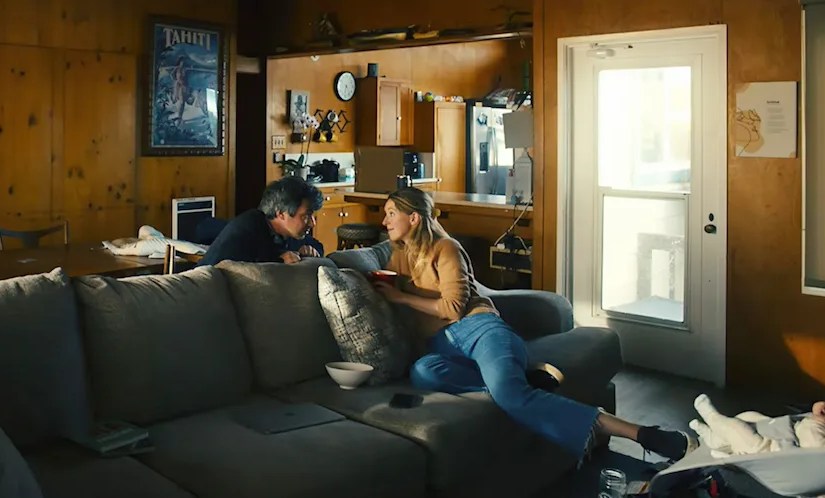
The first ninety minutes of this three-hour opus take place in a San Diego beach house rental occupied by Elizabeth and her husband, Billy Evans, along with their two young children.  Nathan’s crew gets all-access shots to their activities.  At one point, they capture Billy fully nude while showering.  Why?  It’s a testament to the fact that Billy and Elizabeth welcome everything to be seen.

Nathan gets right to the point with Elizabeth, asking if she has any regrets, accepts guilt, etc. With an eleven-year stretch ahead of her, she fails to recognize any crime or deceit she’s committed.  Billy propagandizes her belief by excusing how Elizabeth mentally processes situations in a special kind of way, incomparable to anyone else. Nathan works tirelessly to simplify his questions so minutely to at least get either of them to veer off in another direction. Still, the two stay entirely on track.  Asking Elizabeth if she’s ever told a lie does not just stop with her responding with all but certain “No.”  Nathan has to rephrase his question again and again and again.  Apparently, until Elizabeth Holmes, it did not seem remotely possible that any human being ever avoided telling a lie in any kind of variance.  Not even a harmless white lie.  Elizabeth unequivocally believes she’s never, ever told a lie.

Nathan goes so far as to test Elizabeth’s comprehension of Abbott & Costello’s Who’s On First routine.  She thinks it’s funny, but can not specifically explain why it’s funny or the “miscommunication” the pair were having.  So, Nathan has to simplify the joke to practically every syllable and letter of each word uttered in the bit. The idea does not penetrate.

This woman is a miracle of some sort.

Then again, from what I know outside of this feature film, Elizabeth Holmes managed to put Presidents of the United States and Secretaries of State under her spell. How does she not comprehend the purpose of a comedy routine, but somehow sways billion dollar investors and people of absolute power into her snake oil schemes?

Eventually, it appears that Billy may be a puppet master over Elizabeth, especially when a development that led to the making of this film is revealed.  Nathan Fielder’s picture takes on a whole new and unexpected direction, and the subject of his piece is not so much on just Elizabeth but also on Billy, who stems from a wealthy family with a watchful interest of control in how Nathan steers his narrative while he oversees Elizabeth’s mentality. Her behavior is under his influence as well. Elizabeth does not scramble eggs like she’s supposed to, and supposedly can not concentrate on an interview while doing so.

Billy seems to have an unhealthy interest in his partner. Questionable use of A.I. comes into play ahead of Elizabeth’s departure.  Billy has motives for its use while Elizabeth allows herself to be subservient to his purposes.

Maybe her parents were wise to this scenario.  Nathan’s crew seem to get their perspective with little dialogue from them to offer.  Dad is interrupted (or censored) by Billy.  I don’t think mom ever says one word in the whole picture.  The title, You Can See Everything, carries multiple meanings when you simply read mom and dad’s surrendered expressions.

Perhaps You Can See Everything actually means you can see nothing.

At best, Billy’s on board with resuming a pursuit of Theranos’ original novelty of blood testing machines.  Right now, there’s no evidence in science or engineering to uphold the machine’s capabilities, but the mission stays true.  Billy believes in Elizabeth’s original conception.  Together, they push aside the skeptics and, to Nathan’s amazement, look for new opportunities for Theranos’ resurrection.

Two years after Elizabeth has begun her sentence, Nathan recruits an outsider who arguably may know Elizabeth best, actress Amanda Seyfried, who earned an Emmy for portraying Holmes in the Hulu series, The Dropout. It’s a bold choice. Yet, I wonder why Nathan stopped there. How about the script writers and directors or producers as well? Seyfried might execute the portrayal, but she didn’t craft the words of the dramatization and Nathan reminds her that she acted in a dramatized TV show regardless of her talents.

You Can See Everything is a documentary from beginning to end.  However, Nathan and his crew take an unusual approach to capture the second half of the film.  With limited access because Elizabeth is in prison and more so because Billy tightens his leash over the situation, Nathan must rely on Seyfried to demonstrate where his two subjects stand.  Without giving away all the tricks, Nathan Fielder and Amanda Seyfried make for a compelling pair of investigators.  At times, they are bold enough to challenge each other while they are supposed to be working together. What obligation does Seyfried have to any of this? Is Nathan being objective enough with his subject? An ocean swim near the end of the picture reasonably demands this kind of question.

I saw this film with my wife.  Having previously watched an HBO documentary, plus The Dropout, plus a 60 Minutes story and reading tons of social media, my preconceived notions about Holmes were firmly in place. On the other hand, my wife was primarily unaware of Theranos, Elizabeth Holmes, and the entire story. After Fielder’s film concluded, we had completely opposite perceptions of Elizabeth Holmes, and story that occurred.

That’s the beauty of You Can See Everything, and why it is one of the best pictures of the year. The finished product results in varied perceptions. For someone who insists in her own hynotic way that she has never told a lie, one has to wonder what this woman is built on. Is she a clinical eccentric, or is she a master manipulator who never vacations from a crafted persona?

Perhaps Nathan Fielder dug his hole deeper than he ever wanted, because I believe he’s surprised with what turns up.  Is Elizabeth Holmes a deceitful criminal, always aware of the costly lies and fraud she’s been evidentally proven guilty of?  Is she continuing to maintain a facade of naivety, denying awareness of the harm which stemmed from her actions?  Was she deliberately committing crimes for her personal gain with service to her id and ego?

On the contrary, was she at the behest of her former partner Sunny Bulwali, and just an accomplice, scapegoat, and pawn? Is she currently a brainwashed subject under a new operative, Billy Evans?

Nathan Fielder gets so meticulous with all of the footage he acquires.  The connotations of operative words like “did,” “we” or “I am,” are questioned as a means to uncover the what and why of intent.  Amanda Seyfried is even tested based on her comments regarding Charlie Kirk, a subject completely separate from any of this but still an exploration of character and merit. Amanda quizzes Nathan about his ongoing motive.  Where does Nathan’s eventual interests truly lie? My compliment to Nathan Fielder for allowing his own intentions to be scrutinized.

You Can See Everything could have persisted for another three hours. Because this couple is so unusual and so abnormal and twisted, while living in the aftermath of one of the greatest criminal scandals in modern history, my interest would likely still be upheld.

This fully realized documentary does not surrender its moral compass to reveal truths, because…well…they will never be definitive or devoid of doubt.  That might not satisfy our curiosity.  Nevertheless, Nathan Fielder and his co/director, Lance Oppenheim, earn the A’s in exhaustive efforts. The risk Fielder took though was compromising his objective intentions as he got closer to Elizabeth.

The greatest compliment I can lend to You Can See Everything is to say it is a superb, compelling journey into a never-reaching, unsatisfying abyss.
CLAYFACE

By Marc S. Sanders

The comic book origin story has become a tired trope in movies.  The hero experiences a traumatic event and gains either an epiphany or enhanced abilities that deem him/her for especially unique purposes.  Then they face off against their antagonist and sum up their encounter with the love interest or by reciting a voiceover journal to the viewer.  Roll credits with a promise that “Widget Man Will Return.”  Sound familiar, right?

That’s all well and good but I’m not yet exhausted over a villain origin story like Wicked promised for example.  (I’ve had mixed feelings about Joaquin Phoenix’ Joker movies.) Clayface is a b-villain character spawned out of the crime ridden Gotham City to face off against Batman.  I’ve been hearing that it was modern horror wunderkind Mike Flanagan (Doctor Sleep, the 2026 Carrie series) who approached DC production captain James Gunn with conceptualizing a film for the shape shifting mud monster.  Who would have guessed that the adaptation would be an absolute thrill of grotesque body horror with a sentimental affinity for the main character, “Coast City” movie star Matt Hagen, played by Tom Rhys Harries?

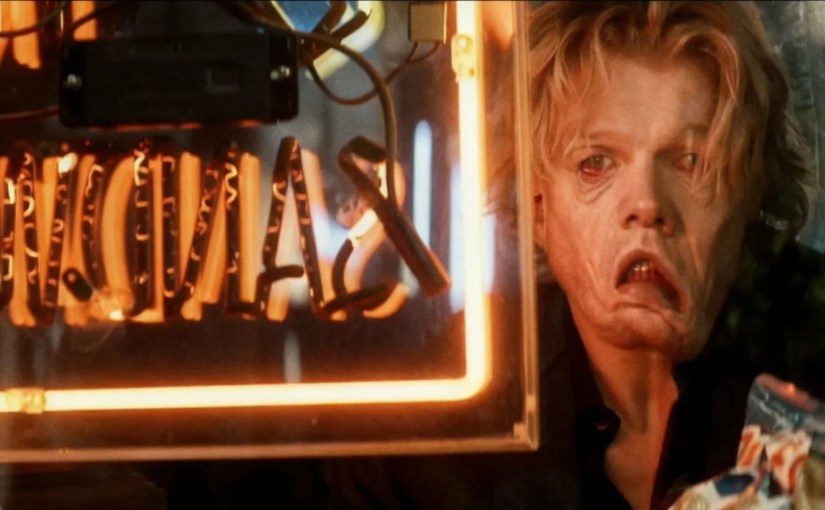
This actor plays a famous actor who sleeps with the wrong woman, only to have his vanity brought down to negative one thousand when her gangster boyfriend (David Dencik) permanently disfigures his face with an assortment of sharp edges.  Matt’s world is essentially destroyed.  His high-powered agent abandons him. He loses out on winning an Oscar.  His wealth is embezzled and he endures one personal betrayal after another.  He discovers that Dr. Caitlyn Corr (Naomi Ackie) has been experimenting with chemicals that one day might intelligently alter human cellular structure.  After much convincing, she agrees to use Matt as a test subject.  When full restoration arrives, Matt is on his way to rejuvenating his fame and fortune, but he and Caitlyn do not account for the jaw slouching, eye drooping and crusty side effects or for the surprising ability to personify other people.  All of this will emerge as a blessing or a curse.

Clayface works because director James Watkins has a lot of fun with infinite inventions that come with sculpting this guy, Matt, and the seedy world of misanthropes he inhabits.  The body count rapidly increases as the very entertaining and wince inducing exposition of this Frankenstein story carries on.  I imagine a lot of the actors had fun being killed on screen in truly inventive ways only to see their name on the next day’s call sheet to come back because now Matt Hagen has assumed their appearance as a means to undo the next traitor in his path.

The skills of this Clayface are awesome.  They are reminiscent of what the liquid Terminator could do, and it’s only right this story of a movie star-pretty boy salutes a lot of Hollywood favorites including The Thing, The Shining, and The Godfather Part II while drawing inspiration from the crafts of David Cronenberg, (The Fly, Dead Ringers).

Yes, the origin story might have been done to death by now, but if creators allow their imaginations to soar, especially with such a flexible character, the possibilities are endless for what can be accomplished.

The cast of unknowns are equally as surprising as the collective unfamiliar faces discovered in the other horror hit from this year, Obsession. Tom Rhys Harries is ready to do anything.  He plays suffering very well and the movie does not over-mire itself in misery. As the monster persona evolves, Harries goes in unexpected directions with his character, including a favorite kitch of mine.  He breaks out in a group dance sequence that is never expected of this non-musical screenplay.  His forbidden love story with Ackie’s smartly sensible character offers a lot of effective conflict to keep the picture engaging.  Their will they/won’t they angle lends something else to the film because simply a warpath of revenge and casualties can get stale. Max Minghella (The Social Network) plays Ackie’s fiancée and the persistent cop who follows the clues.

Clayface is the absolute best installment in James Gunn’s DC Cinematic Universe.  It provides amazing effects with a challenging story and a well-drawn Gotham City ridden with crime and interesting ugliness.  Director James Watkins deserves a lot of credit because he did not need to rely on the famed Dark Knight or a go to commissioner or a giggling, mischievous, brightly colored lunatic.  This picture is a perfectly crafted introduction to an overused environment that has not looked so refreshing in years.

Clayface may open interest for those seeking to learn more about this very capable and powerful villain. DC comics actually has two different documented origins to the guy of glop, but the loss of vanity and pride are what’s really fascinating about this Batman baddie.

I deliver the highest of compliments because this monster mash Jekyll & Hyde left me eager for more.

CÉLINE AND JULIE GO BOATING (France, 1974)

by Miguel E. Rodriguez

DIRECTOR: Jacques Rivette
CAST: Juliet Berto, Dominique Labourier, Bulle Ogier, Barbet Schroeder
MY RATING: 3/10
ROTTEN TOMATOMETER: 80% Certified Fresh

PLOT: Two flighty women have a meet cute and engage in mild hijinks before stumbling into a mystery house where a story endlessly repeats itself.


Jacques Rivette’s celebrated Céline and Julie Go Boating [subtitle: “Phantom Ladies Over Paris”] is the kind of foreign film that made me swear off foreign films for several years when I was a younger man.  Maddeningly elliptical, rambling, and boring, which is especially disappointing because there is an intriguing time-bending subplot that dominates the second half (or more) of the film.  If the entire movie had focused on that one thread and told it more coherently, I would have been satisfied.  Instead, I spent over three hours yelling over and over again at the screen: “Who cares?”

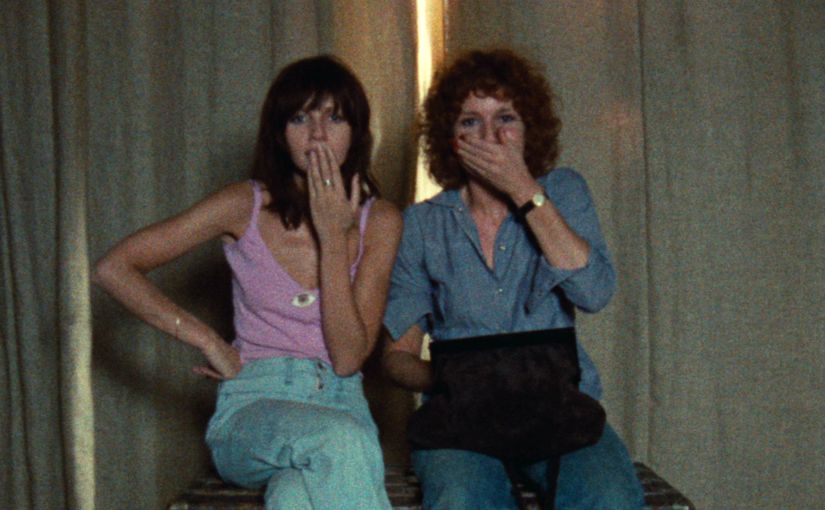
The movie opens with Julie, a bright, Phoebe-Bouffe-esque redhead reading a book about magic on a park bench.  Suddenly, Céline strides by, an elvish brunette in a tank top and a green boa.  She drops something (I can no longer remember what it was) and keeps walking.  Julie picks it up and runs after Céline, trying to return it, but Céline is oblivious, or faking it for some reason.  (Before they even leave the park, the film asserts its God-given right to be weird by adding insert shots of a cat stalking a pigeon in the park.  Are we to infer something about this in relation to these two women?  Hell if I know.)

Eventually, Julie catches up to Céline, invites her to stay at her place, and…and…and from there it becomes an endless series of scenes intended to be quirky and, I guess, feminist in some way, but there was no story to any of it.  Céline takes a shower and spins a tall tale of a safari in Africa, while Julie impulsively rummages through Céline’s backpack and arranges the items she finds around the room.  Céline visits Julie at the library where Julie works (I think?) and starts slamming large children’s books together over and over again.  Why?  Hell if I know.

There is a long detour so we can watch Céline at work as a magician at a sparsely attended nightclub.  Best thing I can say about her act is that she rocks her costume and she’s a reasonably skilled illusionist, but it drags on foreverrrrrr.  One trick after another after another, and I’m watching it going, “Who cares???” Admittedly, there is a sorta-kinda payoff to this scene later when Julie impersonates Céline at the same nightclub, but that scene drags on forever, too, plus her motives are impenetrable.  UNLESS it’s to get Céline back for impersonating HER to meet Julie’s old boyfriend, in yet another scene of obscure motivations.

The intriguing Twilight-Zone-y subplot does play with time in an interesting way, showing us snippets of scenes playing out in an empty house, then replaying them with additional information each time so each successive iteration is more revealing than the last.  But like so much of the rest of the film, it takes foreverrrrr to get off the ground.

It’s not that I didn’t like Céline or Julie.  I had no problems with them in terms of likability.  It’s just that the movie was not structured in a way that made me care about what happened to them or why.  Godard’s Weekend (1967) has a similar storytelling approach, with wild edits and non-sequitur moments, so why did I respond so much more positively to that movie than to this one?  I don’t know.  As I sit here trying to remember plot points as I write this review, I am running out of ways to describe how apathetic I was to the characters, even when they latch on to an actual story with the “haunted” house.  It just didn’t make me care.  Period.  And this went on for three hours…

If I simply didn’t understand the movie, so be it.  There’s a lengthy essay on the film included with the Blu-ray, so maybe I’ll give that a read and maybe try to find what I missed.  There’s an argument to be made against a movie that requires remedial reading, but then we start getting into 2001: A Space Odyssey (1968) territory, and I don’t feel like typing much anymore.

Gene Siskel had a tongue-in-cheek litmus test: “Is this movie better than a documentary of the same actors having lunch?”  Céline and Julie Go Boating incriminates itself by including a five- or ten-minute scene of Céline having lunch with some of her friends in which all of the dialogue was improvised, and that scene is one of the better scenes in the movie.  Talk about having your cake and eating it, too.

THE INVITE

By Marc S. Sanders

Olivia Wilde takes a Virginia Woolf approach with her latest film to direct, co-written by Rashida Jones.  It’s called The Invite and she may have directed her own leading performance into an Oscar nomination for Best Actress.

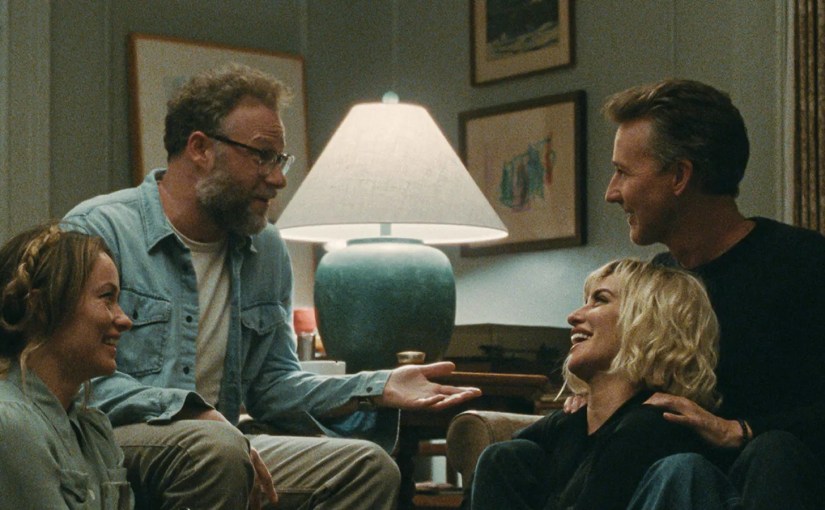
Angela is married to Joe (Wilde with Seth Rogen).  He’s a music professor, who clearly feels like he’s past his prime and his talent for music is being wasted on regular school days. Those who can’t be professional musicians, teach! She is a stay-at-home wife. Their marriage is no longer in heaven, even when their twelve-year-old daughter is at a sleepover. They haven’t had sex in over year. Yet, the evening does serve as an opportunity to invite the neighbors over for dinner. Too bad they arrive while the hosts are in mid-argument over who was supposed to get the wine and whatever else has been stewing on their brains for far too long. Dinner is another thing because dietary restrictions get in the way.

Piña and Hawk (Penelope Cruz and Edward Norton, and yes, you read his character’s name correctly) are the opposite of the stressed, overridden Angela and Joe.  Through the dark lighting of most of the film, the complexions of Piña and Hawk practically glow.  Norton and Cruz look like they swam in the fountain of youth. 

It doesn’t take long to learn that Hawk and Piña are sexually active, a lot, and they relish and ravage each other’s company.  Perhaps, they enjoy others’ company as well.

It’s best not to reveal too much about what develops during this awkward and unexpected evening.  However, it is worth saluting the genuine dialogue of aggravations expressed by a tired married couple who have lost a purpose to remain with each other, while their unmarried upstairs neighbors have every reason to stay together.  It also does not help that Joe is over the constant racket that comes from the happy couple’s apartment due to their constant sexual escapades.

The main attraction of The Invite is Olivia Wilde’s inventive direction. Within a claustrophobic New York City apartment, she places her camera in unusual positions to observe the chatter among the four actors. Close ups hardly ever happen. Instead, Wilde will point her camera at a mirror to catch the reflection of Rogen yelling at Wilde who is out of frame on the other side of the room. Joe’s study is cut off by an interior window-paned door. So, Wilde puts the camera on the outside of the window to peak in on Joe and/or who he brings into the room with him. Olivia Wilde’s camera is the fifth wheel as the viewer is given the opportunity to be a fly on the wall, snooping in on this obstinate evening. We might find ourselves standing at the end of the hall, yards away from where the action is happening, or we are looking through a window across to the other side of the apartment where there is another window to see what our spouse is doing with one of the guests. Everything Olivia Wilde does with shooting this film is accompanied with intended, strategic measure. We’ve always wondered what goes on behind closed doors, and now we have the chance to observe, without getting in the way.

The four actors show their training. Seth Rogen might be doing his regular schtick. However, he has not grown old on me yet and at least you witness genuine pain in this hopeless soul. A sort of slapstick moment occurs for the schlub, but it does not upstage other moments for him.

Edward Norton, and especially Penelope Cruz are very good at restraining themselves. You can feel their pulses are not racing like the other couple’s, who are treading a mile a minute. The screenplay allows Cruz’ character to present her knowledge and experience, and she never looks like she’s trying very hard. It’s not easy to portray complete relaxation and bliss. I was entirely convinced that the neighbors exhaust their energies in the sexual bouts they happily boast about, while the other pair are overtired in fits of rage and aggravation.

Olivia Wilde is the standout though. Her frustrations by sitting adjacent to her character’s husband and his unbearable presence demand enormous concentration. You have to be impressed with how this director sets up a shot or a scene, and then has to take the time to get into character when off camera she’s spinning a lot of plates. In front of the camera, the lines on Wilde’s face say so much about Angela’s background and the long life she’s already led even if she’s not that old. An outstanding and focused performance.

In someone else’s hands, at present or in a past decade, The Invite could have operated like an ordinary get together, where the acting is the main attraction. The performances are very good on level with the biting, cutting dynamics of Mike Nichol’s Who’s Afraid Of Virginia Woolf? and likely better than what John Hughes’ The Breakfast Club ever offered. Again, though, it’s clear that Wilde is looking to stand apart from those films that arguably will outlast the test of time that her film will not. Like me, I imagine the overall populace will not rewatch The Invite. Nor do I anticipate a Criterion edition or an AFI ranking in its future.

The concept of The Invite is nothing new or special. Neither is what is revealed during this lone evening.  At the very least, it’s the director’s technique that upholds this picture, along with four very capable actors delivering its wise, yet wordy, script.

WILDWOOD (2026)

by Miguel E. Rodriguez

DIRECTOR: Travis Knight
CAST: Carey Mulligan, Jake Johnson, Peyton Elizabeth Lee, Charlie Day, Tom Waits, Angela Bassett, Awkwafina, Mahershala Ali
MY RATING: 10/10
ROTTEN TOMATOMETER: 99% Certified Fresh

PLOT: A young girl’s search for her kidnapped brother kicks off a gripping fantasy adventure in the forbidding forests outside of Portland, Oregon.


Wow.  Just…WOW.  Wildwood, the newest entry from director Travis Knight and Laika, the studio behind Coraline (2009), ParaNorman (2012), and Kubo and the Two Strings (2016), pulls out all the stops and delivers the first stop-motion fantasy adventure epic.  The first trailers made it look like a loose retread of 1986’s Labyrinth, with a young girl in search of her baby brother who was kidnapped by shadowy, magical forces.  I was wrong.  Wildwood should be remembered as one of the best fantasy films ever made in any medium.

(Also, just in passing, please note, it earns its PG-13 rating.  Littler kids are likely to be traumatized by some of the visuals, as well as the numerous gruesome onscreen deaths.  You have been warned.)

After a grim prologue involving the suicide of what appears to be a primitive automaton, we meet the modern-day McKeel family: Mom, Dad, Prue, and baby boy Mac.  After numerous light-hearted, but still portentous, warnings to not leave the house with Mac and especially to stay away from the dense woods bordering their home in Portland, Oregon, Prue does exactly that, bumping into a nerdy acquaintance, Curtis, along the way.  In a scene right out of Hitchcock, a playground gradually fills with large crows in a series of clever edits.  This murder of crows swoops down in a cloud of caws and claws, grabs baby Mac, and soars away into the forest.  Prue gives chase with Curtis in tow, and when she arrives at the edge of the forest, something curious happens: the trees part to reveal a path after some blood from Prue’s hand, cut during her pursuit, touches an ivy plant.

What follows is a spectacular adventure that incorporates all the best aspects of C.S. Lewis, J.R.R. Tolkien, and J.K. Rowling…along with any other fantasy writer who uses initials for their first name.  Prue finds herself in a magical world where talking animals live side-by-side with humans.  (Wolves, for example, are soldiers, though they’re not always the brightest bulbs in the box.)  The land is divided into principalities, each ruled by a different species of animal, some of which will help Prue with her quest and others who will stop at nothing to prevent it. 

The riot of diversity in this world was a constant source of amazement for me, especially considering everything was made with stop-motion animation.  I won’t get into the technical details (I’ll assume most of you know what stop-motion is and how time-consuming it is), but that fact alone makes Wildwood nothing short of miraculous.  If it doesn’t win the Academy Award for Best Animated Feature of 2026, it will be a grave miscarriage of justice.

For the entire running time (it’s also the longest stop-motion feature ever made), I felt a nostalgic echo of the great fantasy adventures from my childhood.  Labyrinth, The Dark Crystal (1982), The Secret of NIMH (1982), Willow (1988)…these were movies that had great stories, yes, but they strove to present unforgettable images to go along with their stories.  Wildwood isn’t content just to show us massive flocks of birds – in stop-motion! – or other fantastical creatures.  We also get a massive battle between two armies that plays and feels exactly like something out of The Lord of the Rings.  We get a dynamic, tragic story of a mother’s loss and the lengths to which she’ll go to find her son.  We get a surprise twist regarding Prue’s little brother.

And the entire time, that stunning animation is on display.  I had thought Kubo and the Two Strings would remain the high-water mark for stop-motion films for decades, but I was wrong.  Wildwood tops it, in terms of spectacle and storytelling.  It feels a little bit like Who Framed Roger Rabbit (1988): an astonishing technical feat that could be duplicated in the future, but who would want to?

I should also mention the darker aspects of the story, specifically how it involves death in a number of ways throughout the movie.  We get a suicide right at the top of the film.  At one point, several prisoners are literally murdered in their cages by soldiers with guns.  During the climactic battle, we aren’t shown a lot of especially gory details, but there is no mistake that both sides are out for blood and holding nothing back.  There is at least one unmistakable decapitation.  Wildwood remembers that, without high stakes, there can be no real suspense.  And when the final denouement occurs between Prue and the enemy leader, I gasped the same as I did when poor Wash got skewered in Serenity (2005.)  [If I ruined that for you, you need to watch more movies.]

So, seriously, please, pretty please, with a cherry on top: find a local theater that might still be playing Wildwood and go see it on the big screen.  It is the best movie I’ve seen so far this year.  It is hands-down the best stop-motion film I’ve ever seen.  It will be money well spent, I assure you.