
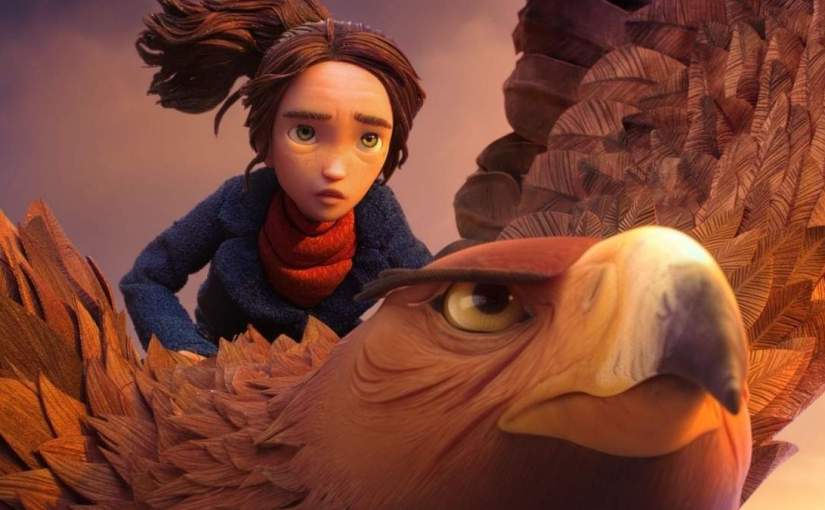
WILDWOOD (2026)

by Miguel E. Rodriguez

DIRECTOR: Travis Knight
CAST: Carey Mulligan, Jake Johnson, Peyton Elizabeth Lee, Charlie Day, Tom Waits, Angela Bassett, Awkwafina, Mahershala Ali
MY RATING: 10/10
ROTTEN TOMATOMETER: 99% Certified Fresh

PLOT: A young girl’s search for her kidnapped brother kicks off a gripping fantasy adventure in the forbidding forests outside of Portland, Oregon.


Wow.  Just…WOW.  Wildwood, the newest entry from director Travis Knight and Laika, the studio behind Coraline (2009), ParaNorman (2012), and Kubo and the Two Strings (2016), pulls out all the stops and delivers the first stop-motion fantasy adventure epic.  The first trailers made it look like a loose retread of 1986’s Labyrinth, with a young girl in search of her baby brother who was kidnapped by shadowy, magical forces.  I was wrong.  Wildwood should be remembered as one of the best fantasy films ever made in any medium.

(Also, just in passing, please note, it earns its PG-13 rating.  Littler kids are likely to be traumatized by some of the visuals, as well as the numerous gruesome onscreen deaths.  You have been warned.)

After a grim prologue involving the suicide of what appears to be a primitive automaton, we meet the modern-day McKeel family: Mom, Dad, Prue, and baby boy Mac.  After numerous light-hearted, but still portentous, warnings to not leave the house with Mac and especially to stay away from the dense woods bordering their home in Portland, Oregon, Prue does exactly that, bumping into a nerdy acquaintance, Curtis, along the way.  In a scene right out of Hitchcock, a playground gradually fills with large crows in a series of clever edits.  This murder of crows swoops down in a cloud of caws and claws, grabs baby Mac, and soars away into the forest.  Prue gives chase with Curtis in tow, and when she arrives at the edge of the forest, something curious happens: the trees part to reveal a path after some blood from Prue’s hand, cut during her pursuit, touches an ivy plant.

What follows is a spectacular adventure that incorporates all the best aspects of C.S. Lewis, J.R.R. Tolkien, and J.K. Rowling…along with any other fantasy writer who uses initials for their first name.  Prue finds herself in a magical world where talking animals live side-by-side with humans.  (Wolves, for example, are soldiers, though they’re not always the brightest bulbs in the box.)  The land is divided into principalities, each ruled by a different species of animal, some of which will help Prue with her quest and others who will stop at nothing to prevent it. 

The riot of diversity in this world was a constant source of amazement for me, especially considering everything was made with stop-motion animation.  I won’t get into the technical details (I’ll assume most of you know what stop-motion is and how time-consuming it is), but that fact alone makes Wildwood nothing short of miraculous.  If it doesn’t win the Academy Award for Best Animated Feature of 2026, it will be a grave miscarriage of justice.

For the entire running time (it’s also the longest stop-motion feature ever made), I felt a nostalgic echo of the great fantasy adventures from my childhood.  Labyrinth, The Dark Crystal (1982), The Secret of NIMH (1982), Willow (1988)…these were movies that had great stories, yes, but they strove to present unforgettable images to go along with their stories.  Wildwood isn’t content just to show us massive flocks of birds – in stop-motion! – or other fantastical creatures.  We also get a massive battle between two armies that plays and feels exactly like something out of The Lord of the Rings.  We get a dynamic, tragic story of a mother’s loss and the lengths to which she’ll go to find her son.  We get a surprise twist regarding Prue’s little brother.

And the entire time, that stunning animation is on display.  I had thought Kubo and the Two Strings would remain the high-water mark for stop-motion films for decades, but I was wrong.  Wildwood tops it, in terms of spectacle and storytelling.  It feels a little bit like Who Framed Roger Rabbit (1988): an astonishing technical feat that could be duplicated in the future, but who would want to?

I should also mention the darker aspects of the story, specifically how it involves death in a number of ways throughout the movie.  We get a suicide right at the top of the film.  At one point, several prisoners are literally murdered in their cages by soldiers with guns.  During the climactic battle, we aren’t shown a lot of especially gory details, but there is no mistake that both sides are out for blood and holding nothing back.  There is at least one unmistakable decapitation.  Wildwood remembers that, without high stakes, there can be no real suspense.  And when the final denouement occurs between Prue and the enemy leader, I gasped the same as I did when poor Wash got skewered in Serenity (2005.)  [If I ruined that for you, you need to watch more movies.]

So, seriously, please, pretty please, with a cherry on top: find a local theater that might still be playing Wildwood and go see it on the big screen.  It is the best movie I’ve seen so far this year.  It is hands-down the best stop-motion film I’ve ever seen.  It will be money well spent, I assure you.

DOWN BY LAW (1986)

by Miguel E. Rodriguez

DIRECTOR: Jim Jarmusch
CAST: Tom Waits, John Lurie, Roberto Benigni, Nicoletta Braschi, Ellen Barkin
MY RATING: 8/10
ROTTEN TOMATOMETER: 88% Fresh

PLOT: A disc jockey, a pimp, and an Italian tourist escape from jail in New Orleans.


The bare-bones plot description above sounds to me like a challenge from some bizarre reality show for screenwriters.  “Here’s your plot, aaaaand GO!”  The opening sequences of Jim Jarmusch’s Down by Law look and feel like an ambitious student film, down to its use of music and the black-and-white cinematography and the artsy montage of Bourbon Street and Orleans Parish, where the film takes place.  Having never seen a Jarmusch film before, as I watched these scenes, I was prepared to sit through a dense character study in which nothing much happens but a lot of talking is involved.  In a weird way, I found myself thinking of Clerks, but I despaired that Down by Law would come anywhere near Smith’s film in terms of getting me engaged in the story.

And then…a funny thing happened…

The film introduces us to two characters.  The first one we meet in great detail is Zack (Tom Waits), a gravelly-voiced former deejay living in near squalor with his girlfriend, Laurette, played by Ellen Barkin on the cusp of major stardom.  Their one scene together reveals the strategy for the rest of the film.  As I suspected, not much happens aside from a lot of talking or, in the case of this first scene, a lot of yelling, but there is a vibe or a sensation or something to the dialogue and the crisp black-and-white images that made their scene more immediate.  I am at a loss to explain exactly what it was.  I got the sense that I wasn’t watching two actors playing a scene.  I felt as if I was looking through a crack in the back wall at two real people having a real conversation.

The next character we meet, Jack (John Lurie), is not as savory as Zack.  Jack is a pimp whom we get to know during a conversation with one of his girls, Bobbie (Billie Neal).  Jack is a small-timer who dreams of hitting it big, but we know, as Bobbie does, that Jack’s big talk will never amount to much.  Jack walks and talks like he’s the man, addressing other hookers and pimps by name, and maybe he even sounds a little dangerous.  But his eagerness to expand his operation leads to some questionable decision-making that lands him in jail, to the great surprise of no one.

I just have to mention again the peculiar power of the direction and the dialogue.  The characters sometimes tend to ramble, but there’s never a second that feels superfluous.  There’s a scene where Zack, the deejay, is approached by an old acquaintance who offers him $1,000 just to drive a car from point A to point B.  The little verbal ballet between the two men, performed in mostly one shot as I recall, could have gone wrong any number of ways, as Zack demurs and his friend persists and round and round they go.  Perhaps because the dialogue is a little circular, it feels more natural than the kind of “punchy” dialogue you might get in a film noir.  The style, the camera placement, the acting, everything just sort of comes together and turns potentially boring dialogue into small windows into Zack’s psyche, and everyone else’s, for that matter.  (I think my online colleague, Marc, would enjoy this film very much, because it uses everyday language to illuminate precisely observed and defined characters.)

Zack winds up sharing Jack’s cell in jail for reasons I won’t get into.  It’s here that the story takes a unique turn.  I’ve read Down by Law described elsewhere as dreamlike or even like a fairy tale.  If so, Roberto Benigni is a benign Rumpelstiltskin.  Benigni plays Roberto (of course), an Italian tourist who has landed in jail for…well, let’s just say his offense is a little more severe than what Zack and Jack are in for, which is funny because Roberto speaks mostly broken English and walks and talks like an Italian Charlie Chaplin.  He doesn’t look like he would hurt a fly, much less commit the crime he supposedly committed.

Benigni’s presence in the film brings a lightness to the movie’s center section as the three men stew in their jail cell for weeks and months.  Zack and Jack are world-weary, anxious to tough out their time with minimal connection to each other, much less to Roberto, who is about as different from Zack and Jack as it’s possible to be without being an actual Muppet.  Is there some kind of deeper commentary being made here about how important it is to just connect with each other to make our lives easier to cope with?  How we would all be better off if we were more like Roberto, who delights in the phrase, “I scream, you scream, we all scream for ICE cream” so much that he almost starts a prison riot with it?  I don’t know.  Maybe.  I just know I felt a warm little glow watching Benigni’s performance, and how well he contrasted with Zack and Jack.

Eventually, the three men escape from prison; Jarmusch makes a bold move by never revealing exactly how they escape, because the how isn’t as important as the fact that they escape, period.  Here is where the movie really evokes fairy tales as the three men trudge through the Louisiana swamps, slowly starving, wary of alligators, working together but getting on each other’s nerves.  Even Roberto’s bubbly personality takes a brief hiatus when his comrades appear to desert him…twice.

I would rather not synopsize the plot any further.  The movie isn’t concerned with a Hollywood-style plot as it is with showing the interplay of these three very specific characters under extraordinary circumstances.  When it’s done as well as this, it’s a pleasure to experience a film that seems completely free from cliches and predictability.  As I said, I’ve never seen a Jarmusch film, but even without knowing much about his filmography, I’m glad I started with this one.  When the closing credits rolled, it strangely didn’t feel like the movie was over.  Instead, it felt as if everything I just saw was the prologue for the rest of their lives.  I envisioned a future where each character is sitting in a bar or on a park bench and spinning a yarn to whomever will listen.  “Hey, I ever tell you about the time I escaped from a New Orleans prison with two other guys?”  Maybe that’s not quite realistic, but when you’re dealing with a seriocomic neo-noir fairy tale, anything’s possible.

[Note: there is a late sequence featuring an Italian actress named Nicoletta Braschi.  Roberto falls in love with her, and she with him, and says they will spend the rest of their lives together.  In real life, Braschi and Benigni were married five years after the film was released, and they are still married today.  Fairy tale, indeed…]