
WILDWOOD (2026)

by Miguel E. Rodriguez

DIRECTOR: Travis Knight
CAST: Carey Mulligan, Jake Johnson, Peyton Elizabeth Lee, Charlie Day, Tom Waits, Angela Bassett, Awkwafina, Mahershala Ali
MY RATING: 10/10
ROTTEN TOMATOMETER: 99% Certified Fresh

PLOT: A young girl’s search for her kidnapped brother kicks off a gripping fantasy adventure in the forbidding forests outside of Portland, Oregon.


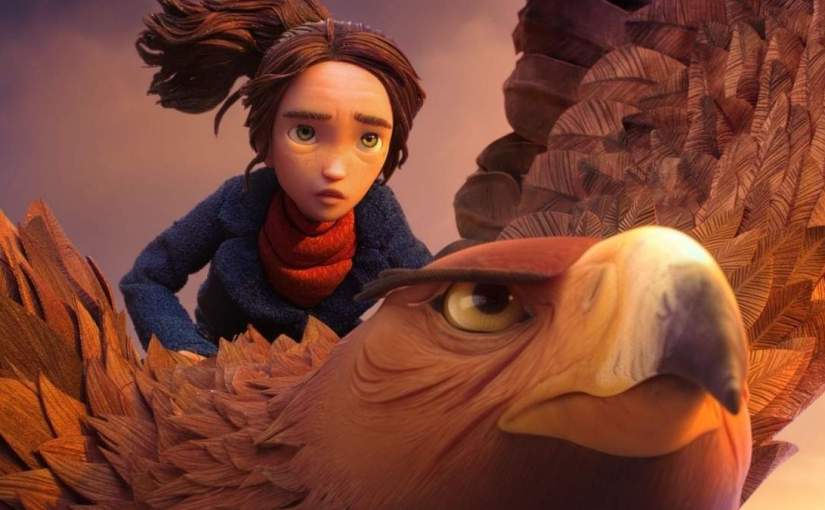
Wow.  Just…WOW.  Wildwood, the newest entry from director Travis Knight and Laika, the studio behind Coraline (2009), ParaNorman (2012), and Kubo and the Two Strings (2016), pulls out all the stops and delivers the first stop-motion fantasy adventure epic.  The first trailers made it look like a loose retread of 1986’s Labyrinth, with a young girl in search of her baby brother who was kidnapped by shadowy, magical forces.  I was wrong.  Wildwood should be remembered as one of the best fantasy films ever made in any medium.

(Also, just in passing, please note, it earns its PG-13 rating.  Littler kids are likely to be traumatized by some of the visuals, as well as the numerous gruesome onscreen deaths.  You have been warned.)

After a grim prologue involving the suicide of what appears to be a primitive automaton, we meet the modern-day McKeel family: Mom, Dad, Prue, and baby boy Mac.  After numerous light-hearted, but still portentous, warnings to not leave the house with Mac and especially to stay away from the dense woods bordering their home in Portland, Oregon, Prue does exactly that, bumping into a nerdy acquaintance, Curtis, along the way.  In a scene right out of Hitchcock, a playground gradually fills with large crows in a series of clever edits.  This murder of crows swoops down in a cloud of caws and claws, grabs baby Mac, and soars away into the forest.  Prue gives chase with Curtis in tow, and when she arrives at the edge of the forest, something curious happens: the trees part to reveal a path after some blood from Prue’s hand, cut during her pursuit, touches an ivy plant.

What follows is a spectacular adventure that incorporates all the best aspects of C.S. Lewis, J.R.R. Tolkien, and J.K. Rowling…along with any other fantasy writer who uses initials for their first name.  Prue finds herself in a magical world where talking animals live side-by-side with humans.  (Wolves, for example, are soldiers, though they’re not always the brightest bulbs in the box.)  The land is divided into principalities, each ruled by a different species of animal, some of which will help Prue with her quest and others who will stop at nothing to prevent it. 

The riot of diversity in this world was a constant source of amazement for me, especially considering everything was made with stop-motion animation.  I won’t get into the technical details (I’ll assume most of you know what stop-motion is and how time-consuming it is), but that fact alone makes Wildwood nothing short of miraculous.  If it doesn’t win the Academy Award for Best Animated Feature of 2026, it will be a grave miscarriage of justice.

For the entire running time (it’s also the longest stop-motion feature ever made), I felt a nostalgic echo of the great fantasy adventures from my childhood.  Labyrinth, The Dark Crystal (1982), The Secret of NIMH (1982), Willow (1988)…these were movies that had great stories, yes, but they strove to present unforgettable images to go along with their stories.  Wildwood isn’t content just to show us massive flocks of birds – in stop-motion! – or other fantastical creatures.  We also get a massive battle between two armies that plays and feels exactly like something out of The Lord of the Rings.  We get a dynamic, tragic story of a mother’s loss and the lengths to which she’ll go to find her son.  We get a surprise twist regarding Prue’s little brother.

And the entire time, that stunning animation is on display.  I had thought Kubo and the Two Strings would remain the high-water mark for stop-motion films for decades, but I was wrong.  Wildwood tops it, in terms of spectacle and storytelling.  It feels a little bit like Who Framed Roger Rabbit (1988): an astonishing technical feat that could be duplicated in the future, but who would want to?

I should also mention the darker aspects of the story, specifically how it involves death in a number of ways throughout the movie.  We get a suicide right at the top of the film.  At one point, several prisoners are literally murdered in their cages by soldiers with guns.  During the climactic battle, we aren’t shown a lot of especially gory details, but there is no mistake that both sides are out for blood and holding nothing back.  There is at least one unmistakable decapitation.  Wildwood remembers that, without high stakes, there can be no real suspense.  And when the final denouement occurs between Prue and the enemy leader, I gasped the same as I did when poor Wash got skewered in Serenity (2005.)  [If I ruined that for you, you need to watch more movies.]

So, seriously, please, pretty please, with a cherry on top: find a local theater that might still be playing Wildwood and go see it on the big screen.  It is the best movie I’ve seen so far this year.  It is hands-down the best stop-motion film I’ve ever seen.  It will be money well spent, I assure you.
SPIDER-MAN: ACROSS THE SPIDER-VERSE

By Marc S. Sanders

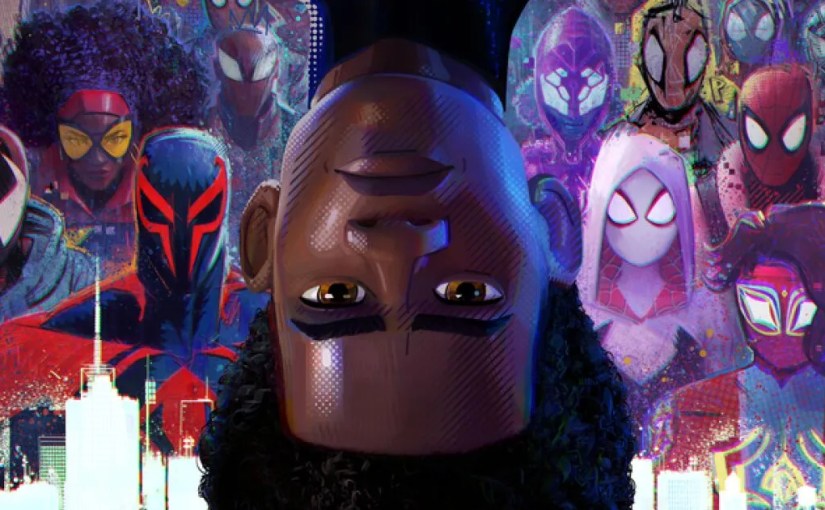
Spider-Man: Across The Spider-Verse is a gorgeous kaleidoscope of color and kinetic energy.  Joaquim Dos Santos, Kemp Powers and Justin K Thompson are a directing powerhouse trio making every scene, moment, or caption completely unique from anything you’ve seen before.  This movie never stops being inventive with itself, all the way down to its end credits.

Within the first half hour of the film, two stories unfold where two “Spider heroes” from different dimensions are struggling with maintaining their costumed alter ego while grasping with lying to their families.  Reader, having just seen the 2023 live action interpretation of The Little Mermaid, I can tell you that in comparison, Across The Spider-Verse is more frank and honest in its characters with what makes them tick and what pains them during their adolescent years.  The acting in this film of various forms of animation is sensational.  Often, animated films don’t let up on the high energy, like the Minions movies for example.  It can get tiring.  This Spider-Man picture allows those quiet intimate moments where it is hard for any teenager to come to terms with his or her parents.  Gwen and Miles are fearful of disappointing those that are close to them.  They’re also reluctant to surrender the secrets they value only with themselves.  Thus, it puts a strain on their respective familial relationships. 

Eventually, the two friends must even come to grips with secrets they’ve kept from one another.  It doesn’t matter that these characters are superheroes.  This is a coming-of-age film on the same level and maturity that writer/directors John Hughes and Cameron Crowe approached with many of their films.  Most teenagers have something unusual in them, and part of growing up is sometimes struggling with whether to ever let our guard down.  The conflicts that Gwen and Miles experience are trying to figure out what is best for themselves and the relationships they have with their parents.  I really felt for them in those quiet moments when the music was turned off and the fast paced scene changes that moved the film’s adventures came to a welcome pause.  Santos, Powers and Thompson know the beats to uphold their story.

Gwen Stacey (Hailee Steinfeld) is known as Spider-Gwen.  Miles Morales (Shameik Moore) is known as Spider-Man, residing in different dimensions of Earth separate from Peter Parker’s interpretation that most people are familiar with.  Complications arise when an inventive new villain causes mayhem in Miles’ neighborhood.  This guy is known as Spot (Jason Schwartzman), who opens holes or portals for him to transport objects like, say an ATM machine from one spot to another as he tries make way with his robbery loot.  Seems like a simple villain of the week, but then Spot gets some ideas and before you know it, Miles is following Gwen into another alternate dimension in pursuit of the dastardly mischief maker. 

Much like we see in time travel films like Back To The Future, if you mess up what was meant to be, it could alter everything else a million fold.  Just one tiny pebble rippling across the water can cause all sorts of trouble, and without even realizing it, Miles’ heroics may have caused a problem that can’t be undone.  This only invites more trouble for the poor kid.

The real treat of Across The Spider-Verse is what Gwen and Miles encounter, which is pretty much the entire history of the most famous Marvel Comics character of all time.  So many different interpretations of Spider-Man eventually lend to this story, and each one serves a purpose within the two-hour film.  My comic book experience allowed me to recognize so much from cartoons of the 1960s to the Saturday morning series of the 80s, and all the way through the various iterations found in newspaper pages and comic magazines. The last 20 years of films are also given their due.  It’s unbelievable how deep the filmmakers go.  Still, you don’t have to know about one single Spider-Man to follow this picture and appreciate all of its frolics.

Beyond a Best Animated Film Oscar, here is an animated film worthy of a nomination in film editing.  Miles and Gwen call it threading.  I love that term!  When they are swinging over skyscrapers and then down into the valleys of the metropolitan city streets alongside the multi lanes of traffic, buses and cabs, through alleyways, over sidewalks, and then up into the skies again, only to run atop an elevated train, the action moves so fast and seamlessly.  It’s a glory to watch it play out.  It feels like a wonderous amusement park ride.  The action is bridged together beautifully in different shades of reds, blues, greys, pinks, and purples.  This is how you assemble a film and take passion in the project.

I did think the movie ran about ten or fifteen minutes too long.  However, the ending packs such a punch.  When the film finishes, I defy you not to hearken back to the first time you saw The Empire Strikes Back, or The Fellowship Of The Ring, or Avengers: Infinity War.  The preview audience that my Cinemaniac pal Anthony and I were a part of roared with cheers at the conclusion of this film with tremendous applause.  Put it this way, reader, sadly the theatre we saw this film at left me wanting a better sound system.  The volume was way too low.  However, it never hindered the thrilling experience we had with this inventive picture story.  (That’s another recommendation.  See Spider-Man: Across The Spider-Verse with the best sound system you can find on the best screen you can uncover.)

Spider-Man: Across The Spider-Verse may be one of the top 10 best films of the year.  I know I’ll be considering it for my list come late December/early January.  Few films get as inventive as this, and it is definitely one of the best Spider-Man films to ever grace a movie screen.