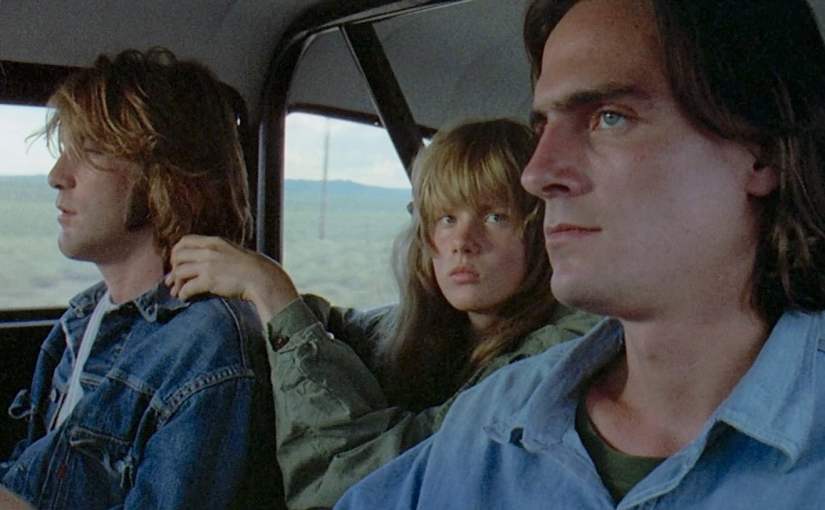
TWO-LANE BLACKTOP (1971)

by Miguel E. Rodriguez

DIRECTOR: Monte Hellman
CAST: James Taylor, Warren Oates, Laurie Bird, Dennis Wilson, Harry Dean Stanton
MY RATING: 3/10
ROTTEN TOMATOMETER: 93% Certified Fresh

PLOT: While drag-racing through the American Southwest in a 1955 Chevrolet 150, a driver and his mechanic cross paths with an enigmatic hitchhiker and the tall-tale-spinning driver of a GTO.


Once upon a time, comic strip Bloom County name-dropped Gregory Peck in a Sunday-paper cartoon.  When this was brought to Peck’s attention, he read the cartoon and asked, “What is Bloom County?  What is the matter with me that I don’t understand it?”

Gregory, I know how you feel.  Monte Hellman’s car-culture cult classic Two-Lane Blacktop is a film that was and is critically lauded, is on the National Film Registry, and is one of the 1,001 Movies You Must See Before You Die.  But after watching it – or sitting through it, more appropriately – I wasn’t angry; I was completely mystified.  What did I just watch?  What was the point?  Why should I care?  Did I miss the point because I missed the sixties?  What is the matter with me that I don’t understand this film?

The ostensible plot involves a quartet of unnamed characters: The Driver (James Taylor!), G.T.O. (Warren Oates), The Girl (Laurie Bird, who tragically took her own life at the age of 26), and The Mechanic (Dennis Wilson!!).  We first see Driver and Mechanic rambling around Arizona in their souped-up, but dressed-down, 1955 Chevy 150.  [Eagle-eyed movie fans will recognize this as the same model car that Bob Falfa drives two years later in American Graffiti.]  To make some bread, they hustle other hot-rod owners into illegal street races which they handily win because, like the Millennium Falcon, their Chevy doesn’t look like much, but she’s got it where it counts.

After one such race, two fateful things happen.  The first is that they are spotted and passed twice by a stock 1970 Pontiac GTO 455 (nice) driven by the Warren Oates character.  The second is that they pick up a hitchhiker, The Girl.  Well, not exactly…she climbs into their car outside a diner, and when they walk outside to leave, they see her in the back seat and just drive off without any observable reaction that I could spot.  Probably wouldn’t happen today, but this was an era still reveling in the remnants of the Summer of Love, so I give it a pass.

At this point, I could spot French New Wave influences, not to mention echoes of The Hustler (1961), Easy Rider (1969), and good omens of American Graffiti (1973), especially in the film’s fascination with cars.  One short scene involves virtually nothing but shots of The Mechanic changing out the rear racing tires for street-legal tires.  I remember thinking, this is a movie about gearheads, BY gearheads, FOR gearheads.  Not necessarily a bad thing – I’d put Mad Max (1979) and its sequels in that category.  So, okay, I thought, let’s see where this goes.

And I waited, and waited, and waited some more.  James Taylor as The Driver has a great intense look while he’s actually driving, but I have to say it: he has zero charisma.  He could have used an acting coach.  Dennis Wilson as The Mechanic is marginally better.  He’s very easygoing on camera, while Taylor looks stiff and uncomfortable.  I can only imagine their presence was a calculated ploy to bring younger audience members to theaters.  Newcomer Laurie Bird as The Girl is as okay as okay gets.

I get it: the French and Italians used non-actors in their neo-realist films to achieve authenticity from their performances.  Well and good.  But whatever those films had, this one does not.  Blacktop would have benefited immeasurably from veteran actors in the two leads, actors who could at least generate some chemistry with Warren Oates, who gives by far the best performance in the film, even it’s in the service of a vaguely antagonistic character that I never understood.

Full confession: this movie is not badly or clumsily made.  Parts of it felt like they were going for a Five Easy Pieces (1970) vibe, and I think they got it visually.  But the movie never got me to care about what happened to any of the characters.  The Driver is a cipher, The Mechanic is barely more than that, The Girl (who, I guess might represent the concept of “free spirit” in the hippie culture?) is maddening at best and impenetrable at worst, and G.T.O. is all over the place emotionally, which I guess makes him the most interesting character in the film.  I didn’t like him much, but I was always curious what would come out of his mouth next.  (His overriding character trait is that he constantly lies to everyone he meets about who he is, improvising his own backstory with each new encounter.)

Which made me think.  For the longest time, I thought that I had issues when movies or TV shows centered their plots on characters who I thought were unlikable.  But then there’s Succession which I can’t rave about highly enough, or Get Carter (1971) or The Godfather (1972), all filled with genuinely unlikable characters, but which are among my favorite entertainments.  Watching Two-Lane Blacktop, I at first thought I didn’t like the movie because I didn’t like the characters, but that’s inaccurate.  I didn’t like the movie because I didn’t care about the characters.  An effective film can introduce anti-heroes and straight-up villains and get us to root for them because we start to care about the characters and the story.  Two-Lane Blacktop was unable to get me to care about the characters, so I simply didn’t care what happened next.  For a hundred minutes.  That’s a long time.

On the Criterion Blu-ray, director Monte Hellman and various other film fans and scholars wax rhapsodic about the film’s existential overtones, and its place in film history as a time capsule of an era when studio films like this one would become more prevalent for the next decade, while simultaneously heralding the rise of independent films (which can actually be traced further back to 1958 with Cassavetes’ Shadows, but what do I know).  While I acknowledge there may be aspects of this movie that eluded me and which I may pick up on if or when I see it again, I have to be honest…my initial reaction was one of consternation.  If I have to peel the movie like an onion to understand its relevance, is that necessarily a good thing?  I don’t know.  Some movies have achieved that kind of goal (I’m thinking specifically of 2001: A Space Odyssey [1968]), but they are few and far between.  For me, Two-Lane Blacktop was not one of them.  Yet, he said with hope for the future.
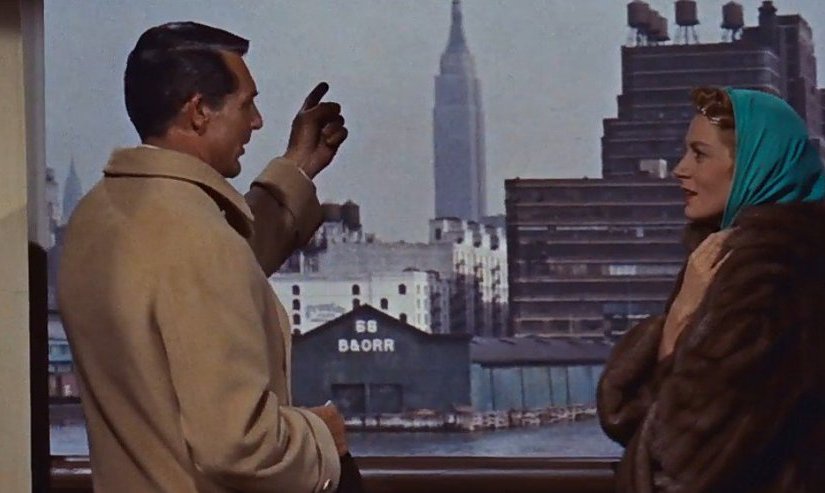
AN AFFAIR TO REMEMBER (1957)

by Miguel E. Rodriguez

DIRECTOR: Leo McCarey
CAST: Cary Grant, Deborah Kerr, Richard Denning, Neva Patterson
MY RATING: 8/10
ROTTEN TOMATOMETER: 65% Fresh

PLOT: A couple, both attached to other people, falls in love and agrees to meet in six months at the Empire State Building – but will it happen?


First, a word to devotees of this film:

No, I have not yet watched Sleepless in Seattle.  Yes, I am aware of the deep connection between the two films.  No, Sleepless is not currently on my watchlist radar, but rest assured I will post a review of it if or when I finally watch it.  Today is not that day.  Tomorrow’s not looking good, either.

All good?  Okay, let’s move on.

Leo McCarey’s An Affair to Remember is a grand old melodrama that would have been a perfect example of its genre if only it had ended differently.  As it happens, McCarey’s filmography does include a perfect example of melodrama: Make Way for Tomorrow (1937), not quite as romantic as An Affair to Remember, but packing a devastating gut-punch of an ending that other films can only aspire to.  If Affair had had the nerve to stick to that kind of an ending, I would absolutely have given it a perfect 10 out of 10.  But, while I don’t believe it’s perfect, it still belongs on your watchlist.

Cary Grant plays Nickie Ferrante, an incurable playboy who is nevertheless engaged to be married to an industrial heiress.  Deborah Kerr is Terry McKay, an “everywoman” type – or as everywoman as one can be while looking like Deborah Kerr.  She is also romantically attached to another man (NOT engaged, which plays a crucial factor later in the film).  The two have a pleasantly non-contrived meet-cute aboard a transatlantic cruise to Europe.  As fate would have it, they are both traveling solo for various reasons.

Their connection is immediate and unforced, reminding me a bit of two of my favorite films, Lost in Translation (2003) and Dodsworth (1936).  Grant and Kerr have a wonderful, breezy onscreen chemistry.  Their conversations, especially when they’re alone in her stateroom, are positively gravid with subtext, but they are careful not to let things get out of hand, even when it’s clear they would both like that very much.  It’s a wonderful balancing act that is rarely successful, so it’s a pleasure to watch when it is.

The development of their relationship unfolds perfectly, so I won’t spoil it.  As their ship pulls back into New York Harbor, they make a hasty, almost teenager-esque pact: meet in six months to see if their connection is still as strong as it is now.  The location: the top of the Empire State Building, still the tallest building in the world in 1957.  “It’s the nearest thing to heaven we have in New York,” gushes Terry.  It’s a tribute to how pervasive this movie is in the pop culture zeitgeist that I knew exactly what would happen just prior to that fateful appointment, but I nevertheless gave a little gasp when it happened.

For me, it’s the second half of An Affair to Remember that shines.  The first half is no slouch, but I masochistically perked up when the possibilities of a tragic romance reared its head.  There’s something about heartbreaking tragedy that makes for a sensational film.  There’s nothing wrong with happy endings, don’t get me wrong, but my favorite Broadway musical of all time isn’t My Fair Lady…it’s Jesus Christ Superstar. When done right, tragedy is strangely cathartic.  I’m thinking of movies like Atonement (2007) or The Remains of the Day (1993) or Brokeback Mountain (2005), movies that will never top anyone’s list of feel-good films, but which are somehow more powerful because…well, I find myself unable to articulate why.  They just are.

And that’s why An Affair to Remember does not quite reach the level of perfection attained by Make Way for Tomorrow.  There was a moment in the final reel when I thought it would, but it goes for the happy ending instead.  That’s right, I begrudge the movie’s happy ending just a little bit.  Sue me.  I fully acknowledge that the moment when Nickie sees a particular item in a particular room during the final scene is a thing of brilliance and beauty.  (Treading carefully here…)  It’s a lovely moment capping a sensationally written and performed scene.  …but it just didn’t strum my heartstrings.  I wanted it to, I really did.  I wanted my heart to swell and feel like it’s going to burst, but it never happened.

(For the record, I also could have done without the multiple musical interludes, especially the two with the kids singing…although I did enjoy Nickie’s flashback/memory when he revisits his grandmother’s house in France.)

Does this make me a curmudgeon?  I don’t think so.  I just feel there was an opportunity here to pull out all the stops for some real reach-for-the-hanky moments.  But, hey, what do I know?  See it and judge for yourself.  An Affair to Remember is a pleasure to watch and listen to, just like the stars themselves.  And, hey, if the ending reduces you to a blubbering mess like Meg Ryan in Sleepless in Seattle, then it did its job.  I won’t judge.  Promise.

THE BAND WAGON (1953)

by Miguel E. Rodriguez

DIRECTOR: Vincente Minnelli
CAST: Fred Astaire, Cyd Charisse, Oscar Levant, Nanette Fabray, Jack Buchanan
MY RATING: 9/10
ROTTEN TOMATOMETER: 95% Fresh

PLOT: An aging song-and-dance man reluctantly teams up with a prima ballerina to headline a Broadway musical, but the pretentious goals of its director threaten to sink the show before it even opens.


The Band Wagon has officially been added to the list of my favorite backstage films, along with The Bad and the Beautiful (1952), 42nd Street (1933), and Singin’ in the Rain (1952), to name just a few.  Even aside from the “meta” aspect of the plot, the scenes of a stage show in various stages of rehearsal hit close to home…sometimes TOO close.  After a disastrous tech rehearsal, one actress asks, “Are we really supposed to open tomorrow night?”  If I had a nickel for every time I’ve said or thought that when performing in a stage show…I’d have a lot of nickels.

Fred Astaire plays Tony Hunter, an aging song-and-dance man whose best days and best movies are behind him.  This is made poignantly clear in an opening scene where Tony’s famous top hat and cane are being auctioned off – and they don’t get a single bid.  He’s in New York because he’s been offered a role in a brand-new musical comedy written by his two good married friends, Lester and Lily Marton (Oscar Levant and the perky Nanette Fabray).  The catch: they want to pair him with Gabrielle Gerard (Cyd Charisse), a top-tier ballerina who can handle the challenging dance moves from the show’s choreographer, Paul Byrd (James Mitchell), with whom she’s involved romantically.  Tony, an old-school soft-shoe hoofer, is not confident he’ll pair well with a tall, leggy ballet dancer and “modern” choreography.

To top it off, the new show will be directed by Broadway darling Jeffrey Cordova (Brit comedian Jack Buchanan) whose artistic sensibilities run more towards Camus and Goethe than Comden & Green.  Will Tony and Gabrielle overcome their differences?  Will Jeff Cordova see the light before turning a light comedy into a long dark night of the soul?  Will Lester and Lily kill each other before opening night?  If you don’t know the answers to these questions being posed in an MGM musical from the height of the Arthur Freed era, you need to see more movies.

The plot of The Band Wagon could be blown over by a smoke ring, but it is extremely perceptive when it comes to backstage life during a stage production.  As an amateur actor, I eat this stuff up with a spoon.  There’s the audition scene: do we go with the seductive blonde or the girl who can actually dance?  There are the seemingly endless dance rehearsals.  There’s the ambitious director who fills the stage with special effects and forgets about the actors.  There are the threats of quitting, the fights over changing a line, the show-mance, and the gallows humor following a disastrous performance.  The Band Wagon, like 42nd Street, should be required viewing for anyone involved in live theater, especially musicals.

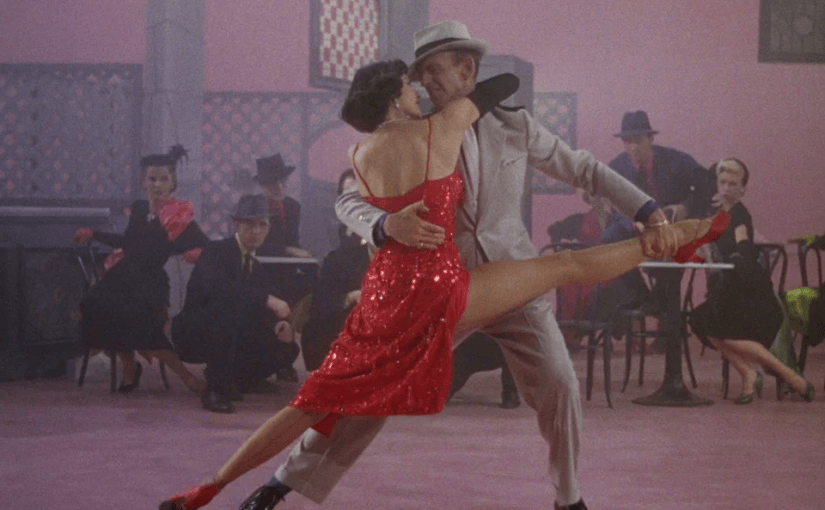
But that’s all just background for the main attraction: Astaire and Charisse.  While Gene Kelly was pure athleticism, Astaire was grace personified.  While Ginger Rogers was unquestionably (and literally) Astaire’s equal, Charisse brings a sensuousness to her duets with Astaire that is unmatched.  In fact, I got the sense in their dances together that Astaire, intentionally or not, was there to make Charisse look good, or even better, I should say.  Or maybe it’s just that Charisse is all I look at in their numbers together.  Little of column A, little of column B.  The highlight of their pairing is the justly celebrated “Girl Hunt Ballet”, a dazzling showcase for Astaire, Charisse, and choreographer Michael Kidd, which serves more or less as the movie’s finale.  A verbal description wouldn’t do it justice, but even if you’re not a fan of The Band Wagon, chances are good you’ve seen one or two YouTube videos that compare this scene to Michael Jackson’s video for “Smooth Criminal.”  Good stuff.

There are other highlights, as well.  This movie gave us the immortal showbiz anthem, “That’s Entertainment”, which was reportedly written in 45 minutes.  There’s also the famous “Triplets” number where Astaire, Fabray, and Buchanan use visual trickery to appear as infants in three little high chairs.  There’s the opening number where Astaire dances through a penny arcade on 42nd Street, incorporating an all-too-brief double act with a shoeshine man whom the producers literally pulled off the street when they saw him dancing for his customers.  Everything is done in the broad, brassy, Technicolor fashion for which director Vincente Minnelli was famous.

That’s really about it.  Astaire has been quoted as saying The Band Wagon was his favorite film of his career, and it’s not hard to see why.  Many moons ago, I watched this movie and, as I recall, slept through most of it.  I was younger and stupider back then.  As a devotee of theater and of classic films, The Band Wagon is one of my favorite musicals overall.  Check it out whenever and wherever you can.

DISCLOSURE DAY (2026)

by Miguel E. Rodriguez

DIRECTOR: Steven Spielberg
CAST: Emily Blunt, Josh O’Connor, Colin Firth, Eve Hewson, Colman Domingo, Wyatt Russell
MY RATING: 9/10
ROTTEN TOMATOMETER: 79% Certified Fresh

PLOT: A cyber-security expert goes on the run from his own shadowy employer; a TV weatherperson exhibits odd behavior after a close encounter with a cardinal; and an 80-year-old secret ties them both together.

[THIS REVIEW CONTAINS SPOILERS.]


First of all, yes, I’m late to the party for this one, but I didn’t feel qualified to write a review after watching this the first time in June, and I didn’t get around to watching it again until last night.

Second, I am a Gen-Xer whose adolescent life was irrevocably impacted by the films of Steven Spielberg, starting with Jaws (1975) through to Jurassic Park and Schindler’s List (both 1993).  I know enough to realize that his body of work is not perfect, but I am a fervent admirer, so if some of that bias comes through in this review, c’est la vie.

Disclosure Day, released when Spielberg was 79 years old, is so full of ideas that the weight of them occasionally threatens to derail the film’s momentum in some earlier passages, and makes some of the later “revelations” a little less wondrous than they might have been if I had seen this movie when I was a pre-teen or teenager.  But the headlong energy of Spielberg’s direction and the powerhouse acting on display from Emily Blunt swept me along and kept me (mostly) breathless for nearly two-and-a-half hours.  This should go at or near the top of anyone’s list of “thinking-man’s thrillers.”

(I won’t bother summarizing the plot…I’m just going to assume you’ve seen the movie.  If you haven’t, apologies for any spoilers below.)

My favorite aspect of this film is the way it draws straight connecting lines between its sci-fi elements and their religious counterparts, much like The Matrix did in 1999 and Contact did in 1997.  Does that make Disclosure Day an unoriginal rehash of similar ideas from thirty years ago?  Absolutely not.  The fact that everything is filtered through the Spielberg lens permeates every scene, reminding me that this story of paradigm-shifting contact with extra-terrestrials is being presented by the man who brought us Close Encounters of the Third Kind (1977) and E.T. the Extra-Terrestrial (1982).  I got the feeling that Disclosure Day is loaded with things that Spielberg has wanted to say for a long time.  I don’t know if that’s factually true, but that’s what it feels like.

I grew up in a Baptist Christian home from kindergarten through four years of Christian college.  This movie spoke to me in a way that Contact touched on, but much more directly.  At one point, the character Jane Blankenship (Eve Hewson) asks a nun: “If you found out we weren’t alone, if someone showed you, PROVED it to you…would that frighten you?”  Contact has a theoretical answer which seemed pretty reasonable, but Disclosure Day adds an extra dimension by asking this question to a nun, whose conviction that we are, in fact, NOT alone is central to her identity.  (She has a great answer that I won’t spoil here.)

I wondered about this question.  Any religion I can think of is centrally based on faith, which, according to the book of Hebrews, is “the evidence of things not seen.”  Well…would happen if, one day, at the Vatican or Jerusalem or Mecca, the clouds parted, the skies opened up, and a celestial figure descended to Earth and told everyone present that, yes, I am God, you’ve been right this entire time, congratulations.  How would the faithful react?  I believe many would bow or kneel and weep with joy…but would they ALL react that way?  Might there be some who became even more fearful than before?  Would some believers rebel at the thought that faith is no longer needed?  After all, there He is.

This question occupied my mind for weeks and months after watching Disclosure Day for the first time.  I drew parallels between religion and the belief in extra-terrestrial life.  If someone proved to me, PROVED it beyond the shadow of a doubt, that alien civilizations are real and have been visiting Earth since 1947…how would I respond?  Would I rejoice in the fact that something I’ve hoped for since childhood was actually proven correct?  Or would this revelation make me feel even smaller compared to the vast cosmos?  If I had that kind of information, would it be my responsibility to tell everyone, to spread the word, as it were?  Or would it be more prudent to keep that information to myself, lest it create a panic?

When a movie makes me ask those kinds of questions, without necessarily providing stone-cold answers, I celebrate it.  Too many films lose faith in the viewer’s intelligence from the get-go.  Spielberg never talks down to his audience with this film.  Right from the beginning, he and screenwriter David Koepp demonstrate their trust in the audience’s ability to keep up by starting the movie in the middle of the action.  No set-up, no narrated prologue, just boom, here’s a guy with a backpack getting kidnapped and there’s his girlfriend and why is everyone scared of a stick of silver metal and who are these people, anyway?

Watching this movie a second time, I was once again blown away by Emily Blunt’s performance.  I am not 100% sure she’ll get an Oscar nomination or anything, but she is heartbreaking when she acquires these abilities she can’t understand or explain, then breaks down late in the film when others look to her as some kind of spiritual figure.  She doesn’t like these abilities.  She doesn’t WANT these abilities, and she certainly doesn’t want anyone revering her because of them.  “I will NOT be anyone’s religion!” she cries out, and I was immediately reminded of the Biblical story of Jesus in the Garden of Gethsemane, raging against God for forcing Him to go through the unimaginable trials to come.

There are many other scientific/religious parallels in the film.  Even the concept of demon possession comes into play when the main bad guy, Scanlon (Colin Firth), is able to “dive” on people remotely, either speaking to them across vast distances or able to literally control their bodies.  When Hugo Wakefield (Colman Domingo) explains to someone that the aliens believe that empathy is the highest form of evolution, as a former practicing Christian, how could I not think of the Golden Rule?  (“Love thy neighbor as thyself.”)

On the surface, Spielberg is asking people to consider the idea that alien life need not be a scary proposition (War of the Worlds [2005] notwithstanding, of course).  Below the surface – not exactly hidden, of course – he’s asking us to consider the idea that empathy for our fellow man could literally save the world.  Impractical?  Maybe.  But a hopeful message regardless.

Disclosure Day is a worthy addition to Spielberg’s impressive filmography, and one of my new favorite films, not because it’s as thrilling as a roller coaster (which some parts of it are), but because it’s as cerebral and rewarding as solving a crossword puzzle in pen.

ENEMY (2013)

by Miguel E. Rodriguez

DIRECTOR: Denis Villeneuve
CAST: Jake Gyllenhaal, Mélanie Laurent, Isabella Rossellini
MY RATING: 8/10
ROTTEN TOMATOMETER: 72%

PLOT: A humdrum history professor seeks out his exact look-alike after spotting him in a movie.


Enemy is like a Twilight Zone episode written by David Lynch, and directed by Paul Thomas Anderson. The best thing about it: it kept me guessing right up until the hair-raising, goosebump-inducing final image. The worst thing about it: TOO MANY QUESTIONS LEFT UNANSWERED.

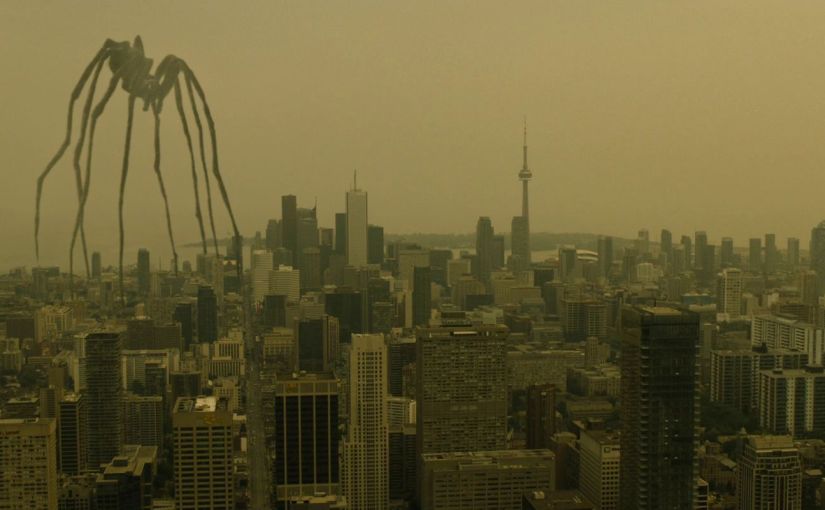
A surreal opening sequence involving a high-roller peepshow and a live spider sets the tone for this mysterious mystery full of mysteries. The premise is immediately captivating, at least for me: what would you do if you spotted your double in a film you’re watching? Not just a very close look-alike, your EXACT double, your doppelganger. How would you react? What would you think? Long lost brother? Insane coincidence?

Jake Gyllenhaal plays Adam, the man who is watching a movie and unexpectedly sees himself in a movie he’s rented. He tracks the actor down, calls him up. The actor, Anthony, is skeptical. Adam’s nervousness about the whole endeavor doesn’t help his case any. Anthony eventually wants to meet. What would you SAY to your double? How would you act? It’s all extremely intriguing.

Director Villeneuve paints the screen with images in pallid browns and beiges. City skylines are seen against murky, muddy, cloudless skies. Adam’s entire wardrobe seems to consist of white shirts, brown pants, and a brown sportscoat. Not really a spring man, apparently. There may be a reason for these color choices, there always is, but I’ll be jiggered if I can figure out what it is, aside from the effect it had of making everything feel…sludgy. To what end? No idea.

There are periodic shots or sequences recalling the peepshow from the opening sequence, and I’m not sure what THOSE are supposed to mean. It seems fairly obvious at first that it must have been Anthony, the actor, seen in the crowd at the beginning, even though we don’t know it yet. But, if that’s true, why is ADAM dreaming about it? Another weird touch: Anthony likes blueberries. Adam visits his mother, who tries to give him blueberries; he says he doesn’t like them, but his mother insists he does. A current of fear coils and slithers under the surface of this movie like a snake hiding under a rock, waiting for nightfall.

What’s going on here? Is Adam gaslighting HIMSELF? The movie is VERY cagey for a while, because the “Shyamalan” factor comes into play: what if they’re both the same person? For a while, the film never shows the two men together in the same shot, so the question hangs in the air. Even when we DO see them in the same shot, I found myself thinking: “Well, ‘Fight Club’ had them both in the same shot, and look what happened THERE.”

I won’t reveal the precise nature of what’s going on, because, at this point, I’m still not sure I understand it all myself. I can say that it kept me interested the whole way through, but it didn’t answer questions I really, REALLY wanted answers to. (No, I don’t require that all movies answer every question. The reason I love movies like “Prometheus” and “Under the Skin” is specifically BECAUSE a lot goes unanswered. But this one left me wanting more.)

And then there’s that last, completely out-of-left-field, borderline repellent final shot. What the HELL does it mean? Do these two men share a common psyche, separated only by physical distance? Is it intended ONLY to shock, with no real meaning? It worked on the level of shock, but upon reflection, I still can’t fathom its meaning.

So. If you Netflix this movie, give it a whirl. You’ll be captivated. You’ll be intrigued. It works on that level EXTREMELY well. Just don’t expect everything to be wrapped up in a nice bundle. This movie is designed to be discussed and debated afterwards.

MUTINY ON THE BOUNTY (1935)

by Miguel E. Rodriguez

DIRECTOR: Frank Lloyd
CAST: Charles Laughton, Clark Gable, Franchot Tone
MY RATING: 9/10
ROTTEN TOMATOMETER: 96% Certified Fresh

PLOT: First mate Fletcher Christian leads a revolt against his sadistic commander, Captain Bligh, in this classic seafaring adventure, based on the real-life 1789 mutiny.


For me, what makes the 1935 version of Mutiny on the Bounty special is not just the cast, although it’s exceptional, or the performances – the only film in Oscar history with three Best Actor nominations – or the rousing story.  It’s the fact that the film provides a clear villain in Captain Bligh and appears to provide a clear hero/anti-hero in Fletcher Christian, while also making a great case that Fletcher was, in fact, wrong to incite the mutiny that made him famous.  Bligh gets what he richly deserves, but does Fletcher Christian have the right to give it to him?  I was reminded of Jason Robards’s classic line from the closing sequence of Crimson Tide, also about a (fictional) mutiny: “…insofar as the letter of the law is concerned, you were both right.  And you were both also wrong.  This is the dilemma…”

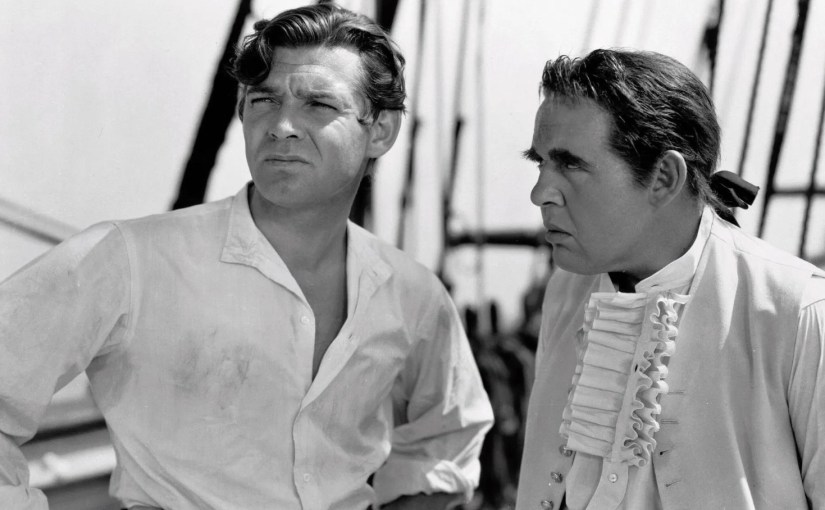
Gable as First Mate Fletcher Christian may not feel entirely appropriate in the role when we first see him, “press-ganging” unlucky sods into the crew of the Bounty in 18th-century England, prepping for a 2-year round-trip voyage to Tahiti.  He’s taller than just about everyone else, handsomer, and speaks with no trace of an English accent.  But his mere presence exudes “I’m the hero”, a quality not everyone can pull off just by standing there.

As the authoritarian Captain Bligh, Charles Laughton is incomparable.  He generates instant antipathy when he’s first seen boarding the Bounty, not because of how he looks, but because of what he does: he commands a punishment of 24 lashes to be applied to a sailor convicted of striking his Captain…even though the sailor has already died from his injuries.  When a crewmember faints at the spectacle, Bligh refuses to allow other crewmen to help him up.  As an omen of things to come, that’s hard to beat.

But before we get to the classic struggle between Bligh and Christian, we first have to put to sea, and there’s an exhilarating sequence/montage of the Bounty getting underway.  Nautical terminology flies fast and furious, commands are repeated, men scurry up the rigging faster than I can walk in a straight line, and I was reminded of my favorite “sailing-ship” movie of all time, Master and Commander: The Far Side of the World.  The effect, while simply accomplished, is palpable and thrilling.  Director Frank Lloyd and ace editor Margaret Booth work hard to keep that adventurous element present throughout the picture, a fact not lost to audiences who made Mutiny on the Bounty the box-office king of 1935.

After the Bounty gets underway to Tahiti, Bligh’s nasty streak gets even worse and worse.  I’ll spare you the details, but his mean-spiritedness and petty cruelty knows no bounds.  Meanwhile, Christian befriends a novice midshipman, Roger Byam.  Like virtually the entire crew, neither man can stand Bligh’s behavior, but they remember they are sworn to the King’s service and follow their orders.

Their friendship is put to the test on the voyage home after their brief, almost idyllic stay on Tahiti.  When Christian incites mutiny, the movie leaves no doubt that it’s the right thing to do.  He’s had all he can take of Bligh, and so has most of the crew.  But there are some who still swear loyalty to Bligh, not because they agree with his methods, but because, one, it’s their duty, and two, mutiny is punishable by death.  After Bligh is cast adrift in the ship’s longboat with men loyal to him, Byam wants to go, too, but there is no more room.

The dynamic here really took me by surprise.  Byam is as clean-cut as they come, but he’s no naif.  His ethical stance is not to be taken lightly.  When Christian calls Byam to his cabin for a talk, Byam refuses to look Christian in the eye, while Christian himself is apologetic and realizes that something has broken between them that may never be repaired.  To me, this exchange was eye-opening.  In many – not all, but many – other films from the Golden Age, the hero’s decisions and motivations are deemed pure and “right.”  But here, to contrast Gable’s “righteous” image, we have another “righteous” character who implies that mutiny was absolutely NOT the way to go, no matter how vicious Bligh had become.  Is it possible that Christian is the “bad guy” in this scenario?

(Towards the end of the film, there’s a court-martial scene.  In another example of the film’s even-handed storytelling, after the verdict is handed down in favor of Bligh and against the mutineers, Bligh seeks to shake the hand of the judge presiding over the court-martial…but the judge refuses, telling him in so many words, “Your superb seamanship is not in doubt, but as a captain of men…”  In other words, the law is the law, but I wouldn’t trust you as far as I could throw you.)

I love that Mutiny on the Bounty refuses to take sides, all appearances to the contrary.  It turns what could have been a straightforward story about black and white into a surprising exploration of the gray areas in between.  The sterling performances from Laughton, Gable, and Franchot Tone (as Roger Byam) are worth the price of admission.  And there are some facts about the historical mutiny itself and its fallout that I did not know or remember, so I feel like I learned something in addition to being superbly entertained.  What more could you ask for?

EL TOPO (Mexico, 1970)

by Miguel E. Rodriguez

DIRECTOR: Alejandro Jodorowsky
CAST: Alejandro Jodorowsky, Brontis Jodorowsky, Mara Lorenzio, Paula Romo
MY RATING: 7/10
ROTTEN TOMATOMETER: 80% Certified Fresh

PLOT: A mysterious black-clad gunfighter wanders a mystical Western landscape encountering multiple bizarre characters. (THERE’S an understatement.)


Having only seen one other film from Alejandro Jodorowsky (Santa Sangre, 1989), I thought I was prepared for El Topo.  I mean, how weird could it be after watching a movie featuring a funeral for an elephant and an armless serial killer who murders by proxy via her son’s hands?  In my review of Santa Sangre, I used words like “fever dream” and “raw emotional power” and “phantasmagorical imagery.”

Now, thinking about El Topo, different words come to mind, but not necessarily in a negative way.  “Demented.”  “Over the top.”  “Cryptic.”  Here is a movie that does for Westerns what Quentin Tarantino did for kung-fu, but through a hallucinogenic filter.  Indeed, at the time of its release, it was dubbed the first “acid Western.”  I leave it to more educated cinephiles than I to tell us if there was a second.

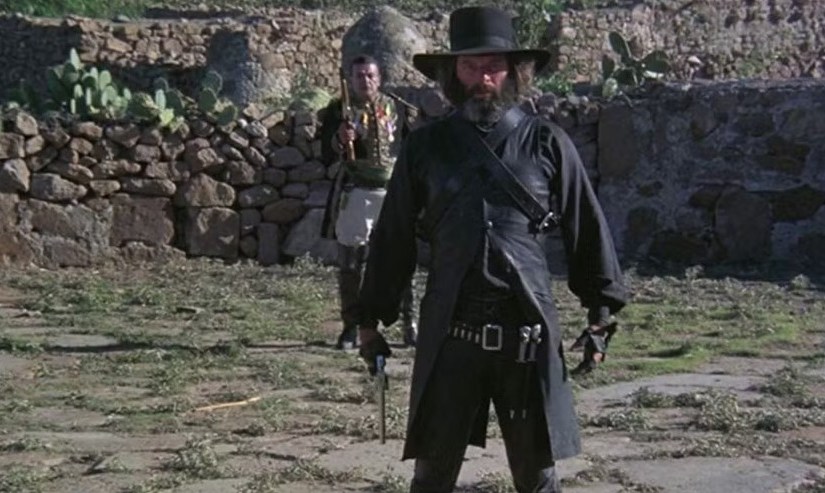
Right from the opening, Jodorowsky lets us know we’re in for something different.  A black-clad gunslinger, El Topo (“The Mole”) rides his horse out of the desert accompanied by a naked boy.  He dismounts and tells the boy to bury a teddy bear and a woman’s photo.  “You are seven years old.  You are a man.  Bury your first toy and your mother’s picture.”  They ride off, and thus begins an epic quest as El Topo searches for four gunfighting masters, seeking to defeat them in single combat.  But first he must liberate an unnamed woman from the clutches of an uncultured colonel and his four lackies, who have laid waste to an entire town…

Since this is basically the second grand image of the film, I feel justified in going on about it a little bit.  The town is a literal bloodbath.  One body is impaled near the top of what looks like a telephone pole.  The main street is dotted with pools of blood, and I don’t mean little puddles.  Bodies of villagers lie alongside the corpses of disemboweled horses.  One survivor crawls up to El Topo and begs to be put out of his misery.  El Topo draws his gun…and hands it to the boy instead.

Put off yet?  This movie should come with “trigger warnings.”  Suicide, disfigurement, sexual assault (with female AND male victims), nudity, animal cruelty, child endangerment, and probably a whole bunch of other stuff I’m forgetting.  The last time I watched a movie with this much controversial content (The Last House on the Left, 1972), I was left with a bad taste in my mouth.  This time, with El Topo, I felt there were parts of it that I could have done without, but I also felt a sneaky admiration that some lunatic was able to get this all on film, and not only did it succeed, but it became a legendary cult classic.

I can understand that, without being an outright fan of the film.  I mean, the whole movie is nothing but a series of WTF moments.  I haven’t even touched on the second woman encountered in the desert, or the colony of rabbits that starts dying spontaneously when El Topo arrives (some of them for real, it looks like), or the fortune teller with the live lion chained to her wagon, or the community of little and differently-abled people trapped inside an underground system of caves (“We are deformed, from the continuous incest”).

I would put El Topo in the same family as John Waters’ Pink Flamingos or Lynch’s Eraserhead, a cult classic that sort of dares you to watch, just so you can say you did it.  Like Santa Sangre, it’s full of unique imagery that you just won’t find anywhere else.  And, also like Santa Sangre, any deeper meanings to the story are either there for the gleaning, or it could just all be an acid trip.  I would accept either interpretation.

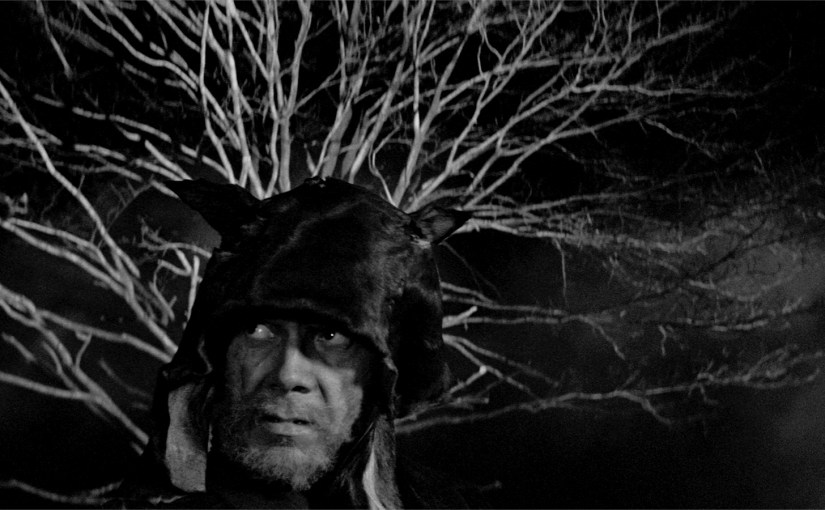
MARKETA LAZAROVÁ (Czechoslovakia, 1967)

by Miguel E. Rodriguez

DIRECTOR: František Vláčil
CAST: Josef Kemr, Magda Vášáryová, Frantisek Velecký
MY RATING: 5/10
ROTTEN TOMATOMETER: 100% Fresh

PLOT: In medieval central Europe, a young virgin promised to God is kidnapped and raped by a marauder whom her religious father seeks to kill in return.


In an interview on the Criterion Blu-ray of Marketa Lazarová, a British scholar of Czech film history acknowledges the film’s density and purposely obscure/unclear editing.  In so many words, he says, “But it’s unique, and you don’t always have to understand something unique.”

I mean…maybe not, but it couldn’t hurt.  Marketa Lazarová was named the best Czech film of all time in 1998, sports a 100% rating at Rotten Tomatoes, and is included in the invaluable compendium 1,001 Movies You Must See Before You Die.  It is loaded with visual style and inarguable beauty in widescreen black-and-white.  The production and costume designs are utterly convincing, placing us firmly in medieval Europe with a degree of authenticity I’ve rarely seen even in modern films set in that era.  But a model of storytelling it is not.  This movie further reinforces my tendency to shy away from “avant-garde” films of the ‘60s and ‘70s.

(And yet I really enjoyed watching Godard’s Weekend…go figure that one out.)

In broad strokes, the story begins with marauders raiding a traveling party and kidnapping the son of a nobleman.  The marauders are all the sons of a battle-scarred local lord, Kozlík, who rules his territory from a medieval castle and treats his sons barely better than he treats his prisoners.  Word of the kidnapping reaches the King, so Kozlík sends his eldest son, Mikolás, to pressure their neighbor, Lazar, to join forces with Kozlík in case the King decides to retaliate.  Lazar refuses, so Mikolás kidnaps Lazar’s virginal daughter, Marketa, just as she was about to join a convent.

Seems pretty straightforward, right?  “A” leads to “B”, “B” leads to “C”, and the gears of a bloody revenge story are set in motion.  But, man, I don’t know if I was in the wrong headspace or what, but I was unable to follow what was going in.  We’re presented with shots that, even with subtitles, don’t clue us in on who we’re looking at, or why.  Some of these shots are straight-up visions/dreams, intermixed with shots in the present, going to a flashback, then to a flashback IN the flashback, then back again and round and round.  Honestly, I felt like I was failing some kind of test.  I had to watch the special features to realize that one of the film’s sequences showed someone having sex with his sister…but even now, I’m not sure they meant with his OWN sister or someone ELSE’S sister.  When I need a flow-chart to follow a film’s progress, I’m not inclined to keep watching.

But I did.  Because, doggone it, there are striking cinematic flourishes that qualify this film as a visual tour de force.  The theme of hunting is referenced right from the start with a pack of wolves (or at least wild dogs) running through the snow toward an unseen quarry.  More than once, we see shots of antagonists and protagonists creeping stealthily through tall grass or tree branches either towards their prey or away from their tormentors.  Two particularly arresting shots look like they were taken from the Stanley Kubrick playbook; you’ll know them when you see them.

Which brings me to something I was thinking about while watching this movie: Kubrick’s 2001: A Space Odyssey.  There is no denying 2001’s place in cinema history as a genuinely important film.  But show it to someone who’s never read the book or the infinite number of essays on the film, and give me odds on whether they will correctly interpret the last twenty minutes, at least in terms of the novel’s explanation.

Marketa Lazarová is not quite as cryptic as 2001, but it is definitely the same species.  In a movie that runs two hours forty-two minutes, I finally got a grasp on the basic nuts and bolts of who was who around the 90-minute mark.  The style and cinematography are stellar, but they were not enough to keep me as interested as I would have been had it been edited more conventionally.  I could go into more details about the story, about the girl Marketa’s plight, how she falls in love with her captor/rapist, the gritty battle scene, the film’s elaborate intertitles separating discrete sections of the film from one another, but it would feel false, because, ultimately, the film’s storytelling method left me not caring what happened one way or the other.

There are plenty of other films that broke new cinematic ground and still managed to be engaging and compelling, so many that I won’t even try to list any here…you know what they are.  One day, I will watch Marketa Lazarová again, perhaps with my Cinemaniac buddies, to maybe catch what I missed the first time around.  On that day, I will welcome a lively discussion of my rightness and/or wrongness of my first experience with this film.  For now, my opinion is that uniqueness alone is not enough to make a film enjoyable.

K-POP DEMON HUNTERS (2025)

by Miguel E. Rodriguez

DIRECTORS: Chris Appelhans, Maggie Kang
CAST: Arden Cho, May Hong, Ji-young Yoo, Ayn Hyo-seop, Ken Jeong, Lee Byung-hun
MY RATING: 8/10
ROTTEN TOMATOMETER: 91% Certified Fresh [plus a resounding 99% on the new “Popcornmeter”, but who’s counting…]

PLOT: A world-renowned K-Pop girl group balance their lives in the spotlight with their secret identities as demon hunters.


For those living under a rock, K-Pop Demon Hunters is the movie that accomplished what no other movie has ever done: have four of its original songs in Billboard’s Top 10 rankings simultaneously.  (Even Saturday Night Fever had only three.)  Three hundred twenty-five million views on Netflix within 91 days.  The first Netflix film to open at #1 at the box office.  Recent winner of the Oscar for Best Animated Film.  Clearly, this is a movie with its finger on the pulse of the enormous global K-pop mania, and despite my general apathy towards K-pop in general (I can’t name one song by BTS, let alone a member – but I do know one of them was in Ready Player One), I figured it was time to give this phenomenon a day in court.

While it has not turned me into a K-pop “deokhu” – I had to look that up – K-Pop Demon Hunters was still great fun.  There were some questions that remained unanswered when the credits rolled, but I’m betting those will be addressed in the inevitable sequel.

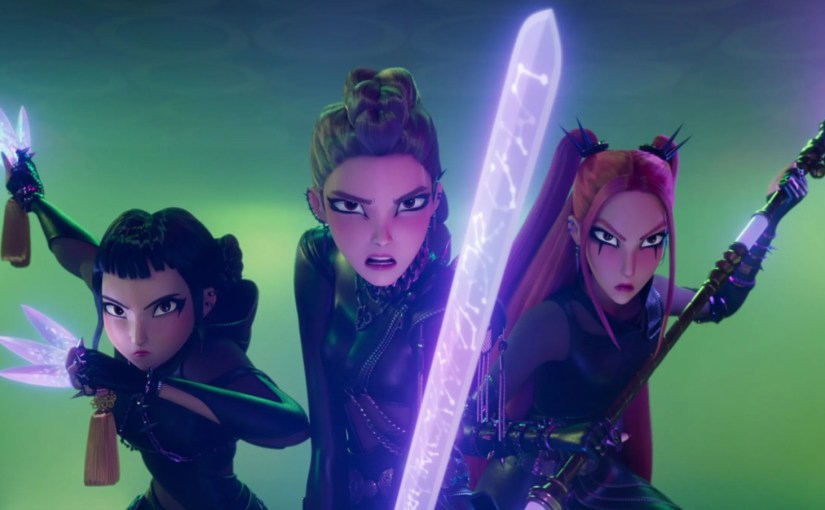
The plot sounds preposterous because, well, it kind of is.  Rumi, Mira, and Zoey are members of a wildly successful K-pop girl group called Huntr/x…when they’re not busy hunting and killing the demons that constantly prowl the city’s population looking for souls to capture for their dark master, Gwi-ma, an amorphous soul-devouring demon voiced by Lee Byung-hun, star of No Other Choice and G.I. Joe: The Rise of Cobra, which I actually liked, but moving on.

The story, interrupted only occasionally, but effectively, by musical numbers, involves a shield – I’m just going to call it a “demon shield” – that blankets the city, protecting its inhabitants from the nefarious demons as long as the girls of Huntr/x can use their voices to strengthen/power it.  If some demon butt-kicking is needed, they have that covered, too, showing off some cool-ass weapons and moves that would make certain radioactive reptiles green, or green-ER, with envy.  Jinu, an enterprising and musically-oriented demon in the underworld, comes up with a plan to defeat Huntr/x indirectly…through their fans.  And how do you sway fans of a kick-ass K-pop girl group?  Why, with an even more kick-ass K-pop BOY group, obviously.

But really, this is all just a clothesline from which to hang some truly creative visual stylings that owe their existence to the success of the recent Spider-Verse animated films.  Demon Hunters builds on that already-unique style by bringing in some even more unique Korean aeni (the Korean version of “anime”) flourishes.  The girls’ faces reflect intense emotions by turning into almost literal emojis.  When angry, their faces turn into something out of Dragon Ball Z.  When sad, their eyes turn huge and watery, the ultimate puppy-dog eyes.  When they see a hunky guy, their eyes first turn into cartoon hearts, then into, ahem, ears of corn when they behold the hunk’s washboard abs.  (The corn later turns into popcorn.)

Out of context (such as it is), this must all sound absurdly infantile, but, after a few minutes of culture shock, I found myself caving in to the absurdity.  And there is a deeper message to be found here, concerning concepts of self-worth vs. self-deprecation, and how self-doubt only wins when you cut yourself off from people who love you.  (I’m simplifying; the movie does a much better job of fleshing it out.)  While it’s not really a movie made for my generation, I nevertheless had a lot of fun with it.

And…yes, dammit, the songs are really catchy.  Even the “Soda Pop” one.

That’s right.  I said it.

THE BAREFOOT CONTESSA (1954)

by Miguel E. Rodriguez

DIRECTOR: Joseph L. Mankiewicz
CAST: Humphrey Bogart, Ava Gardner, Edmond O’Brien, Marius Goring, Rossano Brazzi
MY RATING: 7/10
ROTTEN TOMATOMETER: 100% Fresh

PLOT: The life of a Hollywood star whose candle burned briefly and brightly is told (mostly) by the writer/director who helped discover her.


Towards the beginning of The Barefoot Contessa, I let my expectations get the best of me, as I tend to do.  There were scenes between movie producers and directors and conversations about actors and the movie business and dialogue about bad dialogue at the movies, and I settled myself in for another scorching “behind-the-scenes” movie like Sunset Blvd. or The Bad and the Beautiful.  Heck, it was written and directed by All About Eve’s Joseph L. Mankiewicz, so how could I NOT expect something similar?  But I was wrong.  True, the film takes potshots at the industry, but later on it all feels incidental, a necessary sideshow to lead us to the main attraction.

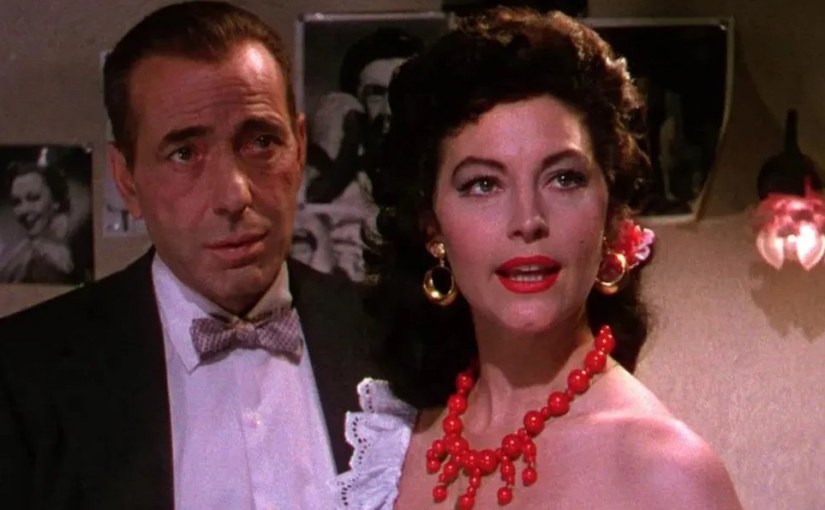
The Barefoot Contessa is a character study about a woman named Maria Vargas (Ava Gardner), who is discovered dancing in a Madrid café by B-movie writer/director Harry Dawes (Humphrey Bogart) and kajillionaire producer Kirk Edwards…whose resemblance to Howard Hughes had to be toned down under threat of legal action from Mr. Hughes himself.  They are scouting for new talent along with Edwards’s gofer, Oscar Muldoon, played by Edward O’Brien, who won an Oscar himself for the role.

Maria is convinced to do a screen test, not by Oscar or Edwards, whose wealth has turned him into a spoiled child, but by the gentle persuasion of Harry Dawes, who quickly sizes Maria up as someone who is not to be bullied or cajoled.  One thing leads to another, and she makes three films in America, all directed by Dawes, and she becomes an enormously popular star, beloved by millions…and three weeks after her fairy-tale wedding to an Italian count, she’s dead.  (That’s not a spoiler; the film opens at her funeral.)

There are so many stories of Hollywood stars who achieve overnight success only to die young for one reason or another.  The Barefoot Contessa tries to get into the mindset of one such actress, but only from the outside, as the public knew her.  Not her friends, because she really only had one: Harry Dawes, the only person who really knew what made her tick, thanks to a heartfelt conversation outside her impoverished Spain apartment.  How much of this conversation reflects what really goes in any actor’s head?  Probably a lot.  She talks about childhood fears, a desire to be loved, her unhappy home life with her parents, insecurities, superstitions (she refuses to wear shoes whenever possible)…there isn’t an actor walking this earth who couldn’t identify with at least two of those issues.

We follow Maria as she moves to Hollywood, changes her last name to D’Amata because it’s more exotic, and becomes a superstar almost against her will.  Ava Gardner plays Maria as someone for whom acting is not a dream job, it’s just a job.  If the by-product is fame and fortune, well, that’s just a lucky break.  Maria is looking for the fairy tale, but it doesn’t involve limos and red carpets, nor does it involve finding a prince who’ll put the slippers back on Cinderella’s feet.

The Barefoot Contessa shifts narrators a couple of times, but it all leads to her fateful meeting with, and eventual wedding to, the dashing Count Vincenzo Torlato-Favrini, an Italian nobleman who “rescues” her from a verbally abusive paramour.  The Count, though, harbors a secret that Dawes, with his “number six sense”, is bothered by, but can’t quite pin down…and since I knew Maria would be dead soon, I thought I knew what that problem was, but boy, was I wrong…

This film may not spark and crackle like All About Eve, but it’s chock full of ideas.  There were times when it felt like it was trying just a little too hard to be a “great” movie, and I know that’s vague, but it’s the best way I can think of to describe it.  I think I need to watch it again, now that I know more or less what’s going to happen, and appreciate what it’s trying to say in the context of stars like Jean Harlow, or Heath Ledger, or Marilyn Monroe, or James Dean.

This movie isn’t so much a “at-what-price-fame” kind of story, though, like Walk the Line or [insert title of musical biopic here].  It’s more like a portrait of someone who beat the system, who was able to reap the benefits of stardom without being consumed by it, much to the consternation of everyone around her.  (But it’s not what killed her; write that up to her desire for the fairy tale.)