TWO-LANE BLACKTOP (1971)

by Miguel E. Rodriguez

DIRECTOR: Monte Hellman
CAST: James Taylor, Warren Oates, Laurie Bird, Dennis Wilson, Harry Dean Stanton
MY RATING: 3/10
ROTTEN TOMATOMETER: 93% Certified Fresh

PLOT: While drag-racing through the American Southwest in a 1955 Chevrolet 150, a driver and his mechanic cross paths with an enigmatic hitchhiker and the tall-tale-spinning driver of a GTO.


Once upon a time, comic strip Bloom County name-dropped Gregory Peck in a Sunday-paper cartoon.  When this was brought to Peck’s attention, he read the cartoon and asked, “What is Bloom County?  What is the matter with me that I don’t understand it?”

Gregory, I know how you feel.  Monte Hellman’s car-culture cult classic Two-Lane Blacktop is a film that was and is critically lauded, is on the National Film Registry, and is one of the 1,001 Movies You Must See Before You Die.  But after watching it – or sitting through it, more appropriately – I wasn’t angry; I was completely mystified.  What did I just watch?  What was the point?  Why should I care?  Did I miss the point because I missed the sixties?  What is the matter with me that I don’t understand this film?

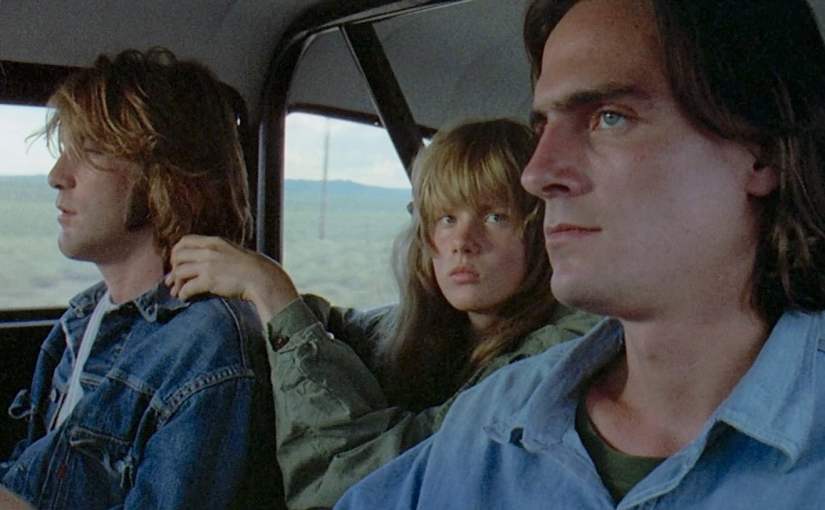
The ostensible plot involves a quartet of unnamed characters: The Driver (James Taylor!), G.T.O. (Warren Oates), The Girl (Laurie Bird, who tragically took her own life at the age of 26), and The Mechanic (Dennis Wilson!!).  We first see Driver and Mechanic rambling around Arizona in their souped-up, but dressed-down, 1955 Chevy 150.  [Eagle-eyed movie fans will recognize this as the same model car that Bob Falfa drives two years later in American Graffiti.]  To make some bread, they hustle other hot-rod owners into illegal street races which they handily win because, like the Millennium Falcon, their Chevy doesn’t look like much, but she’s got it where it counts.

After one such race, two fateful things happen.  The first is that they are spotted and passed twice by a stock 1970 Pontiac GTO 455 (nice) driven by the Warren Oates character.  The second is that they pick up a hitchhiker, The Girl.  Well, not exactly…she climbs into their car outside a diner, and when they walk outside to leave, they see her in the back seat and just drive off without any observable reaction that I could spot.  Probably wouldn’t happen today, but this was an era still reveling in the remnants of the Summer of Love, so I give it a pass.

At this point, I could spot French New Wave influences, not to mention echoes of The Hustler (1961), Easy Rider (1969), and good omens of American Graffiti (1973), especially in the film’s fascination with cars.  One short scene involves virtually nothing but shots of The Mechanic changing out the rear racing tires for street-legal tires.  I remember thinking, this is a movie about gearheads, BY gearheads, FOR gearheads.  Not necessarily a bad thing – I’d put Mad Max (1979) and its sequels in that category.  So, okay, I thought, let’s see where this goes.

And I waited, and waited, and waited some more.  James Taylor as The Driver has a great intense look while he’s actually driving, but I have to say it: he has zero charisma.  He could have used an acting coach.  Dennis Wilson as The Mechanic is marginally better.  He’s very easygoing on camera, while Taylor looks stiff and uncomfortable.  I can only imagine their presence was a calculated ploy to bring younger audience members to theaters.  Newcomer Laurie Bird as The Girl is as okay as okay gets.

I get it: the French and Italians used non-actors in their neo-realist films to achieve authenticity from their performances.  Well and good.  But whatever those films had, this one does not.  Blacktop would have benefited immeasurably from veteran actors in the two leads, actors who could at least generate some chemistry with Warren Oates, who gives by far the best performance in the film, even it’s in the service of a vaguely antagonistic character that I never understood.

Full confession: this movie is not badly or clumsily made.  Parts of it felt like they were going for a Five Easy Pieces (1970) vibe, and I think they got it visually.  But the movie never got me to care about what happened to any of the characters.  The Driver is a cipher, The Mechanic is barely more than that, The Girl (who, I guess might represent the concept of “free spirit” in the hippie culture?) is maddening at best and impenetrable at worst, and G.T.O. is all over the place emotionally, which I guess makes him the most interesting character in the film.  I didn’t like him much, but I was always curious what would come out of his mouth next.  (His overriding character trait is that he constantly lies to everyone he meets about who he is, improvising his own backstory with each new encounter.)

Which made me think.  For the longest time, I thought that I had issues when movies or TV shows centered their plots on characters who I thought were unlikable.  But then there’s Succession which I can’t rave about highly enough, or Get Carter (1971) or The Godfather (1972), all filled with genuinely unlikable characters, but which are among my favorite entertainments.  Watching Two-Lane Blacktop, I at first thought I didn’t like the movie because I didn’t like the characters, but that’s inaccurate.  I didn’t like the movie because I didn’t care about the characters.  An effective film can introduce anti-heroes and straight-up villains and get us to root for them because we start to care about the characters and the story.  Two-Lane Blacktop was unable to get me to care about the characters, so I simply didn’t care what happened next.  For a hundred minutes.  That’s a long time.

On the Criterion Blu-ray, director Monte Hellman and various other film fans and scholars wax rhapsodic about the film’s existential overtones, and its place in film history as a time capsule of an era when studio films like this one would become more prevalent for the next decade, while simultaneously heralding the rise of independent films (which can actually be traced further back to 1958 with Cassavetes’ Shadows, but what do I know).  While I acknowledge there may be aspects of this movie that eluded me and which I may pick up on if or when I see it again, I have to be honest…my initial reaction was one of consternation.  If I have to peel the movie like an onion to understand its relevance, is that necessarily a good thing?  I don’t know.  Some movies have achieved that kind of goal (I’m thinking specifically of 2001: A Space Odyssey [1968]), but they are few and far between.  For me, Two-Lane Blacktop was not one of them.  Yet, he said with hope for the future.

STRIPES

By Marc S. Sanders

A trifecta of talent was widely received when Bill Murray, Harold Ramis and Ivan Reitman came on the Hollywood scene. With films like Meatballs and Animal House, they were toeing the line of B movie T&A material. Audiences, however, responded to the wisdom in the comedic potential of disregarding the authoritative party. That is especially true in their R rated army romp from 1981, Stripes.

Stripes is arguably not their most memorable film of any of their careers, but for me it is probably my favorite; more than Caddyshack or Ghostbusters. The comedy was spot on, and the timing was perfect. When John Winger and Russell Zisky (Murray & Ramis) decide to enlist in the army on a spur of the moment, their basic training experience is actually believable. It could happen. I could relate. If I was as big a guy as John Candy, playing the lovable “Ox,” and I was running the obstacle course, yeah…I might run off course uncontrollably into the outer woods. All these guys are completely out of shape. There’s no way we were ever gonna see Rambo here.

Bill Murray might be the leader of this rag tag gang of miscreants, but his own material is just very, very funny. Few comedies have such a hilarious opening scene as he does while he escorts a snobby woman to the airport in his cab. He has enough of her, and so everything is put out on the table. The Three Stooges would have smacked a pie in this woman’s face. John Winger decides to terrify her with some action photos while he drives. To date, no one has ever come close to duplicating this scene.

Winger continues with his rebellion against his Drill Sargent played by Warren Oates who is terrific in his own right. Oates convincingly comes off as straight army material amid all of these nitwits. He can give a facial expression that says a thousand words.

John Candy is a huge highlight in perhaps his breakthrough cinematic performance. Ramis and Reitman wrote a great character in Ox. I think it’s hilarious that a fat guy thinks the most ideal way to lose weight is to join the army because it’s free with a six to eight week work program. We all love to see that it eventually occurs to Ox that basic training in the Army is not exactly a weight watchers program. A major highlight is when Winger rushes Ox into a mud wrestling ring at an adult club. Pure slapstick fun. You can’t help but laugh.

I’m surprised to see that many took issue with the film’s second half. I loved it as the platoon has to pursue Winger and Ziskey who have a special puke green colored RV that the army has engineered with more weaponry than a James Bond car. Eventually, this leads to a ridiculous rescue within a Russian occupied Czechoslovakian outpost. It’s a great blend of action and comedy that holds up nearly 40 years later. What’s not to like?

I’ll be honest. I saw Stripes when I was 10 or 11, and it actually gave me an education on the current life of what it’s like to be in the Army. Having never enlisted, I’m nevertheless convinced that Warren Oates was an accurate interpretation of what a hard driven Drill Sargeant was like. Because it seemed so genuine. It seemed only fitting that a great comedy could be drawn from resisting that kind of authority. The material in Stripes didn’t come off silly or Looney Tunes like. It all seemed natural. The jokes just came alive amid the challenges of entering the Army life.

Stripes remains a favorite comedy of mine.

IN THE HEAT OF THE NIGHT

By Marc S. Sanders

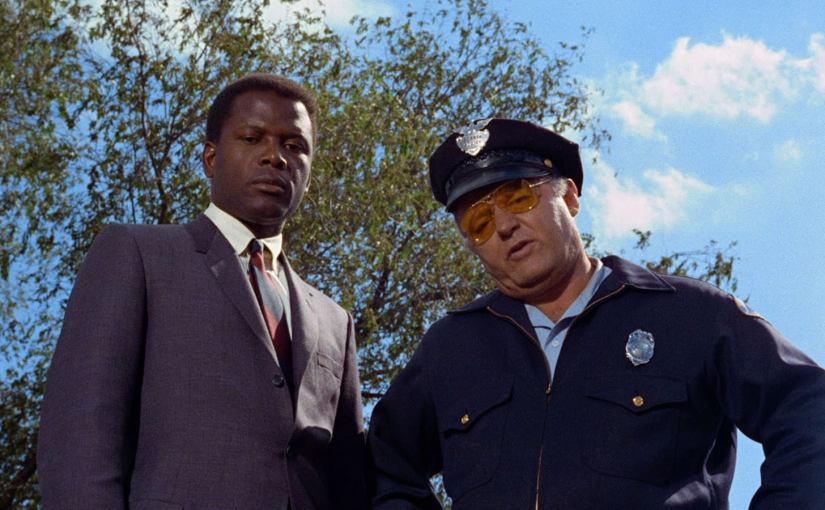
In 1967, just before the assassination of Dr. Martin Luther King Jr, Norman Jewison’s film In The Heat Of The Night won five Academy Awards including Best Picture, Best Actor for Rod Steiger and Best Adapted Screenplay by Sterling Silliphant.  While it is easy to classify the movie as a crime drama/murder mystery/detective story, the setting and themes of racial prejudice overshadow who the killer is or the motive.  As the film progressed, I grew less curious of who bludgeoned white businessman Philip Colbert to death and why.  It was much more important to understand exactly why Steiger’s Mississippi Police Chief Gillespie is so quick to believe that a well dressed and cooperative black man who was simply apprehended for waiting at a train station would be the culprit.  The black man is Virgil Tibbs (Sidney Poitier), a Philadelphia police detective.

After Tibbs has an opportunity to identify himself, Gillespie shamelessly requests his services in solving the crime.  Murder doesn’t happen often in Sparta, Mississippi.  Tibbs’ supervisor speaks highly of his officer’s capabilities.  Tibbs knows how to look for signs of rigor mortis on the deceased.  He knows how to identify that the killer was right-handed and he knows that when another suspect is quickly brought in, that he can’t be the killer either.  Still, many of the heated conversations between Gillespie and Tibbs are the same.  Their back and forths even become redundant at times.  Gillespie, nor the deputies and other residents of Sparta, are apt to listen to a “colored” person.  At one point, Tibbs is put in a cell for not agreeing with Gillespie’s conclusions.  He’s also ordered on two or three occasions to get out of town.  Tibbs is not so willing to surrender though, even if he’s regarded with racial disdain.  The impression is that this murder will not be so challenging for Tibbs to solve, if only he had a little more time and cooperation.  So, the riddle of the crime is not the overall conflict of In The Heat Of The Night.  More so, it is the racial hatred that a deep south Mississippi town has for an educated and skillful black man from up north.  

I read that the film was shot primarily in Sparta, Illinois.  Poitier made that request for his own safety while a tense period within America was occurring against the backdrop of the civil rights movement.  Jewison’s film is quite brave.  In the face of racial divide within the United States, this film still got made.  Yet, it had to be produced with an abundance of caution. 

A telling scene happens in the middle of the picture.  Tibbs requests Gillespie escort him to a wealthy cotton plantation owner’s home.  As they drive up to the home, they pass by the black cotton pickers collecting the crops under the hot sun.  They meet in the estate green house with a Mr. Endicott, who comes off very cordial to Tibbs at first.  However, when a slight accusatory question comes from Tibbs, Endicott slaps him across the face.  Tibbs responds with a slap right back at him.  In Mississippi, a black man better know his place, even if the prime suspect of a murder is a wealthy white man, or more simply just white.  It’s a classic moment in film history.  However, it remains an important scene and maybe its significance should be all the more heightened in modern day 2022 with the Black Lives Matter mentality at the forefront; where police/African American race relations are being tested. 

Three white men were recently sentenced to life in prison without parole for the hate crime killing of a black jogger named Ahmaud Marquez Arbery in the state of Georgia.  All that Mr. Arbery was doing was jogging through a neighborhood.  He didn’t have a weapon.  He hadn’t come in contact with anyone to even slightly suspect a threat.  He was noticed by these three criminals, and because he didn’t belong in that area, he was brutally murdered for the color of his skin.  Evidence would reveal where these men stood with regards to black people as a history of various texts that were clearly racial in nature were later uncovered.  If it wasn’t going to be Mr. Arbery who was murdered, it was eventually going to be another black person who would fall victim to these men. 

Though Dr. King was murdered shortly after the release of In The Heat Of The Night, I’m cautiously optimistic that racial hatred has lessened and the generations that followed learned from the misgivings of their ancestors.  Still, the term “hate crime” is often used in news reports today.  The debate of the Confederate flag and its argument for keeping it flying still has to be pondered.  Fifty years later, I cannot understand why, though. 

I will never forget a vacation I took with my family to Stone Mountain in Georgia back in 2005.  It was fourth of July and we were picnicking on the lawn next to a couple of teenagers while waiting for the fireworks.  I struck up a conversation with a local teenage girl and the flag and the confederacy along with the carving of Confederate leaders (Stonewall Jackson, Robert E. Lee and Jefferson Davis) on the rock sight were brought up.  Her defense of these topics was “It’s history.  Not hate.”  I became much wiser in that moment.  I was just a naïve Jewish guy who was raised in New Jersey.  I was not aware enough.  Much still hadn’t been learned and a whole lot needed to be unlearned.  History is not a reason to celebrate.  History is not meant to honored.  History is meant to be remembered for our rights, and especially our wrongs.  Much of history should not be repeated, and yet that’s what happens all too often.

In The Heat Of The Night is another example of the power of films.  So much is debated about what is taught in our schools.  A proposal of law for “Don’t Say Gay” is likely to be passed in Florida where it’s deemed impermissible to discuss homosexuality in elementary schools.  Books are continuing to be restricted from availability in libraries.  So, if our institutions of learning are being censored, then we have to rely on other mediums.  Movies like Schindler’s List or In The Heat Of The Night or Do The Right Thing offer those opportunities.  Films open a window to view love and hate as well as tolerance and prejudice.  We can never afford to look at our world with rose colored glasses.