
by Miguel E. Rodriguez
DIRECTOR: Monte Hellman
CAST: James Taylor, Warren Oates, Laurie Bird, Dennis Wilson, Harry Dean Stanton
MY RATING: 3/10
ROTTEN TOMATOMETER: 93% Certified Fresh
PLOT: While drag-racing through the American Southwest in a 1955 Chevrolet 150, a driver and his mechanic cross paths with an enigmatic hitchhiker and the tall-tale-spinning driver of a GTO.
Once upon a time, comic strip Bloom County name-dropped Gregory Peck in a Sunday-paper cartoon. When this was brought to Peck’s attention, he read the cartoon and asked, “What is Bloom County? What is the matter with me that I don’t understand it?”
Gregory, I know how you feel. Monte Hellman’s car-culture cult classic Two-Lane Blacktop is a film that was and is critically lauded, is on the National Film Registry, and is one of the 1,001 Movies You Must See Before You Die. But after watching it – or sitting through it, more appropriately – I wasn’t angry; I was completely mystified. What did I just watch? What was the point? Why should I care? Did I miss the point because I missed the sixties? What is the matter with me that I don’t understand this film?
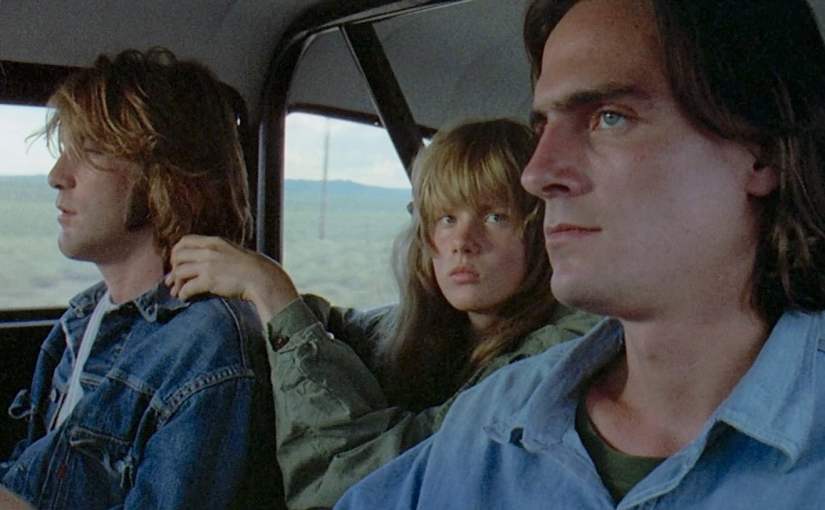
The ostensible plot involves a quartet of unnamed characters: The Driver (James Taylor!), G.T.O. (Warren Oates), The Girl (Laurie Bird, who tragically took her own life at the age of 26), and The Mechanic (Dennis Wilson!!). We first see Driver and Mechanic rambling around Arizona in their souped-up, but dressed-down, 1955 Chevy 150. [Eagle-eyed movie fans will recognize this as the same model car that Bob Falfa drives two years later in American Graffiti.] To make some bread, they hustle other hot-rod owners into illegal street races which they handily win because, like the Millennium Falcon, their Chevy doesn’t look like much, but she’s got it where it counts.
After one such race, two fateful things happen. The first is that they are spotted and passed twice by a stock 1970 Pontiac GTO 455 (nice) driven by the Warren Oates character. The second is that they pick up a hitchhiker, The Girl. Well, not exactly…she climbs into their car outside a diner, and when they walk outside to leave, they see her in the back seat and just drive off without any observable reaction that I could spot. Probably wouldn’t happen today, but this was an era still reveling in the remnants of the Summer of Love, so I give it a pass.
At this point, I could spot French New Wave influences, not to mention echoes of The Hustler (1961), Easy Rider (1969), and good omens of American Graffiti (1973), especially in the film’s fascination with cars. One short scene involves virtually nothing but shots of The Mechanic changing out the rear racing tires for street-legal tires. I remember thinking, this is a movie about gearheads, BY gearheads, FOR gearheads. Not necessarily a bad thing – I’d put Mad Max (1979) and its sequels in that category. So, okay, I thought, let’s see where this goes.
And I waited, and waited, and waited some more. James Taylor as The Driver has a great intense look while he’s actually driving, but I have to say it: he has zero charisma. He could have used an acting coach. Dennis Wilson as The Mechanic is marginally better. He’s very easygoing on camera, while Taylor looks stiff and uncomfortable. I can only imagine their presence was a calculated ploy to bring younger audience members to theaters. Newcomer Laurie Bird as The Girl is as okay as okay gets.
I get it: the French and Italians used non-actors in their neo-realist films to achieve authenticity from their performances. Well and good. But whatever those films had, this one does not. Blacktop would have benefited immeasurably from veteran actors in the two leads, actors who could at least generate some chemistry with Warren Oates, who gives by far the best performance in the film, even it’s in the service of a vaguely antagonistic character that I never understood.
Full confession: this movie is not badly or clumsily made. Parts of it felt like they were going for a Five Easy Pieces (1970) vibe, and I think they got it visually. But the movie never got me to care about what happened to any of the characters. The Driver is a cipher, The Mechanic is barely more than that, The Girl (who, I guess might represent the concept of “free spirit” in the hippie culture?) is maddening at best and impenetrable at worst, and G.T.O. is all over the place emotionally, which I guess makes him the most interesting character in the film. I didn’t like him much, but I was always curious what would come out of his mouth next. (His overriding character trait is that he constantly lies to everyone he meets about who he is, improvising his own backstory with each new encounter.)
Which made me think. For the longest time, I thought that I had issues when movies or TV shows centered their plots on characters who I thought were unlikable. But then there’s Succession which I can’t rave about highly enough, or Get Carter (1971) or The Godfather (1972), all filled with genuinely unlikable characters, but which are among my favorite entertainments. Watching Two-Lane Blacktop, I at first thought I didn’t like the movie because I didn’t like the characters, but that’s inaccurate. I didn’t like the movie because I didn’t care about the characters. An effective film can introduce anti-heroes and straight-up villains and get us to root for them because we start to care about the characters and the story. Two-Lane Blacktop was unable to get me to care about the characters, so I simply didn’t care what happened next. For a hundred minutes. That’s a long time.
On the Criterion Blu-ray, director Monte Hellman and various other film fans and scholars wax rhapsodic about the film’s existential overtones, and its place in film history as a time capsule of an era when studio films like this one would become more prevalent for the next decade, while simultaneously heralding the rise of independent films (which can actually be traced further back to 1958 with Cassavetes’ Shadows, but what do I know). While I acknowledge there may be aspects of this movie that eluded me and which I may pick up on if or when I see it again, I have to be honest…my initial reaction was one of consternation. If I have to peel the movie like an onion to understand its relevance, is that necessarily a good thing? I don’t know. Some movies have achieved that kind of goal (I’m thinking specifically of 2001: A Space Odyssey [1968]), but they are few and far between. For me, Two-Lane Blacktop was not one of them. Yet, he said with hope for the future.

