JAGGED EDGE

By Marc S. Sanders

Joe Eszterhas is the screenwriter of Basic Instinct, which attracted a slew of controversy for its risqué nudity and sexual content framed around a brutal crime drama that many took issue with painting lesbianism in an unfavorable light, by means of an icepick.  If I recall correctly, he sold his screenplay for twenty million and while I consider it to be a crackling good thriller, it’s clear the writer and director (Paul Verhoven) were aiming for shock material of boobs, blood and revealing cross legged visuals to amplify what could’ve been an tame episode of Columbo. 

Prior to that profitable notoriety, Eszterhas churned out courtroom drama mired in lust and murder called Jagged Edge.  I imagine this film was considered daring when released in 1985.  However, jumping to forty years later, everything from the sexual material to the courtroom antics appear stale, outdated and lacking any kind of zip.  In this movie, the murder trial plays like a table tennis volley.  A witness is called by the prosecution, and the defense is shocked as to who this could be.  The favor is returned when the defense calls a witness.  Both sides sit up in their chairs and ask why they didn’t know about this person or why wasn’t evidence presented in discovery and so forth.  Two years after this movie came out, L.A. Law hit the airwaves every Thursday night and this routine became ritual fodder.   Counsel would outsmart the opposition and grin like they shot baskets from center court.  Today though, even I’m much smarter than the lawyers that Eszterhas drafted into this script directed by the late Richard Marquand (Return Of The Jedi, Eye Of The Needle).

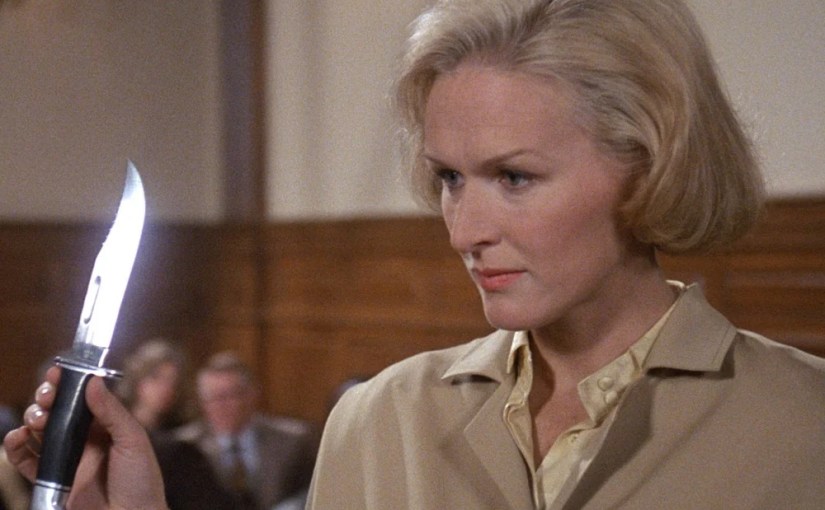
Jeff Bridges is the handsome local San Francisco newspaper editor, Jack Forrester.  He is the husband accused of murdering his wealthy wife in bed with a hunting knife.  The blade is curved and the top of it is jagged.  Hence the title. He’s known for his infidelity, and for repeatedly criticizing the city prosecutor, Tom Kransy (Peter Coyote) in print.  His business attorneys recruit Teddy Barnes (Glenn Close) to defend him.  Teddy has partnering experience with Kransy when they were prosecuting together.  A rift occurred between the two lawyers over a question of ethics.   She moved away from crime and into contract law.

Teddy warns Jack that if he’s not honest with her, she will cease to represent him.  Mr. Eszterhas, I think we know what will happen.  Right?  The witnesses in this trial are nothing challenging for either side.  They topple easily under Teddy and Tom’s questioning and when one side gets a huge advantage, the panic on the other side never feels truly convincing or suspenseful.  If these lawyers had more intelligence than the pens they hold, they would have vetted these people just a fraction better before allowing their testimony. Yet, Jagged Edge is supposed to be fast food law. 

What complicates this case is that ahead of the trial, as Teddy prepares, she becomes engaged in a sexual relationship with Jack.  Horseback riding specially builds the stimulation.  There is the Eszterhas label that many will recognize (Basic Instinct, Jade, Sliver, Showgirls).  The titles speak for themselves when glancing over his resume.  Teddy is supposed to come off with brains and intuition.  Yet, she follows through with unconvincing neglect.  Glenn Close is just too smart a person to be playing someone this reckless and stupid.  In 1985 though, maybe I could buy this. Law & Order episodes likely enhanced the intelligence of what we see in the eyes of the court since that time.

Jeff Bridges and Glenn Close have good chemistry, but Jagged Edge is cookie cutter material in the courtroom while the breadcrumbs that bring the two together are ridiculous.  Recently, I saw Lawrence Kasdan’s Body Heat for the first time.  That’s a sexy thriller that works between a lawyer and a murder suspect because the lawyer was a sleaze from the get-go.  Teddy Barnes is an attorney with principals. She’s also a loving mother and maintains a good relationship with her ex-husband.  So it lacks merit when I see her break her code of ethics so easily by getting involved with her murder suspected client.    It only happens because the omnipotent Joe Eszterhas makes it so by forcing a circle into a square. This professional woman even invites the accused back to her house where her kids reside. Really? Glenn Close’s characters would never do this. Kim Kardashian’s portrayals are another story.

When the killer is finally revealed in Scooby Doo fashion – mask pulled off the culprit – it could have gone one of three ways and any answer would have worked as well as drawing a card in a game of Clue.  Basic Instinct has a similar kind of ending.  It really didn’t matter how it wrapped up.  Columbo would have to walk back his steps to deliver undeniable proof.  Joe Eszterhas just makes it so and that’s what it will become, like a Choose Your Own Adventure.  

Actually, this film had some controversy because when the mask is pulled off the killer, audiences questioned whose face they were actually looking at.  The studio insisted on editing a little more time on the close up following the film’s initial release of first prints.  Siskel & Ebert devoted some airtime three weeks after the film came out to discuss as well.  I can see why there was skepticism, but I felt certain on who it was I was looking at.

Either way, Jagged Edge would always be considered pedestrian material with deliberate shocks of SEX and MURDER for the sake of drawing in crowds for its erotic nature.  Five years later, Basic Instinct would be the one to go full tilt, though.
COOGAN’S BLUFF

By Marc S. Sanders

Coogan’s Bluff is hardly Clint Eastwood’s best film.  The first collaboration with director Don Siegel is thin on story, flat on romance and light on its bad guy.  However, it is an important chapter in Eastwood’s storied career.

Shortly after the famed Sergio Leone spaghetti western Dollars trilogy, and ahead of his big city cop pictures, Coogan’s Bluff was the go-between.  The movie starts like a western with Deputy Coogan emerging out of the hot Arizona desert in his cowboy hat, uniform and rifle.  He’s not on horseback though.  He’s riding a jalopy of a jeep and he’s apprehending a wanted Navajo criminal.  He’s got the cool looking sunglasses on too.

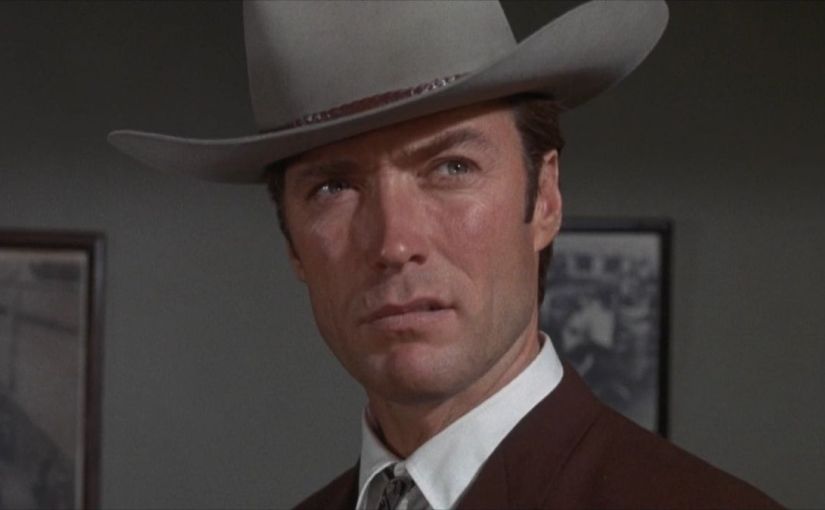
The movie shifts gears, and now Coogan is arriving by helicopter into the concrete jungle of New York City.  We never even see him get his assignment.  He shuttles to the police precinct by cab, maybe the deputy’s first cab ride ever because he gets charged a “luggage fee” for his briefcase. The station is run by Lt. McElroy (Lee J Cobb).  Coogan is the fish out of water, dressed in his white ten-gallon hat, brown suit and bolo tie.  McElroy doesn’t know any better and presumes this brute is from Texas, quite different from Arizona, and especially New York.  In 1968, Coogan is not a typical Midnight Cowboy.

He is here to extradite James Ringerman (Don Stroud) back to Arizona.  Not so fast though because McElroy tells him the crook is locked up at Bellevue for an LSD overdose.  There’s a lot of red tape with the judge and the state Supreme Court to go through before Coogan can get his hands on him.  Like a lot of Eastwood characters, Coogan will exercise his own kind of “bluff” and recover the lawbreaker who has actually escaped from the ward.

Coogan’s Bluff performs like a very rough first draft of a screenplay.  There are gaping holes in the narrative.  It’s never clear what crime Ringerman committed and how or why Coogan was assigned this case.  Siegel’s film began with this Navajo fugitive and a blond, adorable lass for Coogan to get in a tub with at home.  It’s a very abrupt cut to the New York City skyline though with his helicopter arriving on the famed Pan Am building (which is a few years away from a notorious helicopter crash).  Ten minutes in and we are watching a very different movie than what we started with.

A romance sparks between the lawman and a police psychologist (Susan Clark, “Ma’am” on Webster) as quick as Coogan arrives.  That relationship goes nowhere because Clark’s role and storyline lend nothing to the film except to stretch the running time to ninety minutes.  The pair end on a very weird note as well.  Scenes were missing to make this connection add up to the sum.  In their second to last encounter, Susan Clark is fuming with Eastwood over how Coogan treated one of her patients in his pursuit of Ringerman. In the final shot she is adoringly waving him away as his helicopter takes flight. What did I miss here?

It’s not all bad as Siegel’s picture plants the seeds of what would become all too familiar with Clint Eastwood – a tough, handsome, quietly brooding brawler who can handle himself in a bar fight and be triumphant in a thrilling, motorcycle chase.  The edits of both scenes are outstanding and Siegel captures magnificent shots.  

The fights, with pool cues, bottles and beer mugs as weapons of choice, are choreographed really well.  It doesn’t even look like the performers are being careful.  The set looks like something off the Universal lot though. Bar stools and tables break apart too neatly. The blood looks like paint. 

I have to believe Eastwood did most of his own stunt work, including leaping off a speeding bike and tackling Don Stroud’s antagonist.  Seamless work with well positioned camera placements.  It’s all so much more defined than the shaky stuff that Michael Bay would do thirty years later.  That kind of junk only hides the action that they would be afraid to execute.  The real stuff from guys like Siegel, Eastwood, McTiernan, Donner, and Peckinpah will always reign supreme.

Famed musician Lalo Schifrin is dropping familiar notes and cues that would thrill within the Dirty Harry world, four years later.  (Loved his assorted themes for Starsky & Hutch too.) Deputy Coogan, who doesn’t carry a gun, transitions into Inspector Harry Callahan with the .44 Magnum, and the stakes become bigger all around.  Schifrin’s piano keys and nervously fast strings amplify later in his own career from what he initially composed here.  It’s fun to recognize but like the script and edits of the movie, his work also feels incomplete.  Effective and interesting, but choppy and rough.

Don Siegel’s signature camera work is also familiar.  To ensure you recognize something of consequence, the director quickly zooms in on the bag, or prop or picture or close up.  Again, every tactic executed in Coogan’s Bluff feels like practice for what would be perfected later on.

Too much material must have been excised from Coogan’s Bluff in post.  Dots feel unconnected and while Clint Eastwood is worthy of acceptance, his performance is like an audition tape of the tough and silent guys his career will eventually offer.  

The cowboy cop enters a hippie nightclub splashed in rainbow colors and drugged flower power where he meets eventual Dirty Harry regular, Albert Popwell.  It’s fun to see the conservative Clint stick out, and would become a staple routine for his pictures, but this first try doesn’t quite stick the landing.  A bit like this remains unmatched to Eddie Murphy’s famous scene in 48 Hrs. with the honky-tonk club.  

The Man With No Name hung up the poncho, shaved the stubble, exchanged his thin Spanish cigars for cigarettes, put on a suit and carried a badge.  Why, the guy is just almost Dirty Harry!!!! Forgive my redundancy.  It’s just so evident of showing where Clint came from and where he was going next.  The story of this picture doesn’t matter.  The story of the guy leading this picture is what’s important.

I recommend watching a large sum of Clint Eastwood’s filmography before taking in Coogan’s Bluff.  Out of context of the actor/director’s choices, it’s a poor, uninteresting film.  Looking at it after familiarizing yourself with Clint Eastwood, and Don Siegel, it’s fun to see how apparent these men hopped from the dry desert heat into the city streets.

Coogan’s Bluff is not a great movie, but it’s a fascinating transitive piece from 1968.  It simply serves as a confident stride for its marquee name who will carry on a legendary tradition for the next fifty years thereafter. 

COYOTE VS. ACME

By Marc S. Sanders

It’s ironic and a bit reflective to think about how Coyote Vs. Acme eventually made it to theaters.  Along with an anticipated release of Batgirl, featuring another return for Michael Keaton as Batman, the Looney Tunes feature was abruptly shelved by Warner Brothers as a tax write off.  Corporate America was exercising its accountant’s bloody fist in order to amplify the books.  However, the people have spoken and the animated rascal would eventually have his day in court.  Batgirl seems to have not survived the Joker’s man-eating Venus Flytrap, however. (That was actually an episode from the ’60’s TV series that scared the bejeezus outta me when I was a kid…but Robin got eaten, not Batgirl.)

The mega-conglomerate known as Acme is arguably bigger than Amazon, Walmart, Disney, Apple and the world’s crop supply of Frozen Concentrated Orange Juice combined.  Why?  Well, because they have John Cena as their attorney with a bolo tie and cowboy hat to boot along with the shrewdest…I say…I say the shrewdest rooster known to mankind, Foghorn Leghorn as its current CEO.  One thing these guys know how to do is circumvent the faults of their products by executing small settlements or finding loopholes to escape from liability.

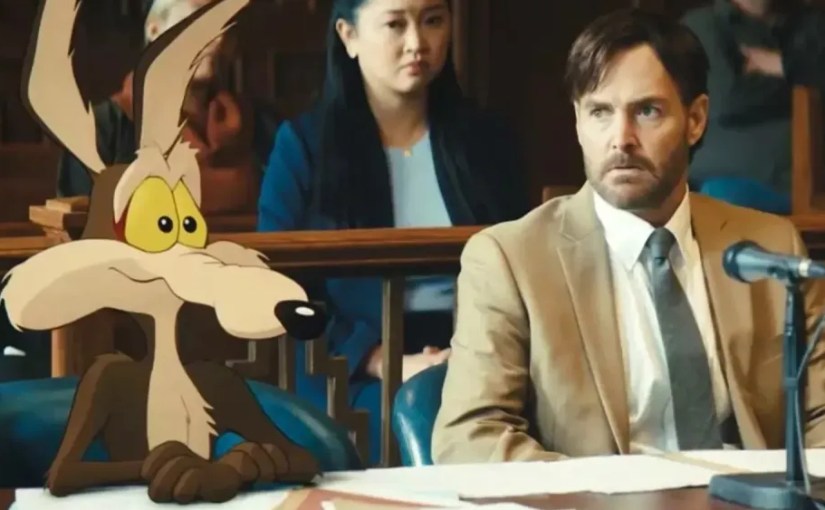
Wile E Coyote has had enough!  He’s invested hundreds of thousands of dollars in anvils, slingshots, gigantic magnets, rocket skates, and falling pianos.  Yet, his targeted prize – the meep, meeping Road Runner – evades captivity.  It’s time Acme bear some responsibility and pay.  So, he hauls all of his defective purchases into a handkerchiefed sack tied to a stick on his shoulder and hires an injury attorney for the cartoon community to represent him – a sad sack in a brown suit named Kevin Avery (Will Forte), assisted by his capably, confident, crusading niece Paige (Lana Candor).

The little man – ahem, rodent – is finally gonna sock it to Goliath corporation.  Suck it WB—-I mean Acme!!!!!

Coyote Vs. Acme is what you’d expect from Looney Tunes.  Everything is ridiculous and welcomes immense laughter with sight gags that only their brand of animation can offer.  No matter how many times poor Wile E. finds himself suspended in midair before suffering an enormous drop below, I love to see the dust cloud poof up and hear the “wampf” foley sound as he slams into the ground.  Being that the Road Runner/Coyote shorts were always my favorite of the Tunes, I never got enough of their routines.  The painted hole in the ground – you know to fall through? That’s here too.

None of the characters are reinvented.  They are just slotted into a courtroom liability suit that’s as familiar as what the Ford Corporation was culpable of when they knowingly left potentially explosive cars on the lots.  (See my review of Class Action found on this site.) 

Why? 

Because monetarily speaking the settlements would be more cost effective than a widespread product recall.  Well, as Wile E, Paige and Kevin will discover, Acme has a similar mindset for the cartoon community.  This makes for good courtroom drama such as the Tasmanian Devil’s raucous, indecipherable testimony (hilarious by the way) or the clandestine secrets that Tweety Bird and Bugs Bunny might be holding on to.  

Daffy Duck likely will not be a reliable witness, though.  DAMN YOU ACME!!!!

Coyote Vs. Acme is great entertainment that you can take your kids to while you laugh and nod your head at the newsworthy stories that inspired this plight of the plaintiff, Mr. Coyote.  Believe it or not, there’s a message mixed within all of the insanity.

I grew a little tired with the middle portion of the movie, and I could have welcomed some more antics within the courtroom that feature an underused Luis Guzmán as the judge.  The stakes of Kevin’s practice going under ring true of material from A Civil Action and Erin Brockovich as the case becomes more insurmountable.  Didn’t really need this frankly.  I don’t care about Kevin.  Just let Kevin do his job in court.  His insecure schlub slows the picture down some, even if Will Forte has cute chemistry with all of the characters.

I love that Tweety’s granny made it into the picture, but where was Sylvester? He’s in the background, having a catnap in the family room, but otherwise he’s got nothing to do.  That was a shame.  

Minor quibbles aside, Coyote Vs. Acme is refreshing animation combined with live action.  The artwork is thankfully not the newly updated computer graphics of Pixar and Minions fare.  I know the Looney Tunes were likely not hand drawn for this feature, but at least their images and actions are preserved in their original fashion.  If it ain’t broke don’t fix it and this is one thing that Acme, Warner Brothers and producer James Gunn keep intact.  Everything looks great with a perfect blending of human characters falling into complicated Looney Tunes traps. The conversations between the animated and human communities are seamless.  John Cena trying to decipher through Tweety’s speech impediment is winning.  I even applauded how the writers approach the now taboo character of the perverted and horny Pepe Le Pew.  The little stinker can actually still serve a purpose in a post Me Too climate.

I hope Coyote Vs Acme opens doors for more material.  Put the guys in a police station, or a hospital.  Have them enact a Law & Order episode.  Any one of them can run for President against Kelsey Grammar or Sean Penn or Mark Ruffalo for example.  These guys can easily operate in an internet world crowded with confusion and identity.  Keep the locomotive going, and if you get run over, dust yourself off, step off the tracks, and sift through the Acme catalog for the next novel invention.

Something has gotta work! Right Doc?

MEEP MEEP!!!

BREEZY

By Marc S. Sanders

The great thing about following Clint Eastwood’s career that spans over seventy years is there is so much I still have to uncover.  For example, following his well-known directed pictures Play Misty For Me and High Plains Drifter, he followed up with a surprising May-December meet cute romance called Breezy, which marks the first time he opted not to direct himself in front of the camera while going against type with an absence of threat or violence.  Heck, he even makes that clear when his heroine of the title makes a run for it out of a stranger’s car.

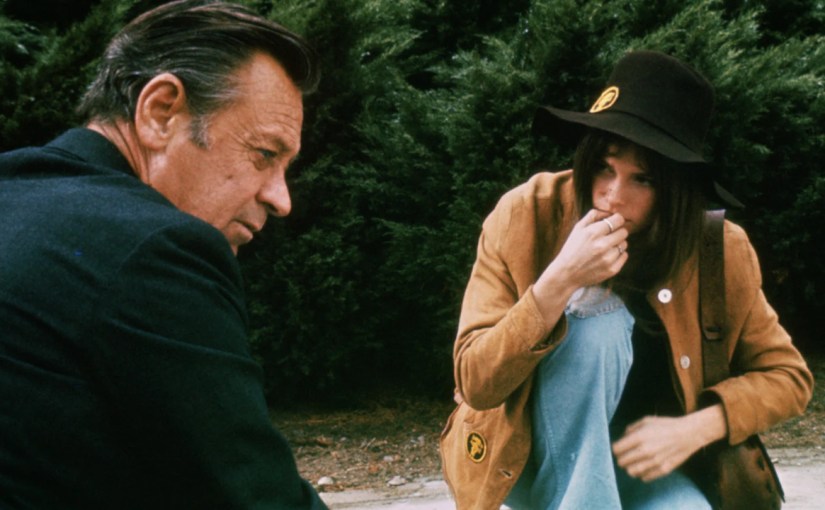
Breezy is played by a young Kay Lenz, her breakthrough role as a cheerful flower child, which reminded me of Julia Roberts’ hooker with a heart of gold in Pretty Woman.  Breezy aimlessly wanders through the California hillsides with her floppy hat and personalized guitar case on her back, hitching rides from one car to another.  When she comes upon the home of real estate agent Frank Harmon (William Holden), she happily hops in his car with a smile and a lot to chat about.  Frank is the middle age, twice divorced lonely bachelor, who is not looking for any company.  Yet, Breezy’s magnetism grows on him.  Her casual nudity around his house is not so much erotic as just a way to get past any awkwardness between the two. Breezy is young but you’d be hard pressed to find any insecurities about her. The more experienced and elder Frank may be quite the opposite, though.

William Holden plays a similar kind of personality that he would offer a few years later in Network; not quite over the hill but not looking back at the youth he might have felt thirty-five years earlier at Breezy’s age.  The main difference is that Breezy is nothing like Faye Dunaway’s cold-hearted character. Frank is mired in what he gave up too easily in his prior marriages (Joan Hotchkis, Marj Dusay), one on bitter terms, the other was regrettably let go.

Breezy is such a departure from what Eastwood, the filmmaker, accomplished in the 1970s.  He’s not crafting anything in the realm of his violent pictures like Dirty Harry or his six shooter cowboys.  Misty was also bent on a twisted and frightening nature which is entirely absent here.  About the only fingerprints you’ll find is a blink/miss it cameo of the proud director standing on the boardwalk as the lovers stroll by.  They also buy two tickets to see Drifter.  I like these wink n’ nod moments, reminiscent of Hitchcock’s notable mischief.  

This adult romance etched out of mid-life crises mixed with naive youth seems like a variant follow up to the success of Love Story. Kay Lenz occupied the Ali McGraw slot.  Midway through this picture, I told myself that had Eastwood been older, he likely would have played Holden’s role who was in his mid-50s at the time.  Eastwood would get the opportunity decades later with his superbly quiet adaptation of The Bridges Of Madison County. I’ll even say his soft spot shows in his Every Which… movies, albeit with an orangutan or Sondra Locke.

I discovered Breezy after listening to a podcast on the director’s career (Make My Day, found on Apple Podcasts) and my observations are much more alert.  Thematically, I had always divided Clint Eastwood’s career into two halves.  Whether it was comedy or drama, I always considered the bulk of his work before Unforgiven to rely on violence being resolved with violence delivered by his fists and gunplay.  To my knowledge thus far, the Oscar winning western was a first that paved the next thirty years of his career with messages of anti-violence (A Perfect World, Letters From Iwo Jima), steering his persona away from any celebration of bloodletting.  Breezy however, seemed to project maturely sensitive insights that I hardly saw from the filmmaker.  

Like most of his films, Breezy was furnished under budget with simple camera work.  The wheel is not being reinvented here, but with his regular crew, Eastwood assembles a tight story that evolves at a nice pace.  The love story is not rushed even if young Breezy opens every page of her book as quickly as she meets a new person.  William Holden in his sport coats, wide ties, and casual sweaters is the turtle against the rabbit of this race.  The enjoyment is observing when these two parties can move at similar speeds.  

You also get the opportunity to see how Frank and Breezy’s backgrounds clash.  The hippies that carry over from the sixties hang on the street corners while the white-collar professionals sit at their desks on the other side of the window, closing real estate transactions.  Frank’s friend Bob Henderson (the typical boring middle age/ middle class name) played by Roger C Carmel (Harry Mudd of Star Trek) thinks about what his life could be if he didn’t have his past choices to weigh him down.  That’s still a common issue for middle-aged men to wrestle with.  Breezy’s girlfriend Marcy (Jamie Smith Jackson) is a cute pal but it’s clear she has no future because of a neglectful boyfriend, and their shared habit of LSD highs.  Interestingly, neither camp has a problem with the other. In Eastwood’s film, these two very different communities are tolerable of the other’s existence. That’s refreshing. Still, Frank and Breezy have to realize the independence they have even if they are years, and worlds, apart from each other.

Clint Eastwood checks off all the boxes to emulate beautiful chemistry from his two leads. Their unexpected romance is uneven, but there lies the challenge for finding solid foundations of love and respect.