JAGGED EDGE

By Marc S. Sanders

Joe Eszterhas is the screenwriter of Basic Instinct, which attracted a slew of controversy for its risqué nudity and sexual content framed around a brutal crime drama that many took issue with painting lesbianism in an unfavorable light, by means of an icepick.  If I recall correctly, he sold his screenplay for twenty million and while I consider it to be a crackling good thriller, it’s clear the writer and director (Paul Verhoven) were aiming for shock material of boobs, blood and revealing cross legged visuals to amplify what could’ve been an tame episode of Columbo. 

Prior to that profitable notoriety, Eszterhas churned out courtroom drama mired in lust and murder called Jagged Edge.  I imagine this film was considered daring when released in 1985.  However, jumping to forty years later, everything from the sexual material to the courtroom antics appear stale, outdated and lacking any kind of zip.  In this movie, the murder trial plays like a table tennis volley.  A witness is called by the prosecution, and the defense is shocked as to who this could be.  The favor is returned when the defense calls a witness.  Both sides sit up in their chairs and ask why they didn’t know about this person or why wasn’t evidence presented in discovery and so forth.  Two years after this movie came out, L.A. Law hit the airwaves every Thursday night and this routine became ritual fodder.   Counsel would outsmart the opposition and grin like they shot baskets from center court.  Today though, even I’m much smarter than the lawyers that Eszterhas drafted into this script directed by the late Richard Marquand (Return Of The Jedi, Eye Of The Needle).

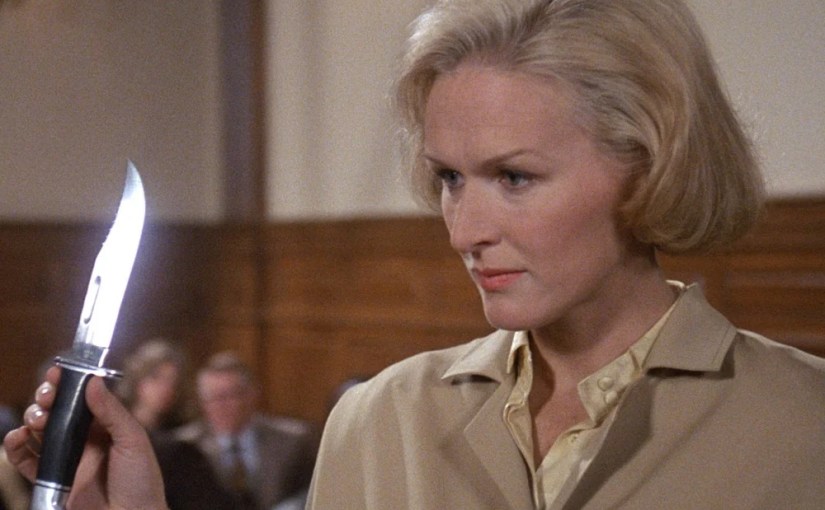
Jeff Bridges is the handsome local San Francisco newspaper editor, Jack Forrester.  He is the husband accused of murdering his wealthy wife in bed with a hunting knife.  The blade is curved and the top of it is jagged.  Hence the title. He’s known for his infidelity, and for repeatedly criticizing the city prosecutor, Tom Kransy (Peter Coyote) in print.  His business attorneys recruit Teddy Barnes (Glenn Close) to defend him.  Teddy has partnering experience with Kransy when they were prosecuting together.  A rift occurred between the two lawyers over a question of ethics.   She moved away from crime and into contract law.

Teddy warns Jack that if he’s not honest with her, she will cease to represent him.  Mr. Eszterhas, I think we know what will happen.  Right?  The witnesses in this trial are nothing challenging for either side.  They topple easily under Teddy and Tom’s questioning and when one side gets a huge advantage, the panic on the other side never feels truly convincing or suspenseful.  If these lawyers had more intelligence than the pens they hold, they would have vetted these people just a fraction better before allowing their testimony. Yet, Jagged Edge is supposed to be fast food law. 

What complicates this case is that ahead of the trial, as Teddy prepares, she becomes engaged in a sexual relationship with Jack.  Horseback riding specially builds the stimulation.  There is the Eszterhas label that many will recognize (Basic Instinct, Jade, Sliver, Showgirls).  The titles speak for themselves when glancing over his resume.  Teddy is supposed to come off with brains and intuition.  Yet, she follows through with unconvincing neglect.  Glenn Close is just too smart a person to be playing someone this reckless and stupid.  In 1985 though, maybe I could buy this. Law & Order episodes likely enhanced the intelligence of what we see in the eyes of the court since that time.

Jeff Bridges and Glenn Close have good chemistry, but Jagged Edge is cookie cutter material in the courtroom while the breadcrumbs that bring the two together are ridiculous.  Recently, I saw Lawrence Kasdan’s Body Heat for the first time.  That’s a sexy thriller that works between a lawyer and a murder suspect because the lawyer was a sleaze from the get-go.  Teddy Barnes is an attorney with principals. She’s also a loving mother and maintains a good relationship with her ex-husband.  So it lacks merit when I see her break her code of ethics so easily by getting involved with her murder suspected client.    It only happens because the omnipotent Joe Eszterhas makes it so by forcing a circle into a square. This professional woman even invites the accused back to her house where her kids reside. Really? Glenn Close’s characters would never do this. Kim Kardashian’s portrayals are another story.

When the killer is finally revealed in Scooby Doo fashion – mask pulled off the culprit – it could have gone one of three ways and any answer would have worked as well as drawing a card in a game of Clue.  Basic Instinct has a similar kind of ending.  It really didn’t matter how it wrapped up.  Columbo would have to walk back his steps to deliver undeniable proof.  Joe Eszterhas just makes it so and that’s what it will become, like a Choose Your Own Adventure.  

Actually, this film had some controversy because when the mask is pulled off the killer, audiences questioned whose face they were actually looking at.  The studio insisted on editing a little more time on the close up following the film’s initial release of first prints.  Siskel & Ebert devoted some airtime three weeks after the film came out to discuss as well.  I can see why there was skepticism, but I felt certain on who it was I was looking at.

Either way, Jagged Edge would always be considered pedestrian material with deliberate shocks of SEX and MURDER for the sake of drawing in crowds for its erotic nature.  Five years later, Basic Instinct would be the one to go full tilt, though.
WALL STREET

By Marc S. Sanders

Oliver Stone is a very good director at providing the evidence of cynicism within the worlds he films.  JFK covered a clandestine, conspiring environment oozing out of the columns of government.  Platoon not only depicted the horrors of war, but also the cancer that poisons the mentality of soldiers expected to protect one another.  Wall Street explores the temptations to cheat the stock market for grand prizes in wealth.  Gordon Gekko is the 1980s tycoon who never knows the meaning of enough.

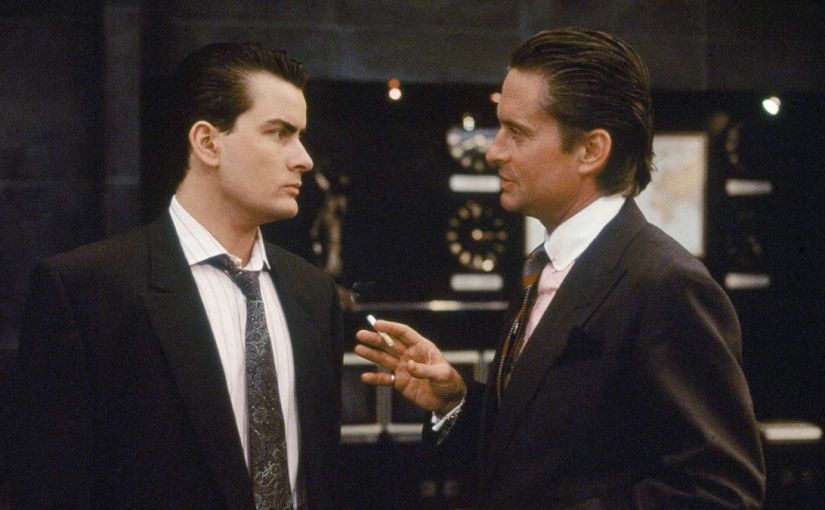
The well-dressed yuppie lizard, Gordon Gekko, is memorably played by Michael Douglas in his only Oscar winning role; regarded as one of the most villainous characters of the last fifty years.  It’s not a modest part, and Douglas’ performance is therefore electrifying.  With slicked back hair, the signature crackle of a voice inherited by his father Kirk, and the newest 80s innovation, a brick size cellular phone, the power to earn money and crush corporate enemies is done with ease.  Gekko relies on obtaining inside information (a federal crime) to find the next chest of treasures.  It might be an illegal practice but the best of the best at making mountains of money do it, and if you keep your process on the down low, nobody will catch wind of what you’re up to.  Gordon Gekko is an absolute genius, and he’s awarded a script of fast talking, slick monologues that justify his sins.

Bud Fox (Charlie Sheen) is the kid on the ground, way below Gordon’s high-rise office, desperately trying to get five minutes with the guy.  A whole day’s wait in the lobby and a birthday gift of Cuban cigars does the trick.  Now the lizard has the fox ensnared in his money-making schemes of deception and pursuits for unlimited greed.

Oliver Stone writes Sheen’s character as virginal when it comes to stock trading.  The kid is dying to get laid with the big boys while getting away from the cold calling hang ups of promising uncertain futures in stocks and bonds.  A subtle and effective angle is to give Bud a mentor.  Hal Holbrook enters the screen from left or right on many occasions to put his hand on Bud’s shoulder and give him his own twist of Confucius philosophy.  Then he exits out of frame towards the opposite direction he enters, leaving Bud to follow the questionable paths that Gordon paves.  Holbrook’s contribution to Wall Street has never been celebrated enough over the years.

Michael Douglas and Charlie Sheen are an outstanding pair of devilish mentorship against innocence lost.  Gekko preaches his passion for wealth on top of more wealth and why nothing should stand in his way, especially the law or the cost of others’ livelihoods.  Bud Fox emulates him as a master of the universe.  Charlie Sheen is great at being the biggest fan in Michael Douglas’ concerts of monologues. Watch how Sheen listens when Douglas has the floor. 

Martin Sheen extends his paternal role to Charlie within Stone’s film.  As Gordon sets designs on taking stock ownership of the small airline company that the father works for, the father/son relationship is tested, and Bud becomes blurred between what is right and wrong.  The Sheens have good debates and heightened dramatic moments.  I wish they were given more to do together though.  Perhaps even showing the wedge of the mother role within this family.

Additionally, Oliver Stone writes dynamics for Bud in a worker relationship with a fellow trader colleague (John C McGinley). There’s a former college pal/now lawyer (James Spader) that Bud tries to squeeze at the behest of Gordon’s demands.  Bud is also covered doing his own tricks of the trade such as dressing as a janitor to dig for what’s forbidden.

Why bring up all of these storylines?  Well, there’s a wealth of great material in Wall Street that’s relevant to the practice of insider trading and corporate overhaul.  Somehow though, Oliver Stone is responsible for writing one of the most unnecessary characters in film history.

Daryl Hannah just had to be cast as the buxom blond love interest for Bud Fox.  She’s never believable as a New York City interior designer and the chemistry between Hannah and Sheen is as thin as water.  Her name is Darien (a 1980s name) and one scene between Michael Douglas and her bustling the streets of Manhattan goes nowhere.  Wall Street is simply not the superb film it could have been because of the amount of time devoted to Daryl Hannah’s character.  Every moment she occupies is cutting room floor material.  When Darien exits the picture she’s never mentioned again.  The history she has with Gordon is never revealed to Bud.  Regrettably, it’s all meaningless.

What’s frustrating with Wall Street is its promise is never fully committed.  The roles awarded to Spader, McGinley, Holbrook and even Saul Rubinek in an early role as Gordon’s nerdy lawyer could have been even more fleshed out in lieu of what is covered with Daryl Hannah’s part.  More moments with Martin and Charlie Sheen would have better served the film.  A competitor tycoon played by Terence Stamp is very interesting and worthy of a larger presence.  Sadly, I imagine a studio producer or even Stone insisted on having a love interest that serves no purpose here except to put a glamorous actress above the title in the credits.  

Nonetheless, Oliver Stone built an authenticity to the hysteria of stock trading and corporate underhandedness.  When he shoots the scenes occupied by Bud and Gordon, he does handheld shaky camera work to emulate that nothing feels sturdy and balanced.  In moments that Bud’s father is at the center, the director shoots with a locked in position, bearing the character’s assured apprehension to trust his son or this prophet of greed.

I especially like the scene where Michael Douglas delivers his famous “Greed…is good!” speech at a shareholders’ annual meeting.  Stone glosses over all the company vice presidents and officers as well as the fat cat suits who carry stakes in the company.  Yet, the filmmaker also takes the time to show that little old lady with the pocketbook who finds her entitled seat to see how the value of her small ownership share is being treated.  Remember, if you own stock like Disney or IBM, you get that invitation in the mail to attend these meetings, and you have just as much a right to attend as all the Gordon Gekkos of the world.

Wall Street serves an important reflection of 1980s capitalism, while taking place in 1985, two years ahead of the infamous market crash of 1987 (the year the film was released).  Guys like Bud Fox had the Charlie Sheen image. Boyish men who got rich quick with little imagination to create and build.  They stood next to tall wealth and learned, but they never gained the knowledge to prepare for quick falls and disheartening sacrifice.  Most importantly, they took their own sense of morale for granted.  These are the best parts of Wall Street.

THE CHINA SYNDROME

By Marc S. Sanders

The China Syndrome explores the inherent risk that comes with a reliance on nuclear energy.  It also touches upon the moral choices within the field of journalism.  Most importantly though, it’s a hell of a thriller.

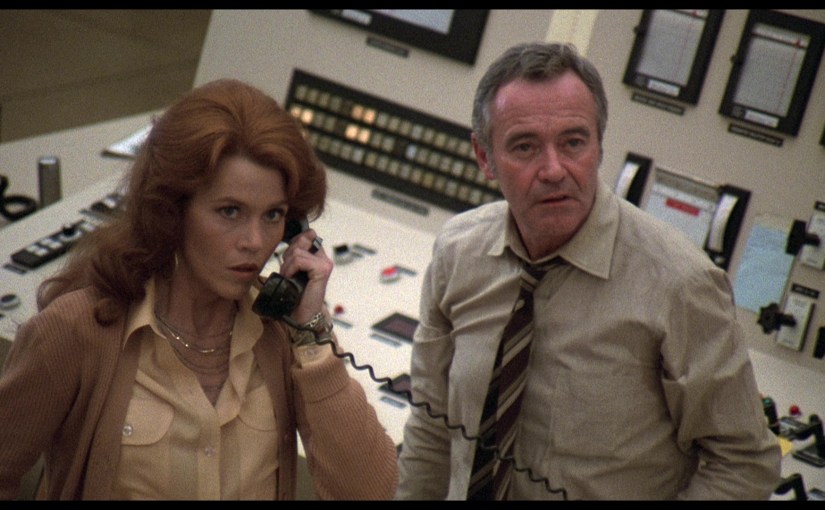
Kimberly Wells (Jane Fonda) is an on the scene reporter doing light fare topics for the evening news, like the novelty of singing telegrams for example.  With her subcontractor cameraman, Richard Adams (Michael Douglas, also one of the film’s producers), they cover a story on how a nuclear power plant operates.  During their tour, a very frightening accident stops short at only being a threat.  While the top brass at the company downplays the incident, Richard manages to record the panic-stricken activity happening among the operators in their soundproof control room.  As Kimberly and Richard gather information about what really happened, they are told they only were so close to what can be described as a China Syndrome – the underground nuclear rods could have overheated, imploded and the blast would have ruptured through the core of the earth where even China could feel it on the other side of the world.  

The corporate elites (led by Richard Herd) are the villains of this picture.  The could be hero is Jack Godell (Jack Lemmon), a could be whistleblower.  Jack oversees the whole operation and following that frightening scene begins to do his own kind of investigation.  What happened only makes sense because due diligence was not upheld, and inconsistencies are being neglected. Problems are only expected to get worse because they are not contained. There would be an enormous monetary expense that will put the company at a loss.  Initially, Jack wants to remain quiet, but the idea of what he’s certain will eventually happen is conflicting him.  As well, Kimberly and Richard’s pursuit of what truths he holds is gnawing at him.  

Jack Lemmon is a frazzled, yet sensible, marvel in this film.  I love the unspoken subtleties of this guy.  Best I could see is that Jack Godell is unmarried and has no children, nor friends beyond the faint connections he shares with his work colleagues, particularly one played by Wilford Brimley.  This only enhances Godell’s isolation in a them-against-him matchup.  Lemmon is great at emoting a sorrow and regret to his character.  He tells the journalists that he loves that plant.  It’s all he has in life and now it spells a certain, eventful doom if the faults in operation are not exposed.  Like Michael Mann’s The Insider, which was released over two decades later, the unlimited resources of this company will do everything in their power to silence this liable peon who works for them.  

The other side of The China Syndrome focuses on Fonda’s character.  When this film was released in 1979, it was the norm to not take a woman reporter seriously.  They were best used as attractive figureheads with beautiful hairstyles and well applied makeup to shift the seriousness of the news over to stories about dogs who can do tricks or hot air balloon happenings.  This film could have made more of a campaign to embrace the female journalists with heavier topics.  Instead, Jane Fonda’s character is not a fighter so much for deserved recognition in a male dominated world.  She’s actually just trying to circumvent around the unspoken chauvinism of her industry and get to the heart of this story that she witnesses firsthand.  The news station would rather her efforts be focused elsewhere.

Richard, the cameraman, is not embraced by Kimberly’s news station and therein lies the debate of airing what appears to be a story of urgency for the benefit of the public.  Yet, the station does not want to face a lawsuit.  What do the principles of journalism mandate even when there’s a monetary and reputational risk to their institution?  

Plenty of films with these kinds of dilemmas have come out following The China Syndrome.  What’s remarkable is the authentic feel of this fictionalized account.  Ahead of the release, the real-life companies that were developing a need for nuclear power were lambasting this film, insisting there was no validity to this story.  They were adamant that the production and maintenance of nuclear power was completely safe and well monitored. Twelve days after this film hit theaters in March 1979, the Three Mile Island accident occurred in Harrisburg, Pennsylvania when a partial nuclear meltdown of a reactor occurred. Traces of harmful gases and iodine were released into the atmosphere, and the incident was rated a Level 5, an “Accident with Wider Consequences.”  I do not believe Michael Douglas and his co-producers/filmmakers necessarily set out to make a statement. Though there are protesting movements peppered throughout the film. It’s a frightening irony, however, when life imitated fiction. 

 Jane Fonda and Jack Lemmon put the suspense of The China Syndrome into play. There’s an awareness to what could happen with technological advances in nuclear energy especially if they are not carefully observed and addressed.  

Over forty years later, do we really know what’s going on and even if we did, what could any of us do about it?