JAGGED EDGE

By Marc S. Sanders

Joe Eszterhas is the screenwriter of Basic Instinct, which attracted a slew of controversy for its risqué nudity and sexual content framed around a brutal crime drama that many took issue with painting lesbianism in an unfavorable light, by means of an icepick.  If I recall correctly, he sold his screenplay for twenty million and while I consider it to be a crackling good thriller, it’s clear the writer and director (Paul Verhoven) were aiming for shock material of boobs, blood and revealing cross legged visuals to amplify what could’ve been an tame episode of Columbo. 

Prior to that profitable notoriety, Eszterhas churned out courtroom drama mired in lust and murder called Jagged Edge.  I imagine this film was considered daring when released in 1985.  However, jumping to forty years later, everything from the sexual material to the courtroom antics appear stale, outdated and lacking any kind of zip.  In this movie, the murder trial plays like a table tennis volley.  A witness is called by the prosecution, and the defense is shocked as to who this could be.  The favor is returned when the defense calls a witness.  Both sides sit up in their chairs and ask why they didn’t know about this person or why wasn’t evidence presented in discovery and so forth.  Two years after this movie came out, L.A. Law hit the airwaves every Thursday night and this routine became ritual fodder.   Counsel would outsmart the opposition and grin like they shot baskets from center court.  Today though, even I’m much smarter than the lawyers that Eszterhas drafted into this script directed by the late Richard Marquand (Return Of The Jedi, Eye Of The Needle).

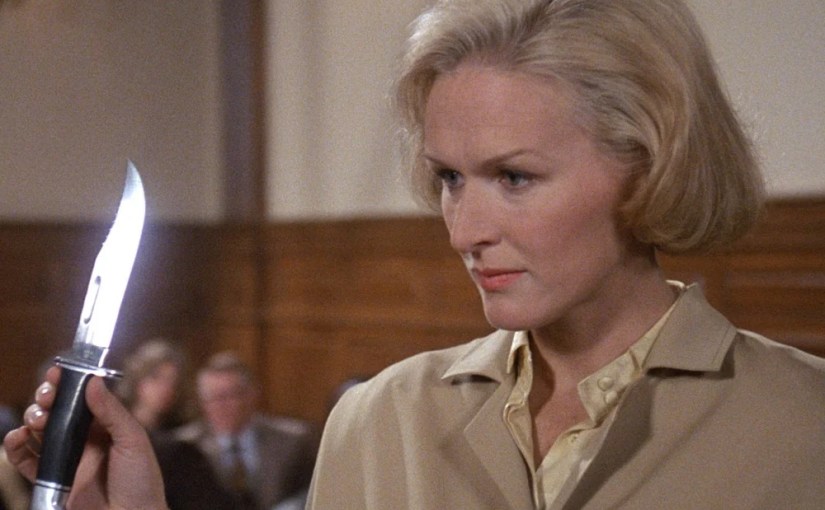
Jeff Bridges is the handsome local San Francisco newspaper editor, Jack Forrester.  He is the husband accused of murdering his wealthy wife in bed with a hunting knife.  The blade is curved and the top of it is jagged.  Hence the title. He’s known for his infidelity, and for repeatedly criticizing the city prosecutor, Tom Kransy (Peter Coyote) in print.  His business attorneys recruit Teddy Barnes (Glenn Close) to defend him.  Teddy has partnering experience with Kransy when they were prosecuting together.  A rift occurred between the two lawyers over a question of ethics.   She moved away from crime and into contract law.

Teddy warns Jack that if he’s not honest with her, she will cease to represent him.  Mr. Eszterhas, I think we know what will happen.  Right?  The witnesses in this trial are nothing challenging for either side.  They topple easily under Teddy and Tom’s questioning and when one side gets a huge advantage, the panic on the other side never feels truly convincing or suspenseful.  If these lawyers had more intelligence than the pens they hold, they would have vetted these people just a fraction better before allowing their testimony. Yet, Jagged Edge is supposed to be fast food law. 

What complicates this case is that ahead of the trial, as Teddy prepares, she becomes engaged in a sexual relationship with Jack.  Horseback riding specially builds the stimulation.  There is the Eszterhas label that many will recognize (Basic Instinct, Jade, Sliver, Showgirls).  The titles speak for themselves when glancing over his resume.  Teddy is supposed to come off with brains and intuition.  Yet, she follows through with unconvincing neglect.  Glenn Close is just too smart a person to be playing someone this reckless and stupid.  In 1985 though, maybe I could buy this. Law & Order episodes likely enhanced the intelligence of what we see in the eyes of the court since that time.

Jeff Bridges and Glenn Close have good chemistry, but Jagged Edge is cookie cutter material in the courtroom while the breadcrumbs that bring the two together are ridiculous.  Recently, I saw Lawrence Kasdan’s Body Heat for the first time.  That’s a sexy thriller that works between a lawyer and a murder suspect because the lawyer was a sleaze from the get-go.  Teddy Barnes is an attorney with principals. She’s also a loving mother and maintains a good relationship with her ex-husband.  So it lacks merit when I see her break her code of ethics so easily by getting involved with her murder suspected client.    It only happens because the omnipotent Joe Eszterhas makes it so by forcing a circle into a square. This professional woman even invites the accused back to her house where her kids reside. Really? Glenn Close’s characters would never do this. Kim Kardashian’s portrayals are another story.

When the killer is finally revealed in Scooby Doo fashion – mask pulled off the culprit – it could have gone one of three ways and any answer would have worked as well as drawing a card in a game of Clue.  Basic Instinct has a similar kind of ending.  It really didn’t matter how it wrapped up.  Columbo would have to walk back his steps to deliver undeniable proof.  Joe Eszterhas just makes it so and that’s what it will become, like a Choose Your Own Adventure.  

Actually, this film had some controversy because when the mask is pulled off the killer, audiences questioned whose face they were actually looking at.  The studio insisted on editing a little more time on the close up following the film’s initial release of first prints.  Siskel & Ebert devoted some airtime three weeks after the film came out to discuss as well.  I can see why there was skepticism, but I felt certain on who it was I was looking at.

Either way, Jagged Edge would always be considered pedestrian material with deliberate shocks of SEX and MURDER for the sake of drawing in crowds for its erotic nature.  Five years later, Basic Instinct would be the one to go full tilt, though.
THE QUICK AND THE DEAD

By Marc S. Sanders

The Quick And The Dead is a gritty, stylish western that boasts a who’s who of great actors.  Some of which went on to magnificent careers.  I wish the story was a strong as the cast list though.  It’s watchable.  It’s intriguing. It’s also too repetitious.

Sharon Stone is Elle.  Otherwise known in these parts as The Lady.  Two minutes into the picture and my suspension of disbelief is withering away.  Not because this gunslinger cowboy is a cowgirl, but because Stone does not look like she fits in the Old West.  Her blond locks are shampooed and conditioned.  Her complexion perfectly made up without a hint of grime or dirt or sunburn.  Stone looks like she took one step off the Oscars red carpet and onto this set. Her costume with a scarf, leather pants, black rimmed hat, and spurred boots looks like its attempting its own kind of Clint Eastwood stranger.  Frankly, it appears to have leaped off the pages of an Old Navy catalogue.

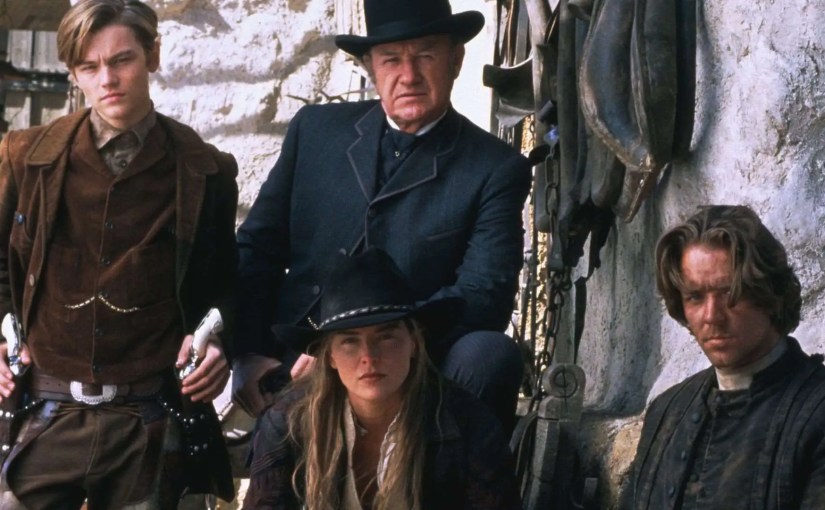
Below Stone on the credit lineup is a much more redeemable list of characters.  Gene Hackman is Mayor Herod who has amped up his level of sinister from his Oscar winning performance in Unforgiven.  There’s also Ace Hanlon played by Lance Henrickson with a rare on-screen giddy grin, whose personal deck of cards consists of aces of spades for every man he’s killed. Sgt Cantrell is the flamboyant personality with the handlebar mustache, deep voice and toothy grin that actor Keith David proudly bears.  A kid named Leonardo DiCaprio plays up the youthful cockiness of an outlaw named The Kid.  All these folks are gunslingers participating in the sport of gunslinging.  Last one left standing is the winner.  Midway through though, Herod will up the ante and deem that the last one left alive is the winner.  Each one challenges another until a final winner is recognized.  One reluctant participant is played by a very youthful looking Russell Crowe.  Cort is a former fast draw, who is now a remorseful preacher for all of the killings he’s committed.  Herod is not entirely convinced and will antagonize Cort to throw his hand in the game.

Sam Raimi directs and Sharon Stone produces this slick small town modern day High Noon.  The problem though is that Raimi and screenwriter Simon Moore choose to only send up the climax of that classic Gary Cooper western over and over.  Time and again, two opponents line up at opposite ends of the street.  The townsfolk observe with close up tension shots.  The hands twitch their fingers next to the holsters and when the clock strikes twelve, the guns go off.  Raimi often gives you the impression that the one expected to live is the one who is going to topple over dead and then an edit shows the match went exactly like you thought it would. 

This whole supporting cast has enough presence and charisma to keep my attention, but the set ups are the same over the course of the film.  Cut in between are discussions within the saloon or the hotel rooms where Herod or the Lady rest.  Cort remains chained in the town square.  When the movie breaks away it goes to flashbacks of Stone’s character as a child when she once crossed paths with the devilish Herod. 

I like the polish that Sam Raimi brought to The Quick And The Dead.  Before Quentin Tarantino was glamourizing his pulp fiction to his own two dimensional westerns and war movies, Raimi was daring enough to let us look through literal bullet holes from the front to the back of his victims.  Holes through the hand, the chest and the head.  It’s fun.  There are also countless closeups of haunting music from Alan Silvestri as a new stranger enters a saloon to click his spurs on the wooden floor.  Quick draw action is how these pistols perform too.  Hangings are a part of any day as well.  All of this is familiar and standard to the B movies brought to us by Sergio Leone’s spaghetti westerns during the mid twentieth century, but now we have a modern day cast and some glossy cinematography.

I was ready for a worthy salute.  It just comes up short due to a lack of any depth in story.  Gunslinging quick draws are not as dynamic as a gunfight at the OK corral.  How much different is one dual draw going to be from the last one we watched five minutes ago?  Raimi’s camera points from behind each challenger.  The music builds louder and louder.  Zoom in shots of townsfolk cut in.  The minute hand on the clock tower moves closer and closer to the roman numeral twelve, and then…BANG BANG!!! (I’ve said this before, haven’t I?  Well, so does the movie.)

The Quick And The Dead is worth seeing especially for another scenery chewing villain from the great Gene Hackman.  I’ll never tire of watching him.  To see the beginnings of Russell Crowe and Leonardo DiCaprio’s potential is a real treat as well.  They all certainly have some acting moments that I loved digging up from this time capsule.  Character actors Keith David and Lance Henrickson break from the standard personas you’ll find on the rest of their resumes.  I just needed more of a variety to this town setting they got play in.  The déjà vu is too overdone.

Sharon Stone usually looks like she’s giving a so so community theatre audition.  It’s hard to take her seriously, the same way I would had Uma Thurman, Susan Sarandon or Geena Davis been cast as The Lady.  Those actresses work for their appearance to be appropriate for the setting of their films.  Look at Sharon Stone here in the dusty Old West.  Then look back to what Sarandon and Davis did in Thelma & Louise.  You’ll see right away, practically anyone else would have been more suitable for the lead of The Quick And The Dead.

PRINCE OF THE CITY

By Marc S. Sanders

Sidney Lumet made an outstanding career of bringing attention to corruption within the halls of police precincts, amid the offices of politics and the inside the hallows of cherrywood courtrooms with manipulating lawyers and unsympathetic judges. His films are spellbinding with difficult conundrums for his protagonists to overcome and survive.  Prince Of The City is a perfect example.

A handsomely young Treat Williams stars as Danny Ciello.  He’s a famed cop working for the New York City Special Investigative Unit.  He’s part of a squad of partners who are also his best friends.  Jerry Orbach is the standout among the gang.  They make a huge difference in the big busts they accomplish.  In fact, some of them were part of the famed French Connection cocaine takedown.  Their celebrated careers lend to their monikers.  Danny is an especially accomplished “prince of the city.”  Proudly, they march into a crowded courtroom with a packed audience to announce another huge indictment with the criminals handcuffed together in a line.  However, these officers are also immoral in their daily practice. 

A bust of illegal immigrant drug dealers is made early in the film where over ninety-two thousand dollars is uncovered, and the team agree to share half among themselves.  A little later, Danny gets a desperate call in the middle of the night from one of his informants and to appease him he rips some heroin off another street user to give to the other one.  It’s a necessary evil to ensure progress as an accomplished detective.  The snatching of the monies? Well, as his brother frustratingly points out, that’s so he and his partners can live comfortably in furnished homes with nice clothes and jewelry. Yet perhaps all of this is no longer sitting right with Danny.

None of this is unusual for Danny but considering that an internal investigator (Norman Parker) has approached him about going undercover to reveal corruption that’s rampant throughout the police force, his conscience is weighing on him.  Danny agrees to go to work on this assignment.  However, he lays out one important condition. He’ll never give up his partners, including wearing a wire in their presence.  He lives with his wife, but he loves his partners.

Prince Of The City is a long film, but its running time is necessary because there are so many facets to Williams’ character.  Also, the residual effects of Danny’s work branch off in so many directions.  More than once, Danny is warned not to perjure himself.  Legal authorities find it hard to believe that Danny only broke his ethical code just three times in eleven years.  However, Danny insists that’s all there is.  He’s warned over and over it better be.  Otherwise, those that are working with him will later work against him.

Lumet is very good at showing realistic settings.  An abandoned post office is designated as a secret locale to store evidence and wiretap records that Danny collects.  In the beginning, the joint is empty, but over a progression of five years’ time, the shelves fill up quickly and a large staff is assembled, equipped with computers, typewriters and stuffed file cabinets.

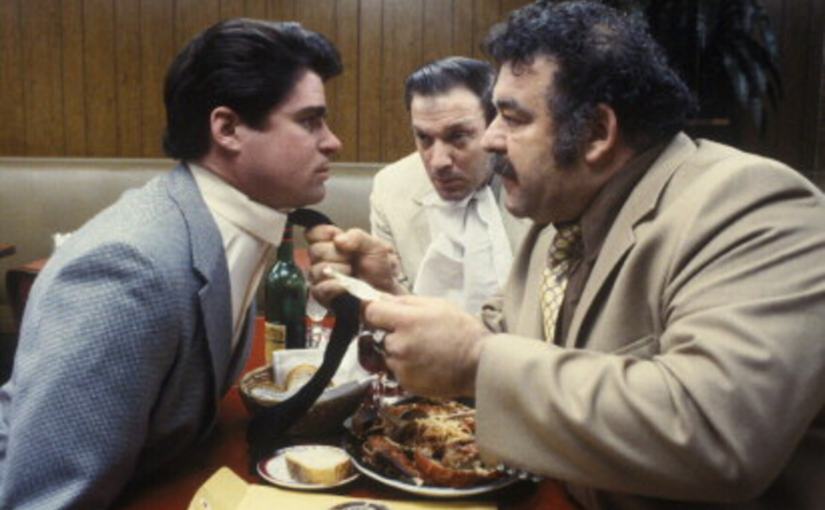
Danny catches cops on the take.  He gets a crooked lawyer on tape.  He’s also taking big risks that amplify his stress.  Lumet showed the increasing agony of a cop against a police department in Serpico with Al Pacino.  I thought the actor was a little overdone in that film.  Here, Treat Williams could not be more authentic, and the transition from cocky detective to paranoid informant, working against his colleagues, comes through much more subtly as the film carries on.  Danny gets caught in a diner sting wearing his wire.  His quick instincts save him, but only after his shirt is torn open showing the wire, and a gun comes out of nowhere.  The sloppy struggle that ensues with a broken glass door and overturned tables loaded with food and dishes is frighteningly realistic.  Lumet shoots the moment with a documentary kind of feel.  Deliberately, there’s no special effect to the camera work here.  It’s all in Williams’ performance and the actors he shares the scene with.

Treat Williams performance is so wired that I am very surprised it did not lead to more recognizable and stand out roles later in his career.  Williams was unknown at the time of this film’s release in 1981, but his lead in this picture is as welcome as Ray Liotta in Goodfellas.

Danny Ciello is a fictional character based on the real-life narcotics detective known as Robert Leuci.  Leuci had a checkered background dating back to when he became an undercover cop informant.  Neither Danny or Robert wears the white hats of pure honor and loyalty.  That is what makes these men so challenging.  Because they are somewhat impure, there is a tipping scale to how they should be regarded. 

A marvelous part occurs in the last act of the film.  Danny’s transgressions as well as what he’s accomplished have all been laid out.  The costs of his partners’ careers have been considered.  The risks and dangers that Danny and his family with two young children have encountered are given their due attention.  Now, as the film is concluding, Lumet along with his co-writer Jay Presson Allen, assemble close to twenty prosecutors and district attorneys in a dark, slightly sunlit office to debate whether Danny Ciello should be charged for violations of perjury.  One prosecutor threatens to resign if Danny is prosecuted.  Another one cannot see how a police officer can be granted pardons for violating the very laws he’s been sworn to uphold. No one is right or wrong in this argument. The collection of actors in this scene is amazing. 

The Oscar nominated script from Lumet and Allen do not provide a straight answer as to whether Danny is a hero or a criminal.  Prince Of The City is never spoon fed to its audience.  Different perspectives and receptions have likely been generated from the picture.  I’d love to hear other people’s viewpoints.

Once again, I commend the running time of Lumet’s film.  Danny Ciello is a complicated man who sacrifices so much that the cost of everything needs to be acknowledged.  The rampant corruption that is uncovered among his colleagues is so extensive that the turnaround response must be depicted.  Some men committed suicide for their crimes.  Some swear they’ll never give themselves up or even Danny.  Danny is expected to do the same in return.  Danny lost friendships and trust over the assignments he accepted. His children and his wife (an excellent Lindsay Crouse) were undeservedly forced to live in fear for their lives, and upend their household, ironically feeling obligated to accommodate those assigned to protect them.  At one time, Danny is relying on men who are heading the investigation, promising to abide by his conditions and guarantee his safety.  Later, these men accept promotions that pull them away to other departments, leaving Danny to deal with people he cannot count on going forward, and who may work against him or refuse to honor original promises.

It’s quite unfair for Danny as he continues to make headway.  An uncaring portrayal by Bob Balaban (really good in everything he does) as a federal prosecutor forces Danny into uncompromising positions where he’s squeezed into offering up everything with little to no options.  Because Danny is no longer the conceited prince that he once considered himself to be, these authorities keep him beholden to his commitments, no matter the cost of his career, his partnerships or how it affects the lifestyle of himself and his family.

Prince Of The City is a very heavy film with much to address.  If this were to be remade, without the guidance of Lumet’s expertise, it could only work as a miniseries.  Though I doubt it would ever compare to Treat Williams’ performance or Sidney Lumet’s specialty in covering the complexities that organically stem from police corruption.  This is a fascinating film that I’m looking forward to watching again.  Because the weight of the material is so thick, I’m certain I’ll discover something new in a repeat viewing.  This is one of Sidney Lumet’s best films.

ALIENS: THE DIRECTOR’S CUT

By Marc S. Sanders

James Cameron’s Aliens is deliberately morose in its storytelling and cinematic look.  It’s ugly and nightmarish.  It’s nerve-wracking at times.  It’s dark and somber too.  It’s also one of the best action films ever made.  For me, this is Cameron’s best film and it’s not only because I’m a sci-fi blockbuster nerd of sorts. 

Serving as a sequel to Ridley Scott’s monster movie, Alien from 1979, Aliens works on its own independence while still adhering to the storyline qualities of the original.  Sigourney Weaver returns as Ripley.  The story begins 57 years later where Ripley’s lifeboat ship from the end of the first film is found in deep space.  She reports back to the conglomerate company of the terrifying happenings she experienced with her crew mates who didn’t survive when an unrecognizable creature terrorized them aboard their vessel.  The company is less than apt to believe her account though. 

One of the company men, Burke (Paul Reiser), requests that Ripley accompany him and a squad of tough Marines on a mission to the planet, LV-426, where her crew discovered an immense crop of eggs and took back an alien aboard their ship.  In Ripley’s absence, a colony of over a hundred families was set up on the planet to establish habitable real estate.  However, the colony has lost contact, and the company is sending in the military to assess the situation to see what’s going on. Ripley is supposed to only serve as an advisor.

James Cameron’s script and direction takes its time to build up suspense and explore what’s unknown to these soldiers.  Upon arrival on the planet, much of what they find is left in wreckage and no one is to be found anywhere.  At best, Ripley can only see what was likely the remains of alien attacks with acid burns within the steel structures.  Yet to Ripley and viewers familiar with the first film, it is still a mystery as to what truly occurred.  Naturally, more will eventually be uncovered and then this arriving crew will have their hands full.

James Cameron has an imagination that bursts with colorful and amazing ideas.  The Terminator films were astonishing in its own apocalyptic future that haunts a present time period.  Titanic was a film mired in much expense and technical setbacks. Though, no one ever expected just how accomplished the award-winning blockbuster turned out to be.  Avatar is wonderous on a planetary level.  However, James Cameron is not necessarily a celebrated script writer.  Often his dialogue is very cheesy and unnatural.  Aliens is the exception though.

The script acknowledges that these gung-ho marines are “grunts.”  Thankfully, they talk like grunts.  I know that many fans adore Bill Paxton as the cut-up member of the troupe known as Hudson, who has brilliant one liners.  It’s actually a well fleshed out character.  Before Hudson knows what he’s up against, this new mission is just a lame “bug hunt” and he happily screams out as their spacecraft makes the quick drop into the planet’s atmosphere.  When he eventually comes to face to face with the monsters, terrifying, cry baby like fear overtakes him.  He’s giving his one liners like “Game over, Man,” and “We’re  fucked!”  Yet, the dread and anxiety are completely relatable.  There’s something out there waiting to tear me apart and eat me, and there’s hardly anyone left to help and rescue me.  I’m in the middle of nowhere.  Cameron wrote a good under the radar kind of character, and we feel for this guy’s dilemma as if it’s our own.  Paxton’s performance made it better and awarded it with adrenalized highs…and these aliens, with teeth and tails and acid for blood, are most definitely scary as hell.

I no longer watch the original theatrical cut of Aliens.  I turn to the Director’s Cut that Cameron always envisioned.  Particularly, it triumphs because the Ripley character is much more fleshed out with necessary dimension for the film.  Early on, a cut scene, now restored, tells us that Ripley’s daughter died from cancer while she was lost in deep space.  The daughter lived to the age of 66, even though Ripley didn’t age a bit.  Awakening from her cryo sleep, only introduces heartache for Ripley.  What I like about this information is that it serves a relationship later found in Aliens.  A little girl named Newt (Carrie Henn) is found by the marines and appears to be the sole survivor of the alien attacks.  Ripley steps in as a surrogate mother towards Newt as all of the characters work tirelessly to survive and somehow get off the planet.  The Director’s Cut gives some value to Ripley and purpose beyond just violently slaughtering aliens as a means of revenge or fulfillment.  It allows Aliens to work on an effective emotional level and Sigourney Weaver earned her Oscar nomination because of it.

Cameron introduces traitors as well into the story, which are likely not so surprising but make the film all the more challenging for the heroes of the picture.  Michael Biehn is the sex symbol, a cool and quiet tough guy.  Jenette Goldstein is a Hispanic marine who gives off good imagery as one of the few female squad members who enters the areas first with the largest gun in the troupe.  Lance Henrikson is memorable as an android that Ripley is apprehensive to trust – perhaps he’s the “Mr. Spock” of this sci-fi entry.

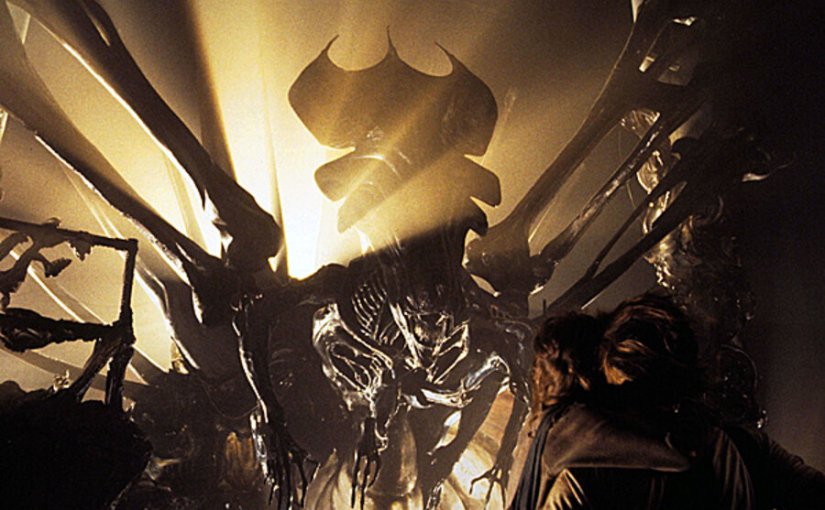
Technically speaking, Aliens is so unbelievably atmospheric in its bleak, futuristic setting.  Barring a few moments where the spaceships clearly look like miniatures, the interiors look organically formed.  I can’t compliment the set pieces enough in that respect.  When the Marines enter a large cavern, it is enormously shell like that it looks like an animal’s nest.  Cameron hides his various monsters perfectly.  So that when they slowly unravel their tales and skeletal forms, it looks as if the darkness within the frames begin to move.  The stillness of what surrounds our main characters awaken with life that maybe we don’t want to see. 

Aliens works independent of Ridley Scott’s prior picture because it’s a war movie; one that is set on an outer space planet.  We witness how the surviving squad troops strategize with what little they have left.  Thereafter, we see how they face enemies who may have the upper hand in battles to come.  I love how Cameron builds suspense with a sensor device the troops use.  It begins to ring as a life form closes in on their proximity.  The monitor fills with glowing blurs as more life forms nearby build up.  A nervous and great moment occurs when they can not understand how the aliens could be so close and yet none of them can see what is so nearby.  The surprise is unexpected and worthy of a scream. 

Cameron’s script doesn’t give his heroes a break.  Aliens thrives on the characters simply playing keep away, while one member of the party is working against what little they have left.  I like that.  While Aliens may be intentionally dreary the fact that there’s no easy out for these folks is what keeps the pulse of the film racing with nonstop suspense and action.

Aliens is an absolutely solid picture promising a future for this franchise. Sadly, it really never excelled above what was accomplished in these first two films from Ridley Scott, and now James Cameron.  Years later, Scott returned to the franchise with some interesting prequel films that colored in some of the elements that were only talked about before, like the company that puts all these people within the peril of the aliens.  Yet to date, that all still remains unfinished.  James Cameron just set the bar so high with his movie that the few that followed never amounted to what he created.

You may not feel all warm and fuzzy after watching Aliens, but at least you’ll feel incredibly excited with its construction from a director in the early years of his profession.  James Cameron brought about a solid script and unbelievable effects that say so much on a visual level.  If Aliens makes you nervous, fearful and especially terrified, then James Cameron has done his job.