COOGAN’S BLUFF

By Marc S. Sanders

Coogan’s Bluff is hardly Clint Eastwood’s best film.  The first collaboration with director Don Siegel is thin on story, flat on romance and light on its bad guy.  However, it is an important chapter in Eastwood’s storied career.

Shortly after the famed Sergio Leone spaghetti western Dollars trilogy, and ahead of his big city cop pictures, Coogan’s Bluff was the go-between.  The movie starts like a western with Deputy Coogan emerging out of the hot Arizona desert in his cowboy hat, uniform and rifle.  He’s not on horseback though.  He’s riding a jalopy of a jeep and he’s apprehending a wanted Navajo criminal.  He’s got the cool looking sunglasses on too.

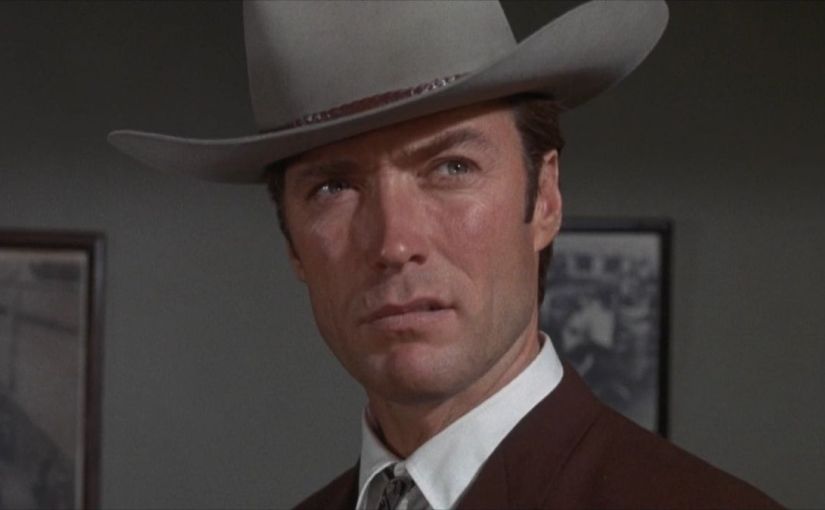
The movie shifts gears, and now Coogan is arriving by helicopter into the concrete jungle of New York City.  We never even see him get his assignment.  He shuttles to the police precinct by cab, maybe the deputy’s first cab ride ever because he gets charged a “luggage fee” for his briefcase. The station is run by Lt. McElroy (Lee J Cobb).  Coogan is the fish out of water, dressed in his white ten-gallon hat, brown suit and bolo tie.  McElroy doesn’t know any better and presumes this brute is from Texas, quite different from Arizona, and especially New York.  In 1968, Coogan is not a typical Midnight Cowboy.

He is here to extradite James Ringerman (Don Stroud) back to Arizona.  Not so fast though because McElroy tells him the crook is locked up at Bellevue for an LSD overdose.  There’s a lot of red tape with the judge and the state Supreme Court to go through before Coogan can get his hands on him.  Like a lot of Eastwood characters, Coogan will exercise his own kind of “bluff” and recover the lawbreaker who has actually escaped from the ward.

Coogan’s Bluff performs like a very rough first draft of a screenplay.  There are gaping holes in the narrative.  It’s never clear what crime Ringerman committed and how or why Coogan was assigned this case.  Siegel’s film began with this Navajo fugitive and a blond, adorable lass for Coogan to get in a tub with at home.  It’s a very abrupt cut to the New York City skyline though with his helicopter arriving on the famed Pan Am building (which is a few years away from a notorious helicopter crash).  Ten minutes in and we are watching a very different movie than what we started with.

A romance sparks between the lawman and a police psychologist (Susan Clark, “Ma’am” on Webster) as quick as Coogan arrives.  That relationship goes nowhere because Clark’s role and storyline lend nothing to the film except to stretch the running time to ninety minutes.  The pair end on a very weird note as well.  Scenes were missing to make this connection add up to the sum.  In their second to last encounter, Susan Clark is fuming with Eastwood over how Coogan treated one of her patients in his pursuit of Ringerman. In the final shot she is adoringly waving him away as his helicopter takes flight. What did I miss here?

It’s not all bad as Siegel’s picture plants the seeds of what would become all too familiar with Clint Eastwood – a tough, handsome, quietly brooding brawler who can handle himself in a bar fight and be triumphant in a thrilling, motorcycle chase.  The edits of both scenes are outstanding and Siegel captures magnificent shots.  

The fights, with pool cues, bottles and beer mugs as weapons of choice, are choreographed really well.  It doesn’t even look like the performers are being careful.  The set looks like something off the Universal lot though. Bar stools and tables break apart too neatly. The blood looks like paint. 

I have to believe Eastwood did most of his own stunt work, including leaping off a speeding bike and tackling Don Stroud’s antagonist.  Seamless work with well positioned camera placements.  It’s all so much more defined than the shaky stuff that Michael Bay would do thirty years later.  That kind of junk only hides the action that they would be afraid to execute.  The real stuff from guys like Siegel, Eastwood, McTiernan, Donner, and Peckinpah will always reign supreme.

Famed musician Lalo Schifrin is dropping familiar notes and cues that would thrill within the Dirty Harry world, four years later.  (Loved his assorted themes for Starsky & Hutch too.) Deputy Coogan, who doesn’t carry a gun, transitions into Inspector Harry Callahan with the .44 Magnum, and the stakes become bigger all around.  Schifrin’s piano keys and nervously fast strings amplify later in his own career from what he initially composed here.  It’s fun to recognize but like the script and edits of the movie, his work also feels incomplete.  Effective and interesting, but choppy and rough.

Don Siegel’s signature camera work is also familiar.  To ensure you recognize something of consequence, the director quickly zooms in on the bag, or prop or picture or close up.  Again, every tactic executed in Coogan’s Bluff feels like practice for what would be perfected later on.

Too much material must have been excised from Coogan’s Bluff in post.  Dots feel unconnected and while Clint Eastwood is worthy of acceptance, his performance is like an audition tape of the tough and silent guys his career will eventually offer.  

The cowboy cop enters a hippie nightclub splashed in rainbow colors and drugged flower power where he meets eventual Dirty Harry regular, Albert Popwell.  It’s fun to see the conservative Clint stick out, and would become a staple routine for his pictures, but this first try doesn’t quite stick the landing.  A bit like this remains unmatched to Eddie Murphy’s famous scene in 48 Hrs. with the honky-tonk club.  

The Man With No Name hung up the poncho, shaved the stubble, exchanged his thin Spanish cigars for cigarettes, put on a suit and carried a badge.  Why, the guy is just almost Dirty Harry!!!! Forgive my redundancy.  It’s just so evident of showing where Clint came from and where he was going next.  The story of this picture doesn’t matter.  The story of the guy leading this picture is what’s important.

I recommend watching a large sum of Clint Eastwood’s filmography before taking in Coogan’s Bluff.  Out of context of the actor/director’s choices, it’s a poor, uninteresting film.  Looking at it after familiarizing yourself with Clint Eastwood, and Don Siegel, it’s fun to see how apparent these men hopped from the dry desert heat into the city streets.

Coogan’s Bluff is not a great movie, but it’s a fascinating transitive piece from 1968.  It simply serves as a confident stride for its marquee name who will carry on a legendary tradition for the next fifty years thereafter. 

THE ENFORCER

By Marc S. Sanders

It’s no surprise that Harry Callahan is a chavaunistic son of a bitch. He has never been one to be shy about his prejudices, after all. In 1976, viewers found it endearing in an ironic way. Today, the character would never be produced into a studio film.

The third entry in the popular Dirty Harry series called The Enforcer is good but does not hold up as well as I remember. By the end, Harry must upgrade from blowing the bad guy away with a bazooka. He can no longer settle for his trusty .44 Magnum. It makes sense. Make everything your protagonist normally does do the same thing he’s always done, only make it bigger, and more actiony!!!! Not much interest in the on-screen chemistry that Clint Eastwood will have with said bazooka though.

Fortunately, there’s a better angle here and that is through actor Tyne Daly, as Harry’s new partner. Daly is terrific as one of San Francisco’s first female Police Inspectors who has to live up to the muster of a violent city as she accompanies a violent cop. It’s a great character that draws out feelings in Harry. She gives him pause to care and think beyond himself. Eastwood and Daly are where the chemistry is really at.

Everything else is kind of a waste really. Callahan never goes toe to toe with the main bad guy, a leader of a militant group terrorizing the city. This villain is nothing great or exciting.

Still, beyond Daly there are some great action scenes such deescalating a liquor store hold up by plowing a squad car through its front door. Makes sense, right?

SUDDEN IMPACT

By Marc S. Sanders

The very first R rated picture I ever saw in theaters was the fourth installment of Clint Eastwood’s Dirty Harry franchise, entitled Sudden Impact.  I was eleven years old and I loved it.  My brother Brian took me with his best friend Nick.  Age 11 and I’m in a crowded theater on a Saturday night watching a brutally violent and sometimes funny crime drama with the cop who carries the .44 Magnum.  Looking back, it felt like a rite of passage.  It felt rebellious.  I’d now be the coolest kid in school as I recount for them everything I was allowed to see that their parents refused to even consider.

Brian introduced me to many of what remain my favorites this very day.  He introduced me to Jackie Gleason in The Honeymooners,and then at age 8 or 9 I must have watched the first of Eastwood’s series, Dirty Harry, on video tape.  At that age, you just want to get to the next shootout where Harry allows his bloodletting revolver do the talking while he finishes his hot dog.  I watched those first three films (Dirty Harry, Magnum Force and The Enforcer) over and over again.  As an adult, I more so appreciate the themes of the San Francisco cop, Harry Callahan.  He always had a low tolerance for the bureaucratic BS of court procedure and legal precedent.  He was always smart enough to know who the real bad guys were and that was enough to bring them in. If they didn’t cooperate, well then there were other means. 

The first two films in the series question Harry’s procedures and philosophies.  The third film, although entertaining to a degree, deviated from that.  The fourth film returns to test Harry’s beliefs in police enforcement and justice.  Only this time, it’s actually from the perspective of a gang rape victim, played by Sondra Locke.

Much of the first hour of Sudden Impact is episodic.  Scene after scene shows Harry’s encounters with various hoods that he has a connection too.  Harry disrupts a wedding to undo a vicious mobster.  Later, those guys try to take him down.  Some punk kids get off on a technicality in court.  They’ll have something to say to Harry as well, and just in case you need a little more action, there is that very memorable coffee shop robbery where Harry tempts all of us to “Go ahead.  Make my day.”  There’s also good laughs as Harry is gifted a bulldog he calls Meathead. 

Weaved within these various moments is a separate story focusing on a beautiful painter who has a knack for killing men with one bullet to the genitals and another to the head.  She has revenge on her mind following a gang rape of her and her sister ten years prior.  Eventually, Harry is assigned to investigate and he is on his way to a fictional neighborhood known as San Paulo (filmed in Santa Cruz).  Harry has to navigate around a difficult police captain (Pat Hingle) as the killings continue to happen out here.

I’ve always been fascinated with the Dirty Harry series.  Surprisingly, when I do internet searches on the films and character, I don’t find much that explores the measure of rights and law.  Yet, beyond the sometimes-comic book violence of the pictures there’s much to question and think about.  Is Harry right with his chosen actions?  After all, the films make clear that the bad guys are the bad guys.  The writing however, makes it a challenge when legality interferes and the rights of men and women are tested.  Sudden Impact does the same thing.  With Eastwood directing, he makes the viewers witnesses to what the Locke character is subjected too.  That should be enough, right?  Real life is not that clean cut though.  However, in an age of internet surfing and headline breezing, people are endlessly tried in the court of public opinion and not a court of law.

The first film in the series had Harry declare that the law is crazy.  The second film tested the protagonist when he uncovers that people supposedly on his own team were carrying out vigilante murders against the worst mobsters and pimps in the city, as a means to clean up the streets.  Now, another and more personal vigilante appears.  What makes Harry right and these others wrong?  I don’t think any of the five films in the series ever give a clear-cut answer.  That’s okay.  I’d be frightened if there were a direct response, because it remains a complex issue.  When the courts fail us, what is there left to do?

Do not mistake me.  I am not calling for violence.  I’m just questioning a system that is sometimes broken.    

Recently, a local trial wrapped up where a retired police officer shot a man in a movie theatre who became argumentative and belligerent when he wouldn’t turn off his cell phone.  Popcorn was thrown, a gun was drawn and a man was instantly killed.  The retired police officer was found not guilty by a jury of his peers.  The court of public opinion by and large have been outraged with this verdict.  The grieving widow felt as if justice was not served.  Followers of the story didn’t either.  Another story focused on a beloved teacher who was hit by a car in a school parking lot.  I actually got into a public Facebook debate with someone who said the driver should be punished to the full extent of the law.  I questioned if the driver is truly guilty of murder or manslaughter.  It could have just been an accident.  We are humans to a fault.  How do we know the teacher didn’t just step in front of the car without looking?  The opposing view insisted the driver had to be speeding.  Maybe.  Yet, at the time neither of us knew that.  A car going at 5 mph can just as easily crush a human to death as a car going at 30 mph.  I insisted to the person I was sparring with that she was riding a slippery slope of presumption without all of the facts disclosed.  A police report has yet to be publicly disclosed.  Circumstances always come into play.

I know I’m digressing.  With a Dirty Harry picture like Sudden Impact, it’s laid all out for you.  Harry will request that four robbers put down their guns before introducing his friends Smith & Wesson.  He’ll also consider the circumstances after a woman’s life has been permanently scarred with no one to side with her.  A police officer should not be judge and jury.  Yet, it’s reassuring those films like Sudden Impact or Dirty Harry will allow a comeuppance for the wrongdoers in the world. During the closing minutes of the film, Sondra Locke delivers a monologue that at least is worth consideration even if it’s not agreeable.  I don’t believe our society should turn into a wild west circus where you can get gunned down in a movie theater over thrown popcorn.  I do believe however, that evidence must be taken more seriously in many circumstances.  Suspicion must be valued more often. 

Sudden Impact might have a right-wing attraction to it.  It glorifies gun violence, for the sake of action entertainment.  Harry doesn’t just have a .44 Magnum.  Now, he also has a .44 Magnum Auto Mag!!!!  (Whatever that is!)  Ironically, this picture is primarily told from a woman’s point of view where she wants to be believed and she wants justice, much like many of the messages of the Me-Too movement that gained major traction in 2019.  It’s insisted that when a victim says they have been raped or assaulted, no matter how far back the incident occurred, it should be believed.  The argument is where’s the proof?  Like Harry Callahan though, proof is not always the end all be all.  Instinct and common sense sometimes have to prevail.  Again, it’s a slippery slope, but it’s also always worth questioning.  Harry Callahan is always worth questioning.