
By Marc S. Sanders
Coogan’s Bluff is hardly Clint Eastwood’s best film. The first collaboration with director Don Siegel is thin on story, flat on romance and light on its bad guy. However, it is an important chapter in Eastwood’s storied career.
Shortly after the famed Sergio Leone spaghetti western Dollars trilogy, and ahead of his big city cop pictures, Coogan’s Bluff was the go-between. The movie starts like a western with Deputy Coogan emerging out of the hot Arizona desert in his cowboy hat, uniform and rifle. He’s not on horseback though. He’s riding a jalopy of a jeep and he’s apprehending a wanted Navajo criminal. He’s got the cool looking sunglasses on too.
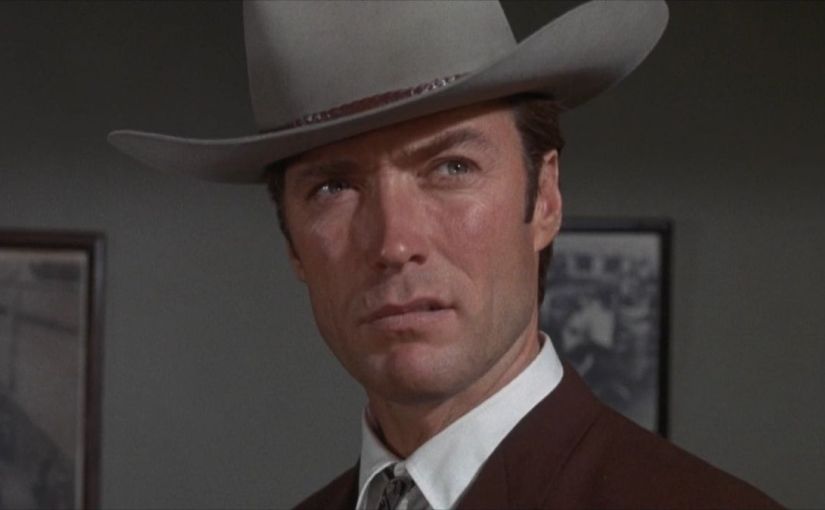
The movie shifts gears, and now Coogan is arriving by helicopter into the concrete jungle of New York City. We never even see him get his assignment. He shuttles to the police precinct by cab, maybe the deputy’s first cab ride ever because he gets charged a “luggage fee” for his briefcase. The station is run by Lt. McElroy (Lee J Cobb). Coogan is the fish out of water, dressed in his white ten-gallon hat, brown suit and bolo tie. McElroy doesn’t know any better and presumes this brute is from Texas, quite different from Arizona, and especially New York. In 1968, Coogan is not a typical Midnight Cowboy.
He is here to extradite James Ringerman (Don Stroud) back to Arizona. Not so fast though because McElroy tells him the crook is locked up at Bellevue for an LSD overdose. There’s a lot of red tape with the judge and the state Supreme Court to go through before Coogan can get his hands on him. Like a lot of Eastwood characters, Coogan will exercise his own kind of “bluff” and recover the lawbreaker who has actually escaped from the ward.
Coogan’s Bluff performs like a very rough first draft of a screenplay. There are gaping holes in the narrative. It’s never clear what crime Ringerman committed and how or why Coogan was assigned this case. Siegel’s film began with this Navajo fugitive and a blond, adorable lass for Coogan to get in a tub with at home. It’s a very abrupt cut to the New York City skyline though with his helicopter arriving on the famed Pan Am building (which is a few years away from a notorious helicopter crash). Ten minutes in and we are watching a very different movie than what we started with.
A romance sparks between the lawman and a police psychologist (Susan Clark, “Ma’am” on Webster) as quick as Coogan arrives. That relationship goes nowhere because Clark’s role and storyline lend nothing to the film except to stretch the running time to ninety minutes. The pair end on a very weird note as well. Scenes were missing to make this connection add up to the sum. In their second to last encounter, Susan Clark is fuming with Eastwood over how Coogan treated one of her patients in his pursuit of Ringerman. In the final shot she is adoringly waving him away as his helicopter takes flight. What did I miss here?
It’s not all bad as Siegel’s picture plants the seeds of what would become all too familiar with Clint Eastwood – a tough, handsome, quietly brooding brawler who can handle himself in a bar fight and be triumphant in a thrilling, motorcycle chase. The edits of both scenes are outstanding and Siegel captures magnificent shots.
The fights, with pool cues, bottles and beer mugs as weapons of choice, are choreographed really well. It doesn’t even look like the performers are being careful. The set looks like something off the Universal lot though. Bar stools and tables break apart too neatly. The blood looks like paint.
I have to believe Eastwood did most of his own stunt work, including leaping off a speeding bike and tackling Don Stroud’s antagonist. Seamless work with well positioned camera placements. It’s all so much more defined than the shaky stuff that Michael Bay would do thirty years later. That kind of junk only hides the action that they would be afraid to execute. The real stuff from guys like Siegel, Eastwood, McTiernan, Donner, and Peckinpah will always reign supreme.
Famed musician Lalo Schifrin is dropping familiar notes and cues that would thrill within the Dirty Harry world, four years later. (Loved his assorted themes for Starsky & Hutch too.) Deputy Coogan, who doesn’t carry a gun, transitions into Inspector Harry Callahan with the .44 Magnum, and the stakes become bigger all around. Schifrin’s piano keys and nervously fast strings amplify later in his own career from what he initially composed here. It’s fun to recognize but like the script and edits of the movie, his work also feels incomplete. Effective and interesting, but choppy and rough.
Don Siegel’s signature camera work is also familiar. To ensure you recognize something of consequence, the director quickly zooms in on the bag, or prop or picture or close up. Again, every tactic executed in Coogan’s Bluff feels like practice for what would be perfected later on.
Too much material must have been excised from Coogan’s Bluff in post. Dots feel unconnected and while Clint Eastwood is worthy of acceptance, his performance is like an audition tape of the tough and silent guys his career will eventually offer.
The cowboy cop enters a hippie nightclub splashed in rainbow colors and drugged flower power where he meets eventual Dirty Harry regular, Albert Popwell. It’s fun to see the conservative Clint stick out, and would become a staple routine for his pictures, but this first try doesn’t quite stick the landing. A bit like this remains unmatched to Eddie Murphy’s famous scene in 48 Hrs. with the honky-tonk club.
The Man With No Name hung up the poncho, shaved the stubble, exchanged his thin Spanish cigars for cigarettes, put on a suit and carried a badge. Why, the guy is just almost Dirty Harry!!!! Forgive my redundancy. It’s just so evident of showing where Clint came from and where he was going next. The story of this picture doesn’t matter. The story of the guy leading this picture is what’s important.
I recommend watching a large sum of Clint Eastwood’s filmography before taking in Coogan’s Bluff. Out of context of the actor/director’s choices, it’s a poor, uninteresting film. Looking at it after familiarizing yourself with Clint Eastwood, and Don Siegel, it’s fun to see how apparent these men hopped from the dry desert heat into the city streets.
Coogan’s Bluff is not a great movie, but it’s a fascinating transitive piece from 1968. It simply serves as a confident stride for its marquee name who will carry on a legendary tradition for the next fifty years thereafter.

