
By Marc S. Sanders
The great thing about following Clint Eastwood’s career that spans over seventy years is there is so much I still have to uncover. For example, following his well-known directed pictures Play Misty For Me and High Plains Drifter, he followed up with a surprising May-December meet cute romance called Breezy, which marks the first time he opted not to direct himself in front of the camera while going against type with an absence of threat or violence. Heck, he even makes that clear when his heroine of the title makes a run for it out of a stranger’s car.
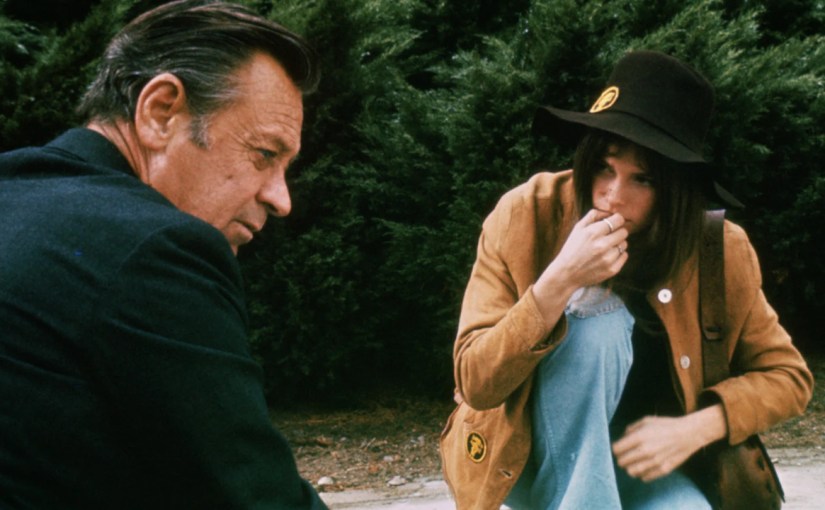
Breezy is played by a young Kay Lenz, her breakthrough role as a cheerful flower child, which reminded me of Julia Roberts’ hooker with a heart of gold in Pretty Woman. Breezy aimlessly wanders through the California hillsides with her floppy hat and personalized guitar case on her back, hitching rides from one car to another. When she comes upon the home of real estate agent Frank Harmon (William Holden), she happily hops in his car with a smile and a lot to chat about. Frank is the middle age, twice divorced lonely bachelor, who is not looking for any company. Yet, Breezy’s magnetism grows on him. Her casual nudity around his house is not so much erotic as just a way to get past any awkwardness between the two. Breezy is young but you’d be hard pressed to find any insecurities about her. The more experienced and elder Frank may be quite the opposite, though.
William Holden plays a similar kind of personality that he would offer a few years later in Network; not quite over the hill but not looking back at the youth he might have felt thirty-five years earlier at Breezy’s age. The main difference is that Breezy is nothing like Faye Dunaway’s cold-hearted character. Frank is mired in what he gave up too easily in his prior marriages (Joan Hotchkis, Marj Dusay), one on bitter terms, the other was regrettably let go.
Breezy is such a departure from what Eastwood, the filmmaker, accomplished in the 1970s. He’s not crafting anything in the realm of his violent pictures like Dirty Harry or his six shooter cowboys. Misty was also bent on a twisted and frightening nature which is entirely absent here. About the only fingerprints you’ll find is a blink/miss it cameo of the proud director standing on the boardwalk as the lovers stroll by. They also buy two tickets to see Drifter. I like these wink n’ nod moments, reminiscent of Hitchcock’s notable mischief.
This adult romance etched out of mid-life crises mixed with naive youth seems like a variant follow up to the success of Love Story. Kay Lenz occupied the Ali McGraw slot. Midway through this picture, I told myself that had Eastwood been older, he likely would have played Holden’s role who was in his mid-50s at the time. Eastwood would get the opportunity decades later with his superbly quiet adaptation of The Bridges Of Madison County. I’ll even say his soft spot shows in his Every Which… movies, albeit with an orangutan or Sondra Locke.
I discovered Breezy after listening to a podcast on the director’s career (Make My Day, found on Apple Podcasts) and my observations are much more alert. Thematically, I had always divided Clint Eastwood’s career into two halves. Whether it was comedy or drama, I always considered the bulk of his work before Unforgiven to rely on violence being resolved with violence delivered by his fists and gunplay. To my knowledge thus far, the Oscar winning western was a first that paved the next thirty years of his career with messages of anti-violence (A Perfect World, Letters From Iwo Jima), steering his persona away from any celebration of bloodletting. Breezy however, seemed to project maturely sensitive insights that I hardly saw from the filmmaker.
Like most of his films, Breezy was furnished under budget with simple camera work. The wheel is not being reinvented here, but with his regular crew, Eastwood assembles a tight story that evolves at a nice pace. The love story is not rushed even if young Breezy opens every page of her book as quickly as she meets a new person. William Holden in his sport coats, wide ties, and casual sweaters is the turtle against the rabbit of this race. The enjoyment is observing when these two parties can move at similar speeds.
You also get the opportunity to see how Frank and Breezy’s backgrounds clash. The hippies that carry over from the sixties hang on the street corners while the white-collar professionals sit at their desks on the other side of the window, closing real estate transactions. Frank’s friend Bob Henderson (the typical boring middle age/ middle class name) played by Roger C Carmel (Harry Mudd of Star Trek) thinks about what his life could be if he didn’t have his past choices to weigh him down. That’s still a common issue for middle-aged men to wrestle with. Breezy’s girlfriend Marcy (Jamie Smith Jackson) is a cute pal but it’s clear she has no future because of a neglectful boyfriend, and their shared habit of LSD highs. Interestingly, neither camp has a problem with the other. In Eastwood’s film, these two very different communities are tolerable of the other’s existence. That’s refreshing. Still, Frank and Breezy have to realize the independence they have even if they are years, and worlds, apart from each other.
Clint Eastwood checks off all the boxes to emulate beautiful chemistry from his two leads. Their unexpected romance is uneven, but there lies the challenge for finding solid foundations of love and respect.

