
by Miguel E. Rodriguez
DIRECTOR: Vincente Minnelli
CAST: Fred Astaire, Cyd Charisse, Oscar Levant, Nanette Fabray, Jack Buchanan
MY RATING: 9/10
ROTTEN TOMATOMETER: 95% Fresh
PLOT: An aging song-and-dance man reluctantly teams up with a prima ballerina to headline a Broadway musical, but the pretentious goals of its director threaten to sink the show before it even opens.
The Band Wagon has officially been added to the list of my favorite backstage films, along with The Bad and the Beautiful (1952), 42nd Street (1933), and Singin’ in the Rain (1952), to name just a few. Even aside from the “meta” aspect of the plot, the scenes of a stage show in various stages of rehearsal hit close to home…sometimes TOO close. After a disastrous tech rehearsal, one actress asks, “Are we really supposed to open tomorrow night?” If I had a nickel for every time I’ve said or thought that when performing in a stage show…I’d have a lot of nickels.
Fred Astaire plays Tony Hunter, an aging song-and-dance man whose best days and best movies are behind him. This is made poignantly clear in an opening scene where Tony’s famous top hat and cane are being auctioned off – and they don’t get a single bid. He’s in New York because he’s been offered a role in a brand-new musical comedy written by his two good married friends, Lester and Lily Marton (Oscar Levant and the perky Nanette Fabray). The catch: they want to pair him with Gabrielle Gerard (Cyd Charisse), a top-tier ballerina who can handle the challenging dance moves from the show’s choreographer, Paul Byrd (James Mitchell), with whom she’s involved romantically. Tony, an old-school soft-shoe hoofer, is not confident he’ll pair well with a tall, leggy ballet dancer and “modern” choreography.
To top it off, the new show will be directed by Broadway darling Jeffrey Cordova (Brit comedian Jack Buchanan) whose artistic sensibilities run more towards Camus and Goethe than Comden & Green. Will Tony and Gabrielle overcome their differences? Will Jeff Cordova see the light before turning a light comedy into a long dark night of the soul? Will Lester and Lily kill each other before opening night? If you don’t know the answers to these questions being posed in an MGM musical from the height of the Arthur Freed era, you need to see more movies.
The plot of The Band Wagon could be blown over by a smoke ring, but it is extremely perceptive when it comes to backstage life during a stage production. As an amateur actor, I eat this stuff up with a spoon. There’s the audition scene: do we go with the seductive blonde or the girl who can actually dance? There are the seemingly endless dance rehearsals. There’s the ambitious director who fills the stage with special effects and forgets about the actors. There are the threats of quitting, the fights over changing a line, the show-mance, and the gallows humor following a disastrous performance. The Band Wagon, like 42nd Street, should be required viewing for anyone involved in live theater, especially musicals.
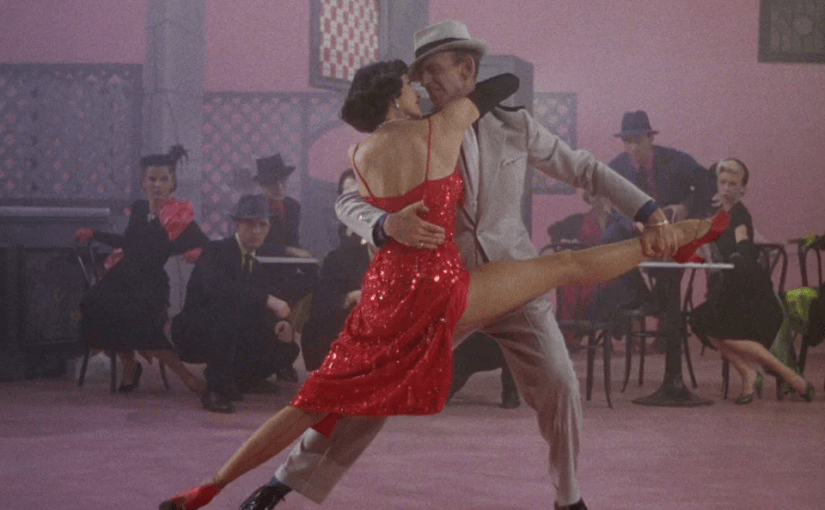
But that’s all just background for the main attraction: Astaire and Charisse. While Gene Kelly was pure athleticism, Astaire was grace personified. While Ginger Rogers was unquestionably (and literally) Astaire’s equal, Charisse brings a sensuousness to her duets with Astaire that is unmatched. In fact, I got the sense in their dances together that Astaire, intentionally or not, was there to make Charisse look good, or even better, I should say. Or maybe it’s just that Charisse is all I look at in their numbers together. Little of column A, little of column B. The highlight of their pairing is the justly celebrated “Girl Hunt Ballet”, a dazzling showcase for Astaire, Charisse, and choreographer Michael Kidd, which serves more or less as the movie’s finale. A verbal description wouldn’t do it justice, but even if you’re not a fan of The Band Wagon, chances are good you’ve seen one or two YouTube videos that compare this scene to Michael Jackson’s video for “Smooth Criminal.” Good stuff.
There are other highlights, as well. This movie gave us the immortal showbiz anthem, “That’s Entertainment”, which was reportedly written in 45 minutes. There’s also the famous “Triplets” number where Astaire, Fabray, and Buchanan use visual trickery to appear as infants in three little high chairs. There’s the opening number where Astaire dances through a penny arcade on 42nd Street, incorporating an all-too-brief double act with a shoeshine man whom the producers literally pulled off the street when they saw him dancing for his customers. Everything is done in the broad, brassy, Technicolor fashion for which director Vincente Minnelli was famous.
That’s really about it. Astaire has been quoted as saying The Band Wagon was his favorite film of his career, and it’s not hard to see why. Many moons ago, I watched this movie and, as I recall, slept through most of it. I was younger and stupider back then. As a devotee of theater and of classic films, The Band Wagon is one of my favorite musicals overall. Check it out whenever and wherever you can.

