
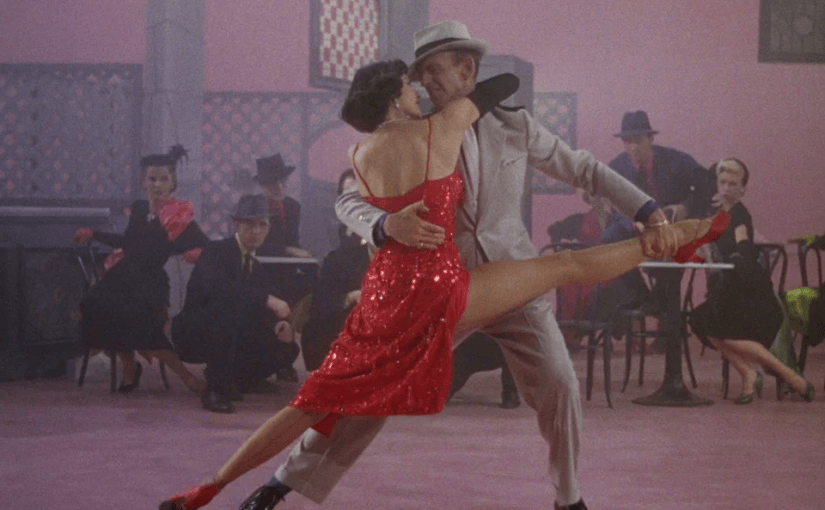
THE BAND WAGON (1953)

by Miguel E. Rodriguez

DIRECTOR: Vincente Minnelli
CAST: Fred Astaire, Cyd Charisse, Oscar Levant, Nanette Fabray, Jack Buchanan
MY RATING: 9/10
ROTTEN TOMATOMETER: 95% Fresh

PLOT: An aging song-and-dance man reluctantly teams up with a prima ballerina to headline a Broadway musical, but the pretentious goals of its director threaten to sink the show before it even opens.


The Band Wagon has officially been added to the list of my favorite backstage films, along with The Bad and the Beautiful (1952), 42nd Street (1933), and Singin’ in the Rain (1952), to name just a few.  Even aside from the “meta” aspect of the plot, the scenes of a stage show in various stages of rehearsal hit close to home…sometimes TOO close.  After a disastrous tech rehearsal, one actress asks, “Are we really supposed to open tomorrow night?”  If I had a nickel for every time I’ve said or thought that when performing in a stage show…I’d have a lot of nickels.

Fred Astaire plays Tony Hunter, an aging song-and-dance man whose best days and best movies are behind him.  This is made poignantly clear in an opening scene where Tony’s famous top hat and cane are being auctioned off – and they don’t get a single bid.  He’s in New York because he’s been offered a role in a brand-new musical comedy written by his two good married friends, Lester and Lily Marton (Oscar Levant and the perky Nanette Fabray).  The catch: they want to pair him with Gabrielle Gerard (Cyd Charisse), a top-tier ballerina who can handle the challenging dance moves from the show’s choreographer, Paul Byrd (James Mitchell), with whom she’s involved romantically.  Tony, an old-school soft-shoe hoofer, is not confident he’ll pair well with a tall, leggy ballet dancer and “modern” choreography.

To top it off, the new show will be directed by Broadway darling Jeffrey Cordova (Brit comedian Jack Buchanan) whose artistic sensibilities run more towards Camus and Goethe than Comden & Green.  Will Tony and Gabrielle overcome their differences?  Will Jeff Cordova see the light before turning a light comedy into a long dark night of the soul?  Will Lester and Lily kill each other before opening night?  If you don’t know the answers to these questions being posed in an MGM musical from the height of the Arthur Freed era, you need to see more movies.

The plot of The Band Wagon could be blown over by a smoke ring, but it is extremely perceptive when it comes to backstage life during a stage production.  As an amateur actor, I eat this stuff up with a spoon.  There’s the audition scene: do we go with the seductive blonde or the girl who can actually dance?  There are the seemingly endless dance rehearsals.  There’s the ambitious director who fills the stage with special effects and forgets about the actors.  There are the threats of quitting, the fights over changing a line, the show-mance, and the gallows humor following a disastrous performance.  The Band Wagon, like 42nd Street, should be required viewing for anyone involved in live theater, especially musicals.

But that’s all just background for the main attraction: Astaire and Charisse.  While Gene Kelly was pure athleticism, Astaire was grace personified.  While Ginger Rogers was unquestionably (and literally) Astaire’s equal, Charisse brings a sensuousness to her duets with Astaire that is unmatched.  In fact, I got the sense in their dances together that Astaire, intentionally or not, was there to make Charisse look good, or even better, I should say.  Or maybe it’s just that Charisse is all I look at in their numbers together.  Little of column A, little of column B.  The highlight of their pairing is the justly celebrated “Girl Hunt Ballet”, a dazzling showcase for Astaire, Charisse, and choreographer Michael Kidd, which serves more or less as the movie’s finale.  A verbal description wouldn’t do it justice, but even if you’re not a fan of The Band Wagon, chances are good you’ve seen one or two YouTube videos that compare this scene to Michael Jackson’s video for “Smooth Criminal.”  Good stuff.

There are other highlights, as well.  This movie gave us the immortal showbiz anthem, “That’s Entertainment”, which was reportedly written in 45 minutes.  There’s also the famous “Triplets” number where Astaire, Fabray, and Buchanan use visual trickery to appear as infants in three little high chairs.  There’s the opening number where Astaire dances through a penny arcade on 42nd Street, incorporating an all-too-brief double act with a shoeshine man whom the producers literally pulled off the street when they saw him dancing for his customers.  Everything is done in the broad, brassy, Technicolor fashion for which director Vincente Minnelli was famous.

That’s really about it.  Astaire has been quoted as saying The Band Wagon was his favorite film of his career, and it’s not hard to see why.  Many moons ago, I watched this movie and, as I recall, slept through most of it.  I was younger and stupider back then.  As a devotee of theater and of classic films, The Band Wagon is one of my favorite musicals overall.  Check it out whenever and wherever you can.

SINGIN’ IN THE RAIN

By Marc S. Sanders

Reader, I’ve been having a hard week.  My beloved puppy dog, Falcon, has not been feeling well and my family and I are so worried for him.  It’s just been a long week having to deal with reality.  Nevertheless, when I watch a classic musical like Singin’ In The Rain, it’s impossible not to smile and catch on to the energy that drives the film from the talents of Gene Kelly, Debbie Reynolds and Donald O’Connor.  This trio are not just sensational dancers and singers.  They’re adoring comedians that set a standard for facial expressions and endless entertainment variety. 

A simple, but informative story sets the spine of the picture.  Talking films like Al Jolson’s The Jazz Singer are catching on in Hollywood movie houses and the silent pictures are quickly becoming archaic.  Established talents like Don Lockwood (Kelly) and Lina Lamont (a scene stealing Jean Hagen) are being threatened with becoming extinct unless they can adapt to the use of their voices in the romantic cinematic roles they are known for.  Don will adjust.  Lina is another story.  Her alluring blond bombshell looks are recognized everywhere.  However, none of that will line up with her natural, squeaky, ear piercing vocals.  She’s a hopeless case for the best vocal coaches that money can buy.  Don and Lina are star attractions with contracts to guarantee them work, but Lina’s voice could put the movie studio out of business. 

Fortunately, Don just happens to land smack dab into the passenger seat of Kathy Selden’s (Reynolds) car.  Kathy has the voice, and soon Don and his trusty songwriting companion and pal, Cosmo Brown (O’Connor), will realize the acting talent to boot.  In the meantime, though, Kathy’s voice will dub in for Lina’s on screen.  There are great gags at Lina’s expense as she tries to work with a microphone for the first time.  This is Lucille Ball material of the finest, comedic polish.

In between all these story developments reside some of the greatest musical song and dance numbers to ever grace a screen.  Few, if any, films have matched the rubber faced hyperactive quick steps of Donald O’Connor during his rendition of “Make ‘em Laugh!” What he does with this cutaway scene looks like a superpower of marvelous agility.  Jim Carrey could never stand next to Donald O’Connor.

Gene Kelly’s accompaniment with O’Connor and their silly, tongue twisting “Moses Supposes” is magnificent to watch.  You could be on your death bed, looking at this scene, and I truly believe you’ll think nothing is so bad in life while you watch this moment.  The pair are masters with their physicality of jumping on and off desks and chairs, while they toss around a stuffy, glass eyed linguist caught in the middle of their shenanigans.  Every prop and set piece are given functionality, be it a lamp shade, office supplies or stacks of paper.  Then there are the lyrics.  How do you so fluently utter words like “Moses” and “supposes” and every other imaginable piece of vocabulary that phonetically sound like them to seem like it is as natural as saying grace? And they do it all while bouncing all over the place with two stepping in perfect sync.  It’s like nothing I’ve ever seen before.  These guys are functioning on one motor.

To add further compliment, I must emphasize that the camera pointed at these magnificent players hardly ever cuts away.  There are long sequences where the guys are literally walking up walls and back flipping over.  It’s all done in one shot.  There’s only frequent edits away for a close up or another angle.  Otherwise, Gene Kelly and Donald O’Connor are defying the impossible to show breathless choreography.  They seem to defy physics, and the props they use cooperate with every step, leap, run or jump taken.

The same goes for when Debbie Reynolds makes it a trio during another unforgettable number called “Good Morning.”  The furniture pieces are choregraphed to work with the three dancers.  All three race towards a sofa, step on to the seat cushions in unison and then walk onto the back of the sofa, allowing it to flawlessly tip over so they can continue their stride.  Just writing about this, I think about how amazing and wondrous this scene is.  Lightning in a bottle!

All of the material contained within Singin’ In The Rain is incredibly cheerful, full of color and humor and tremendously likable characters.  Yet, it does not ever teeter on being hokey or cheesy.  The musical doesn’t feel dated.  This film transcends generations like The Wizard Of Oz or Star Wars.  No matter the age, anyone should be able to like this movie. 

I love the irony of the number “Singin’ In The Rain” that lends to the title of the picture.  Just think about the word “rain.”  Often it is associated with gloominess and sorrow and mood.  However, the tempo of Singin’ In The Rain as a full length film invites happiness and glee no matter the situation.  Gene Kelly’s clownish activity with an umbrella, a large smile and a rain soaked street corner becomes one of the most delightful moments ever to grace a screen. He stomps, skips and splashes in the large puddles while taking a leap on to a streetlamp just to express all of Don Lockwood’s glorious bliss and adoration for his new love Kathy Selden.  A hat becomes its own character as gushing rain drains out of a storm pipe soaking Don’s head.  The brim of the hat seems to develop its own form of jubilation.

I’ve read that Gene Kelly was a viciously strict co-director (with Stanley Donen) and choreographer on this film.  Debbie Reynolds has testified to long sessions of endless starts and stops.  It was tortuous at times.  If just a toe or a hand was out of place in any of the choreography, Kelly would not stand for it.  It had to be perfect.  I can’t imagine Kelly in a demanding or authoritative capacity.  He is just so cheerful and lovable on screen and so is the entire company of performers.  I guess the contrast with his character lends to how impressed I am with the final product.  However, to make a picture like Singin’ In The Rain this exact and eye popping requires astute examination.  The assembled rhythm of the three dancers and the chorus behind them at least matches some of the most refined military assembly marches I’ve ever seen. 

Watch Singin’ In The Rain for a glimpse into the evolution of Hollywood and cinema.  Watch it for a simple, yet funny story.  Watch it for the characters and set pieces.  Most of all, watch Singin’ In The Rain to discover how grand and wonderful life can be.  It’s likely that none of my readers can do what Kelly, Reynolds or O’Connor accomplish in this film, but I can guarantee that you’ll feel just as joyous as they do while they are putting the show on for you.

Singin’ In The Rain is why movies are so important for our emotional lexicon of escapism.  It lends to good health to watch Singin’ In The Rain.  It’s a film we all need.

Singin’ In The Rain is a reason to live.