
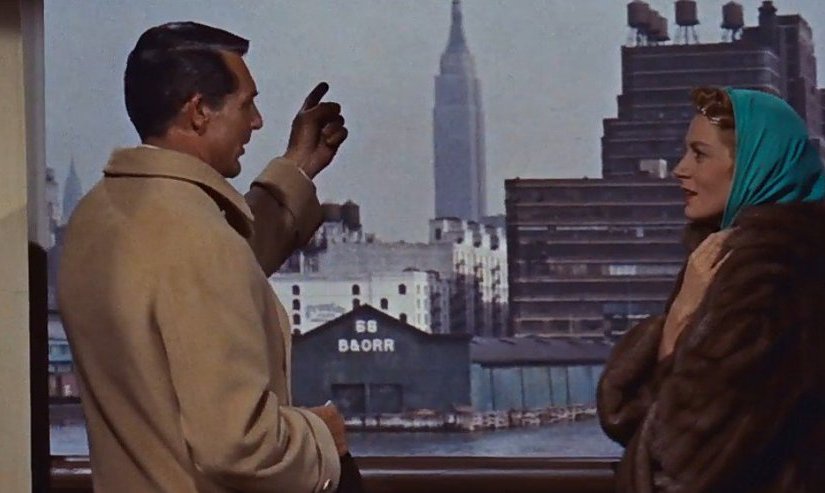
AN AFFAIR TO REMEMBER (1957)

by Miguel E. Rodriguez

DIRECTOR: Leo McCarey
CAST: Cary Grant, Deborah Kerr, Richard Denning, Neva Patterson
MY RATING: 8/10
ROTTEN TOMATOMETER: 65% Fresh

PLOT: A couple, both attached to other people, falls in love and agrees to meet in six months at the Empire State Building – but will it happen?


First, a word to devotees of this film:

No, I have not yet watched Sleepless in Seattle.  Yes, I am aware of the deep connection between the two films.  No, Sleepless is not currently on my watchlist radar, but rest assured I will post a review of it if or when I finally watch it.  Today is not that day.  Tomorrow’s not looking good, either.

All good?  Okay, let’s move on.

Leo McCarey’s An Affair to Remember is a grand old melodrama that would have been a perfect example of its genre if only it had ended differently.  As it happens, McCarey’s filmography does include a perfect example of melodrama: Make Way for Tomorrow (1937), not quite as romantic as An Affair to Remember, but packing a devastating gut-punch of an ending that other films can only aspire to.  If Affair had had the nerve to stick to that kind of an ending, I would absolutely have given it a perfect 10 out of 10.  But, while I don’t believe it’s perfect, it still belongs on your watchlist.

Cary Grant plays Nickie Ferrante, an incurable playboy who is nevertheless engaged to be married to an industrial heiress.  Deborah Kerr is Terry McKay, an “everywoman” type – or as everywoman as one can be while looking like Deborah Kerr.  She is also romantically attached to another man (NOT engaged, which plays a crucial factor later in the film).  The two have a pleasantly non-contrived meet-cute aboard a transatlantic cruise to Europe.  As fate would have it, they are both traveling solo for various reasons.

Their connection is immediate and unforced, reminding me a bit of two of my favorite films, Lost in Translation (2003) and Dodsworth (1936).  Grant and Kerr have a wonderful, breezy onscreen chemistry.  Their conversations, especially when they’re alone in her stateroom, are positively gravid with subtext, but they are careful not to let things get out of hand, even when it’s clear they would both like that very much.  It’s a wonderful balancing act that is rarely successful, so it’s a pleasure to watch when it is.

The development of their relationship unfolds perfectly, so I won’t spoil it.  As their ship pulls back into New York Harbor, they make a hasty, almost teenager-esque pact: meet in six months to see if their connection is still as strong as it is now.  The location: the top of the Empire State Building, still the tallest building in the world in 1957.  “It’s the nearest thing to heaven we have in New York,” gushes Terry.  It’s a tribute to how pervasive this movie is in the pop culture zeitgeist that I knew exactly what would happen just prior to that fateful appointment, but I nevertheless gave a little gasp when it happened.

For me, it’s the second half of An Affair to Remember that shines.  The first half is no slouch, but I masochistically perked up when the possibilities of a tragic romance reared its head.  There’s something about heartbreaking tragedy that makes for a sensational film.  There’s nothing wrong with happy endings, don’t get me wrong, but my favorite Broadway musical of all time isn’t My Fair Lady…it’s Jesus Christ Superstar. When done right, tragedy is strangely cathartic.  I’m thinking of movies like Atonement (2007) or The Remains of the Day (1993) or Brokeback Mountain (2005), movies that will never top anyone’s list of feel-good films, but which are somehow more powerful because…well, I find myself unable to articulate why.  They just are.

And that’s why An Affair to Remember does not quite reach the level of perfection attained by Make Way for Tomorrow.  There was a moment in the final reel when I thought it would, but it goes for the happy ending instead.  That’s right, I begrudge the movie’s happy ending just a little bit.  Sue me.  I fully acknowledge that the moment when Nickie sees a particular item in a particular room during the final scene is a thing of brilliance and beauty.  (Treading carefully here…)  It’s a lovely moment capping a sensationally written and performed scene.  …but it just didn’t strum my heartstrings.  I wanted it to, I really did.  I wanted my heart to swell and feel like it’s going to burst, but it never happened.

(For the record, I also could have done without the multiple musical interludes, especially the two with the kids singing…although I did enjoy Nickie’s flashback/memory when he revisits his grandmother’s house in France.)

Does this make me a curmudgeon?  I don’t think so.  I just feel there was an opportunity here to pull out all the stops for some real reach-for-the-hanky moments.  But, hey, what do I know?  See it and judge for yourself.  An Affair to Remember is a pleasure to watch and listen to, just like the stars themselves.  And, hey, if the ending reduces you to a blubbering mess like Meg Ryan in Sleepless in Seattle, then it did its job.  I won’t judge.  Promise.

TO CATCH A THIEF (1955)

by Miguel E. Rodriguez

DIRECTOR: Alfred Hitchcock
CAST: Cary Grant, Grace Kelly, Jessie Royce Landis, John Williams [no, not THAT John Williams]
MY RATING: 7/10
ROTTEN TOMATOMETER: 93% Certified Fresh

PLOT: A retired jewel thief in the French Riviera sets out to prove his innocence after being suspected of returning to his former occupation.


Alfred Hitchcock’s To Catch a Thief is somewhat of a paradox.  It contains all the hallmarks of the master’s touch during what was arguably his most fruitful decade of work: exotic location shoots, a breathless romance, sly comedy, daring innuendo, and, of course, a vivacious blonde.  But there is little to no suspense.  There’s an intriguing mystery that admittedly left me guessing until almost the very end, but I never felt invested in the hero’s predicament.  I cared way more about L.B. Jefferies [Rear Window] or Roger O. Thornhill [North by Northwest] or even “Scottie” Ferguson [Vertigo] than I did for John Robie.

The story opens right away with a typical Hitchcock wink-and-nod.  The camera pushes in to an inviting travel brochure for the south of France, then there’s an immediate smash cut to a woman screaming.  Is she being murdered?!  This is a Hitchcock movie, after all!  No, she’s distraught because someone has stolen her precious jewelry.  There has been a rash of burglaries, in fact, perpetrated by a shadowy, unseen figure whom French authorities believe is none other than the infamous John Robie (Cary Grant), aka “The Cat.”  But Robie has retired comfortably to a stunning villa and claims he’s innocent of this new string of daring crimes.  To clear his name, he must do what the police can’t: identify and capture the burglar himself.

There’s a subplot about how Robie was involved in the French Resistance during the war, but his former comrades, who now all work at the same restaurant (!), are distrustful of him.  I was never quite clear on why.  Something about how the law could catch up to them if Robie was ever arrested?  But if they were Resistance, why would they be considered criminals?  Did they help him with his previous string of burglaries?  The screenplay is not 100% clear on this, unless my attention wandered at some point.

Anyway, in the course of Robie’s investigation, he meets (by chance?) the stunning Frances Stevens, played by the inimitable Grace Kelly in one of her three films for Hitchcock.  At first, she is aloof towards Robie, but when he escorts her to her hotel room after rebuffing him all night, she boldly plants a firm kiss on his lips before closing the door on him.  Not only that, she reveals the next day she knows exactly who Robie is and practically dares him to steal the fabulous diamond necklace she’s wearing.

While Frances is certainly no shrinking violet, her attitude and character felt…forced.  The screenplay explains (in a roundabout way) that she is a bit of a thrill-seeker, so she’s getting her kicks by tweaking a known criminal.  Okay, fair enough, I guess, but later in the film, she abruptly declares she’s in love with Robie, almost out of the blue.  This and other incidents, too numerous to mention, had me thinking that the new burglar was actually…Frances herself?  Watch the movie and tell me I’m wrong for thinking that way.  She throws herself at him in a male-fantasy kind of way because, duh, it’s a Hitchcock movie, but this aspect kept me locked in to my theory of her as the burglar, because what other motive could she possibly have?

Without giving TOO much away, let it be said that the mystery of the new burglar’s identity is cleverly hidden until the final scenes which demonstrate Roger Ebert’s Law of Economy of Characters.  This law posits that a character introduced with no clear role will turn out to be important to the plot.  In hindsight, it’s an obvious choice, but I must admit, it did keep me guessing.

But, again, while there was mystery, there was no genuine suspense.  The whole film is so light-hearted and airy that to introduce real danger might have ruined the atmosphere.  It’s not just comic, it’s downright slapstick, exemplified in a scene where Robie runs from the police only to fall into a bunch of flowers at a market and the elderly flower-seller starts beating him with a bunch of lilies.  In an earlier scene set in a hotel casino, Robie drops a 10,000-franc chip down the cleavage of a female guest as part of a ruse.  These and other instances almost make me want to classify this film as a romantic comedy rather than a suspense thriller.

Which brings up another point.  To Catch a Thief might be the most unwittingly prophetic film in Hitchcock’s filmography.  Consider:

  1. There is an early scene when Robie gets on a bus and sits next to a woman who is holding small birdcage.  Shades of The Birds, released eight years after To Catch a Thief.
  2. One scene features Robie in a motorboat, running from the police who are chasing him in…an airplane.  Four years later, Cary Grant would be running from another airplane in North by Northwest.
  3. A late scene features a key character dangling from a rooftop, which immediately reminded me of Vertigo, released five years later.
  4. The scene at the flower market takes place at an outdoor market that looks uncannily like the same one Cary Grant visits while looking for some rare stamps in Stanley Donen’s Charade, released TEN years later.  (Not a Hitchcock movie, but one featuring a very similar romantic relationship, this time with Audrey Hepburn.)

Having said all of that, I still must confess that this movie did not exactly stir up my emotions the way many other Hitchcock films do, even after repeated viewings.  To Catch a Thief is beautiful to look at, not least because of its sensational location photography and, of course, Grace Kelly.  The mystery at the center of the plot is sound, and I appreciate Hitchcock’s sense of humor, which occupies front and center as opposed to his other films where it lurks at the edges of the danger.  But I was never on the edge of my seat.  I know, I know, this isn’t Psycho or The Birds, but…there you have it.