
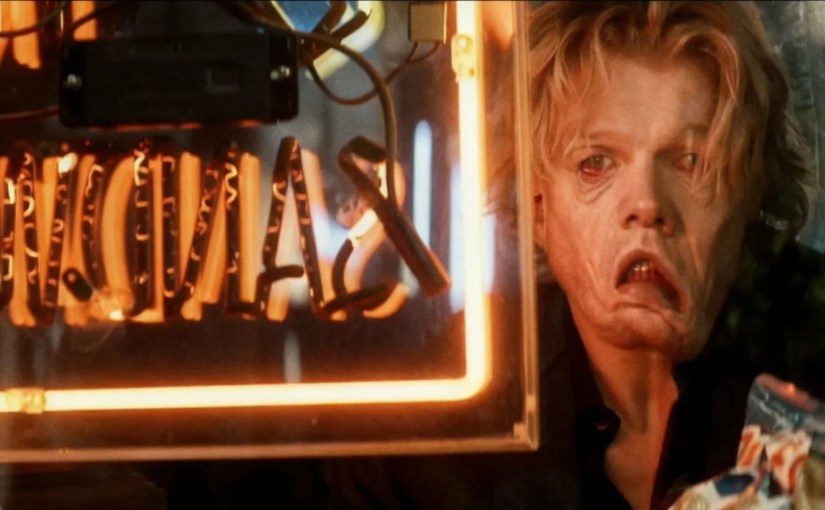
CLAYFACE

By Marc S. Sanders

The comic book origin story has become a tired trope in movies.  The hero experiences a traumatic event and gains either an epiphany or enhanced abilities that deem him/her for especially unique purposes.  Then they face off against their antagonist and sum up their encounter with the love interest or by reciting a voiceover journal to the viewer.  Roll credits with a promise that “Widget Man Will Return.”  Sound familiar, right?

That’s all well and good but I’m not yet exhausted over a villain origin story like Wicked promised for example.  (I’ve had mixed feelings about Joaquin Phoenix’ Joker movies.) Clayface is a b-villain character spawned out of the crime ridden Gotham City to face off against Batman.  I’ve been hearing that it was modern horror wunderkind Mike Flanagan (Doctor Sleep, the 2026 Carrie series) who approached DC production captain James Gunn with conceptualizing a film for the shape shifting mud monster.  Who would have guessed that the adaptation would be an absolute thrill of grotesque body horror with a sentimental affinity for the main character, “Coast City” movie star Matt Hagen, played by Tom Rhys Harries?

This actor plays a famous actor who sleeps with the wrong woman, only to have his vanity brought down to negative one thousand when her gangster boyfriend (David Dencik) permanently disfigures his face with an assortment of sharp edges.  Matt’s world is essentially destroyed.  His high-powered agent abandons him. He loses out on winning an Oscar.  His wealth is embezzled and he endures one personal betrayal after another.  He discovers that Dr. Caitlyn Corr (Naomi Ackie) has been experimenting with chemicals that one day might intelligently alter human cellular structure.  After much convincing, she agrees to use Matt as a test subject.  When full restoration arrives, Matt is on his way to rejuvenating his fame and fortune, but he and Caitlyn do not account for the jaw slouching, eye drooping and crusty side effects or for the surprising ability to personify other people.  All of this will emerge as a blessing or a curse.

Clayface works because director James Watkins has a lot of fun with infinite inventions that come with sculpting this guy, Matt, and the seedy world of misanthropes he inhabits.  The body count rapidly increases as the very entertaining and wince inducing exposition of this Frankenstein story carries on.  I imagine a lot of the actors had fun being killed on screen in truly inventive ways only to see their name on the next day’s call sheet to come back because now Matt Hagen has assumed their appearance as a means to undo the next traitor in his path.

The skills of this Clayface are awesome.  They are reminiscent of what the liquid Terminator could do, and it’s only right this story of a movie star-pretty boy salutes a lot of Hollywood favorites including The Thing, The Shining, and The Godfather Part II while drawing inspiration from the crafts of David Cronenberg, (The Fly, Dead Ringers).

Yes, the origin story might have been done to death by now, but if creators allow their imaginations to soar, especially with such a flexible character, the possibilities are endless for what can be accomplished.

The cast of unknowns are equally as surprising as the collective unfamiliar faces discovered in the other horror hit from this year, Obsession. Tom Rhys Harries is ready to do anything.  He plays suffering very well and the movie does not over-mire itself in misery. As the monster persona evolves, Harries goes in unexpected directions with his character, including a favorite kitch of mine.  He breaks out in a group dance sequence that is never expected of this non-musical screenplay.  His forbidden love story with Ackie’s smartly sensible character offers a lot of effective conflict to keep the picture engaging.  Their will they/won’t they angle lends something else to the film because simply a warpath of revenge and casualties can get stale. Max Minghella (The Social Network) plays Ackie’s fiancée and the persistent cop who follows the clues.

Clayface is the absolute best installment in James Gunn’s DC Cinematic Universe.  It provides amazing effects with a challenging story and a well-drawn Gotham City ridden with crime and interesting ugliness.  Director James Watkins deserves a lot of credit because he did not need to rely on the famed Dark Knight or a go to commissioner or a giggling, mischievous, brightly colored lunatic.  This picture is a perfectly crafted introduction to an overused environment that has not looked so refreshing in years.

Clayface may open interest for those seeking to learn more about this very capable and powerful villain. DC comics actually has two different documented origins to the guy of glop, but the loss of vanity and pride are what’s really fascinating about this Batman baddie.

I deliver the highest of compliments because this monster mash Jekyll & Hyde left me eager for more.

DOCTOR SLEEP

By Marc S. Sanders

I never yearned for a sequel to The Shining.  Yet, color me surprised at how well I took to Mike Flanagan’s adaptation of Stephen King’s return to psychic Danny Torrance and the haunting baggage he carries as a middle-aged adult in Doctor Sleep.  This is a time jump sequel that is nearly forty years in the future.

The film version of this story had a tricky challenge.  King notoriously despised Stanley Kubrick’s horror classic adaptation of The Shining. Several important details were not consistent between his book and the movie.  So, what was Flanagan to do?  Well, he got his blessing from the author to move ahead as a sequel to Kubrick’s interpretation because he also ensured that he would not veer too far away from how the novel was edited.  The director reasoned with King that more people are familiar with Kubrick’s product than what’s in King’s pages. Mike Flanagan found the right balance to please not only Stephen King, but also the respective fans of the novels and Kubrick’s unforgettable film.

Danny is played by Ewan McGregor.  He’s often reflecting on his childhood following his survival from his stay at the haunted Overlook Hotel in the snowy mountains of Colorado, where his delirious and murderous father terrorized him and his mother Wendy with an axe.  Now Danny is making efforts to recover from alcoholism as he takes a job as a hospice orderly in a small New Hampshire town.  It keeps him isolated while the ugly hauntings that he shines on stay contained in his mental lockboxes.  He also uses his gift to allow patients to peacefully carry over to the other side.   Danny becomes known as Doctor Sleep.

Elsewhere in the country there is a traveling cabal of people who devour the energies off of young children with similar shining abilities like Danny.  This small cult is known as The True Knot and their leader is the charming Rosie The Hat (Rebecca Ferguson).  The presence of one very special child is Abra (Kyliegh Curran).  Flanagan gets very creative in showing how Rosie, Abra and Danny locate and communicate with one another from faraway points.  Rosie’s technique is reminiscent of an amusing sequence in The Big Lebowski, though as you might expect the mood is altogether different in Doctor Sleep.  

Doctor Sleep is a longer picture than it needed to be.  The exposition goes on for quite a while where three separate stories are proceeding, and it becomes cumbersome to see how the dots are connected.  Yet, the movie eventually finds its way as things become more simplified.  Flanagan works some action scenes and neat visuals into the picture, but he does not neglect Stephen King’s penchant for nauseating and grotesque horror either.  Normally, I feign at seeing victimized children in deadly peril for the sake of escapist entertainment.  Here, it is repulsive on more than one occasion, but the moments serve the story and enhance the motives of the villains.  

The payoff of the film is the third act where this adaptation relies on much of Kubrick’s treatment of The Shining.  As the book was entirely different with its ending, Flanagan had to take a chance with some creative liberties.  Amazingly, his efforts score very well.  I’m not the biggest fan of Stanley Kubrick’s film (read my review on this site), but I had to cheer as more developments gradually unfolded.  There’s much to explore through the eyes of Ewan McGregor as Danny.

Mike Flanagan’s craftsmanship with a cast of supporting actors, including Henry Thomas (E.T.: The Extra-Terrestrial) assuming Jack Nicholson’s role, are quite uncanny and lend to the argument to not depend on AI or “de-aging” visuals to recapture what once was.  Carl Lumbly effectively takes over for Scatman Caruthers and Alexandra Essoe does a very good pick up from Shelley Duvall’s performance as Wendy – a little flighty, melancholy and zany. The little ticks and inflections in these newly cast actors are mimicked quite well without going over the top.

Set pieces etched into anyone’s subconscious who has seen The Shining are impressively recreated by Flanagan’s team, from stained walls, big curtains and chandeliers to that very familiar orange, brown/black sectional pattern on the carpet of The Overlook.  At one point in film, Danny goes for a job interview and the office he sits in is an exact recreation of when his father Jack met with the managers of the hotel at the beginning of Kubrick’s film.  This kind of attempt at consistency has to be saluted.  It’s really amazing.  Mike Flanagan shows his painstaking efforts at recapturing Kubrick’s designs. I do not look at these efforts by Flanagan as commemorations so much as I see an omnipotence that observes Danny like it did to his father Jack before him. Danny might have survived, but the demons of his past and the sins of his father remain. He can never escape where he came from even if he relocates to New Hampshire, or wherever he goes.

Doctor Sleep offers the disturbing imagery you’d expect from Stephen King.  I’ve never been the author’s biggest fan.  Still, I really appreciate the creativity he lent to his sequel nearly a half century later.  It makes sense to have waited this long for the writer to pick up where he left off with some of his most well-known characters and locations.  

This dark fantasy works for its collection of heroes and their villains.

NOTE: I viewed the Blu Ray Director’s Cut which Miguel informed me is the better way to watch the film. I agree. There are more nods to Stanley Kubrick’s original film, and the outline of the picture performs in chapter sections like you might expect in Stephen King’s novel. Mike Flanagan never lost sight of either storyteller’s accomplishments. Doctor Sleep is an undervalued achievement in film. A very worthy sequel.

DOCTOR SLEEP (2019)

by Miguel E. Rodriguez

Director: Mike Flanagan
Cast: Ewan McGregor, Rebecca Ferguson, Kyliegh Curran
My Rating: 9/10
Rotten Tomatometer: 76% Certified Fresh

PLOT: Nearly forty years after the events of The Shining, an adult Danny Torrance makes contact with someone else who can “shine”, and is soon drawn into a war with a band of people who hunt gifted people like himself.


If you had asked me a year ago to list movies will never get a sequel, Stanley Kubrick’s 1980 adaptation of The Shining would have been near the top of that list.  As adaptations go, it has its share of fans and detractors, but as a stand-alone horror movie, it’s a stone-cold masterpiece that has never been equaled.  When I heard that they were actually making a sequel based on Stephen King’s own sequel to The Shining, I was extremely skeptical.  The last time someone made a follow-up to a Kubrick film was 2010 (1984), and while that film was a decent sci-fi flick, it didn’t come close to the spectacle of Kubrick’s 2001: A Space Odyssey (1968).  So my expectations were, as they say, tempered.

After watching Doctor Sleep earlier tonight, I can say, unequivocally, that while the film is not perfect, I could not have asked for a better sequel to The Shining.  It’s a treasure trove for fans of the original, and also for fans of the extended universe that King has created for his novels, starting with the Dark Tower series forward.  (For those particular fans, you’ll be glad to see a very specific two-digit number making a conspicuous cameo…)

To begin with, the story is classic King.  Danny Torrance has grown into an irresponsible adult with a drinking problem, marking an unfortunate parallel with his father, Jack.  He hits bottom and takes up residence in a sleepy New Jersey town, joins AA, and works as an orderly at a local hospice.  Up to now, he has done everything in his power to keep his “shine” in check, but he finds a pragmatic use for his gift working with terminal patients, with the help of an inscrutable cat who can sniff out which patient is going to die next.

Eventually he comes into contact with a young girl named Abra, who lives in another part of New Jersey, but who can “shine” like he can.  And then there’s this nomadic group of people, calling themselves The True Knot, who are apparently hunting down other people with the “shine” for their own nefarious purposes.

It all wraps and weaves into a thrilling tale that skillfully retains the feel of Kubrick’s film.  Doctor Sleep works on its own merits, but the more you know about The Shining, the more thoroughly you’ll enjoy this new film.  Sharp-eyed cinephiles will be amazed at how many times, and in how many different ways, Kubrick’s style is echoed and referenced in this sequel.  These include liberal use of fade transitions, lots of static shots, Steadicam shots, use of natural lighting, those shots with the axe (!), even the aspect ratio that the film was shot in.  I got a giddy little swoop every time I saw how carefully the director, Mike Flanagan, was working the master’s craft into his film.  It was like watching a very subtle Kubrickian version of Ready Player One.  And it never comes off as plagiarism…it’s definitely homage, not theft.

Another aspect I really enjoyed was how the movie doesn’t rush through anything.  It’s two-and-a-half hours long, longer than average these days, which is yet another echo of The Shining.  When it works, that kind of pacing and running time gives the viewer the luxury of settling into the rhythm of the characters, makes them feel more like real people instead of cardboard cutouts hurrying from one milestone to the next.  For example, there’s a scene where one character performs a kind of astral projection to find someone.  There is a rather long series of shots showing her traveling through space that I can easily imagine would have been truncated in a lesser film.  Doctor Sleep, instead, gives us a good long look at her journey, to really feel the distance involved.  It’s quite a beautiful sequence, in fact.

This was a much better movie than I anticipated, which is good, because I never believed it was necessary.  It’s a relief to see that the continuation of Danny Torrance’s story has been handled in such a respectful manner, both towards the first film nearly 40 years ago and towards the viewers and fans.  It’s not perfect (I could pick nits about one particular aspect of the finale if I wanted to), but it’s a worthy successor to Kubrick’s masterpiece.  This belongs on the list of the best Stephen King adaptations along with It (2017), The Green Mile, and The Shawshank Redemption.

P.S. The blu-ray edition of Doctor Sleep contains a director’s cut that extends the running time by thirty minutes, adds more details about Abra’s powers, among other things, and inserts “chapter breaks” that almost make it feel like a miniseries.