
By Marc S. Sanders
You watch a miniseries and you think you know someone. Then you watch a documentary, and well…maybe not.
Comic Nathan Fielder covers the remaining 34 days before disgraced fraudster CEO Elizabeth Holmes was to begin her sentence in prison. A whopping eight-billion-dollar corporation called Theranos crumbled like a house of cards when her novel blood testing machine was revealed to be nothing but scraps for parts. Holmes and her COO, domestic partner Sunny Balwani, were tried for their white-collar crimes (in her case, infamous black turtlenecks), leaving remains of endless intrigue and astonishment. Fielder’s documentary, You Can See Everything, is edited with compelling music and intense close-ups as he catches up with how Holmes is coping and where her mindset is at the moment. I think he discovers things are much more disturbing and incredibly surprising. As well, the filmmaker may need to reexamine his own beliefs.
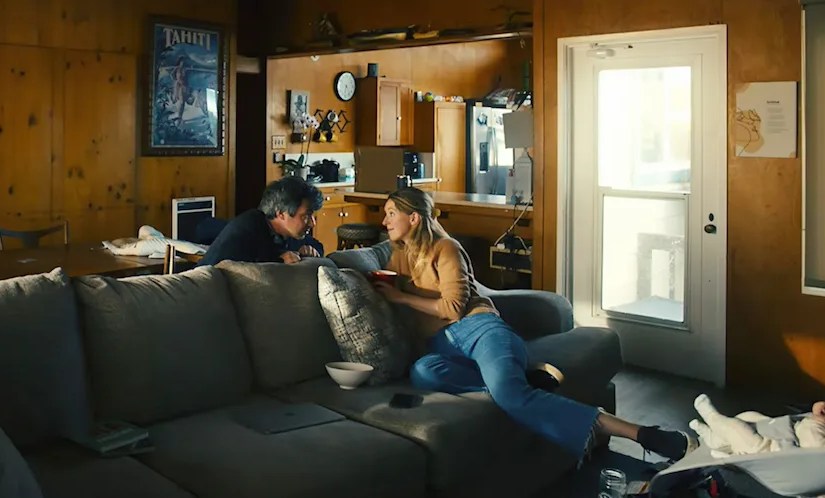
The first ninety minutes of this three-hour opus take place in a San Diego beach house rental occupied by Elizabeth and her husband, Billy Evans, along with their two young children. Nathan’s crew gets all-access shots to their activities. At one point, they capture Billy fully nude while showering. Why? It’s a testament to the fact that Billy and Elizabeth welcome everything to be seen.
Nathan gets right to the point with Elizabeth, asking if she has any regrets, accepts guilt, etc. With an eleven-year stretch ahead of her, she fails to recognize any crime or deceit she’s committed. Billy propagandizes her belief by excusing how Elizabeth mentally processes situations in a special kind of way, incomparable to anyone else. Nathan works tirelessly to simplify his questions so minutely to at least get either of them to veer off in another direction. Still, the two stay entirely on track. Asking Elizabeth if she’s ever told a lie does just stop with her responding with all but certain “No.” Nathan has to rephrases his question again and again and again. Apparently, until Elizabeth Holmes, it did not seem remotely possible that any human being ever avoided telling a lie in any kind of variance. Not even a harmless white lie. Elizabeth unequivocally believes she’s never, ever told a lie.
Nathan goes so far as to test Elizabeth’s comprehension of Abbott & Costello’s Who’s On First routine. She thinks it’s funny, but can not specifically explain why it’s funny or the “miscommunication” the pair were having. So, Nathan has to simplify the joke to practically every syllable and letter of each word uttered in the bit. The idea does not penetrate.
This woman is a miracle of some sort.
Then again, from what I know outside of this feature film, Elizabeth Holmes manage to put Presidents of the United States and Secretaries of State under her spell. How does she not comprehend the purpose of a comedy routine, but somehow sways billion dollar investors and people of absolute power into her snake oil schemes?
Eventually, it appears that Billy may be a puppet master over Elizabeth, especially when a development that led to the making of this film is revealed. Nathan Fielder’s picture takes on a whole new and unexpected direction, and the subject of his piece is not so much on just Elizabeth but also on Billy, who stems from a wealthy family with a watchful interest of control in how Nathan steers his narrative while he oversees Elizabeth’s mentality. Her behavior as well. Elizabeth does not scramble eggs like she’s supposed to, and supposedly can not concentrate on an interview while doing so.
Billy seems to have an unhealthy interest in his partner. Questionable use of A.I. comes into play ahead of Elizabeth’s departure. Billy has motives for its use while Elizabeth allows herself to be subservient to his purposes.
Maybe her parents were wise to this scenario. Nathan’s crew seem to get their perspective with little dialogue from them to offer. Dad is interrupted (or censored) by Billy. I don’t think mom ever says one word in the whole picture. The title, You Can See Everything, carries multiple meanings when you simply read mom and dad’s surrendered expressions.
Perhaps You Can See Everything actually means you can see nothing.
At best, Billy’s on board with resuming a pursuit of Theranos’ original novelty of blood testing machines. Right now, there’s no evidence in science or engineering to uphold the machine’s capabilities, but the mission stays true. Billy believes in Elizabeth’s original conception. Together, they push aside the skeptics and, to Nathan’s amazement, look for new opportunities for Theranos’ resurrection.
Two years after Elizabeth has begun her sentence, Nathan recruits an outsider who arguably may know Elizabeth best, actress Amanda Seyfried, who earned an Emmy for portraying Holmes in the Hulu series, The Dropout. It’s a bold choice. Yet, I wonder why Nathan stopped there. How about the script writers and directors or producers as well. Seyfried might execute the portrayal, but she didn’t craft the words of the dramatization.
You Can See Everything is a documentary from beginning to end. However, Nathan and his crew take an unusual approach to capture the second half of the film. With limited access because Elizabeth is in prison and more so because Billy tightens his leash over the situation, Nathan must rely on Seyfried to demonstrate where his two subjects stand. Without giving away all the tricks, Nathan Fielder and Amanda Seyfried make for a compelling pair of investigators. At times, they are bold enough to challenge each other while they are supposed to be working together. What obligation does Seyfried have to any of this? Is Nathan being objective enough with his subject? An ocean swim near the end of the picture reasonably demands this kind of question.
I saw this film with my wife. Having previously watched an HBO documentary, plus The Dropout, plus a 60 Minutes story and reading tons of social media, my preconceived notions about Holmes were firmly in place. On the other hand, my wife was primarily unaware of Theranos, Elizabeth Holmes, and the entire story. After Fielder’s film concluded, we had completely opposite perceptions of Elizabeth Holmes, and story that occurred.
That’s the beauty of You Can See Everything, and why it is one of the best pictures of the year. The finished product results in varied perceptions. For someone who insists in her own hynotic way that she has never told a lie, one has to wonder what this woman is built on. Is she an clinical eccentric, or is she master manipulator who never vacations from a crafted persona?
Perhaps Nathan Fielder dug his hole deeper than he ever wanted, because I believe he’s surprised with what turns up. Is Elizabeth Holmes a deceitful criminal, always aware of the costly lies and fraud she’s been evidentally proven guilty of? Is she continuing to maintain a facade of naivety, denying awareness of the harm which stemmed from her actions? Was she deliberately committing crimes for her personal gain with service to her id and ego?
On the contrary, was she at the behest of her former partner Sunny Bulwali, and just an accomplice, scapegoat, and pawn? Is she currently a brainwashed subject under a new operative, Billy Evans?
Nathan Fielder gets so meticulous with all of the footage he acquires. The connotations of operative words like “did,” “we” or “I am,” are questioned as a means to uncover the what and why of intent. Amanda Seyfried is even tested based on her comments regarding Charlie Kirk, a subject completely separate from any of this but still an exploration of character and merit. Amanda quizzes Nathan about his ongoing motive. Where does Nathan’s eventual interests truly lie? My compliment to Nathan Fielder for allowing his own intentions to be scrutinized.
You Can See Everything could have persisted for another three hours. Because this couple is so unusual and so abnormal and twisted, while living in the aftermath of one of the greatest criminal scandals in modern history, my interest would likely still be upheld.
This fully realized documentary does not surrender its moral compass to reveal truths that will never be definitive or devoid of doubt. That might not satisfy our curiosity. Nevertheless, Nathan Fielder and his co/director, Lance Oppenheim, earn the A’s in exhaustive efforts. The risk Fielder took though was compromising his objective intentions as he got closer to Elizabeth.
The greatest compliment I can lend to You Can See Everything is to say it is a superb, compelling journey into a never-reaching, unsatisfying abyss.

