
THE INVITE

By Marc S. Sanders

Olivia Wilde takes a Virginia Woolf approach with her latest film to direct, co-written by Rashida Jones.  It’s called The Invite and she may have directed her own leading performance into an Oscar nomination for Best Actress.

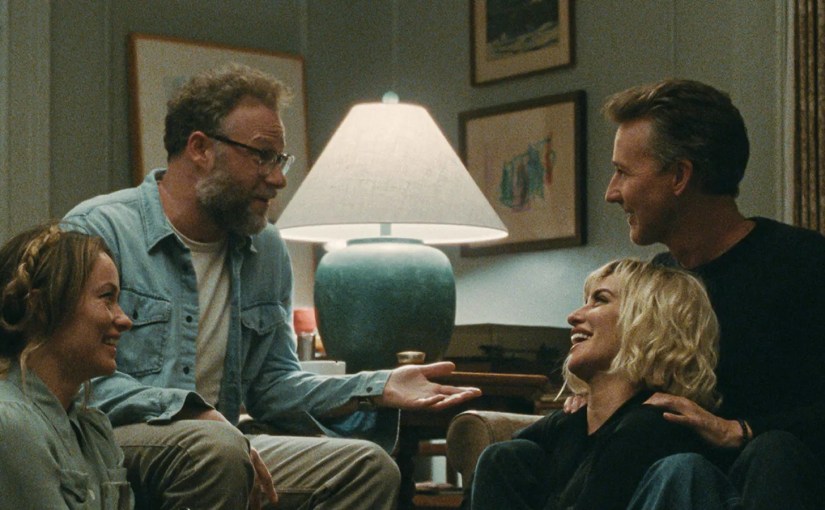
Angela is married to Joe (Wilde with Seth Rogen).  He’s a music professor, who clearly feels like he’s past his prime and his talent for music is being wasted on regular school days. Those who can’t be professional musicians, teach! She is a stay-at-home wife. Their marriage is no longer in heaven, even when their twelve-year-old daughter is at a sleepover. They haven’t had sex in over year. Yet, the evening does serve as an opportunity to invite the neighbors over for dinner. Too bad they arrive while the hosts are in mid-argument over who was supposed to get the wine and whatever else has been stewing on their brains for far too long. Dinner is another thing because dietary restrictions get in the way.

Piña and Hawk (Penelope Cruz and Edward Norton, and yes, you read his character’s name correctly) are the opposite of the stressed, overridden Angela and Joe.  Through the dark lighting of most of the film, the complexions of Piña and Hawk practically glow.  Norton and Cruz look like they swam in the fountain of youth. 

It doesn’t take long to learn that Hawk and Piña are sexually active, a lot, and they relish and ravage each other’s company.  Perhaps, they enjoy others’ company as well.

It’s best not to reveal too much about what develops during this awkward and unexpected evening.  However, it is worth saluting the genuine dialogue of aggravations expressed by a tired married couple who have lost a purpose to remain with each other, while their unmarried upstairs neighbors have every reason to stay together.  It also does not help that Joe is over the constant racket that comes from the happy couple’s apartment due to their constant sexual escapades.

The main attraction of The Invite is Olivia Wilde’s inventive direction. Within a claustrophobic New York City apartment, she places her camera in unusual positions to observe the chatter among the four actors. Close ups hardly ever happen. Instead, Wilde will point her camera at a mirror to catch the reflection of Rogen yelling at Wilde who is out of frame on the other side of the room. Joe’s study is cut off by an interior window-paned door. So, Wilde puts the camera on the outside of the window to peak in on Joe and/or who he brings into the room with him. Olivia Wilde’s camera is the fifth wheel as the viewer is given the opportunity to be a fly on the wall, snooping in on this obstinate evening. We might find ourselves standing at the end of the hall, yards away from where the action is happening, or we are looking through a window across to the other side of the apartment where there is another window to see what our spouse is doing with one of the guests. Everything Olivia Wilde does with shooting this film is accompanied with intended, strategic measure. We’ve always wondered what goes on behind closed doors, and now we have the chance to observe, without getting in the way.

The four actors show their training. Seth Rogen might be doing his regular schtick. However, he has not grown old on me yet and at least you witness genuine pain in this hopeless soul. A sort of slapstick moment occurs for the schlub, but it does not upstage other moments for him.

Edward Norton, and especially Penelope Cruz are very good at restraining themselves. You can feel their pulses are not racing like the other couple’s, who are treading a mile a minute. The screenplay allows Cruz’ character to present her knowledge and experience, and she never looks like she’s trying very hard. It’s not easy to portray complete relaxation and bliss. I was entirely convinced that the neighbors exhaust their energies in the sexual bouts they happily boast about, while the other pair are overtired in fits of rage and aggravation.

Olivia Wilde is the standout though. Her frustrations by sitting adjacent to her character’s husband and his unbearable presence demand enormous concentration. You have to be impressed with how this director sets up a shot or a scene, and then has to take the time to get into character when off camera she’s spinning a lot of plates. In front of the camera, the lines on Wilde’s face say so much about Angela’s background and the long life she’s already led even if she’s not that old. An outstanding and focused performance.

In someone else’s hands, at present or in a past decade, The Invite could have operated like an ordinary get together, where the acting is the main attraction. The performances are very good on level with the biting, cutting dynamics of Mike Nichol’s Who’s Afraid Of Virginia Woolf? and likely better than what John Hughes’ The Breakfast Club ever offered. Again, though, it’s clear that Wilde is looking to stand apart from those films that arguably will outlast the test of time that her film will not. Like me, I imagine the overall populace will not rewatch The Invite. Nor do I anticipate a Criterion edition or an AFI ranking in its future.

The concept of The Invite is nothing new or special. Neither is what is revealed during this lone evening.  At the very least, it’s the director’s technique that upholds this picture, along with four very capable actors delivering its wise, yet wordy, script.
THE 355 (2022)

by Miguel E. Rodriguez

Director: Simon Kinberg
Cast: Diane Kruger, Penélope Cruz, Jessica Chastain, Lupita Nyong’o, Bingbing Fan
My rating: 5/10
Rotten Tomatometer: 25% (…oof…)

PLOT: When a highly advanced technological googah falls into mercenary hands, a wild card CIA agent joins forces with three international agents on a mission to retrieve it.


I can’t speak for my colleague, Marc, but sometimes it’s harder for me to write about mediocre films than about films that are either outstanding or truly terrible. It’s harder to muster up the motivation to break down a movie that’s not bad or great, but merely so-so.

That’s the situation in which I find myself, sitting down here to write about The 355, a female-led action-thriller from director Simon Kinberg, whose previous writing credits are like a roll call of woulda-shoulda-coulda superhero movies: xXx: State of the Union, X-Men: The Last Stand, Jumper, X-Men: Apocalypse, the ill-fated 2015 reboot of Fantastic Four, and so on. (Full disclosure: he did write the 2005 comedy thriller Mr. & Mrs. Smith, which I believe is highly underrated, but that might be due more to the onscreen chemistry of Angelina Jolie and Brad Pitt than the script.)

The 355 (the title is explained only in the film’s final five minutes, so be patient) is standard Bond/Bourne stuff: an advanced technological doodad has surfaced and every bad guy on Earth wants it. It’s a fancy-looking USB drive that, once connected to any laptop in the world and properly decrypted, can access literally any network and/or mainframe in existence. As proof, the device’s inventor uses it to first crash a military transport jet flying overhead and then, as an encore, cuts the cable to his house. Personally, I would have reversed that lineup, but that’s just me.

(If this plot device sounds familiar, well, that’s because it is, as anyone who remembers the movie Sneakers will attest…but whatever.)

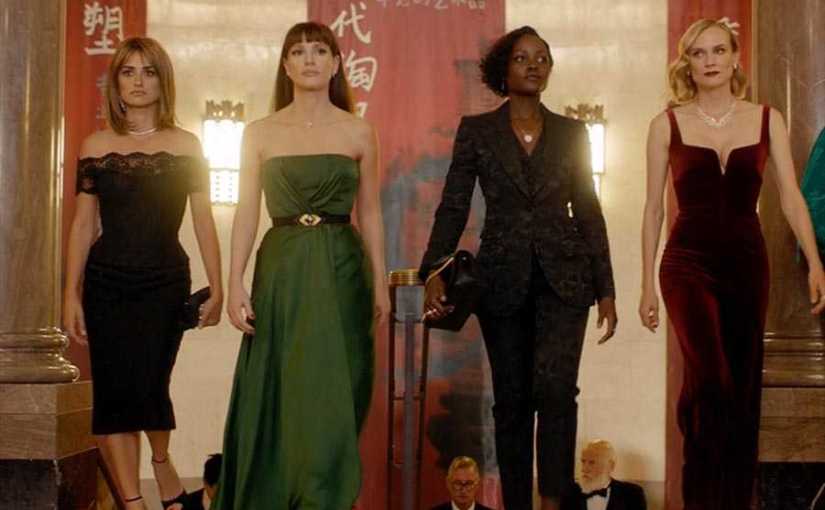
The device is stolen, and the good guys need to get it back before the bad guys do. Enter the main characters of the film: Mason Browne (Jessica Chastain) for the CIA, Marie Schmidt (Diane Kruger) for German intelligence, Khadijah Adiyeme (Lupita Nyong’o) for MI6, and poor Graciela Rivera (Penélope Cruz), a therapist who is in the wrong place at the wrong time. There’s some nonsense about them fighting each other at first, then banding together when they belatedly realize they’re on the same side.

The first major action scene is really well done, I have to say. There’s a foot chase through Parisian streets and subways that is as well done as any similar chase in the Bourne trilogy or any given Bond film. For that matter, ALL of the action scenes are competently executed…but that’s about it. There’s no flash or style, no real sense of originality.

There’s one sequence in particular that takes place in and around a fish-packing warehouse that, after a few minutes, became extremely muddled, and I lost track of who was chasing whom, and why, and how. The camera just seemed to be recording the action without getting me invested. It was curiously bland and detached.

The story itself was vaguely disappointing and unsatisfying, as well. It serves as the very definition of “by-the-numbers.” Virtually every cliche from better spy films are evident. The partner (Sebastian Stan) who’s dead…or is he? The trustworthy boss…or is he? The villain (Bingbing Fan) who lurks in the background…or is she a villain?

Now, there are uncountable films that have used these cliches to better effect, but it’s especially disappointing in The 355 because, throughout the movie, the story felt as if it was on the verge of talking about some truly interesting topics, specifically as it relates to women. There are subplots about how Mason, the CIA agent, has no personal attachments, while Khadijah, the MI6 agent, has a lover, and Graciela, the therapist, has a whole family waiting at home for her. Marie, the German spy, has some REAL problems that I won’t get into here. The story dances around the social perception of what women should or shouldn’t do with their lives. You want to be a secret agent full time? Okay, but you’ll get judged for not wanting to start a family. You want to start a family? Okay, but you’ll get judged for not being as professional or as dedicated as others in your line of work. You want to try to do both? Fine, but just when you think it can work, it doesn’t, so you should have come down on one side or the other. It’s a no-win scenario, and it happens all the time.

The movie dances with exploring this concept further, and then dances away in favor of more cliches and unnecessary plot twists. There’s even a whole sequence that feels as if it was lifted directly from one of the Ocean’s movies. Any one of them, take your pick.

There is also a moment when, out of NOWHERE, the stakes are raised in dramatic and horrifying fashion, so much so that it felt completely out of place. I was reminded, oddly, of a scene in the 2006 remake of The Hills Have Eyes where one of the mutant baddies slowly waves a gun over an infant in a crib. To me, it felt like overkill, and that’s the feeling I got with this off-putting twist. Was it necessary? It was shocking, true, and effective, but was it necessary? I don’t believe it was. I would have believed these women were motivated enough without bringing in outside pressure. And, to be honest, it felt like it was punishing those women who dared to have a life outside of their profession and rewarding those women who didn’t. No doubt there are other interpretations, but that’s how I saw it.

All in all, The 355 wasn’t downright unpleasant or super thrilling. It wasn’t exactly a waste of time, but it didn’t exactly blow my hair back, either. I don’t think it’s quite as bad as that Tomatometer would suggest, but…

Yeah…wait for streaming.