12 YEARS A SLAVE

By Marc S. Sanders

I’m grateful for those brave filmmakers who defy what is so glaringly oppressive in order to uphold a truth.  Steven Spielberg accomplished this with Saving Private Ryan and especially Schindler’s List.  I own both films on 4K, but I’ve only watched them each a handful of times.  I recently completed my second watch of Steve McQueen’s 12 Years A Slave.  While Schindler may feel more personal to me as a Jewish person who has met several Holocaust survivors, McQueen’s movie is uncompromising in its cruelty to black people , recklessly referred to as n!gg@rs, being held as property within the southern antebellum confines of slavery during the mid 1800s just ahead of the Civil War.  It’s one thing to read about lynchings and whippings.  It’s another to see it visualized; to see the life being breathlessly taken from a human being.  Not a slave.  A human being.

From such an ugly period in American history, the isolated story of this film follows the North Eastern free black man Solomon Northrup (Chiwetel Ejiofor, giving the performance of his career – heartbreaking, smart, emotional, fearful and brave at the same time).  He is a happily married father of two who earns an honest trade as an entertaining violinist in a well to do upstate New York Community.  When his family leaves town for a few weeks, Solomon is approached by two happy, colorfully dressed charmers with top hats (Scoot McNairy, Taran Killam).  Solomon believes he is being recruited to perform for some events across state lines for a significant sum of money.  He’s wined and dined by the men for a few weeks.  However, following a lavish dinner among the three, he awakens to find himself in southern Georgia, chain shackled at his four limbs.  

Despite his protests, insisting he is a legal free man, he is slapped, screamed at and trudged along to Louisiana and sold to a wealthy Plantation owner (Benedict Cumberbatch), who is comparatively kinder than his property keeper (Paul Dano).  Dano especially stood out to me this time as I reflected on Quentin Tarantino’s regard for the character actor. I question if the director, infamous for tossing the n-word around in nearly all of his films, has even seen 12 Years A Slave and had an opportunity to observe Paul Dano’s appearance. Dano’s character is genuinely mean spirited and hateful with that southern redneck naive racism for the black man. It’s what is demanded of this piece. His performance cruelly teases the black slaves with a song that sounds like a nursery rhyme but chants like a horror film while his screams insist they clap along. McQueen is wise enough to edit Dano’s voiceover singing as the slaves are getting accustomed to the new property, they are forced to tend to and live upon. Later, Dano and Ejiofor will conflict with one another, and the scene is terrifying of what it implies will arrive. So, there’s my two cents on actor Paul Dano (also known for There Will Be Blood, The Batman, and Prisoners). I’ll throw two more cents around and ask Mr. Tarantino to go reflect on his meritless position on this fine actor.

This picture also features Paul Giamatti headlining a horrible scene, working like a car salesman as he slaps the naked physiques of Solomon and other black people. His purpose is to demonstrate the value and endurance of these “properties” for potential buyers.  The novelty of used car salesman tactics seemed to originate here.  With no regret, black children are torn away from a helpless, anguished mother.  McQueen with John Ridley’s Oscar winning adapted screenplay includes this scene to show how quickly a transition into slavehood occurs.  Solomon and many of these other folk were free moments ago.  Now, they are delivered off a boat and are being sold like cattle, to be used not just for work but for sexual appetites and playthings.

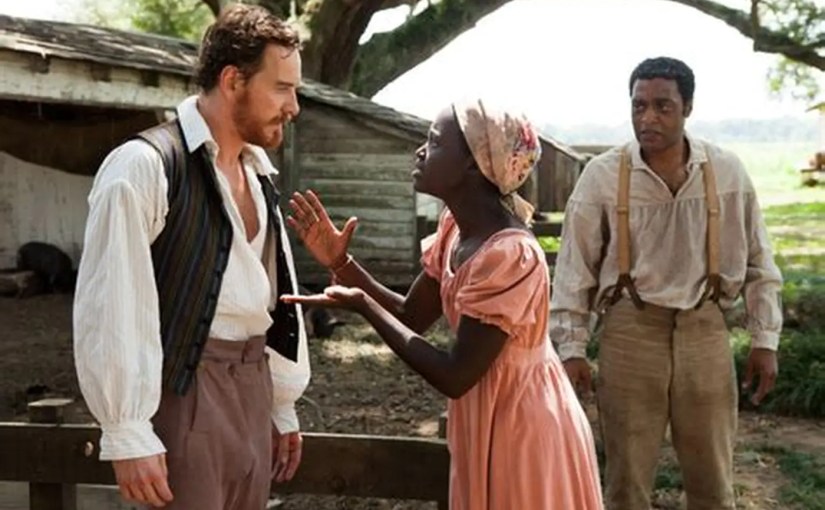
The second half of the story finds Solomon as a sold property slave of the viciously harsh Edwin Epps.  Michael Fassbender has never been more terrifying with intense rage that hides any other memorable performance in his impressive career.  He more than serves the antagonism of this film the same way that Ralph Fiennes did for Schindler’s List.  This is a monstrous individual.  Strong, oppressive, with no way to be endeared.  If he’s mad, for whatever reason, he’s going to be mad at his faultless slave workers who do nothing out of line and work solely to satisfy Edwin’s demands.

As the title implies, Solomon’s captivity carries on for twelve years with no access to his family or proper legal authority.  He also dare not reveal he can read or write, lest he will come up as a threat to those that violated his legal rights as a free northerner.  Solomon Northrup was always to remain trapped.  Even his talents with the violin are compromised as he’s awakened in the middle of the night to marshal the entertainment for Edwin as he compels his property to dance naked among themselves in his drawing room.  

As horrific as Solomon Northrup’s story is, later accounted for in his published book, it’s a fast paced and engrossing tale.  McQueen assures an understanding of how harsh it was to live within the dense, stale heat while picking pounds of cotton for the slave owners and their wives.  The whispers of flies and mosquitoes, along with tall grass and dragonflies often found in the south bring an awareness to the mundane and exhausting life of picking cotton from sunup to sundown.

The work was never the worst though.  The younger black girls were groomed to be continually raped.  A telling moment occurs when Edwin prances around the property in just a loose, sweaty shirt (no pants) with a child holding his hand. It is easy to grasp what’s to become of this girl, especially considering how Edwin treats Patsey, a teenage slave, who is repeatedly raped and beaten by him while infuriating the jealously of the Mistress Epps (Sarah Paulson).  

Lupita Nyong’o is Patsey, in an Oscar winning performance.  Nyong’o’s anguish matches Fassbender’s rage in equal fashion.  (He was Oscar nominated too.) Ahead of shooting days, the actors maintained rigid exercises together to preserve a direct trust during the abusive scenes.  Though thoroughly convincing in their dialects and performances of tears and brutal anger and screams, I cannot imagine it would be healthy for either actor to go full method here.  Had they actually done so, I’d argue they’d never return to a sense of acceptable balance, mentality and perception between one another.  What they do together, just like this whole cast, is hard, brutal work. Just look at how red faced Fassbender gets. See how glossy Nyong’o’s complexion gets behind the screams and tears. Not all of this is just makeup spray water.

Steve McQueen takes large sections of his two-hour film to demonstrate the carryover of time.  I’m not necessarily talking about twelve years.  Rather, minutes and hours.  One section has Solomon strung up from a tree by the neck.  The only thing keeping him from crushing his windpipe is to continually tip toe on the wet mud beneath his feet.  Morning turns into sweltering afternoon and into night.  McQueen does not rush this moment.  He wants the audience to realize that black slaves were regularly hung from oak trees.  It’s one kind of understanding to endure the hanging with literally no aid or sympathy to rely on.  What’s worse? A quick hanging that ends in blacked out death, or the kind that only dangles a person to the absolute brink of death?

The hardest sequence is an unbroken four and a half minute shot.  The director’s camera circles around Patsey’s scarred, bound, naked body, as she gets bloodier and bloodier by the unending whippings from Edwin’s unreasonable rage. When the taskmaster forces Solomon to take over, a sad irony is that Patsey begs Solomon to resume the whipping.  She’d rather take her punishment from him, than the slave owner.  

Paulson is in the background of this scene too.  She never flinches, always looks justified in permitting this action to carry on seemingly like a Lady MacBeth.  Nyong’o allows herself to be weakened to nothingness with horrifying screams.  Fassbender seems to never tire of flinching his arm with the whip in hand.  Ejiofor does not rush into what is forced upon him but once he begins, he’s out of breath with terrible suffering for what he is compelled to bestow upon this helplessly tied up woman.  Again, McQueen never breaks this into quick edits.  It is all one shot, as you see mists of sweat, blood and body heat emanate from Nyong’o’s back with every swiftly delivered lash.  It is so unfair.  That’s a terrible understatement, but it’s what comes to the forefront of my mind.  What person ever deserves this kind of treatment?  What reason could there ever be to whip a person into a bloody, stinging, charred up pulp?  This is never, ever fair.  

The scene is so harrowing that I have yet to discover how it was safely put together for filming purposes.  What these actors went through. It’s uncanny how real it looks.

None of what you see in 12 Years A Slave is ever forgivable. Long after these doers of evil are dead as well as their offspring and their offsprings, it remains as never excused and should never be offered repentance.  Some would actually say “Well you have to understand, that’s what it was like at the time.” To hell with that. Today, moments like these are actually being dismissed and erased from our institutions as attempts are made to “make America great again.” There are places in this world where this kind of treatment still occurs.  It’s fascinating that generations have not learned from the sins of ancestors.

McQueen’s film is assembled with amazing craftsmanship.  John Ridley’s screenplay contains a dialogue that performs with intellect, even if there are characters that we presume were denied formal educations.  Brad Pitt offers a cameo as a white man with a conscious devoid of prejudice.  Listen to his dialogue against that of Fassbender’s.  On a sweltering summer day on the plantation, these two sides of the slave ownership argument operate like a congressional debate.  Ridley incorporates vocabulary that lend to another time, long outdated, but telling of the limits that some people will never adopt. Ejiofor, as an educated Solomon, has been diminished to look like a censored man, but even his shredded, dirty slave wear does not prevent him from realizing there is a hope for common sense and good nature, even in this unseen corner of the world.

The antebellum plantations are vast and isolated from a civilization with architecture of tall posts on white porches.  These areas look like contained miniature empires; maybe adapted from grand landmarks of ancient Rome or Greece. The costumes deliver a wide contrast of social status.  The cast of slave actors perform scenes nude in dirty field settings, broken sheds and dark, smelly cattle barns. The white aristocrats are dressed in the finest fabrics.  12 Years A Slave does not just describe. More importantly, as a very well-done film, it shows how wide a berth these people are separated from one another.

This is a necessary, monumental biography to watch and explore.  In social media I continuously remind people that the Holocaust happened less than ninety years ago, and it could easily happen again.  The same is equally true for slave history.  If the acceptance of this mentality can be taught, it will be learned and then it will be executed.  It can happen so easily and so swiftly.

History is unclear of what became of Solomon Northrup after he wrote his book, ahead of his death, but his story will never be forgotten.  It’s fortunate that McQueen’s picture was bestowed an enormous number of accolades including winning the Oscar for Best Picture.  An Academy Award is not simply recognition for artistic greatness.  Its reputation allows a piece of filmmaking to constantly be recalled for years to come among an elite collection of accomplished achievements.  If anything, that should ensure the terrible chapters of American slavery are never, ever forgotten.

THE WILD ROBOT (2024)

by Miguel E. Rodriguez

DIRECTOR: Chris Sanders
CAST: Lupita Nyong’o, Pedro Pascal, Bill Nighy, Stephanie Hsu, Ving Rhames, Mark Hamill, Catherine O’Hara
MY RATING: 10/10
ROTTEN TOMATOMETER: 97% Certified Fresh

PLOT: An intelligent helper robot winds up stranded on an island populated only by wild animals.  To survive its new environment, it adjusts its programming, with unexpected results.


Just days after watching Flow [2024], a dialogue- and human-free animated film about animals struggling to survive after a cataclysmic flood, I watched The Wild Robot, also human-free, also starring mostly animals, and also about the struggle for survival, but it adds conventional dialogue and an intelligent robot in search of its purpose.  In broad, REALLY broad strokes, they are similar, but don’t bother asking me which one is better.  I give them both a ten-out-of-ten, each for different reasons from the other.  Flow may be literally unique, at least in my experience, but The Wild Robot tames its genre and bends it to its will, creating one of the most heart-tugging movie experiences since Wall*E [2008].  If you’re prone to crying during a movie, this is a three-hanky film, at least.  (Penni went through five, herself.)

On a dark and stormy night, a mysterious container washes up on the shores of an uninhabited island.  Inside is Rozzum 7134, an intelligent helper robot with exceptional physical capabilities and the speaking voice of Lupita Nyong’o.  Hope she gets her royalty checks.  Upon escaping her would-be watery coffin, Rozzum searches the island for the one thing that will give her existence meaning: a task to complete.  The opening scenes get us off to a hilarious start as she tries to complete tasks for various animals, to no avail.  In an intelligent bit of screenwriting, she powers down for a couple of days and, through passive listening, effectively learns the language of the animals around her.  In a lesser movie, this feat might have been handled with the push of a button.  I liked the fact the writers went for something a little easier to swallow, science-fiction-wise.

Through circumstances which I will not reveal, Rozzum winds up as the guardian for a newly-hatched gosling, and as the unlikely friend of a fox named Fink (Pedro Pascal, whose voice was utterly unrecognizable; I thought it was Matthew Broderick).  The gosling imprints on Rozzum, which she finds bothersome.  A helpful mom opossum, Pinktail (Catherine O’Hara), warns Rozzum that the gosling must learn to feed itself, swim, and fly by the next fall so he can migrate with the other goose; otherwise, it will starve during the harsh winter.  Presto…a task!

Eventually, Rozzum is shortened to Roz and she names the gosling Brightbill (Kit Connor).  As she undertakes her task of raising the gosling, Roz’s programming…evolves.  She starts to actually care for the little guy.  She starts asking questions that robots aren’t supposed to ask.  She exhibits all the early warning signs of helicopter-momism.  And all the while, she debates whether to activate the internal beacon that will let her makers know where she is…

Because the plot is so dependent on tugging those heartstrings, that’s all I’ll say about it.  Let me talk instead about Wild Robot’s visual style.  The backgrounds and characters are gorgeous, sumptuous, evocative of oil or acrylic paintings.  I could mention two or three specific shots right now that contain some of the most beautiful animated imagery I’ve seen since Pinocchio [1940], but I don’t want to give anything away.  (Hint: butterflies and geese.)  In this way, among others, it shares a lot of DNA with Flow, whose backgrounds and characters also resembled hand-painted objects.  I don’t even want to think about how long it took to create such a painterly style and make it look so effortless and organic.

I also liked the way Wild Robot used its story to make a pointed commentary, but not in the direction I thought it would go.  From the trailers, I assumed it would be yet another paint-by-numbers story about preserving nature or life, which was already covered as well as it possibly could be covered by Brad Bird’s The Iron Giant [1999].  Instead, Wild Robot makes some eloquent statements about the terrifying task of parenthood.  At one point, Roz, who is programmed to solve problems, discovers the task she’s undertaken – raising a gosling, i.e., being a parent – is a task that could potentially never end.  She experiences the fear of almost losing a child.  The joy of watching Brightbill learn to fly, while at the same time realizing that means he will one day migrate.  As I list the plot points here, it sounds like the movie is composed of cliches, but I can assure you, it’s not.  All of these nuances, and many more, are allowed to occur organically without the slightest hint of being nudged along by the screenplay.

DreamWorks has created possibly their best animated film since…gosh, I’ll go all the way back to The Prince of Egypt [1998].  It’s a crowd-pleasing adventure with a point, which is a hallmark of only the best science-fiction movies/stories.  There are real stakes on the line.  There are some actual deaths in the story, which surprised me for some reason, but there you are.  It looks sensational.  It’s smart.  I can’t say enough about it.  The Wild Robot was one of my most favorite films of 2024.

BLACK PANTHER

By Marc S. Sanders

Ryan Coogler’s Black Panther is a stand out film among what has become an overpopulated Marvel Cinematic Universe.

It is a super hero film for sure, complete with the standard gadgets, super strength and abilities, action and over the top science fiction. Yet, this film did not have to be a superhero narrative to drive home the message of its story. This could have been an Oliver Stone film rooted in political quagmire. It could have been a John Hughes teen rip off film that takes place in a typical Wasp suburban school.

A question embraces this film. Simply, when is it appropriate to share?

Chadwick Boseman plays the title character also known as T’Challa, and following the recent death of his father he becomes the next king of the fictional African based country of Wakanda, a location hidden from the rest of the world so that no one else can take advantage of its most precious resource, Vibranium, which has allowed for the most sophisticated technology, weaponry and even medical advancements ever known. How it’s all lumped together, who knows? Pick up a Marvel Comics Encyclopedia for that answer. T’Challa is tasked with whether it is a moral obligation to share the resource with the rest of the world. However, if it is provided, will the Vibranium be taken advantage of for nefarious purposes?

(SIDE NOTE: Reviewing all of these Marvel films is getting to be trying, as I feel resorted to using the same terminology some times; words and phrases like “hero,” “villain,” “nefarious purposes” and “also known as.”)

His nemesis is Eric Killmonger played by Michael B. Jordan; this guy is going to get an Oscar one day. Killmonger is an educated, skilled soldier and cousin to T’Challa who was abandoned by Wakanda following his own father’s betrayal of the country. He grew up in the projects of Oakland, California. Killmonger returns to Wakanda with the purpose of becoming king and allowing the tech and resources Wakanda possesses to be used by the outside world, particularly by populations of African descent and people of color who have endured a history of suffering. Once again, Marvel Studios scores with a villain you want to root for and endorse. Just like Jeff Bridges’ Obidiah Stane in the first Iron Man film, you have to recognize the stance that Killmonger holds on his side of argument. That’s great writing. It’s not so much that Killmonger is a slaughterer. He really isn’t at all. Once he overthrows the hero, the mission is only just beginning as he wishes to right the wrongs of Wakanda for never providing in the first place. It’s ironic really. This guy sides on the fact that he doesn’t want a wall, while the protagonist is doing all he can to maintain a divider to the outside world. In 2018, was there another film that really reflected the sign of the times so succinctly?

Coogler makes a beautiful sweeping film of country and special effects. The Wakandan ships are very cool. Overhead shots of Africa and the camp bases of various tribes are astonishing. One particular tribe resides on a winter like mountainside and the leaders room is spectaculary decorated in horizontal lumber hangings. T’Challa’s staff of mostly female combat warriors and scientists led by Lupita Nyong’o are really exciting. At times the film takes inspiration from some of the best standards of the James Bond films, as his sister introduces her latest inventions for the Black Panther suit. Naturally, the Black Panther costumes are stand outs in the film, black with glowing power enhancements of purples and yellows.

Is Black Panther worthy of a Best Picture nomination and an abundance of awards attention? I’m still not sure. It’s a very strong piece that is light years ahead of any DC Universe film, but it has great characters and messages like most of the Marvel films and even some of the more recent Bond films featuring Daniel Craig. Maybe it is one of the best films of they year, and maybe it should be a Best Picture nominee, but perhaps only because 2018 did not offer a wealth of extraordinary film achievements to begin with. I found merits in all of the 8 Best Picture nominees in this particular year, but I also found problems with many of them too (don’t get me started on A Star Is Born); shortcomings that in another year with better films would keep many of these nominees from ever being considered for the grand prize.

Yet, as I document these thoughts, I think about Black Panther again. Truly, it does not have anything negative in its feature. Ryan Coogler directed and wrote a very focused and thought provoking film. Yup! It was truly one of the year’s best films.

THE 355 (2022)

by Miguel E. Rodriguez

Director: Simon Kinberg
Cast: Diane Kruger, Penélope Cruz, Jessica Chastain, Lupita Nyong’o, Bingbing Fan
My rating: 5/10
Rotten Tomatometer: 25% (…oof…)

PLOT: When a highly advanced technological googah falls into mercenary hands, a wild card CIA agent joins forces with three international agents on a mission to retrieve it.


I can’t speak for my colleague, Marc, but sometimes it’s harder for me to write about mediocre films than about films that are either outstanding or truly terrible. It’s harder to muster up the motivation to break down a movie that’s not bad or great, but merely so-so.

That’s the situation in which I find myself, sitting down here to write about The 355, a female-led action-thriller from director Simon Kinberg, whose previous writing credits are like a roll call of woulda-shoulda-coulda superhero movies: xXx: State of the Union, X-Men: The Last Stand, Jumper, X-Men: Apocalypse, the ill-fated 2015 reboot of Fantastic Four, and so on. (Full disclosure: he did write the 2005 comedy thriller Mr. & Mrs. Smith, which I believe is highly underrated, but that might be due more to the onscreen chemistry of Angelina Jolie and Brad Pitt than the script.)

The 355 (the title is explained only in the film’s final five minutes, so be patient) is standard Bond/Bourne stuff: an advanced technological doodad has surfaced and every bad guy on Earth wants it. It’s a fancy-looking USB drive that, once connected to any laptop in the world and properly decrypted, can access literally any network and/or mainframe in existence. As proof, the device’s inventor uses it to first crash a military transport jet flying overhead and then, as an encore, cuts the cable to his house. Personally, I would have reversed that lineup, but that’s just me.

(If this plot device sounds familiar, well, that’s because it is, as anyone who remembers the movie Sneakers will attest…but whatever.)

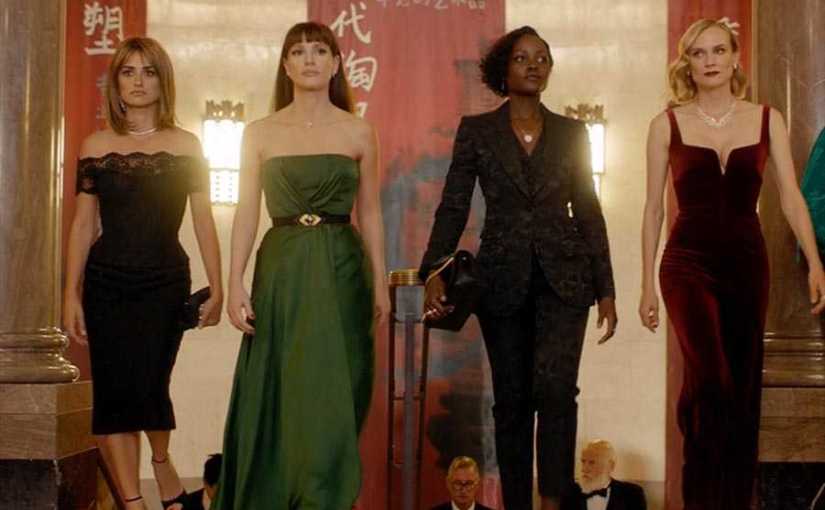
The device is stolen, and the good guys need to get it back before the bad guys do. Enter the main characters of the film: Mason Browne (Jessica Chastain) for the CIA, Marie Schmidt (Diane Kruger) for German intelligence, Khadijah Adiyeme (Lupita Nyong’o) for MI6, and poor Graciela Rivera (Penélope Cruz), a therapist who is in the wrong place at the wrong time. There’s some nonsense about them fighting each other at first, then banding together when they belatedly realize they’re on the same side.

The first major action scene is really well done, I have to say. There’s a foot chase through Parisian streets and subways that is as well done as any similar chase in the Bourne trilogy or any given Bond film. For that matter, ALL of the action scenes are competently executed…but that’s about it. There’s no flash or style, no real sense of originality.

There’s one sequence in particular that takes place in and around a fish-packing warehouse that, after a few minutes, became extremely muddled, and I lost track of who was chasing whom, and why, and how. The camera just seemed to be recording the action without getting me invested. It was curiously bland and detached.

The story itself was vaguely disappointing and unsatisfying, as well. It serves as the very definition of “by-the-numbers.” Virtually every cliche from better spy films are evident. The partner (Sebastian Stan) who’s dead…or is he? The trustworthy boss…or is he? The villain (Bingbing Fan) who lurks in the background…or is she a villain?

Now, there are uncountable films that have used these cliches to better effect, but it’s especially disappointing in The 355 because, throughout the movie, the story felt as if it was on the verge of talking about some truly interesting topics, specifically as it relates to women. There are subplots about how Mason, the CIA agent, has no personal attachments, while Khadijah, the MI6 agent, has a lover, and Graciela, the therapist, has a whole family waiting at home for her. Marie, the German spy, has some REAL problems that I won’t get into here. The story dances around the social perception of what women should or shouldn’t do with their lives. You want to be a secret agent full time? Okay, but you’ll get judged for not wanting to start a family. You want to start a family? Okay, but you’ll get judged for not being as professional or as dedicated as others in your line of work. You want to try to do both? Fine, but just when you think it can work, it doesn’t, so you should have come down on one side or the other. It’s a no-win scenario, and it happens all the time.

The movie dances with exploring this concept further, and then dances away in favor of more cliches and unnecessary plot twists. There’s even a whole sequence that feels as if it was lifted directly from one of the Ocean’s movies. Any one of them, take your pick.

There is also a moment when, out of NOWHERE, the stakes are raised in dramatic and horrifying fashion, so much so that it felt completely out of place. I was reminded, oddly, of a scene in the 2006 remake of The Hills Have Eyes where one of the mutant baddies slowly waves a gun over an infant in a crib. To me, it felt like overkill, and that’s the feeling I got with this off-putting twist. Was it necessary? It was shocking, true, and effective, but was it necessary? I don’t believe it was. I would have believed these women were motivated enough without bringing in outside pressure. And, to be honest, it felt like it was punishing those women who dared to have a life outside of their profession and rewarding those women who didn’t. No doubt there are other interpretations, but that’s how I saw it.

All in all, The 355 wasn’t downright unpleasant or super thrilling. It wasn’t exactly a waste of time, but it didn’t exactly blow my hair back, either. I don’t think it’s quite as bad as that Tomatometer would suggest, but…

Yeah…wait for streaming.

US (2019)

By Miguel E. Rodriguez

Director: Jordan Peele
Cast: Lupita Nyong’o, Winston Duke, Elizabeth Moss
My Rating: 9/10
Rotten Tomatometer: 94% Certified Fresh

PLOT: A family’s beach vacation turns sinister when a group of doppelgängers begins to terrorize them.


[SPOILER, SPOILER, MOST CERTAIN SPOILERS TO FOLLOW]

It’s abundantly clear after two films (with hopefully many more to come) that Jordan Peele was and is an enormous fan of The Twilight Zone, that legendary TV show that presented tales of strange and the weird situations that very often turned into legitimate horror stories.  For me, that’s what Us is: a feature-length episode of The Twilight Zone, with everything amped up to 11, including the ambitious nature of the ending which, I think, bit off a little more than it could chew.

However, the ending is not what makes this film special, it’s how we get there.  And the events leading up to the end of the film make for one of the most unsettling movie experiences I’ve ever had.

I cannot stress the creepy nature of this story enough.  A family’s beach vacation is interrupted when intruders invade their home, and the intruders turn out to be…their doubles.  Doppelgängers.  Virtually identical except for disturbing aspects, like an additional scar or a perpetual smile or a cloth mask.  When these “others” faced their victims inside the house, I was indescribably terrified.  I found myself asking, what would I do in this situation?  If I found myself sitting across from an exact duplicate of me, a duplicate who never spoke but just stared and smiled and made weird clicking noises instead of talking?

I’d s**t myself, that’s what I’d do.

The story takes some interesting twists and turns, and it doesn’t follow traditional genre convention when it comes to who lives and who dies.  Whenever I expected one thing to happen, the movie neatly sidestepped my expectations ingeniously.

There’s also unexpected comedy, especially when someone tries to use their automated personal assistant at a crucial moment.  Think of all the times Siri has misinterpreted your questions.  Yeah.  It’s one of THOSE moments.

The movie is an amalgam of the best moments of Rod Serling, M. Night Shyamalan, Alfred Hitchcock, John Carpenter, and even a little Spielberg here and there with the comedy moments.  It’s clear that director Jordan Peele has digested the best films from these directors and crafted his own take on the horror/suspense genre, using those masters as a guide.  (I’m referring to Shyamalan’s EARLIER films when I call him a master, because they WERE masterful…not his later stuff, which is…not great.)

I, for one, found myself sucked into the story, hook, line, and sinker.  It did become clear, however, that the underlying reason for the existence of these doppelgängers was, inevitably, going to be a LITTLE disappointing.  Science experiment gone awry?  Space aliens?  Results of a newly-emerging virus?  As the movie entered its final stages and the meaning behind the doubles’ existence was revealed, I did find myself a little disappointed.  Like when someone shows you how a stunning magic trick was accomplished with a simple fake thumb.

Would it have been more interesting to leave the existence of these doubles unexplained?  To make it a TRUE Twilight Zone episode and leave the audience with a mystery instead of a true resolution?  I think it would have been more interesting that way, so instead of shaking my head at the almost banal nature of the doppelgängers, I would have left intrigued.  After all, John Carpenter never explained how Michael Meyers vanished after being shot several times at point blank range.  But it was CREEPY, brother.

So, there you go.  I loved it, the ending was a little disappointing, but not disappointing enough to kill the movie for me.  The journey was more important than the final destination, in my book.