12 YEARS A SLAVE

By Marc S. Sanders

I’m grateful for those brave filmmakers who defy what is so glaringly oppressive in order to uphold a truth.  Steven Spielberg accomplished this with Saving Private Ryan and especially Schindler’s List.  I own both films on 4K, but I’ve only watched them each a handful of times.  I recently completed my second watch of Steve McQueen’s 12 Years A Slave.  While Schindler may feel more personal to me as a Jewish person who has met several Holocaust survivors, McQueen’s movie is uncompromising in its cruelty to black people , recklessly referred to as n!gg@rs, being held as property within the southern antebellum confines of slavery during the mid 1800s just ahead of the Civil War.  It’s one thing to read about lynchings and whippings.  It’s another to see it visualized; to see the life being breathlessly taken from a human being.  Not a slave.  A human being.

From such an ugly period in American history, the isolated story of this film follows the North Eastern free black man Solomon Northrup (Chiwetel Ejiofor, giving the performance of his career – heartbreaking, smart, emotional, fearful and brave at the same time).  He is a happily married father of two who earns an honest trade as an entertaining violinist in a well to do upstate New York Community.  When his family leaves town for a few weeks, Solomon is approached by two happy, colorfully dressed charmers with top hats (Scoot McNairy, Taran Killam).  Solomon believes he is being recruited to perform for some events across state lines for a significant sum of money.  He’s wined and dined by the men for a few weeks.  However, following a lavish dinner among the three, he awakens to find himself in southern Georgia, chain shackled at his four limbs.  

Despite his protests, insisting he is a legal free man, he is slapped, screamed at and trudged along to Louisiana and sold to a wealthy Plantation owner (Benedict Cumberbatch), who is comparatively kinder than his property keeper (Paul Dano).  Dano especially stood out to me this time as I reflected on Quentin Tarantino’s regard for the character actor. I question if the director, infamous for tossing the n-word around in nearly all of his films, has even seen 12 Years A Slave and had an opportunity to observe Paul Dano’s appearance. Dano’s character is genuinely mean spirited and hateful with that southern redneck naive racism for the black man. It’s what is demanded of this piece. His performance cruelly teases the black slaves with a song that sounds like a nursery rhyme but chants like a horror film while his screams insist they clap along. McQueen is wise enough to edit Dano’s voiceover singing as the slaves are getting accustomed to the new property, they are forced to tend to and live upon. Later, Dano and Ejiofor will conflict with one another, and the scene is terrifying of what it implies will arrive. So, there’s my two cents on actor Paul Dano (also known for There Will Be Blood, The Batman, and Prisoners). I’ll throw two more cents around and ask Mr. Tarantino to go reflect on his meritless position on this fine actor.

This picture also features Paul Giamatti headlining a horrible scene, working like a car salesman as he slaps the naked physiques of Solomon and other black people. His purpose is to demonstrate the value and endurance of these “properties” for potential buyers.  The novelty of used car salesman tactics seemed to originate here.  With no regret, black children are torn away from a helpless, anguished mother.  McQueen with John Ridley’s Oscar winning adapted screenplay includes this scene to show how quickly a transition into slavehood occurs.  Solomon and many of these other folk were free moments ago.  Now, they are delivered off a boat and are being sold like cattle, to be used not just for work but for sexual appetites and playthings.

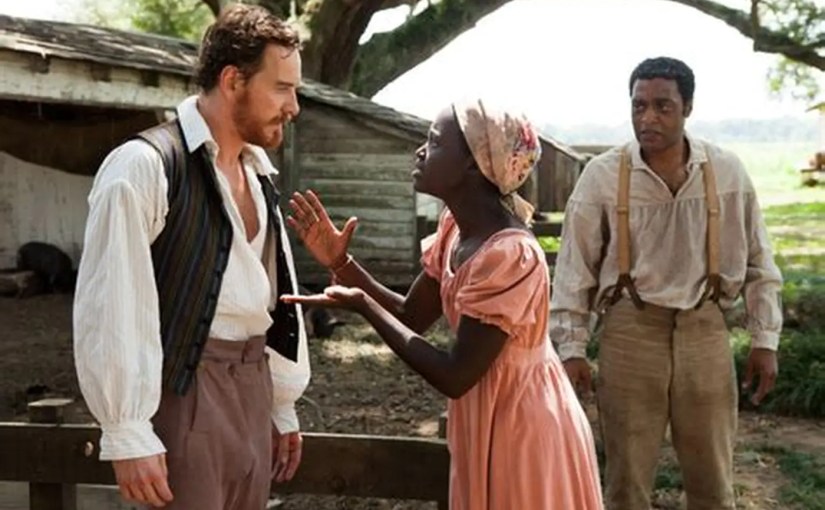
The second half of the story finds Solomon as a sold property slave of the viciously harsh Edwin Epps.  Michael Fassbender has never been more terrifying with intense rage that hides any other memorable performance in his impressive career.  He more than serves the antagonism of this film the same way that Ralph Fiennes did for Schindler’s List.  This is a monstrous individual.  Strong, oppressive, with no way to be endeared.  If he’s mad, for whatever reason, he’s going to be mad at his faultless slave workers who do nothing out of line and work solely to satisfy Edwin’s demands.

As the title implies, Solomon’s captivity carries on for twelve years with no access to his family or proper legal authority.  He also dare not reveal he can read or write, lest he will come up as a threat to those that violated his legal rights as a free northerner.  Solomon Northrup was always to remain trapped.  Even his talents with the violin are compromised as he’s awakened in the middle of the night to marshal the entertainment for Edwin as he compels his property to dance naked among themselves in his drawing room.  

As horrific as Solomon Northrup’s story is, later accounted for in his published book, it’s a fast paced and engrossing tale.  McQueen assures an understanding of how harsh it was to live within the dense, stale heat while picking pounds of cotton for the slave owners and their wives.  The whispers of flies and mosquitoes, along with tall grass and dragonflies often found in the south bring an awareness to the mundane and exhausting life of picking cotton from sunup to sundown.

The work was never the worst though.  The younger black girls were groomed to be continually raped.  A telling moment occurs when Edwin prances around the property in just a loose, sweaty shirt (no pants) with a child holding his hand. It is easy to grasp what’s to become of this girl, especially considering how Edwin treats Patsey, a teenage slave, who is repeatedly raped and beaten by him while infuriating the jealously of the Mistress Epps (Sarah Paulson).  

Lupita Nyong’o is Patsey, in an Oscar winning performance.  Nyong’o’s anguish matches Fassbender’s rage in equal fashion.  (He was Oscar nominated too.) Ahead of shooting days, the actors maintained rigid exercises together to preserve a direct trust during the abusive scenes.  Though thoroughly convincing in their dialects and performances of tears and brutal anger and screams, I cannot imagine it would be healthy for either actor to go full method here.  Had they actually done so, I’d argue they’d never return to a sense of acceptable balance, mentality and perception between one another.  What they do together, just like this whole cast, is hard, brutal work. Just look at how red faced Fassbender gets. See how glossy Nyong’o’s complexion gets behind the screams and tears. Not all of this is just makeup spray water.

Steve McQueen takes large sections of his two-hour film to demonstrate the carryover of time.  I’m not necessarily talking about twelve years.  Rather, minutes and hours.  One section has Solomon strung up from a tree by the neck.  The only thing keeping him from crushing his windpipe is to continually tip toe on the wet mud beneath his feet.  Morning turns into sweltering afternoon and into night.  McQueen does not rush this moment.  He wants the audience to realize that black slaves were regularly hung from oak trees.  It’s one kind of understanding to endure the hanging with literally no aid or sympathy to rely on.  What’s worse? A quick hanging that ends in blacked out death, or the kind that only dangles a person to the absolute brink of death?

The hardest sequence is an unbroken four and a half minute shot.  The director’s camera circles around Patsey’s scarred, bound, naked body, as she gets bloodier and bloodier by the unending whippings from Edwin’s unreasonable rage. When the taskmaster forces Solomon to take over, a sad irony is that Patsey begs Solomon to resume the whipping.  She’d rather take her punishment from him, than the slave owner.  

Paulson is in the background of this scene too.  She never flinches, always looks justified in permitting this action to carry on seemingly like a Lady MacBeth.  Nyong’o allows herself to be weakened to nothingness with horrifying screams.  Fassbender seems to never tire of flinching his arm with the whip in hand.  Ejiofor does not rush into what is forced upon him but once he begins, he’s out of breath with terrible suffering for what he is compelled to bestow upon this helplessly tied up woman.  Again, McQueen never breaks this into quick edits.  It is all one shot, as you see mists of sweat, blood and body heat emanate from Nyong’o’s back with every swiftly delivered lash.  It is so unfair.  That’s a terrible understatement, but it’s what comes to the forefront of my mind.  What person ever deserves this kind of treatment?  What reason could there ever be to whip a person into a bloody, stinging, charred up pulp?  This is never, ever fair.  

The scene is so harrowing that I have yet to discover how it was safely put together for filming purposes.  What these actors went through. It’s uncanny how real it looks.

None of what you see in 12 Years A Slave is ever forgivable. Long after these doers of evil are dead as well as their offspring and their offsprings, it remains as never excused and should never be offered repentance.  Some would actually say “Well you have to understand, that’s what it was like at the time.” To hell with that. Today, moments like these are actually being dismissed and erased from our institutions as attempts are made to “make America great again.” There are places in this world where this kind of treatment still occurs.  It’s fascinating that generations have not learned from the sins of ancestors.

McQueen’s film is assembled with amazing craftsmanship.  John Ridley’s screenplay contains a dialogue that performs with intellect, even if there are characters that we presume were denied formal educations.  Brad Pitt offers a cameo as a white man with a conscious devoid of prejudice.  Listen to his dialogue against that of Fassbender’s.  On a sweltering summer day on the plantation, these two sides of the slave ownership argument operate like a congressional debate.  Ridley incorporates vocabulary that lend to another time, long outdated, but telling of the limits that some people will never adopt. Ejiofor, as an educated Solomon, has been diminished to look like a censored man, but even his shredded, dirty slave wear does not prevent him from realizing there is a hope for common sense and good nature, even in this unseen corner of the world.

The antebellum plantations are vast and isolated from a civilization with architecture of tall posts on white porches.  These areas look like contained miniature empires; maybe adapted from grand landmarks of ancient Rome or Greece. The costumes deliver a wide contrast of social status.  The cast of slave actors perform scenes nude in dirty field settings, broken sheds and dark, smelly cattle barns. The white aristocrats are dressed in the finest fabrics.  12 Years A Slave does not just describe. More importantly, as a very well-done film, it shows how wide a berth these people are separated from one another.

This is a necessary, monumental biography to watch and explore.  In social media I continuously remind people that the Holocaust happened less than ninety years ago, and it could easily happen again.  The same is equally true for slave history.  If the acceptance of this mentality can be taught, it will be learned and then it will be executed.  It can happen so easily and so swiftly.

History is unclear of what became of Solomon Northrup after he wrote his book, ahead of his death, but his story will never be forgotten.  It’s fortunate that McQueen’s picture was bestowed an enormous number of accolades including winning the Oscar for Best Picture.  An Academy Award is not simply recognition for artistic greatness.  Its reputation allows a piece of filmmaking to constantly be recalled for years to come among an elite collection of accomplished achievements.  If anything, that should ensure the terrible chapters of American slavery are never, ever forgotten.

NEXT GOAL WINS (United Kingdom, 2023)

by Miguel E. Rodriguez

DIRECTOR: Taika Waititi
CAST: Michael Fassbender, Oscar Kightley, Kaimana, David Fane
MY RATING: 9/10
ROTTEN TOMATOMETER: 41%

PLOT: In 2011, the literal world’s-worst soccer team from American Samoa gets a new coach one month before the next World Cup qualifiers.


In all the best ways imaginable, Next Goal Wins is a throwback to those countless formulaic sports movies of yore, from The Bad News Bears to Little Giants to Cool Runnings to The Mighty Ducks and beyond, right down to some of the songs used on the soundtrack. The underdog formula is nearly as old as film itself, and there have been many, many bad attempts at using it.  Where Next Goal Wins succeeds is in making the audience really care about the players and the coach before the big match.

Apparently, that’s not easy to do.  The list of films that get this basic concept wrong is long and undistinguished, from badly-thought-out sequels (Rocky V, Major League: Back to the Minors) to original concepts that crashed and burned (The Air Up There, The Babe).  In fact, there have been so many BAD sports films that I initially didn’t want to see Next Goal Wins.  But it’s from a director I admire, New Zealander Taika Waititi (Jojo Rabbit, Thor: Ragnarok), and the trailers made it look mildly interesting with its exotic setting in American Samoa.

After watching it, I am once again compelled to repeat Roger Ebert’s axiom: “It’s not what a movie is about, it’s how it is about it.”  The formula may be old, but Next Goal Wins executes it beautifully, like a textbook sliding tackle.

The story begins with a flashback to when the American Samoan national football team – that’s “soccer” to us Yanks – legendarily lost 31-0 to Australia in the first round of the 2001 World Cup qualifiers.  (The device for this flashback is a charming narration from Taika Waititi himself, playing a Samoan priest…or preacher…it’s not quite clear, but it’s pretty funny.)  Flash forward to 2011 when a down-on-his-luck soccer coach Thomas Rongen (Michael Fassbender) is given a take-it-or-leave-it offer to coach the American Samoan team…a team which, by the way, had never scored a single goal since its inception.  The existing coaching staff, along with the team’s devoted fans, are so beaten down by disappointment and defeat that they don’t even necessarily want a win.  They’ll take just a single goal in official competition.

(I should mention here that before you think this is going to be another “white savior” movie, I assure you, it’s not. In fact, one of the characters brings up that very question, and the team ultimately rises and falls based on how they incorporate their own attitudes and customs rather than in utilizing new methods from their new Caucasian coach. This is key.)

What happens next is predictable to anyone who has ever seen Major League.  We meet the team members, a squad of misfits that includes an oversized goalie, a guy who looks like a reject from the old Geico caveman commercials, and a transgender player who spends most of her time on the practice field standing alone and playing with her hair.  Tradition says that the goalie must redeem himself, the caveman guy will reveal hitherto-unknown skills, and the transgender player will rise to the occasion when it counts.

Does all of this happen?  Well, yes and no.  I don’t want to reveal too much, because a lot of the pleasure in this film is watching how it toys with cliches, turning some of them slightly sideways while fully embracing others.  …okay, I’ll reveal one example.  Remember the overweight goalie?  You’ve probably seen him in the trailer, where the coach tells him to go around instead of jumping over him during a drill.  In another, less-inspired film, he would somehow save the day during the climactic match.  Nope.  He’s replaced about halfway through the movie with the ORIGINAL goalie from ten years earlier, the one who allowed 31 goals against Australia.  (But, as another team member points out, he did make 60 saves in that same game.)  Now this guy has something to prove.

Predictably, everything leads up to the first qualifier against Tonga.  We’re never given much info about this team other than they are the opponents and are therefore two-dimensional douchebags.  They insult the Samoan team unnecessarily and taunt the transgender player at a pre-game mixer.  Formulaic, yes, but it fits neatly into the mold of this movie, and I’m willing to let it slide.  There’s even a revelatory discovery halfway through the match that blindsided me and imparted even more emotional weight to the entire movie.  Don’t let anyone spoil it for you.

After looking at the critical comments regarding Next Goal Wins, it seems like this is just going to be one of those movies that either works for you, or it doesn’t.  One critic calls it “deeply irritating” because it follows the underdog sports movie formula in lockstep.  Well, yes, but it does it so well and with enough variations on that theme that I forgive its predictability.  Another critic says the film “doesn’t seem nearly as challenging or risky as most of what Waititi has given us before.”  Well, geez, what were you expecting, Slap Shot crossed with Jojo Rabbit?  Other critics make that same complaint, that the film suffers relative to Waititi’s previous films.  Well, wouldn’t it be fairer to judge the movie itself instead of comparing it to his earlier work?  Or is that just me?

Next Goal Wins was just a great time at the movies.  It may not unlock the secrets of the universe, but I had more fun than I expected.  I can’t ask for much more than that.

(P.S. For those of you keeping score, my girlfriend cried twice.  Do with that information what you will.)

ALIEN: COVENANT

By Marc S. Sanders

I imagine it would take a defiant personality to become a God and bearer of life.  That individual would most likely have to be beyond human to follow through on such an endeavor.  In cinematic fiction, to occupy such a role would require an exceptional actor with a calm yet powerful command.  It is fortunate that in Ridley Scott’s follow up to his Alien prequel, Prometheus, that he was able to recruit Michael Fassbender in the role of David – the android invested in discovering new amalgamations of life from unknown sources within a very deep universe.

I understand Alien: Covenant left many fans and critics divided and that it was not the box office success many were hoping for.  In addition, a follow up chapter to this film seemed more unlikely following Disney buying out 20th Century Fox.  Nevertheless, none of these occurrences dismiss one of best dual role performances I have ever seen, compliments of Michael Fassbender. 

The actor first appears in a prologue as David discussing challenging questions with his maker, the wealthy industrialist Peter Weyland (Guy Pearce), a younger looking iteration than from the prior film.  David has met his maker.  However, he questions who created his own maker.  No satisfying answer comes from the conversation and thus it ends with Weyland commanding his “child servant” to a menial task of serving him tea.  David, we learn, will resent humans who opt to subject his incredible capabilities to menial tasks.  He is destined for greater achievements than servitude.  David is meant to be a God.

The film diverts to a period eleven years after the events of Prometheus.  A massive ship known as The Covenant is embarking on a journey to a paradise where the cryo-sleeping colonists and the hundreds of human embryos in storage will set up a new civilization for themselves.  They have just over seven years left of their journey.  The crew of fifteen who command this expedition are also sleeping while an android named Walter (Fassbender in another role) oversees operations.  Following a collision with a storm-like phenomena in space, the crew is violently awakened and the captain (James Franco) does not survive. A reluctantly nervous replacement named Oram (Billy Crudup) now must lead, and it appears fortunate that Covenant has come upon another nearby planet sending a signal source in the form of a John Denver song.  Why John Denver????? I guess the Beatles and Rolling Stones were too expensive. This locale might suit the colonists’ needs and save them another seven years of travel and unexpected risk.

Oram and the former captain’s wife, Daniels (Katherine Waterston), lead a team down to the planet.  A wheat field is surprisingly found.  There’s beautiful blue sky and mountain ranges.  Water is found.  Still, there’s a disturbing realization. Not a single animal or life form is anywhere.  No insects, no birds, no wildlife, nothing.  Like prior installments in the franchise, it is not long before some crew members get ill, very, very rapidly.  Then the first of several terrifying episodes begins.  All of that is visual and not necessary to recap here.

David makes an “Obi Wan Kenobi” like appearance amid the mayhem and calms everything down.  The highlight of Covenant is when Fassbender as Walter (a down to earth American interpretation of an android) encounters Fassbender as David (a refined English example). Upon entering David’s habitat, it is clear he has been busy over the last decade since he and Dr. Elizabeth Shaw (Noomi Rapace, from Prometheus) arrived on this uncharted planet that was once populated by The Engineers, also from the first film.

At the risk of mild spoilers, I offer the following observations, because the thought provoking aspects of Ridley Scott’s third monster movie, are worthy of insightful conversation. 

Walter and David are undoubtedly the most interesting characters of Alien: Covenant.  They possess two totally opposite mindsets.  Almost like they are the angel and devil figures found on a person’s shoulders.  They regard the value of people differently.  Walter holds humanity in high esteem, ready to assist while they continue explorations of great beyonds.  David is prepared to dismiss them, though they serve a valuable purpose in his own selfish discovery to harbor a new breed of creature – one considered to be a perfect organism.  Experimentation has been David’s sole focus.  Now he may have finally uncovered precisely what he needs for his masterpiece of creation.

There are staple moments and happenings that are no longer surprising in Alien: Covenant because there’s a formula that traditionally worked in the long gestating franchise before.  Nevertheless, the film is far from stale.  The story offers up a well-conceived history to the origins of the alien breed, known as Xenomorphs from other films.  Why and how they came to exist are provided.  Hey, I’ll happily say this is more definitive than the Old Testament.

To witness one actor on both sides of a debate discussing the purpose of human preservation and what value people serve from this point is really a thrill.  Both Walter and David are artificial intelligence.  They are so advanced that they have usurped humans as the greatest thinkers in the universe.  It’s not farfetched in this age of smart phones and an over reliance on technological innovations to incorporate this into a monster movie.  It only enhances and improves upon a tired old Godzilla cliche.  Movies are sometimes quite prophetic.  So, it’s not even ridiculous to categorize a film like Network with a bloody sci-fi horror film like Alien: Covenant or even a couple of Tom Clancy political thrillers.

Alien: Covenant boasts a good cast particularly with Katherine Waterston, Billy Crudup, and an unusually serious Danny McBride as a good ol’ boy pilot named Tennessee.  McBride does well with the drama and horror to come.  He’s not a novelty act.  While these actors may be playing well developed characterizations, I know they are only here for the body count and to keep David and the aliens busy.

Again though, the film especially belongs to Michael Fassbender.  A brilliantly inspired casting choice for the first film in this more recent resurgence of the franchise.  It’s only a huge blessing that he returned, and this next film pounced on his capabilities to balance the two roles on opposite ends of the spectrum.  Regardless of whether he’s playing Walter or David, Alien: Covenant only gets more interesting when Fassbender occupies a scene. 

An especially telling moment is so wisely written with a kind of seductiveness between the androids while one teaches the other to play the flute.  Humans no longer need to program computers.  The computers can work it out themselves, and even develop an intimate attraction for one another.  What’s most delightful is again, I remind you, that Michael Fassbender is the only one working in scenes like this.  How often has an actor gone in for a kiss in another role that he is playing in the same scene?  He hides so well in Walter and David, that you lose sight of the fact that you’re watching only one performer doing all the work.

The final scene of the picture caters beautifully to what Fassbender offers in his two roles.  The story’s conclusion will leave you thinking and wondering what comes next.  Intentional or not, I regard the ending of Ridley Scott’s picture as an homage to other great films like The Silence Of The Lambs and The Usual Suspects.  You may feel shockingly haunted as the end credits roll.

Overall, Alien: Covenant is a chilling, mind-bending masterpiece of science fiction horror and what-if prophecy.

PROMETHEUS (2012)

by Miguel E. Rodriguez

Director: Ridley Scott
Cast: Noomi Rapace, Michael Fassbender, Charlize Theron, Idris Elba, Guy Pearce, Logan Marshall-Green
My Rating: 10/10
Rotten Tomatometer: 73%

PLOT: A deep-space research vessel arrives at a distant moon, searching for clues to the origins of mankind.  What they find instead threatens their lives and the lives of everyone back on Earth.


I am at a loss to explain the mediocre Tomatometer score for Prometheus, Ridley Scott’s long-awaited return to the universe he created in Alien [1979].  Intellectually, I can hear the arguments:

  • “Where’s the Xenomorph?”
  • “So did the ‘Engineers’ create humans or what?”
  • “Is that planet at the beginning supposed to be Earth?”
  • “Where’s the Xenomorph?”
  • “Why did that idiot scientist approach the snake-looking creature?”
  • “How is the android able to break almost all of Asimov’s Laws of Robotics?”
  • “What’s with the open-ended ending that provides no resolution?”
  • “WHERE’S THE XENOMORPH???”

I get it.  You hear Ridley Scott is making a prequel to Alien and you build up a lot of expectations, especially after watching some of the sorrier sequels that piled up after Aliens [1986].  When you go into a movie expecting one thing and get another, people get hacked off.  I feel you, bro.

But to those people who dismissed Prometheus because it didn’t deliver what they expected to get, all I can say is: your loss.  Because Prometheus is one of the greatest sci-fi movies of all time, in my humble opinion, and it’s mostly for the very same reasons that people disliked it in the first place.

After a brief prologue set in an unknown time in an unknown place, we jump to the year 2093, when a deep-space research vessel arrives at a far distant moon, searching for clues to the origin of mankind.  Dr. Elizabeth Shaw (Noomi Rapace) says they were led to this specific moon by “Engineers”, humanoid beings who are visible in ancient cave drawings from across the globe.  She believes the Engineers can provide an answer, THE Answer, to Life, the Universe and Everything. (Apologies to Douglas Adams.)

Instead of Engineers, Dr. Shaw and her expedition discover miles of underground caverns and a room full of canisters that turn out to contain a horrifying contagion that attack the body at a cellular and/or genetic level, creating painful mutations that, if they don’t kill the host outright, turns them incredibly violent.  We also get a glimpse of the famous “space jockey”, the fossilized alien creature seated in some kind of contraption inside the spaceship in Alien.  So at LAST we’re in familiar territory.

But still no Xenomorph.

The story progresses, the shipboard android turns out to be less than trustworthy, people die in creative and horrifying ways, an Engineer actually turns up, we get a couple more visually spectacular tie-ins to the first Alien…but by the time we get to the end, what gives?  The movie’s obviously over, but we haven’t gotten any answers to the burning questions: Who are the Engineers?  If that was an Engineer in the prologue, was that supposed to be Earth?  If it WASN’T Earth, why even HAVE that prologue?  And don’t try to tell me that was a Xenomorph at the end…

Well, here’s my two cents.

First, of all, expectations are tricky.  They can color and compromise your entire movie-watching experience.  When I went to see Prometheus, I did have my own set of expectations, but as the movie settled in and it became clear that the movie had other designs, I had to consciously shake myself loose of my expectations and embrace what was being presented to me.

Second of all, the visuals are stunning.  I happened to see this in 3-D, and it’s one of a handful of movies where the technology was used PERFECTLY.  No gimmicky shots of spears or harpoons or whatever being pointed out of the screen.  It was used as it should always be used: as a tool to further immerse you into the world of the film without overloading you or being ridiculously obvious.  The gorgeous landscapes during the prologue and during our heroes’ descent to the surface are awe-inspiring.

And then, the story.  I was completely okay with the open-ended nature of the story, and I’ll tell you why.

There are some films out there that play Prometheus’s game of asking questions and not answering them.  One of the most famous examples is Stanley Kubrick’s adaptation of 2001: A Space Odyssey [1968].  If you’ve never read the book, I defy you to provide a concise explanation of the last thirty minutes of that movie.  But that didn’t bother people, because the goal was to get the viewer to ask questions, to provoke discussions about the movie that would eventually get around to some of the same questions asked in Prometheus: Why are we here?  What is our purpose?

And then there are other films that play that open-ended game and fail.  The one that comes immediately to mind is Darren Aronofsky’s The Fountain [2006].  By the end of that movie, my head was locked in a tilted position like a cocker spaniel hearing a strange noise.  If I had been a cartoon character, the word balloon over my head would have been all question marks.  I once read a full description of what was really going on in that film, but to the degree that I understood it, I simply didn’t care.  If I have to go that much work to “get” a movie, the movie didn’t do its job.

There are those who say that’s what Prometheus did, throwing us in the deep end and making us do some mental heavy lifting with no payoff.  But I disagree.

I think, for me, it has to do with the very nature of the questions Prometheus is asking.  “If we could discover the answers to the riddles of our existence, to what lengths would we go, or should we go, to get those answers?  And do we even want to know the answers?  Are we better off NOT knowing?”  These are questions that, almost by definition, can’t be answered in any satisfying way.  So Prometheus presents a possible answer, but then teases it away so there is still some mystery in the story.  If the characters in Prometheus had discovered some kind of document that laid out the Engineers’ plans in detail, I would have felt cheated.  It would have been woefully anticlimactic.  I liked it better that the biggest questions went unanswered, so I could formulate my OWN theories about the Engineers, their plans, their methods, their history, their future, etcetera.  It’s much more stimulating to let my imagination run riot.

(Granted, some of those questions are answered in Alien: Covenant [2017], but that movie still had the guts to leave some things to the imagination by the end.)

Prometheus couches deep philosophical riddles about our very existence within a crackling good thriller with spectacular visuals from beginning to end.  It stands tall as one of the best prequels ever made…Xenomorph or no Xenomorph.

INGLOURIOUS BASTERDS

By Marc S. Sanders

If you are going to rewrite history then go crazy.  Go big and bloody.  Go for broke.  Don’t hold back.  Quentin Tarantino didn’t hold back when he penned and directed Inglourious Basterds, my personal favorite of his films.

To date of when this review is published, Tarantino has directed nine films and if ever the maturity of a director is so evident, it really shows with Basterds where three quarters of the picture is performed in either French or German.  English is secondary here, and Italian is limited to only a couple of “Bonjournos!”  and “Gorlamis!”

Tarantino presents early 1940s France when Germany occupied most of the country and practically rounded up all of the Jews.  In 1941, a cunning detective of a Nazi Colonel, Hans Landa (Christoph Waltz performing as one of the greatest villains of all time) visits a French dairy farmer to ensure there are no unaccounted-for Jews scurrying around; scurrying around like their beastly equivalent, the rat.  Landa is the hawk that will most assuredly find them.  This scene is the best written moment within Tarantino’s catalog of various scripts and dialogue exchanges.  The Landa character offers justification as to why a Jew needs to be exterminated to the point that he nearly had me (a conservative practicing Jewish man) believing in his hateful philosophy.  The lines crackle here with Waltz doing most of the talking while the sad dairy farmer can do no more than respond with certifying Landa’s interesting points.  Tarantino closes the peaceful discussion with horrifying violence though.  Hans Landa may be complimentary of a farmer’s milk and his three beautiful daughters.  He may be eloquent in his dialogue albeit French, German or English, but he is a ruthless enforcer of law …of Nazi law at least.  I also would like to note Tarantino’s tactful way of using props like the pipes the characters smoke, the glass of milk that is consumed by Landa and the ink pen and spreadsheet he uses for accounting of the Jews in the area.  There’s an uncomfortable intimidation in all of these items as they are handled by Waltz, the actor.  Later in the film, Waltz will send a chill down your spine as he happily enjoys a delicious strudel with whipped cream.  Inglourious Basterds is a great combination of directing, editing, cinematography and acting.

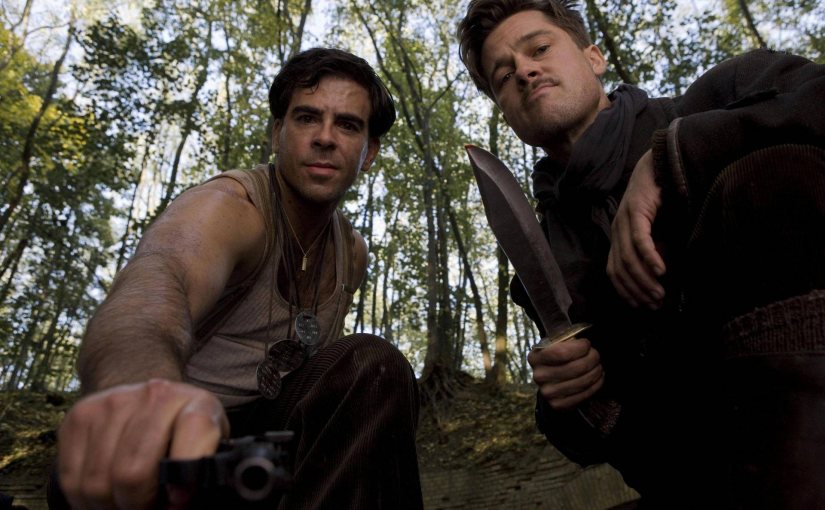
The film diverts into a few separate stories, namely the title characters led by Aldo “The Apache” Raines, played with Tennessee redneck glee by Brad Pitt.  The Basterds consist of mostly Jewish American soldiers tasked with going deep into enemy territory and literally killing and scalping one hundred Nazi soldiers, each.  However, keep at least one alive during each encounter with a carved souvenir on their forehead, to spread the word of the Basterds intent.  This is deliberate B movie Dirty Dozen material and it works because it doesn’t take itself seriously.  Tarantino maintains that pulpy fiction narrative.  A cut to an over-the-top crybaby Adolph Hitler asks, “What is a Hugo Stiglitz?” and then we get a quick pause with big black block letters across the screen spelling out HUGO STIGLITZ.  This guy is a bad ass; a German turncoat who only wants to kill fellow German Nazis.  He’ll shoot them up until they are dead three times over.  He’ll stab them in the face twenty times through a pillow.  He’s not a suave killer.  He likes it violent and bloody messy.  The Basterds are fans.

The heroine of the film is Shoshanna (Melanie Laurent), a Jewish girl who is living undercover as a cinema owner in France.  By implied force she is tasked with presenting Himmler’s proud film of Nazi Germany’s finest war hero, Fredrick Zoller (Daniel Bruhl), recreating his bird’s nest three day sniper battle against an army of three hundred men.  This is where Tarantino does best at writing what he knows, and what he knows best is anything about cinematic film.  He literally uses his knowledge of film and film reels to bridge his story while setting Shoshanna on a mission to actually end World War II in one swift motion.   

In addition, he captures the adoration of film lovers and celebrity status.  Zoller is as heroic a celebrity as John Wayne or Zorro.  When he is recognized in the coffee houses or on the street, he humbly stops his ongoing flirtation with an uninterested Shoshanna, to give an autograph or pose for a picture.

Furthermore, Tarantino applies the scientific knowledge of how 35mm film is more flammable than paper as well as how to edit a film reel to an unexpected moment for Shoshanna’s Nazi audience.  He knows the architecture of a European cinema with its lobby and balconies and seating capacities.  He allows his characters to speak on an intellectual level by discussing great film artists of the time – filmmakers not as well-known as Chaplin here in the United States, but just as great or even artistically better. The art direction of the cinema both inside and out is adorned with washed out, distressed classic noir films.  Shoshanna changes out the lettering of the curved marquee top of the theater as well.  It might sound mundane, but to me it’s all atmospheric.

Beyond the subject of cinematic art, a bad guy will weed out a spy disguised in Nazi garb by recognizing how he signals for three drinks with his hand.  There’s a right way and a wrong way to place an order with a bartender.  Inglourious Basterds may be a fictional historical piece, but it also will give you an education. All of this reminds me that Quentin Tarantino has graduated from the simplicity of Reservoir Dogs to something bigger and grander and glossier.  Production money with a large budget will lend to that status of course, but Tarantino still had to learn to truly know what he was doing.

I will not spoil the ending here.  It’s a bloody blast for sure.  Moreover, it’s shocking.  If anything, Inglourious Basterds introduces an exclusive universe that resides in the mind of Quentin Tarantino where the textbook is thrown away, burned, riddled with bullets and blown up; it is where something else altogether happened, and you know what? I really wish it did actually happen this way.