
By Marc S. Sanders
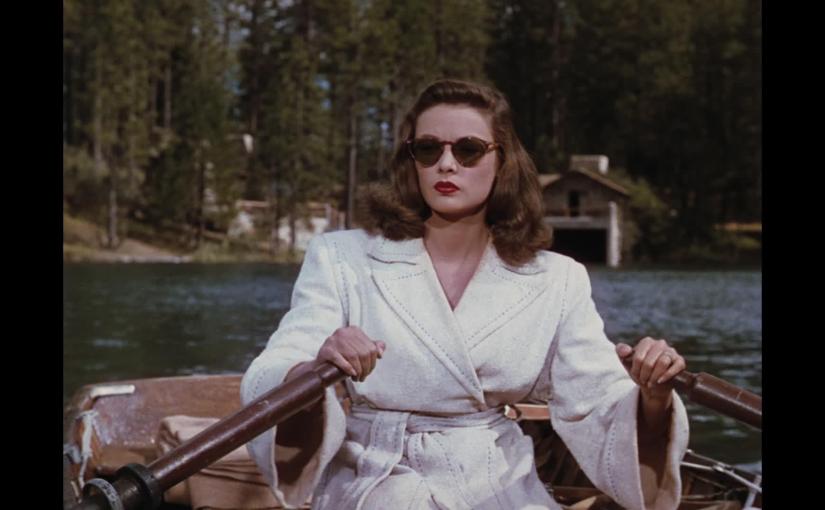
Martin Scorsese declared that Gene Tierney is one of the most underrated actresses of all time. It’s likely her femme fatale performance in Leave Her To Heaven supports that argument. Miguel mistakenly left his Criterion copy at my house and on a whim, I popped it into the machine. With no knowledge of what the film was about, I gradually found myself stunned as the story initially unfolds as a meet-cute encounter between a charming novelist and a stunning, pleasant woman who get caught up in a whirlwind romance that turns questionably eerie.
The author is Richard Harland (Cornel Wilde). He meets the voluptuous Ellen (Tierny) sitting cross from him on a passenger train car. She just happens to be reading his latest best seller, and she takes to him at first sight because he looks strikingly familiar to her deceased father. It’s also convenient to know they have the same destination at a retreat ranch in New Mexico. Ellen’s mother, Margaret (Mary Philips), and her adopted sister (or maybe not?), Ruth (Jeanne Crain) are also staying there. The ladies are actually going to spread father’s ashes high up on a mountain top nearby.
Richard is captivated with Ellen but respects her boundaries when he learns that she’s engaged to marry Russell Quinton (Vincent Price), an imposing man who is running for district attorney in Boston, Massachusetts. That changes very quickly upon Russell’s surprise visit one night, where Ellen announces in front of everyone, including Richard, that she is now engaged to the writer. Richard may be caught off guard, but he’s thrilled to spend his future with this alluring woman.
Everything seems idyllic. Ellen caters to his every whim without even be asked. She cooks and cleans for him and insists on not hiring a housekeeper to do such chores.
Richard is also quite fond of Ruth and Margaret, and he’s certain that Ellen will take kindly to his younger brother Danny (Darryl Hickman). Danny resides at physical therapy home in Georgia. He’s unable to walk but hoping to soon. That doesn’t hinder his enthusiasm for his new sister in law and more time with his brother.
Everything seems perfect, and yet there are expressions and random observations about Ellen that leave all but Danny and Richard with trepidation. Ruth and Margaret are kind people, but they seem to have reservations about Ellen’s intentions. Who should Richard be cautious of though?
Leave Her To Heaven relies upon a diabolical personality hiding in plain sight. It begins with a lawyer telling some folks the story of Richard’s time with Ellen. Richard arrives at a lakeside dock in Maine, and then he is on his way by canoe to visit a woman at a getaway cottage on the other side of the lake. He’s been through some kind of ordeal. It’s not clear what woman he’s going to see and why, nor what he’s recently endured. The lawyer’s story has much to spell out.
Growing up in the 1980s and 90s, this film noir feels like it carries influence towards more modern classics like Fatal Attraction and The Hand That Rocks The Cradle, and even the recent sleeper hit of 2025, The Housemaid with Sydney Sweeney and Amanda Seyfried (which I highly recommend). Especially effective is how trustworthy John M Stahl’s scenes of exposition seem. At any point his film, adapted from the novel by Ben Ames Williams, could have steered in the direction of glowing optimism and promising possibilities. Having not known where the story was going to take me enhanced my experience with the picture. Gene Tierney’s lovely and later disturbing composition kept me alert and when later moments occur that leave no doubt of what her goals are, the suspense held on to a haunting pinnacle.
The third act relies heavily on Vincent Price’s contributions, and he is a superb antagonist. He’s far from the eerie B-fest persona that made him famous, but he is largely intimidating. Still, his material is written to be extremely contrived as the screenplay resorts to lopsided courtroom drama. Leave Her To Heaven is fully aware it’s not following legitimate protocol in a standard trial. The courtroom setting operates more like a conduit to tie up loose ends and ensure all the pertinent characters get on the same page. With Vincent Price driving the narrative, the thrills remain upheld.
The Technicolor on the Criterion edition deserves praise. For a film noir from 1945, this restoration looks entirely modern and and with the exception of the courtroom scenes, never feels outdated. When you’ve run out of Alfred Hitchcock material to bite your nails on, Leave Her To Heaven is a very good and solid alternative.
Best advice, be careful when you fall in love at first sight.

