
By Marc Sanders
You know, everything is not an anecdote. You have to discriminate. You choose things that are funny or mildly amusing or interesting. You’re a miracle! Your stories have none of that...It’s like going on a date with a Chatty Cathy doll. I expect you have a little string on your chest, you know, that I pull out and have to snap back. Except I wouldn’t pull it out and snap it back, you would. Agh! Agh! Agh! Agh! And by the way, you know, when you’re telling these little stories? Here’s a good idea: have a point. It makes it so much more interesting for the listener!
– Neil Page to Del Griffeth, Planes, Trains & Automobiles, 1987
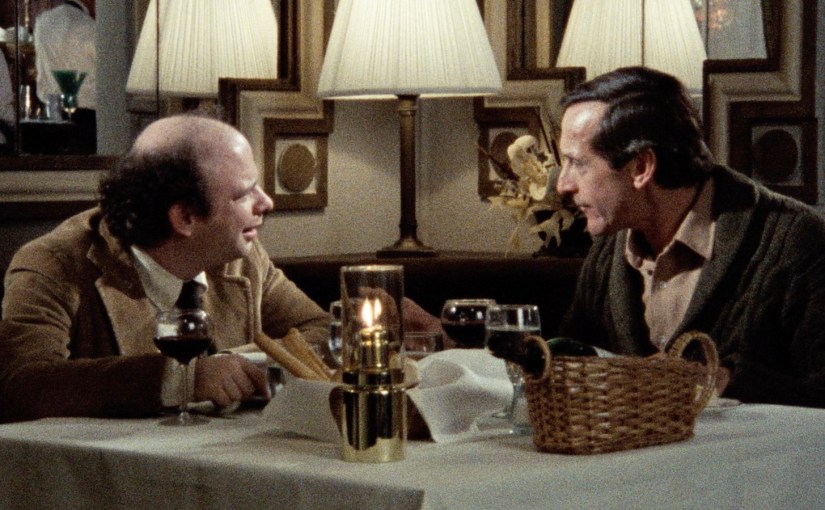
Gene Siskel and Roger Ebert deemed My Dinner With Andre one of the ten best films of the 1980s. It’s unique with a bold attempt at building an irresistible attraction to focusing entirely on a conversation in a restaurant booth between two men over dinner. Nevertheless, I find it to be a swirling black hole descent into a void I could not escape. I walked into this restaurant with nothing. I walked out with nothing.
Siskel deemed the discussion between Andre Gregory and Wallace Shawn to be a conversation into “intellectual outer space.” He’s not wrong. Especially when listening to Andre speak, anyone with at least a fourth-grade education will likely gather that he proudly shares his exploits in India and wherever else along with his experiences chatting with inspiring scholars and philosophers as the only way to live. Outer space is an understatement because for most of the time I could not tell you how Andre goes from point A to point Z. Wallace, patronizingly regarded as “Wally” by Andre, primarily represents the listener.
You getting all of this Wally? I’m sorry Wallace.
Wallace Shawn’s voiceover explains that he is a playwright who is broke with no prospects on the horizon. His agent has encouraged him to meet the famed theater director Andre Gregory for dinner. Wallace is not thrilled about this idea as his last encounter with the man is not fondly remembered. Yet, as celebrated an artist as Andre is, one day he all but left his career and his family behind to explore the world. Now he’s back in New York City for one night and he has an interest in meeting up with Wally – a seemingly likable loser in a tan Corduroy suit with a bald head surrounded by frizzy, uncontrollable hair on the sides. Of all people, Wally had to know why Andre wanted to see him.
My wife and I share a common frustration and we are trying to remind our daughter of it as she is quickly entering college independence. Often when we are in social gatherings, we make the effort to ask about the person we are talking to. We’ll ask where they originate from, why they took up an interest in movies, books or shucking corn. We’ll express concern for how their mother is holding up or what their vacation plans are. Often the response will carry on for ten or twenty minutes with that person talking about themselves and the people in their life. What’s disappointing is that we don’t get asked about us. We have a mother. We go to the movies and on vacation. We read books. We shuck corn. It says a lot about how self-absorbed many of us can be. That was my impression of the Andre Gregory in this picture. Wally just sits there sipping his soup and often looks at Andre puzzled as to what point he’s making here.
Frankly, I didn’t like Andre. He’s a magnificent deliverer of dialogue with a soothingly smooth voice. The guy should have his own podcast. Yet, he never stops to come up for air, and he carries on talking about the fascinating people he’s encountered and the exotic adventures he’s experienced. Everything he says seems so elevated that I questioned if he’s a narrator of extremely tall tales. Is Andre exaggerating? Is he lying? Is he also a storyteller?
As well, I went so far as to question Andre’s ideology. On a number of occasions, he works fascist terminology into his anecdotes. He describes someone as handsome and muscular as an SS soldier. Who does that? The physique of an SS Brownshirt is the best way to illustrate someone you have met? Hitler is brought up. The Nazi party as well, and he speaks freely about these allegories in front of Wally, a known Jewish man. Someone as learned as Andre Gregory could not conjure up different references to enhance his stories?
When it’s finally Wally’s turn to speak, I’m at least grateful that he challenges Andre. With no money to his name and no immediate prospect of success or deserved recognition he says that he can simply feel fulfilled with a cold cup of coffee in the morning and a book to read. Personally, I need more than that out of life. I don’t mind saying that I’m a materialist by nature. I find joy in what I collect. At least I can applaud Wallace for not subscribing to the babbling National Geographic issue sitting on the other side of the table from him.
By the end of the film Wallace spends the last shred of his money to take a cab across town. He thinks about the various establishments he visited for an ice cream soda or whatnot, and he declares that he can’t wait to get home to tell his girlfriend about his dinner with Andre. This is where I’m confused. Why would Wallace want to talk about that pretentious, blathering organism, with no soul? Andre seemed ignorant of the guy he calls “Wally.” He never seems to express any admiration for his friend’s theater accomplishments. He never carries an interest in what “Wally” is up to or how he came up with an inventiveness to write a particular play. Most importantly, he never seemed to respect “Wally” for the simplicity he joyfully gets out of life.
Though they are playing themselves, Wallace Shawn and Andre Gregory insist that these personalities are more fictional than realistic. That’s not hard to believe because the Andre Gregory of My Dinner With Andre exists on such a high plain it seems impossible to live the life he’s leading. In 1981, when this film, directed by Louise Malle, was released how could a forty something man accomplish all that Andre Gregory had done? So, I could not embrace this mostly one-sided conversation that’s devoid of sensitivity for his listener.
I suppose to like My Dinner With Andre you’d have to either at least like Andre Gregory or love to hate Andre Gregory and neither option complemented me. When you sit down to dinner with someone, the experience isn’t just about the bread basket and catering presentation. It’s not only about the wait staff and if the scent of the cork is pleasing. It isn’t the atmosphere, either.
It’s the company you keep that matters.

