MY DINNER WITH ANDRE

By Marc Sanders

You know, everything is not an anecdote. You have to discriminate. You choose things that are funny or mildly amusing or interesting. You’re a miracle! Your stories have none of that...It’s like going on a date with a Chatty Cathy doll. I expect you have a little string on your chest, you know, that I pull out and have to snap back. Except I wouldn’t pull it out and snap it back, you would. Agh! Agh! Agh! Agh! And by the way, you know, when you’re telling these little stories? Here’s a good idea: have a point. It makes it so much more interesting for the listener!

  – Neil Page to Del Griffeth, Planes, Trains & Automobiles, 1987

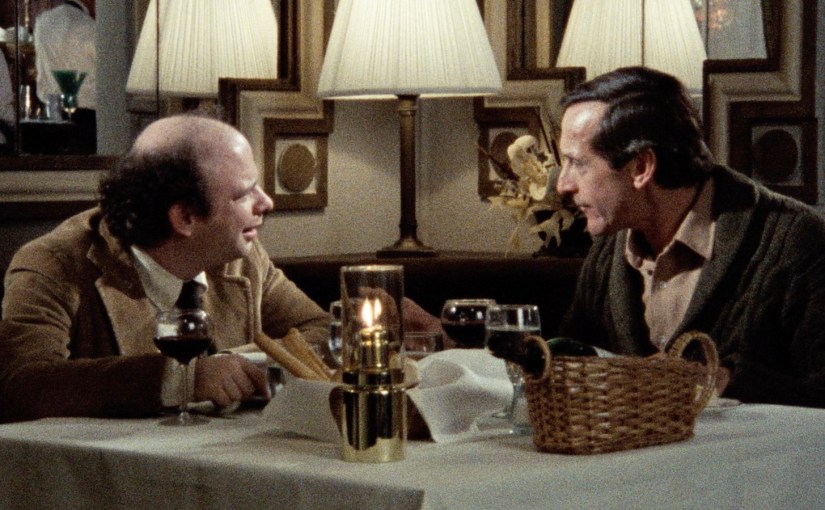
Gene Siskel and Roger Ebert deemed My Dinner With Andre one of the ten best films of the 1980s. It’s unique with a bold attempt at building an irresistible attraction to focusing entirely on a conversation in a restaurant booth between two men over dinner. Nevertheless, I find it to be a swirling black hole descent into a void I could not escape.  I walked into this restaurant with nothing.  I walked out with nothing.

Siskel deemed the discussion between Andre Gregory and Wallace Shawn to be a conversation into “intellectual outer space.”  He’s not wrong.  Especially when listening to Andre speak, anyone with at least a fourth-grade education will likely gather that he proudly shares his exploits in India and wherever else along with his experiences chatting with inspiring scholars and philosophers as the only way to live.  Outer space is an understatement because for most of the time I could not tell you how Andre goes from point A to point Z.  Wallace, patronizingly regarded as “Wally” by Andre, primarily represents the listener.  

You getting all of this Wally? I’m sorry Wallace.

Wallace Shawn’s voiceover explains that he is a playwright who is broke with no prospects on the horizon.  His agent has encouraged him to meet the famed theater director Andre Gregory for dinner.  Wallace is not thrilled about this idea as his last encounter with the man is not fondly remembered.  Yet, as celebrated an artist as Andre is, one day he all but left his career and his family behind to explore the world.  Now he’s back in New York City for one night and he has an interest in meeting up with Wally – a seemingly likable loser in a tan Corduroy suit with a bald head surrounded by frizzy, uncontrollable hair on the sides.  Of all people, Wally had to know why Andre wanted to see him.

My wife and I share a common frustration and we are trying to remind our daughter of it as she is quickly entering college independence. Often when we are in social gatherings, we make the effort to ask about the person we are talking to.  We’ll ask where they originate from, why they took up an interest in movies, books or shucking corn.  We’ll express concern for how their mother is holding up or what their vacation plans are.  Often the response will carry on for ten or twenty minutes with that person talking about themselves and the people in their life.  What’s disappointing is that we don’t get asked about us.  We have a mother.  We go to the movies and on vacation.  We read books.  We shuck corn.  It says a lot about how self-absorbed many of us can be.  That was my impression of the Andre Gregory in this picture.  Wally just sits there sipping his soup and often looks at Andre puzzled as to what point he’s making here.

Frankly, I didn’t like Andre.  He’s a magnificent deliverer of dialogue with a soothingly smooth voice.  The guy should have his own podcast.  Yet, he never stops to come up for air, and he carries on talking about the fascinating people he’s encountered and the exotic adventures he’s experienced.  Everything he says seems so elevated that I questioned if he’s a narrator of extremely tall tales.  Is Andre exaggerating?  Is he lying?  Is he also a storyteller?

As well, I went so far as to question Andre’s ideology.  On a number of occasions, he works fascist terminology into his anecdotes.  He describes someone as handsome and muscular as an SS soldier.  Who does that?  The physique of an SS Brownshirt is the best way to illustrate someone you have met?  Hitler is brought up.  The Nazi party as well, and he speaks freely about these allegories in front of Wally, a known Jewish man.  Someone as learned as Andre Gregory could not conjure up different references to enhance his stories?

When it’s finally Wally’s turn to speak, I’m at least grateful that he challenges Andre. With no money to his name and no immediate prospect of success or deserved recognition he says that he can simply feel fulfilled with a cold cup of coffee in the morning and a book to read. Personally, I need more than that out of life.  I don’t mind saying that I’m a materialist by nature.  I find joy in what I collect.  At least I can applaud Wallace for not subscribing to the babbling National Geographic issue sitting on the other side of the table from him.

By the end of the film Wallace spends the last shred of his money to take a cab across town.  He thinks about the various establishments he visited for an ice cream soda or whatnot, and he declares that he can’t wait to get home to tell his girlfriend about his dinner with Andre.  This is where I’m confused.  Why would Wallace want to talk about that pretentious, blathering organism, with no soul?  Andre seemed ignorant of the guy he calls “Wally.”  He never seems to express any admiration for his friend’s theater accomplishments.  He never carries an interest in what “Wally” is up to or how he came up with an inventiveness to write a particular play.  Most importantly, he never seemed to respect “Wally” for the simplicity he joyfully gets out of life.

Though they are playing themselves, Wallace Shawn and Andre Gregory insist that these personalities are more fictional than realistic.  That’s not hard to believe because the Andre Gregory of My Dinner With Andre exists on such a high plain it seems impossible to live the life he’s leading.  In 1981, when this film, directed by Louise Malle, was released how could a forty something man accomplish all that Andre Gregory had done?  So, I could not embrace this mostly one-sided conversation that’s devoid of sensitivity for his listener.  

I suppose to like My Dinner With Andre you’d have to either at least like Andre Gregory or love to hate Andre Gregory and neither option complemented me.  When you sit down to dinner with someone, the experience isn’t just about the bread basket and catering presentation.  It’s not only about the wait staff and if the scent of the cork is pleasing. It isn’t the atmosphere, either.  

It’s the company you keep that matters.
LACOMBE, LUCIEN (France, 1974)

by Miguel E. Rodriguez

DIRECTOR: Louis Malle
CAST: Pierre Blaise, Aurore Clément, Holger Löwenadler
MY RATING: 7/10
ROTTEN TOMATOMETER: 100% Fresh

PLOT: In 1944, an 18-year-old boy from a small French village collaborates with the Gestapo and subsequently falls in love with a Jewish girl.


The effectiveness of Louis Malle’s Lacombe, Lucien may depend partially on how much you know about cinema history after World War II.  It’s a historical fact that there were French countrymen who sided with the invading Nazis, going so far as to infiltrate the French Resistance and inform on their neighbors to the Gestapo.  When the war ended, that fact was politely and discreetly avoided in war films for decades.  No one wanted to spoil the notion that the whole of France united with each other to harass the Nazis at every opportunity, and that the Resistance fighters were unambiguously, morally pure.  In France, surviving collaborators went about their business, some more anonymously than others.

In 1974, Lacombe, Lucien became one of the first, if not THE first, French film to not only broach the topic of Nazi collaborators, but also to depict the French Resistance as employing guerilla tactics and carrying out assassinations that were just as morally questionable as any other similar attacks in history.  It was a bold move, to be sure.  Even when you remove that context from the film, when you watch it as a stand-alone piece of cinema, it is still makes for compelling viewing.  However, for my part, the very ending of the movie left me frustrated.  While French audiences may have seen it differently in 1974, I saw it almost as if the filmmakers simply ran out of story and used a title card to tie things up in a bow.  But the journey to get to those final frames is worthwhile, even though the lead character is one of the most loathsome people I’ve ever seen on film.  I would compare him to Amon Goeth from Schindler’s List, not because they are similar characters, but because they elicited the same reaction from me: disgust.  (Or maybe they are similar characters…you tell me.)

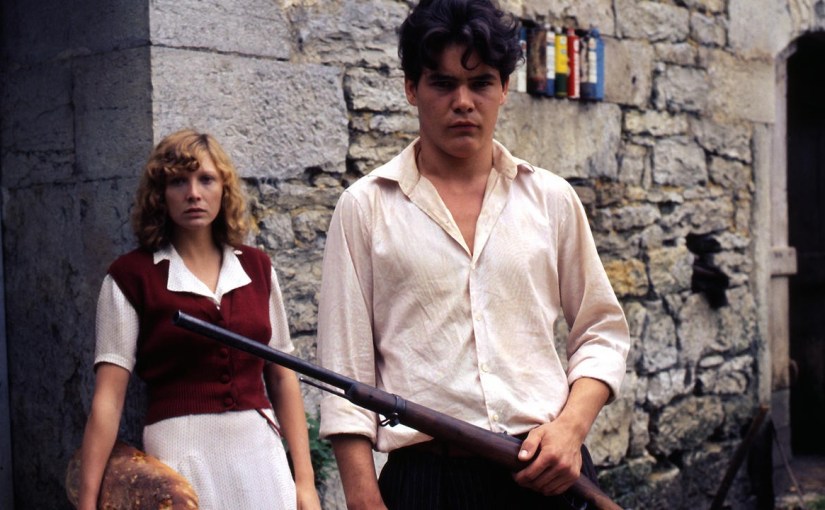
The film opens in 1944, just a few weeks after D-Day, in a small town in southwest France.  We first meet young Lucien Lacombe, maybe 17 or 18, mopping a hospital floor, apparently doing a good deed for his community.  Through an open window, he spies a small songbird chirping on a tree branch.  Lucien makes sure no one is watching, pulls a slingshot from his pocket, takes careful aim, and kills the little bird with one shot.  He smirks and goes back to the business of mopping.  We will witness many other instances of Lucien killing other animals.

Indeed, many of these scenes are done for real: the actor playing Lucien clearly kills several rabbits with a shotgun, one with a wooden club.  In another scene, he catches, decapitates, and calmly starts to pluck a chicken for dinner, all in one unbroken take.  Now, this would have been normal behavior for someone living in a farm community in the French countryside, where someone has to prepare tonight’s dinner.  The difference is, Lucien seems to enjoy these tasks a little too much.  Even worse, though, are the times where he is utterly impassive about it, especially with the one rabbit he catches in the snare.  These are hard scenes to watch, but in hindsight, they are vital to unpacking or interpreting Lucien’s actions later in the film.

Through a series of events that reminded me a little bit of Goodfellas (“All my life, I wanted to be a gangster”), Lucien allows himself to be recruited into a cadre of French collaborators whose base of operations is a fancy hotel where their opulent lifestyle is a rebuke to those silly Resistance fighters who must scrape a living from the dirt.  He is more than willing to do what it takes to get a taste of the good life.  He turns in a schoolteacher who is also a Resistance officer; he makes a show of being contrite about it, but he quickly gets over it.

The rest of the movie shows Lucien puffed up with pride in his new social status, bullying anyone and everyone who dares to talk down to him.  There are, to be sure, broader statements being made here about the psyche of anyone who deludes themselves into believing in their inherent superiority over their fellow man just because they’re handed a membership card, regardless of how small-minded or shallow they might be.  However, during the movie, I never thought of those broader implications.  It’s a testament to how well the movie was directed and acted that I was concerned only with how Lucien behaved and acted, and not with whatever director Malle was trying to say from a metaphorical or allegorical standpoint.

To watch Lucien bully people around was sickening and pathetic.  He is introduced to a tailor, Albert Horn, who will make him some new clothes.  Lucien’s friend in the Gestapo casually informs him that Albert is a Jew who is only allowed to live in relative peace because of his skills as a tailor, and because he makes regular payoffs to the Gestapo.  Albert has a 20-something-year-old daughter, improbably named France, with whom Lucien is almost immediately smitten, despite her ethnicity.  He tries to impress France by getting her to the front of a food line, but she demurs.  When people in line complain, he smugly explains he’s with the German police and he can do whatever he wants.  The idea of that kind of power in the hands of someone as despicable as Lucien made me as angry as I can ever recall being while watching a film.

In the background of Lucien’s plotline is the shadowy Resistance itself.  Various members of the French collaborators are being killed here and there, certainly not a bad thing.  But the aftermath of their attacks is no less disquieting than anything perpetrated by the pro-Nazi collaborators, especially after a brazen attack on the fancy hotel headquarters, where the bodies of the collaborators are just as dead as the bodies of the Resistance fighters.  Perhaps the film is making a point that dead is dead, no matter which side you’re on, so you’d better be sure you’re dead for the right reasons because history will remember you one way or the other.

At the center of all this is Lucien’s face with his cold eyes and virtually expressionless mouth.  He doesn’t smile, he smirks.  He threatens Albert and France with exposure and arrest if Albert doesn’t allow Lucien to date, then marry, France.  For her part, France is wise enough to know when to humor Lucien and when to go along with his behavior, for the good of her father.  Lucien, besotted with power, is too clueless to realize how smart she really is.

I have a general guideline that I dislike movies with rotten characters at the center of them.  But I must admit that Lacombe, Lucien sucked me into the story and kept me there, despite how much I disliked Lucien himself.  I guess I wanted to see how much the filmmakers would allow him to get away with before he was swatted down.  Whether he gets swatted down or not is for you to discover, but let it be said that the ending manages to have it both ways, which was challenging for me.  I both did and didn’t get the kind of closure I wanted, which explains my somewhat median rating despite how well-made the film is.

It may be that I’m not old enough, or knowledgeable enough, to really appreciate the impact Lacombe, Lucien had on 1974 audiences.  I can only report how it made me feel right now.  It made me feel anger and indignance towards Lucien throughout the whole movie, even when he makes a crucial decision that seems as if it will redeem his character.  I don’t think it does, because the damage he instigated has been done and cannot be undone by a single act of contrition when it’s far too late to make any difference.  Perhaps that’s not a very Christian idea, but that’s how the movie made me feel, regardless.  Lucien deserves what he gets and more.  Does that apply to the real-life French collaborators, many of whom were still alive when this movie was released?  It’s not for me to pass judgement on those people.  But I can’t deny how the movie itself made me feel towards the people within the world of the film.

ELEVATOR TO THE GALLOWS (1958, France)

by Miguel E. Rodriguez

Director: Louis Malle
Cast: Jeanne Moreau, Maurice Ronet, Georges Poujouly
My Rating: 10/10
Rotten Tomatometer: 93% Certified Fresh

PLOT: A married woman and her lover hatch an apparently foolproof plan to kill her husband (his boss), but a split-second decision at a crucial moment sends everything into a tailspin.


We plan, God laughs. – old Yiddish proverb

Let me get this out of the way right at the top: Elevator to the Gallows is one of the best crime drama/thrillers I’ve ever seen.  It holds its own against anything by Hitchcock or Clouzot.  With admirable focus and restraint, first-time director Louis Malle (My Dinner with Andre, Vanya on 42nd Street) crafts a gripping illustration of how the best laid plans can fall apart because of one minor miscue.

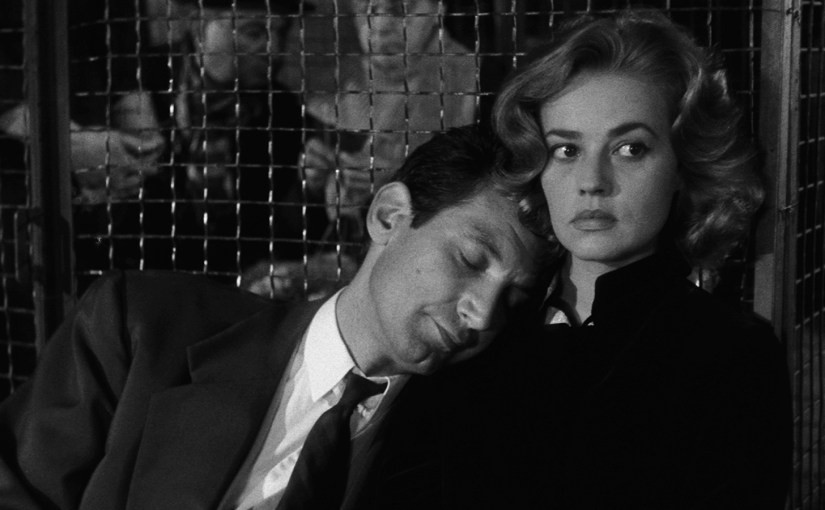
The film cuts right to the chase at the opening scene, showing a phone conversation between Florence Carala (Jeanne Moreau) and her lover, Julien Tavernier.  They discuss their plans for Julien to kill her husband in his office on a Saturday evening, after which he’ll pick her up at a café where she’ll be waiting, and that will be that.  Everyone will assume her husband is in Geneva on business, and no one will discover the murder, which Julien will arrange to look like a suicide, until Monday morning, giving Florence and Julien plenty of time to make their escape.

(I liked how we never got any flashbacks of the relationship between Florence and Julien.  All we need to know is, they’re lovers, they’re desperate enough to commit murder, and that’s it.  Very concise.  I love it.)

Julien’s plan involves using a grappling hook to avoid using the office elevator to get to his boss’s office one floor above his.  He proceeds with the plan, nearly getting caught in the process, but he’s able to commit the crime and leave the building with several witnesses as an alibi, witnesses who will say they never saw him enter his boss’s office before he left.  So far so good.

Julien gets to the street, takes the top down from his convertible, takes one last look back at the building…and realizes he left a vital clue in full view of any pedestrian or street cop.  Leaving his car running, he decides to run back into the office building and retrieve the evidence before the night guard shuts off the power for the night.

Unnoticed by Julien, a florist and her bad-boy boyfriend have been having an argument at the shop next to his car.  The boyfriend sees this rich man leave his convertible on the street…with the engine running…

Thus begins a Hitchcockian odyssey that leaves Julien stranded in an elevator, his car and his identity stolen, and his mistress stranded on the streets wondering where the hell her lover is.  At one point, Florence sees Julien’s car drive by the café where she’s waiting…she can’t quite make out the driver, but who is that girl in the car with him?!  Has she been betrayed at the last minute?

The film follows the younger couple, Louis and Véronique, as they tool around in Julien’s car, eventually winding up at a roadside motel, and unwittingly making friends with two German tourists.  They even share drinks with the Germans and take some candid photos using a little spy camera in Julien’s raincoat.  (We learn that Julien was in the Foreign Legion and was well-trained as a soldier – maybe even in spycraft.)  I found myself wondering why we were wasting time with this larcenous couple…until they decide to check into the motel as Mr. and Mrs. Tavernier to cover their own tracks.

The screenplay ingeniously heaps one hasty decision on top of another so that, just when it seems Julien might be in the clear, something else happens that makes it seem impossible he won’t be discovered or at the very least blamed for something he didn’t do.  Meanwhile, Julien is desperately trying to escape the elevator, using a penknife as a screwdriver, getting excruciatingly close to tripping a vital switch that’s just out of his reach.  He eventually tries to get out using the old climbing-the-cable trick…which is of course exactly when a night watchman is making his rounds.

This story is so good, I can’t believe there hasn’t been an American remake.  And it’s not like there aren’t other great films out there that cut right to the chase and never look back for flashbacks or additional material.  I’m not sure what makes Elevator to the Gallows so good, to be honest.  Maybe I was rooting for Florence and Julien when they are clearly not the good guys.  Maybe it’s the economy of the storytelling, or the screw-turning twists that lead the police to believe Julien has committed more than one murder.  At one point, Louis and Véronique make a startling decision that had me yelling at the screen.

Words fail me on this one.  I can’t describe it any better than by saying this is one of the best films I’ve ever seen, certainly one of the best film-noirs I’ve ever seen, and a movie that I’ll bet Hitchcock watched while thinking to himself, “Damnation…I wish I’d thought of that.”