
By Marc S. Sanders
The title is not meant to just be taken literally. Roger Michell’s film shot on location in New York City pull the fulcrums which alter the destructive paths of two very different men. The script beckons them to pave each other’s roads they will follow from here on out. Their destinations can lead to hope or despair.
Doyle Gipson (Samuel L Jackson) is a recovering alcoholic who is ready to close on a house in Queens that his estranged wife Valerie (Kim Staunton) and two young sons can move into. Finally, the insurance telemarketer seems to be on the straight and narrow. He doesn’t want a glass of champagne. He feels like champagne, bubbly and alive. His AA sponsor doesn’t rejoice in that comment. Doyle just has to get to family court and demonstrate that he’s a devoted and loving father and ask the judge to decline Valerie’s plan to relocate to Oregon with the boys.
Gavin Banek (Ben Affleck), the son in law and young law partner of Stephan Delano (Sydney Pollack) just has to make a quick appearance in court to undoubtedly prove that his now deceased client intentionally signed off on dismantling his multi-million-dollar trust leaving the proceeds for the law firm to collect. The client’s granddaughter argues that her grandfather was mentally incapacitated and therefore the agreement carries no merit. Gavin has all the documents lined up with clear and original signatures from the client. This should be a slam dunk.
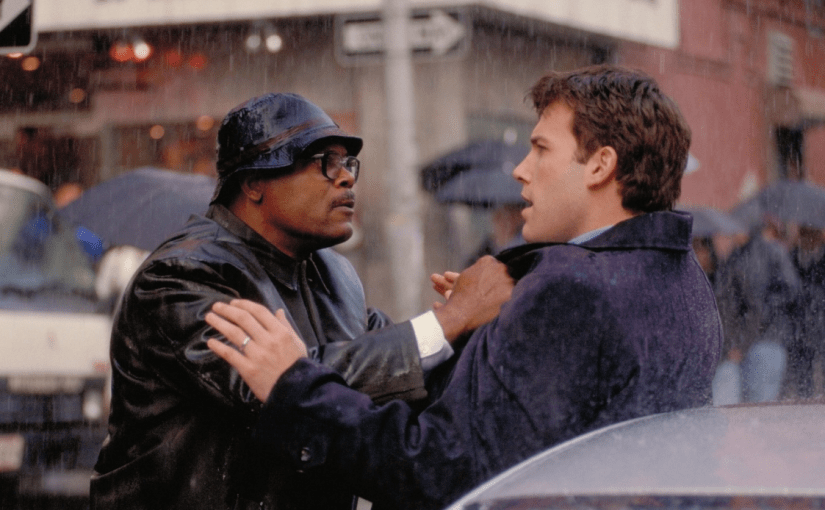
Car accidents never happen at a convenient time. On one rainy day in the city, Doyle and Gavin meet following a sideswipe collision. Doyle wants to exchange information. Gavin is good with giving over a blank check and being on his way. Thus, leaving the scene of an accident.
In the rush of things though, Gavin has dropped the power of attorney file, glaringly noticeable in an orange binder. Doyle collects it while being left stranded on the freeway. Being twenty minutes late works against him, and Valerie is granted permission to leave the state.
Without that orange file, Gavin is short of proving his argument in court. He has until 5 o’clock on Good Friday to deliver the document to the opposing council and judge or the granddaughter can file a malpractice suit with claims of fraud and possible jail time for Gavin, Stephan and another partner, Walter (Richard Jenkins).
Two separate stories are at play here, running parallel against each other until the lines collide once, then separate and then collide again and again by the hands of the two men working against each other to get ahead.
Changing Lanes is a study of willpower for Doyle. Samuel L Jackson is giving one of his best performances. He’s continuously being tested. He can have a temper when he’s in the midst of chaos but as his AA sponsor (William Hurt) will remind him outbursts of anger are not substitutes for the bottle. So you didn’t have a drink!! You can’t exonerate or excuse however else you behave irrationally.
Changing Lanes is morality piece for Gavin. He has money and power and resources to fix any kind of scenario and circumvent the boundaries of law to Stephan, Walter and his own advantage. The question is if he should follow through on what’s in front of him. His code of ethics is tested and other than Michelle, an associate at the firm (Toni Collette), all are telling him what needs to be done. Not what should be done. Including his wife and Stephan’s silver spooned daughter, Cynthia, played with attractive deviousness by Amanda Peet. A magnificent piece of dialogue that lends justification to commit to what’s not right and sound may be the actress’ best scene of her career. A gentle, yet direct Lady MacBeth.
Actually, even Michelle, (Toni Collette lending a catalog of subtle expressions) who’s also Gavin’s mistress and in the “I told you so” position, has ideas that triggers a lot of unwanted turmoil for the men. Changing Lanes truly puts the corrupt in the driver’s seat while leaving the innocents in the wreckage left behind. What does that say about us as a society? I guess I’ll need to atone for a lot more than I thought on Yom Kippur, this year.
The men quickly find ways to locate one another and cause harm and setbacks by their antagonism. Some of these scenarios are definitely convenient over the course of an eight-hour day, especially in a populated New York City. However, the circumstances are at least sensible. The plausibility should not be questioned however because the script by Chap Taylor and Michael Tolkin is very insightful and reflective.
There’s a million ways Changing Lanes could have ended. There’s certainly a button well in place on its finality but what remains are the transformations of these two men. On the surface, in any kind of setting, Affleck and Jackson come from different cloths and it serves the picture very well, because New York is always the battleground for a variety of walks of life. Watch how the actors argue with each other. They might as well be speaking different languages because too often people of different backgrounds fail to see what their neighbors are going through. Doyle and Gavin must go through a lot of pains before they can see a clear sky on a stormy day.
The trailer for Changing Lanes is thrilling but terribly deceptive. It’ll make you believe this is a kind road rage action picture, complete with Jackson’s signature temper tantrum that’s found in a number of his films. Maybe the preview convinces you that Affleck looks like the victimized white guy, and that is entirely unfair to an audience and both actors, as well as the writers and directors.
I’m bold enough to declare that my write up is a much more transparent offering of what to expect from this fine, forgotten film – a highlight for the resumes of every actor here. Changing Lanes leaves you thinking about what’s just and what can be done right when temptations and tempers do not collide accordingly with our day.

