
CHANGING LANES

By Marc S. Sanders

The title is not meant to just be taken literally.  Roger Michell’s film shot on location in New York City pull the fulcrums which alter the destructive paths of two very different men.  The script beckons them to pave each other’s roads they will follow from here on out.  Their destinations can lead to hope or despair.

Doyle Gipson (Samuel L Jackson) is a recovering alcoholic who is ready to close on a house in Queens that his estranged wife Valerie (Kim Staunton) and two young sons can move into.  Finally, the insurance telemarketer seems to be on the straight and narrow.  He doesn’t want a glass of champagne.  He feels like champagne, bubbly and alive.  His AA sponsor doesn’t rejoice in that comment.  Doyle just has to get to family court and demonstrate that he’s a devoted and loving father and ask the judge to decline Valerie’s plan to relocate to Oregon with the boys.

Gavin Banek (Ben Affleck), the son in law and young law partner of Stephan Delano (Sydney Pollack) just has to make a quick appearance in court to undoubtedly prove that his now deceased client intentionally signed off on dismantling his multi-million-dollar trust leaving the proceeds for the law firm to collect.  The client’s granddaughter argues that her grandfather was mentally incapacitated and therefore the agreement carries no merit.  Gavin has all the documents lined up with clear and original signatures from the client.  This should be a slam dunk.

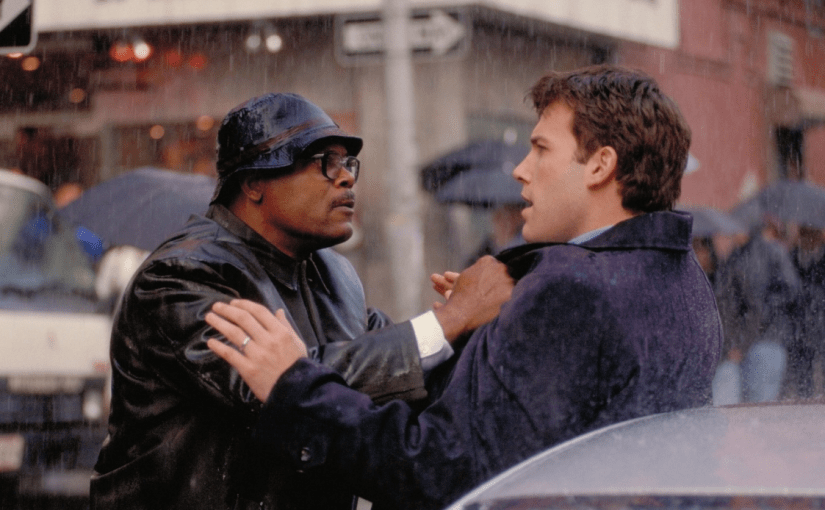
Car accidents never happen at a convenient time. On one rainy day in the city, Doyle and Gavin meet following a sideswipe collision.  Doyle wants to exchange information.  Gavin is good with giving over a blank check and being on his way. Thus, leaving the scene of an accident. 

In the rush of things though, Gavin has dropped the power of attorney file, glaringly noticeable in an orange binder.  Doyle collects it while being left stranded on the freeway.  Being twenty minutes late works against him, and Valerie is granted permission to leave the state.  

Without that orange file, Gavin is short of proving his argument in court.  He has until 5 o’clock on Good Friday to deliver the document to the opposing council and judge or the granddaughter can file a malpractice suit with claims of fraud and possible jail time for Gavin, Stephan and another partner, Walter (Richard Jenkins).

Two separate stories are at play here, running parallel against each other until the lines collide once, then separate and then collide again and again by the hands of the two men working against each other to get ahead.  

Changing Lanes is a study of willpower for Doyle.  Samuel L Jackson is giving one of his best performances.  He’s continuously being tested.  He can have a temper when he’s in the midst of chaos but as his AA sponsor (William Hurt) will remind him outbursts of anger are not substitutes for the bottle.  So you didn’t have a drink!! You can’t exonerate or excuse however else you behave irrationally.

Changing Lanes is morality piece for Gavin.  He has money and power and resources to fix any kind of scenario and circumvent the boundaries of law to Stephan, Walter and his own advantage.  The question is if he should follow through on what’s in front of him.  His code of ethics is tested and other than Michelle, an associate at the firm (Toni Collette), all are telling him what needs to be done. Not what should be done. Including his wife and Stephan’s silver spooned daughter, Cynthia, played with attractive deviousness by Amanda Peet.  A magnificent piece of dialogue that lends justification to commit to what’s not right and sound may be the actress’ best scene of her career.  A gentle, yet direct Lady MacBeth.

Actually, even Michelle, (Toni Collette lending a catalog of subtle expressions) who’s also Gavin’s mistress and in the “I told you so” position, has ideas that triggers a lot of unwanted turmoil for the men.  Changing Lanes truly puts the corrupt in the driver’s seat while leaving the innocents in the wreckage left behind.  What does that say about us as a society?  I guess I’ll need to atone for a lot more than I thought on Yom Kippur, this year.

The men quickly find ways to locate one another and cause harm and setbacks by their antagonism. Some of these scenarios are definitely convenient over the course of an eight-hour day, especially in a populated New York City.  However, the circumstances are at least sensible.  The plausibility should not be questioned however because the script by Chap Taylor and Michael Tolkin is very insightful and reflective.

There’s a million ways Changing Lanes could have ended.  There’s certainly a button well in place on its finality but what remains are the transformations of these two men.  On the surface, in any kind of setting, Affleck and Jackson come from different cloths and it serves the picture very well, because New York is always the battleground for a variety of walks of life.  Watch how the actors argue with each other.  They might as well be speaking different languages because too often people of different backgrounds fail to see what their neighbors are going through.  Doyle and Gavin must go through a lot of pains before they can see a clear sky on a stormy day.

The trailer for Changing Lanes is thrilling but terribly deceptive.  It’ll make you believe this is a kind road rage action picture, complete with Jackson’s signature temper tantrum that’s found in a number of his films.  Maybe the preview convinces you that Affleck looks like the victimized white guy, and that is entirely unfair to an audience and both actors, as well as the writers and directors.  

I’m bold enough to declare that my write up is a much more transparent offering of what to expect from this fine, forgotten film – a highlight for the resumes of every actor here.  Changing Lanes leaves you thinking about what’s just and what can be done right when temptations and tempers do not collide accordingly with our day.

AVENGERS: INFINITY WAR

By Marc S. Sanders

Avengers: Infinity War is a really FAT movie. Like ORCA FAT (thank you Keyser Soze), because it is chock full of so much to see. If this equated to gorging on junk food, after two hours and forty minutes, I would have a diabetic cardiac arrest immediately following the credits. Is this a film that is worth that handicap, however? You bet it is.

There is an ensemble of top Hollywood talent portraying a huge cast of characters, once again, and thus another installment has surfaced in the franchise that allows them to have various moments to shine. Producer Kevin Feige with all of Disney’s support, has mastered the formula to ensemble casting and production, as good as when George Clooney and company performed under Steven Soderbergh’s direction in the Ocean’s 11 remake. Thousands of special effects shots do not overpower the stage presence of the actors. The Marvel movies succeed because a story is always written first. Then witty dialogue comes thereafter, and then valid, convincing shock value. The special effects are the final ingredient. This is what the Transformers franchise and (yes, I’ll even own up to it) the Star Wars prequel trilogy (about ¾ of it) failed to achieve. This successful formula gives merit to the (at the time) biggest opening weekend ever, worldwide, and Avengers: Infinity War deserves the accolades.

How good is it? Well, reflecting back to May 1980, when sitting in a crowded theatre watching the ending to The Empire Strikes Back, by comparison I think audiences have finally been served up a cliffhanger (10 years in the making) that is just as effective. How is this all going to wrap up from here? How is this all going to be resolved? Reader, I don’t know if the next chapter will be satisfying. I don’t know if we will feel cheated like Annie Wilkes from Stephen King’s Misery. Presently, however, I’m turning an ending like this over in my mind; the same way I did with my pals in 1980 debating the survival ratio of Han Solo and if Darth Vader has told the truth, and if that was Vader’s brain or head that I saw, and who is this “another” that Yoda referred to….and that, my friends, is what makes a spectacular film. I don’t care if it gets watered down in the hype and McDonald’s promotions and toys. If you can mull over a movie long after it has ended, for days, even months and years, then a film like The Empire Strikes Back and Avengers: Infinity War has more than served its purpose.

Josh Brolin provides a villain with a justification to his madness. He’s not just twirling his mustache to be mischievous and sinister. He has a destiny to fulfill, and his portrayal of the mad titan Thanos does not compromise. This is a beast of a purple villain with size 52 boots and gold-plated armor with a chin that looks like it was clawed by Wolverine. Thanos cries, actually cries, while committing his crimes. He’s not just cackling. He flat out says that he executes his actions all so that he can relax and retire. Isn’t that what we are all trying to do, anyway? Nothing wrong with that. Guy sounds like a CEO to a large corporation. Maybe Thanos is updated to resemble an Elon Musk. 

All of the other actors from main staple Robert Downey Jr to Chris Pratt to Chadwick Boseman to Zoe Saldana and Chris Hemsworth, and so on, remain consistent to what we’ve seen of various prior installments. Their gimmicks continue to avoid becoming stale. Audience applause is cued by their appearances. These are well loved characters.

As an avid comic book reader of the silver age (1980s), Avengers: Infinity War presents itself as of one those annual limited series runs that were special because they were MAIN EVENTS!!!! My favorite back then was Marvel’s Secret Wars. Typically, a comic book from the 1980s would average about 18-22 pages with advertisements sprinkled in. Nearly every scene in this film equates to one issue of a limited run of a main event. That is a why a fat movie like this succeeds. The cast of characters are separated in various story lines. The scenes are given their time to flesh out and develop to move the subplots and overall story along. Each scene is like reading a new 18 page issue comic book. If I’m watching a comic book film, by golly, I want to see how a comic book is brought to life in a cinematic medium. Marvel’s films succeed greatly over DC’s films (produced by Warner Bros) because they rely on the source material. They know they got the goods. Cast it right, adapt it properly and go with that. If it ain’t broke, don’t fix it. A wealth of material (nearly 70 years) and Marvel/Disney uses it all. (How does DC/Warner Bros miss the mark so often?)

Of all of the Avengers films, Infinity War is definitely the best one. Ironically, I wasn’t expecting it to be. I was waiting for this stuff to get old and tiring. It just hasn’t faltered yet. It hasn’t gotten lazy yet. It all seems so fresh still. It’s a fantastic cinematic accomplishment. Sure, its main story is a guy chasing down six different colorful MacGuffins. So what! It’s simple. It allows the characters to stand out from there. An organized plotline like this doesn’t take much effort or time to explain its purpose. It states its conflict early on, and then the show stopping moments present themselves. One after the other after the other until a monster of an ending that is so jaw dropping, head shaking, thrilling and gasping, satisfyingly arrives. 

More importantly, the MacGuffin search drives the motivations and fleshes out the film’s main character, Thanos. This Marvel installment belongs to Josh Brolin as Thanos. Everyone else serves as his antagonists. What matters is that the bad guy wins this time, just like demonstrating that an Empire will strike back. Ironic that Spider-Man makes a humorous correlation to that celebrated franchise from almost forty years ago.

Avengers: Infinity War ended up in my top 10 list of 2018, and still holds as the best film in the Marvel Cinematic Universe.

CAPTAIN AMERICA: CIVIL WAR

By Marc S. Sanders

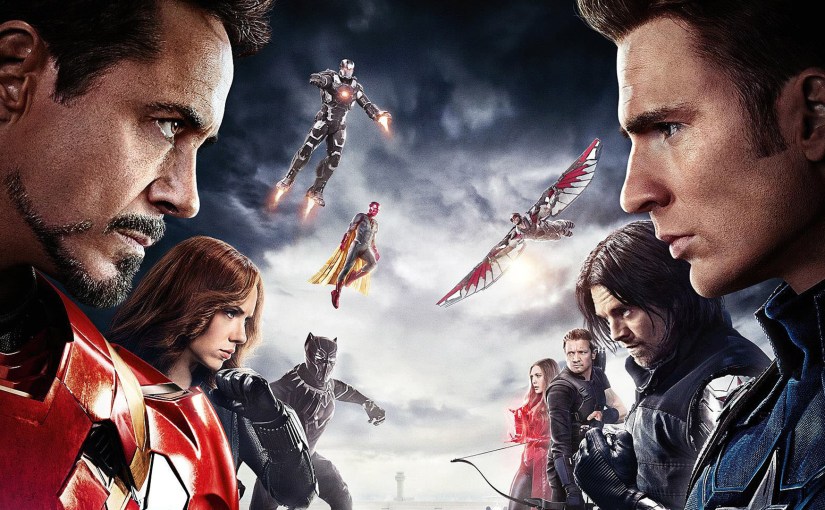
I think the Civil War chapter must be one of the best installments in the Marvel Cinematic Universe. The action ranging from fight scenes to car chases to shootouts and explosions are so well executed and edited.

This film lives up to what makes each Marvel character special in their own way, and while most of the attention is naturally focused on Chris Evans’ Captain America and Sebastian Stan’s Winter Soldier (aka Bucky), the large cast is respectively given numerous moments to shine individually with well-conceived backgrounds and traits beyond just their superpowers.

Interestingly, until the late scene where all the characters collide against one another, the film was very shy of any intentional humor and focused more on what is morally correct in this fantasy world. There was a debate to grapple with, and a threat to both sides of the moral compass. All good layered dimensions, my favorite vice of effective storytelling.

Anyone who says popcorn movies like Avengers are nothing more and simply brainless would fail at recognizing good analysis and dimension. More often than not the MCU succeeds at setting up a dilemma to keep a viewer hooked. Once they are taken…then the storytellers will do something bold like destroy the headquarters, or an airport, or a whole city or Iron Man’s armor, and on and on. Too many other franchises (Transformers, Fast/Furious or DC) bring the buildings down before the cement is dry and the windows are Windexed. That’s when story is neglected for showmanship. There’s no weight to the loss. What do I care who died? You just destroyed the village in order to save it. Disney and Marvel know this and steer clear of those habits.

The cast is so perfectly assembled in Civil War. They interact very well with line exchanges, debates and fisticuffs.

Much of this film was a blur during my first viewing. These are Marvel movies. There are so many now, the scenes all seem to blend together. Yet now I see this particular film is special. Good set pieces, costumes, makeup, visual effects and great performances lead to a great, fun presentation. I’m sold.

THE INCREDIBLE HULK

By Marc S. Sanders

The Marvel Marathon continued with the most underappreciated installment in the Marvel Cinematic Universe (MCU), The Incredible Hulk.

Edward Norton is the best of the cinematic Bruce Banners. He plays the role smart and desperate, and that’s the purpose of Dr. Banner once he is left to be on the run following his unfortunate encounter with gamma radiation. Norton enhances a script credited to Zak Penn. As such, we are treated to the efforts of Banner to rid himself of the raging green monster within. He communicates with a mysterious “Mr. Blue” by means of encrypted email as he hides out in the stacked, labyrinth tenements of Brazil. This setting presents an early high octave foot chase over rooftops and through narrow alleyways as Banner is pursued by General Thadeus “Thunderbolt” Ross, bent on using the hulk effects as a means to develop an army of super soldiers. Banner knows nothing good can come of this and therefore has to run until he finds a cure. To make things more complicated, Banner must keep his true love, Betty (Liv Tyler), out of harm’s way. Betty is the General’s daughter.

Louis Leterrier directs under a lot of demanding expectations following the unforeseen success of Iron Man, and before that, the disappointing bore delivered by Ang Lee with Hulk. For the most part Leterrier gets it right. Three high stakes action scenes featuring both Norton as Banner and later as a very gritty, very angry and very strongly aggressive nine-foot green monster are well choreographed blends of CGI and principle photography. A well-cast adversary in the form of Tim Roth is great as he willingly gets experimented on to match the power of the Hulk. Roth plays Emil Blonsky as an eager soldier bent on getting superior to the might of the Hulk. Leterrier shoots Roth gradually changing physically, but more importantly in performance. The center of the film shows Roth sprinting across a college campus to confront the Hulk head on. He then demonstrates astounding agility with leaps over the Hulk’s head. It’s a great match up.

William Hurt plays General Ross. I’d never consider him for this part based on Hurt’s previous resume. Yet, if you put him in a camouflage uniform, slap a thick, silver mustache on him, and grizzle his voice, he works well in the part.

Like Jeff Bridges in Iron Man, the villains offered up by Tim Roth and William Hurt are another two of my favorites in the MCU. Again, they are not after world domination. One is motivated by the discovery of advanced power. The other is moved by misguided opportunity.

Not much can be said about Liv Tyler. She screams. She cries. She yells at a New York City cabbie and she gets to kiss Edward Norton.

What I like about this film is the approach from the beginning. The opening credits offer all you need to know, so that it can quickly jump into the action and the pursuit. Penn, Norton and Leterrier dodge the go to origin story to tell us instead where Bruce Banner and the rest have left off. It’s efficient storytelling.

Leterrier also cuts his action and attention to the Hulk quite well. Sure, we all want to see the Hulk but let’s see his ultimate power first. Leterrier recognizes this is part monster movie. So, when an early set piece takes place in a dark soda factory, we are quickly familiarized with the architecture, and we believe the monster to be hidden under cat walks and in dark corners ready to swipe away a thug leaving only a sneaker behind. Eventually you see his silhouette, followed by his eyes accompanied by a Lou Ferrigno growl, and now you are sitting up at full attention. Later, Leterrier sticks to a similar routine by showing an enlarged hand bursting from a gas cloud.

This iteration of the Hulk is the best. He’s dirty and built like a linebacker with shaggy green hair. His expression is one of “STOP BOTHERING ME AND LEAVE ME ALONE.” Compared to the later installments, this version is better. He’s not as clean, not as disciplined, and thus we are more nervous around this Hulk than other Hulks we see in later films.

It’s still disappointing that Norton did not continue on with the role. I believe his “lonely man” interpretation, inspired by the late Bill Bixby’s TV version. A sad man in an unfortunate circumstance. Comparing his portrayal to Mark Ruffalo, the latter seems trapped in unconvincing dramatics. The internal conflict never seems that challenging to Ruffalo like it does to Edward Norton.

Though my only wish was that some unraveled threads (The Leader, The Abomination. Right, Marvel fans?) were not left unresolved in later MCU films. As an actor with several dual personality roles on his docket (Primal Fear, Fight Club, The Score), Norton is the better Banner, and it’s because of him along with Tim Roth and William Hurt that The Incredible Hulk is really one of the better Marvel pictures.

A Favorite Stan Lee Cameo: What happened after he drank that soda????