
CHANGING LANES

By Marc S. Sanders

The title is not meant to just be taken literally.  Roger Michell’s film shot on location in New York City pull the fulcrums which alter the destructive paths of two very different men.  The script beckons them to pave each other’s roads they will follow from here on out.  Their destinations can lead to hope or despair.

Doyle Gipson (Samuel L Jackson) is a recovering alcoholic who is ready to close on a house in Queens that his estranged wife Valerie (Kim Staunton) and two young sons can move into.  Finally, the insurance telemarketer seems to be on the straight and narrow.  He doesn’t want a glass of champagne.  He feels like champagne, bubbly and alive.  His AA sponsor doesn’t rejoice in that comment.  Doyle just has to get to family court and demonstrate that he’s a devoted and loving father and ask the judge to decline Valerie’s plan to relocate to Oregon with the boys.

Gavin Banek (Ben Affleck), the son in law and young law partner of Stephan Delano (Sydney Pollack) just has to make a quick appearance in court to undoubtedly prove that his now deceased client intentionally signed off on dismantling his multi-million-dollar trust leaving the proceeds for the law firm to collect.  The client’s granddaughter argues that her grandfather was mentally incapacitated and therefore the agreement carries no merit.  Gavin has all the documents lined up with clear and original signatures from the client.  This should be a slam dunk.

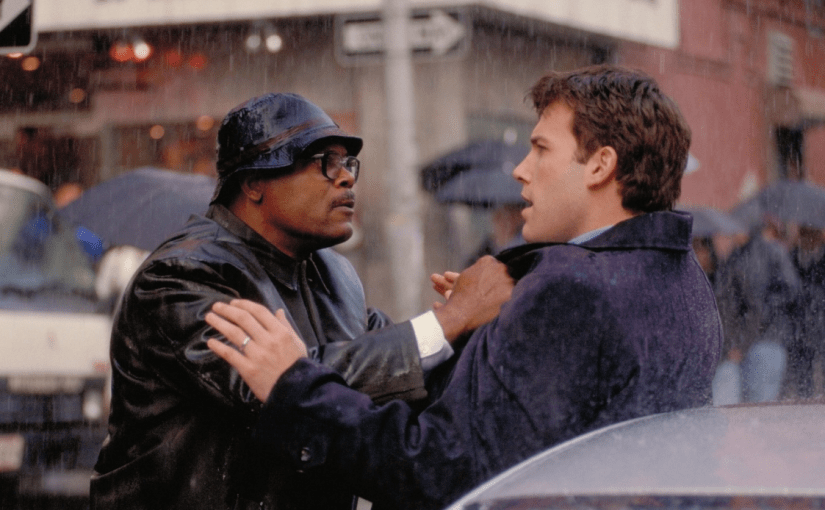
Car accidents never happen at a convenient time. On one rainy day in the city, Doyle and Gavin meet following a sideswipe collision.  Doyle wants to exchange information.  Gavin is good with giving over a blank check and being on his way. Thus, leaving the scene of an accident. 

In the rush of things though, Gavin has dropped the power of attorney file, glaringly noticeable in an orange binder.  Doyle collects it while being left stranded on the freeway.  Being twenty minutes late works against him, and Valerie is granted permission to leave the state.  

Without that orange file, Gavin is short of proving his argument in court.  He has until 5 o’clock on Good Friday to deliver the document to the opposing council and judge or the granddaughter can file a malpractice suit with claims of fraud and possible jail time for Gavin, Stephan and another partner, Walter (Richard Jenkins).

Two separate stories are at play here, running parallel against each other until the lines collide once, then separate and then collide again and again by the hands of the two men working against each other to get ahead.  

Changing Lanes is a study of willpower for Doyle.  Samuel L Jackson is giving one of his best performances.  He’s continuously being tested.  He can have a temper when he’s in the midst of chaos but as his AA sponsor (William Hurt) will remind him outbursts of anger are not substitutes for the bottle.  So you didn’t have a drink!! You can’t exonerate or excuse however else you behave irrationally.

Changing Lanes is morality piece for Gavin.  He has money and power and resources to fix any kind of scenario and circumvent the boundaries of law to Stephan, Walter and his own advantage.  The question is if he should follow through on what’s in front of him.  His code of ethics is tested and other than Michelle, an associate at the firm (Toni Collette), all are telling him what needs to be done. Not what should be done. Including his wife and Stephan’s silver spooned daughter, Cynthia, played with attractive deviousness by Amanda Peet.  A magnificent piece of dialogue that lends justification to commit to what’s not right and sound may be the actress’ best scene of her career.  A gentle, yet direct Lady MacBeth.

Actually, even Michelle, (Toni Collette lending a catalog of subtle expressions) who’s also Gavin’s mistress and in the “I told you so” position, has ideas that triggers a lot of unwanted turmoil for the men.  Changing Lanes truly puts the corrupt in the driver’s seat while leaving the innocents in the wreckage left behind.  What does that say about us as a society?  I guess I’ll need to atone for a lot more than I thought on Yom Kippur, this year.

The men quickly find ways to locate one another and cause harm and setbacks by their antagonism. Some of these scenarios are definitely convenient over the course of an eight-hour day, especially in a populated New York City.  However, the circumstances are at least sensible.  The plausibility should not be questioned however because the script by Chap Taylor and Michael Tolkin is very insightful and reflective.

There’s a million ways Changing Lanes could have ended.  There’s certainly a button well in place on its finality but what remains are the transformations of these two men.  On the surface, in any kind of setting, Affleck and Jackson come from different cloths and it serves the picture very well, because New York is always the battleground for a variety of walks of life.  Watch how the actors argue with each other.  They might as well be speaking different languages because too often people of different backgrounds fail to see what their neighbors are going through.  Doyle and Gavin must go through a lot of pains before they can see a clear sky on a stormy day.

The trailer for Changing Lanes is thrilling but terribly deceptive.  It’ll make you believe this is a kind road rage action picture, complete with Jackson’s signature temper tantrum that’s found in a number of his films.  Maybe the preview convinces you that Affleck looks like the victimized white guy, and that is entirely unfair to an audience and both actors, as well as the writers and directors.  

I’m bold enough to declare that my write up is a much more transparent offering of what to expect from this fine, forgotten film – a highlight for the resumes of every actor here.  Changing Lanes leaves you thinking about what’s just and what can be done right when temptations and tempers do not collide accordingly with our day.
GLENGARRY GLEN ROSS

By Marc S. Sanders

The characters in David Mamet’s Glengarry Glen Ross are under terrible pressure.  They are salesmen who are consistently chasing insurmountable sales goals in real estate properties.  One of them has an ill daughter in the hospital.  Another has a temptation to rob his office as a means of earning some fast cash.  Another is in despair of his self-worth.  To be a salesman, of any kind of commodity, is a tough life to lead.  The payoffs can be enormous when a sale is successful.  However, once a transaction is complete, the response is often “what have you done for me lately?”  These guys are never happy.  However, they are also some of the cruelest, most insensitive, and thoughtless people you will ever meet.  They have no other choice but to behave that way.  It’s the nature of the business.

The film adaptation of Mamet’s Pulitzer Prize winning play contains a collection of outstanding actors doing some of their best work.  They embrace the brutal dialogue the screenplay hands over to them with relentless cursing and flaring tempers.  Glengarry Glen Ross has you believe that you run your sales career on your own with little help or encouragement from the people you slave for. 

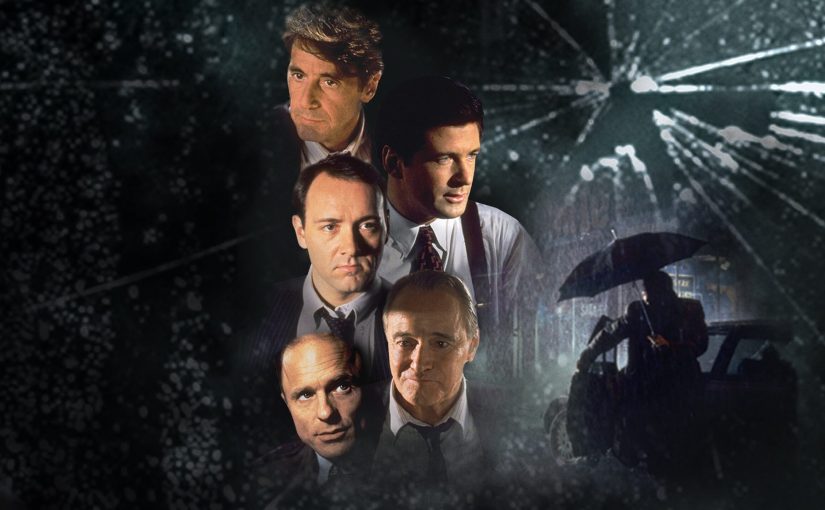
Early in the film, Alec Baldwin, known only as a man named Blake (based on the end credits) visits the office where these salesmen are based out of.  He delivers an unforgiving and harsh reality of what these men must do.  They either get their sales numbers high on the board, where they can win a new Cadillac, or they settle for a set of steak knives for second place.  After that, they are fired.  Regardless of where they currently stand though, they should not even be pouring themselves a cup of coffee.  Coffee is only for closers.  The office manager, known as Williamson (Kevin Spacey), only provides the men with sales leads that have already been exhausted with rejection and hang ups. 

Director James Foley does a wise technique with color.  The first half of the film appears in drabs of greens and greys amid an evening of torrential rain downpour.  Before Blake finishes his threatening presentation, he dangles new leads, the “Glengarry Leads,” in front of the men saying these are not for them, because they are only for closers.  The old leads that Williamson hands out are on green index cards, nothing flashy.  Blake’s leads are bright pink with a gold ribbon tied around them.  Foley makes sure that even a prop tells a story.

The salesman that gets the most attention is perhaps Shelley “The Machine” Levene played by Jack Lemmon.  He’s elderly and past his prime with no numbers currently on the sales board.  Frequently, he is making calls to the hospital for an update on his daughter who is due for surgery, but if he can’t make a payment, then the procedure is likely not to happen.  Lemmon is fascinating in maybe the best performance of his career.  Many of his scenes are toe to toe with Spacey as he shifts from pleading to demanding to disingenuously threatening and ultimately bribing Williamson for the new leads. Levene is so out of touch now that he can’t even sell Williamson on helping him out.  Spacey as Williamson is terrific in his defiance to not lend any sort of aid to Shelley.

David Mamet added additional material to the script, not found in the stage play.  The Blake character is new to the film, for example, and I think it is a better, more fleshed out story because of it.  As well, Foley is able to go outside of the reserved settings of the bar and office, as he follows Levene making a knock-on-the-door sales call in the middle of the rainy night to a family man.  This may be Lemmon’s best scene of the film as he weasels his way into the home to quickly get his raincoat and hat off and get a seat on the sofa as he begins his “once in a lifetime” opportunity that the potential customer may miss out on.  It’s a sales pitch, despite Lemmon’s charm, and the patron can see right through Levene’s performance.  As the door closes on Shelley, you’re terribly sad for his desperation and failure.

On the other end of the spectrum is the current, most successful salesman named Richard Roma.  He’s played by a showy looking Al Pacino who initially doesn’t perform in the broad strokes he’s become recognized for as an actor.  Pacino does a quiet, delicate approach to his character’s sales presentation as he shares a table with a sap (Jonathan Pryce) who is weeping into his liquor glass.  Roma stretches the rainy evening out in the bar with this guy, talking about vague anythings, until he can subtly pounce on him with a brochure that’ll get his signature on a contract. 

Two other salesmen, Moss and Aaronow (Ed Harris, Alan Arkin) vent their frustrations elsewhere in the bar as they eventually segue into an idea of burglarizing the office for those tempting new leads.  However, are they working together as a team on this idea, or is one working something over on the other?  Mamet’s dialogue is chopped up perfectly with utterances and interruptions, that before a character reveals his intentions, you are left flabbergasted.  What is demonstrated here is that a skillful salesman is also an efficacious manipulator.

The second half of the film is set on the following morning where the sunlight has come through.  New revelations following the stormy night from before will present themselves as the men gradually arrive at the office to find it actually has been robbed.  The obvious of circumstances are there.  However, Mamet sets up an ending that’ll leave you breathless.  It did for me the first time I watched the film.  Just when you think you are watching a protagonist throughout the film, something else entirely comes up.

Glengarry Glen Ross has been regarded as a modern-day Death Of A Salesman.  Maybe it is.  I’ve worked in this kind of field before. There were months where I was good at it, and like everyone else, I would brag about my success with recaptured anecdotes and celebratory curse words flying out of my mouth.  There were also months where I would gripe about how uncompromising this life is. When I didn’t want to do sales any longer, I spent twelve years as an assistant to sales representatives.  They are not your friend.  They are only focused on the next contract to be signed and booked before month end, and they will ask anything of you with a seething f-word attached to their request.    Are we so terrible if we can not make an unreachable goal with tools that offer no help and supervisors that lend no encouragement or forgiveness?  To be a salesman means that any of your past accomplishments or education do not define you.  You are only identified as the one who must acquire the next thing, and then the next thing after that.  It will change your attitude about yourself and how you treat others.  It’ll alter your dialogue which is so vitally apparent in Mamet’s story.  It will even influence you to take measures you never thought you’d be capable of.

James Foley enhanced an already electrifying script from David Mamet.  He knew that if he was going to show how hard and challenging it is to be a salesman of boring, uninteresting, and practically intangible parcels of land, then he was going to have to be relentless in the art direction and settings contained in the film.  The first half of the film never, ever lets up with the rain storm going on outside in the city street.  The evening is as black as can be, and yet Williamson casually will ask Levene if he is going out tonight. Who in the dead of night in the rain is going to want to talk to a droning salesman about anything?  Yet, that’s what is expected of this life.  The office setting is unfriendly, decorated with ideals that hang from the walls with phrases like “A man must embrace further than what he can reach.”  Little touches like this only add to the uncaring and selfish nature the men really have for one another. 

Glengarry Glen Ross depicts a hard life for the man in a suit.  You may dress like what is expected of a professional, but you are also always scraping the bottom of another bottom.  The cliché that money can’t buy happiness is personified in a film like this.  You may get to the top and score a nice commission, but it’ll soon be forgotten and nothing you’ve done before will lend to your current state.  Next month, someone else will be standing where you are standing.  Worse, you may never be standing on top again, and then what will you do?

Sadly, I believe that Glengarry Glen Ross reflects what many people experience at least at one point in their lives.  We are all salespeople to a degree whether we are doing a job interview or even trying to impress the parents of someone we are dating.  It doesn’t always work out.  The question is where do any of us go from that point.