
CHANGING LANES

By Marc S. Sanders

The title is not meant to just be taken literally.  Roger Michell’s film shot on location in New York City pull the fulcrums which alter the destructive paths of two very different men.  The script beckons them to pave each other’s roads they will follow from here on out.  Their destinations can lead to hope or despair.

Doyle Gipson (Samuel L Jackson) is a recovering alcoholic who is ready to close on a house in Queens that his estranged wife Valerie (Kim Staunton) and two young sons can move into.  Finally, the insurance telemarketer seems to be on the straight and narrow.  He doesn’t want a glass of champagne.  He feels like champagne, bubbly and alive.  His AA sponsor doesn’t rejoice in that comment.  Doyle just has to get to family court and demonstrate that he’s a devoted and loving father and ask the judge to decline Valerie’s plan to relocate to Oregon with the boys.

Gavin Banek (Ben Affleck), the son in law and young law partner of Stephan Delano (Sydney Pollack) just has to make a quick appearance in court to undoubtedly prove that his now deceased client intentionally signed off on dismantling his multi-million-dollar trust leaving the proceeds for the law firm to collect.  The client’s granddaughter argues that her grandfather was mentally incapacitated and therefore the agreement carries no merit.  Gavin has all the documents lined up with clear and original signatures from the client.  This should be a slam dunk.

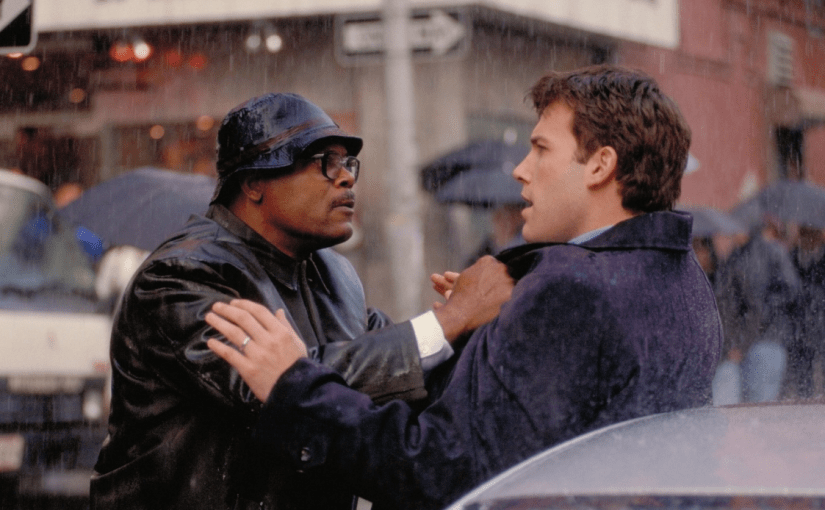
Car accidents never happen at a convenient time. On one rainy day in the city, Doyle and Gavin meet following a sideswipe collision.  Doyle wants to exchange information.  Gavin is good with giving over a blank check and being on his way. Thus, leaving the scene of an accident. 

In the rush of things though, Gavin has dropped the power of attorney file, glaringly noticeable in an orange binder.  Doyle collects it while being left stranded on the freeway.  Being twenty minutes late works against him, and Valerie is granted permission to leave the state.  

Without that orange file, Gavin is short of proving his argument in court.  He has until 5 o’clock on Good Friday to deliver the document to the opposing council and judge or the granddaughter can file a malpractice suit with claims of fraud and possible jail time for Gavin, Stephan and another partner, Walter (Richard Jenkins).

Two separate stories are at play here, running parallel against each other until the lines collide once, then separate and then collide again and again by the hands of the two men working against each other to get ahead.  

Changing Lanes is a study of willpower for Doyle.  Samuel L Jackson is giving one of his best performances.  He’s continuously being tested.  He can have a temper when he’s in the midst of chaos but as his AA sponsor (William Hurt) will remind him outbursts of anger are not substitutes for the bottle.  So you didn’t have a drink!! You can’t exonerate or excuse however else you behave irrationally.

Changing Lanes is morality piece for Gavin.  He has money and power and resources to fix any kind of scenario and circumvent the boundaries of law to Stephan, Walter and his own advantage.  The question is if he should follow through on what’s in front of him.  His code of ethics is tested and other than Michelle, an associate at the firm (Toni Collette), all are telling him what needs to be done. Not what should be done. Including his wife and Stephan’s silver spooned daughter, Cynthia, played with attractive deviousness by Amanda Peet.  A magnificent piece of dialogue that lends justification to commit to what’s not right and sound may be the actress’ best scene of her career.  A gentle, yet direct Lady MacBeth.

Actually, even Michelle, (Toni Collette lending a catalog of subtle expressions) who’s also Gavin’s mistress and in the “I told you so” position, has ideas that triggers a lot of unwanted turmoil for the men.  Changing Lanes truly puts the corrupt in the driver’s seat while leaving the innocents in the wreckage left behind.  What does that say about us as a society?  I guess I’ll need to atone for a lot more than I thought on Yom Kippur, this year.

The men quickly find ways to locate one another and cause harm and setbacks by their antagonism. Some of these scenarios are definitely convenient over the course of an eight-hour day, especially in a populated New York City.  However, the circumstances are at least sensible.  The plausibility should not be questioned however because the script by Chap Taylor and Michael Tolkin is very insightful and reflective.

There’s a million ways Changing Lanes could have ended.  There’s certainly a button well in place on its finality but what remains are the transformations of these two men.  On the surface, in any kind of setting, Affleck and Jackson come from different cloths and it serves the picture very well, because New York is always the battleground for a variety of walks of life.  Watch how the actors argue with each other.  They might as well be speaking different languages because too often people of different backgrounds fail to see what their neighbors are going through.  Doyle and Gavin must go through a lot of pains before they can see a clear sky on a stormy day.

The trailer for Changing Lanes is thrilling but terribly deceptive.  It’ll make you believe this is a kind road rage action picture, complete with Jackson’s signature temper tantrum that’s found in a number of his films.  Maybe the preview convinces you that Affleck looks like the victimized white guy, and that is entirely unfair to an audience and both actors, as well as the writers and directors.  

I’m bold enough to declare that my write up is a much more transparent offering of what to expect from this fine, forgotten film – a highlight for the resumes of every actor here.  Changing Lanes leaves you thinking about what’s just and what can be done right when temptations and tempers do not collide accordingly with our day.

PLANES, TRAINS AND AUTOMOBILES

By Marc S. Sanders

The Tuesday Before Thanksgiving Tradition blazes on for another year as Steve Martin and John Candy travel from New York City to Wichita, Kansas and then who knows where all while trying to reach their final destination of Chicago, Illinois in time for Thanksgiving dinner.

Despite the fact that Planes, Trains & Automobiles was made in 1987 before the age of cell phones, personal navigation systems, Priceline .com and Ubers, it remains a timeless classic of inadvertent comedy. Travel is still as frustrating, maybe more so now, and family kinship is still treasured.

Martin plays Marketing Executive Neil Page, forced to succumb to the unwanted company of Shower Curtain Ring Salesman Del Griffeth (Candy). One inconvenience after another delays Neil from getting home to his family for the holiday. Del wants to be helpful, yet he is anything but.

The roles are perfectly cast. One of the best on screen couples of all time. I imagine had John Candy not passed away so young, he would have been paired up with Steve Martin at least one more time.

Writer/Director John Hughes is a master at taking simple circumstances (detention on a Saturday, skipping school, traveling) and blossoming it into episodes of relatability amplified in both comedy and drama. His knack for dialogue is a huge factor in his scenes. Consider the best scene in the film between Martin and favorite character actor Edie McClurg where 19 F- bombs are tossed over the mix up of a rental car. It happens all the time to any one of us, and Hughes took advantage of the frustration and built comedy that comes from it. Its not funny when you are in the moment. It’s funny when you recall the moment later on. It’s a brilliant scene.

Nut grabbing, taxi races, ride hitching in 1 degree weather, bed sharing with what you think are pillows, burning cars, wrong way driving, encounters with death and the devil, “The Canadian Mounted,” and a perfect excuse to use Ray Charles’ rockin’ “Mess Around” all point to a reason for a climax that arguably (on the first time any of us saw the film) we never expected or considered. If you don’t choke up, you have no soul.

Hughes was all too familiar with the meaning of Thanksgiving when he wrote Planes, Trains & Automobiles. I like to think those that see the film are even better for having watched it.

It’s a very funny movie, but it’s very special movie as well. Give thanks, offer what you can, when you can, and Happy Thanksgiving. 

HAPPINESS (1998)

by Miguel E. Rodriguez

Director: Todd Solondz
Cast: Jane Adams, Jon Lovitz, Philip Seymour Hoffman, Dylan Baker, Lara Flynn Boyle, Louise Lasser, Ben Gazzara, Camryn Manheim, Molly Shannon
My Rating: 8/10
Rotten Tomatometer: 81% Certified Fresh

PLOT: Various characters, some linked, some not, struggle with the search for happiness in their lives.


A little history:

Todd Solondz’s film Happiness was so controversial that the Sundance Film Festival actually refused to screen it.  It was originally financed by October Films, but upon seeing the final product, October’s owner, Seagrams, dropped the film like a hot potato.  Happiness initially received an NC-17 rating, which would have immediately limited distribution opportunities, as well as created advertising difficulties.  Therefore, it was released unrated, uncut, and unaltered.

I remember reading about this movie years ago in Roger Ebert’s four-star review; he eventually labeled it one of the top ten movies of 1998.  I got curious, so, since this was in the days before Netflix – and I’m not sure Netflix would have made it available anyway – I snapped up the first DVD copy I could find and watched it.

And…um…oh my.  There are dark comedies (Pulp Fiction), and there are Dark Comedies (Dr. Strangelove).   And then there are DARK COMEDIES.  Happiness is a DARK COMEDY.

Remember that scene in Pulp Fiction when Marvin gets shot in the back of the car?  Remember the blood that covered the rear windshield and the blood and pieces of flesh and skull that were peppered all over John Travolta and Samuel L. Jackson?  Horrific, right?  But it was such a shocking moment that I remember laughing hysterically for the first few seconds after the incident, so that I missed the next few lines of dialogue from Vincent and Jules.

Happiness is like that.  You’re watching scenes of emotional devastation, but the circumstances under which they’re happening are…kinda funny.  Or at least funny in that shocked kind of way.  Your brain can’t quite believe what your eyes and ears are feeding it, and so you laugh.  At least, I did when I recently re-watched it with my girlfriend last night.  She didn’t do a lot of laughing, for the record.

The plot: We meet three sisters, Joy (Jane Adams), Helen (Lara Flynn Boyle), and Trish (Cynthia Stevenson).  Joy is an aspiring 30-something songwriter who still lives at home and has just broken up with her boyfriend in a scene that’s right at the top of the film and sets the appropriate mood: somewhere between funny and discomfort.  Helen is a moderately successful writer who has written a bestselling collection of poems about childhood rape.  Cynthia is a mother of two boys, married to a successful psychiatrist named Bill (Dylan Baker).  She seems to be the happiest of the three sisters, but she’s that kind of person who says things like, “You know, we all thought you would never amount to much, but NOW look at you!”

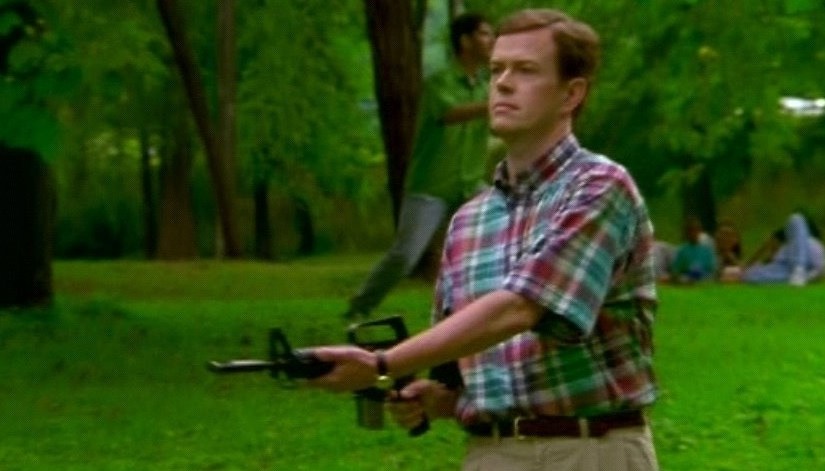
Cynthia’s husband, Bill, has a dark secret, one which I will not divulge here, but it’s revealed fairly early in the film.  He is a man so desperately in search of happiness that his efforts to fulfill his desires dance on the edge of farce.  He is so compelled to be happy (or at least what passes for happy in his mind) that he is, at one point, reduced to, um, “interfering with himself” in the backseat of his own car in broad daylight, risking discovery at every second by passers-by.

I haven’t even mentioned the part where he drugs the tuna fish sandwich.  Or ditches the PTA meeting for an impromptu “rendezvous.”  Or has a conversation with his 11-year-old son about why length doesn’t matter.  But enough about Bill for now.

Helen, the author, feels like a faker because she was, in fact, never raped as a child, so her happiness and success is built on lies.  She wishes her work could have more immediacy or legitimacy.  Then she could be REALLY happy.  And she might have a way: Daryl (Philip Seymour Hoffman), her next-door neighbor, is so obsessed with her that he finds it impossible to talk to her in person.  So he starts making obscene phone calls to her while he’s at work.  He gets the shock of his life when, after one call, she star-69s him and says, “I want to see you.”

And Joy…poor, ironically-named Joy.  Her trials and tribulations in the movie are more relatable than the others I’ve mentioned previously, so I’ll leave them alone for now.

Now, the subject matter of the movie has sparked controversy, as I mentioned earlier.  Are we, as an audience, expected to empathize with these characters?  Speaking as a guy who has had his fair share of heartbreaking crushes, I’ve gotta say I did empathize a bit with Daryl, the phone pervert.  I certainly don’t condone his behavior, but I was achingly aware of his thought processes as he stood in the elevator next to the object of his desire, desperate to talk to her, certain that she represents true happiness, but eternally unable to do anything about it.

I also identified a little with Kristina, played by Camryn Manheim.  She lives a couple of doors down from Daryl and is always knocking on his door to deliver tidbits of news.  (“Our doorman was found bludgeoned to death in his apartment this morning…supposedly his penis was missing.”)  She is clearly crushing on Daryl, but Daryl is oblivious in the face of his own crush.  Their relationship, or lack thereof, pays off in a scene set in a diner during which a secret is revealed that sees the Marvin scene from Pulp Fiction and raises.

But what about Bill, Cynthia’s husband with the dark secret?  While I can relate to characters like Kristina and Daryl and Joy, what is this distasteful nonsense doing in this movie?  Let’s make no bones about it: Bill is a monster, enslaved to desires he can’t understand; he can only bend to their will.  Does that make him an object of sympathy?  SHOULD that make him an object of sympathy?  There’s an excruciating scene where Bill’s son asks him very, VERY specific questions about his compulsion, and to our amazement, instead of shying away from them, Bill tearfully answers them honestly and directly, including that last question that I had completely forgotten was in the movie.  Does this honesty make Bill honorable?  Previous scenes have shown that Bill is always honest with his son, and he makes the decision not to break that streak, even when the answers are shameful and, probably for some, gag-inducing.

My take: Bill’s crimes and desires have made him irredeemable, in my book.  But…BUT…he did the right thing by being honest with his son.  In that ONE sense, I have to give the character props.  If I were in his place, I’m not sure I would have done the same thing.

Geez, I just realized I haven’t even mentioned another subplot about the parents of the three sisters who have relocated to Florida and are undergoing a separation (NOT a divorce!), even though they’re still living in the same house.  Eh, I’ll leave that one alone, too.

So anyway.  Whenever I read a review that gets this long-winded, I always find myself asking the question, “Yeah, but is it any GOOD?”

Yes, it is.  It’s literate, compelling, and funny, but you may hate yourself for laughing afterwards.  That’s the genius of the movie.  It creates these situations that you laugh at, but when you try to describe the scene to your friends, they just stare at you in abject horror.

(I give it an 8 instead of a higher score just on the basis of the “icky” feeling I get when watching some of the scenes.  You’ve been warned.)