
DON’T SAY GOOD LUCK

By Marc S. Sanders

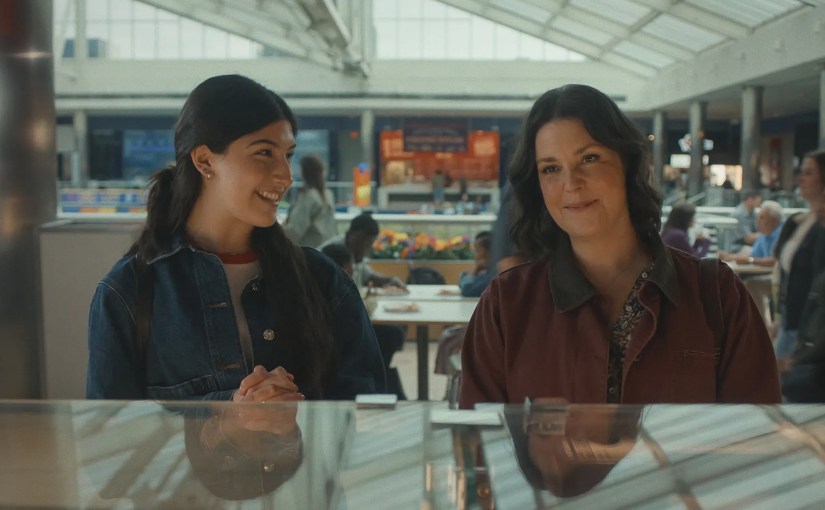
Adam Sandler’s production company, Happy Madison, has released a new film for his daughter, Sunny Sandler, to star in, and like her their previous collaboration, You Are So Not Invited To My Bat Mitzvah, it’s an engaging, comedically emotional hit.  Don’t Say Good Luck is not as strong as the family dramas that are built on blocks of biting sarcasm like Terms Of Endearment and Steel Magnolias, but the cast and writing devote at least the same level of emotional maturity to the product.  

You might argue that Sunny Sandler falls under the category of a “Hollywood nepo-baby,” but the actress’ talent in performance, accompanied by show stopping singing, demonstrates that she deserves to be on stage and/or in front of a camera.  She’s a dynamo that I find far more appealing than I ever gave her comedic father credit for.

Laura Hankin wrote this screenplay based on her experience as an eighth grader who was cast in the school play while dealing with a terminally sick relative at home.  Sandler portrays Sophie who only hopes to get cast as the supporting role in the school’s upcoming production of Waitress: The Musical.  Following call backs, Sophie learns that she’ll be playing the lead.  It’s exciting, unexpected and certainly challenging, especially because she’ll romantically be playing opposite the cute boy in school and they’ll have to kiss on stage.  Yet, it’s also bittersweet because she has to accept her best friend Carolyn (Scarlett Estevez) has dropped out of the show while not being entirely forthright with Sophie, and Carolyn’s new friendship with Erin.  

Sophie’s happy home life is also compromised because mom’s cancer has returned and the forecast for survival is not likely.  Mom is Elizabeth, played with beautiful sensitivity by Melanie Lynskey.  Lynskey and Sandler make a perfect mother/daughter pair with outstanding chemistry.  Their pace is marvelous either when they are putting on southern belle acts for strangers in the mall or struggling with Elizabeth’s decline.  They make you laugh and cry.  I’m bold enough to declare that Sunny is much more entertaining than her successful father Adam, who I’ve never been that drawn to. Lynskey’s performance is contained with an energy to remain as an active mom. She relies on the convincing makeup to gradually show her decline while not crutching upon a weakened voice or droopy body language. That happens too often. This portrayal is welcome and convincing as one of those people who say “I’m gonna fight this.”

Don’t Say Good Luck is a refreshing coming of age comedy-drama that treats its young actors with authentic respect.  Following …Bat Mitzvah and now this film, I gratefully believe that Adam Sandler seeks out these scripts because they are not exclusive to just the two or three leads.  Hankin’s screenplay fleshes out the other kids in the musical’s cast.  Every actor with at least one line of dialogue appears to serve a meaningful purpose to this film. With so many active participants in the cast the setting’s community is on a solid foundation. There’s life within this high school where the kids go through the theatre games followed by musical choreography and vocal warmups. Even the quirky musical director, who has few lines, has a characterization that is relatable. This is rarely seen, and hard to accomplish in most movies, especially with a brisk running time of only ninety minutes.

Claire Scavone stands out as the enthusiastic actor freshman with the big smile, big glasses and BIG VOICE who absolutely loves theater and the kids she performs with.  She’s an outstanding escape from the heavier moments of the film.  The typical, blond popular girl (Elyse Bell) who always gets the leads is not the staple enemy of the picture. She’s got the privileged ego at first sight, but then there’s a quick reveal to how she relates to Sophie. Don’t Say Good Luck is not that movie where the snob gets her comeuppance. None of us should love to hate a kid. Sandler’s production knows this.

Adam’s friend Steve Buscemi has reached the stage of playing a grandfather and paired with Bebe Neuwirth as his wife who comes home to help their daughter with family tasks.  Buscemi is not trying to steal any scenes.  Neuwirth is the mother who oversteps her offers to help but rattles the discomfort that comes when cancer is killing a loved one.

Stephanie Beatriz does more with the theater teacher role than you’d find in typical Nickelodeon or Disney fare.  She emulates what is rewarding about teaching with encouragement and respect for her class.  As a community theater actor/director/producer, I related to every issue that comes her way from tech issues to sets coming apart and especially to instilling confidence in her student actors.  My daughter missed out on this experience in her high school productions.  This film reminds me of what I absorbed when I took up theater in school.  I also appreciate that the kids are not heightened to be smarter than standard dimwit adults that so many other films rely on.  

Max Greenfield as dad might have been worthy of a more expansive role.  The guy who runs the sandwich shop with Jon Lovitz, while balancing taking care of his terminally ill wife and a pair of rambunctious twin boys.  However, like Endearment and Magnolias, this film hinges on the mother/daughter perspective.  So, I can forgive this shortcoming.

Don’t Say Good Luck is schmaltzy with the inevitable sappiness found in tear jerkers, but the dialogue does not appear wasted, and director Julia Hart finds those perfect beats with her ensemble of mostly young actors and extras.  She also captures heart wrenching close ups of Sunny Sandler whose dynamic performance must respond to first love, friendship challenges, domestic drama, exciting opportunities and a likely potential for loss.  If you are not completely engaged in her closing song performance that wraps up this piece, you left behind several pieces of both your heart and soul somewhere. She belongs on the charts.

Don’t Say Good Luck pulls Sunny Sandler out of Adam’s large shadow.  She gives an emotionally strong, breakthrough performance that might earn her at least a Golden Globe award in the Comedy/Musical category, as well as trophies in the young actor awards ceremonies.  

Don’t Say Good Luck is now streaming on Netflix.
HAPPINESS (1998)

by Miguel E. Rodriguez

Director: Todd Solondz
Cast: Jane Adams, Jon Lovitz, Philip Seymour Hoffman, Dylan Baker, Lara Flynn Boyle, Louise Lasser, Ben Gazzara, Camryn Manheim, Molly Shannon
My Rating: 8/10
Rotten Tomatometer: 81% Certified Fresh

PLOT: Various characters, some linked, some not, struggle with the search for happiness in their lives.


A little history:

Todd Solondz’s film Happiness was so controversial that the Sundance Film Festival actually refused to screen it.  It was originally financed by October Films, but upon seeing the final product, October’s owner, Seagrams, dropped the film like a hot potato.  Happiness initially received an NC-17 rating, which would have immediately limited distribution opportunities, as well as created advertising difficulties.  Therefore, it was released unrated, uncut, and unaltered.

I remember reading about this movie years ago in Roger Ebert’s four-star review; he eventually labeled it one of the top ten movies of 1998.  I got curious, so, since this was in the days before Netflix – and I’m not sure Netflix would have made it available anyway – I snapped up the first DVD copy I could find and watched it.

And…um…oh my.  There are dark comedies (Pulp Fiction), and there are Dark Comedies (Dr. Strangelove).   And then there are DARK COMEDIES.  Happiness is a DARK COMEDY.

Remember that scene in Pulp Fiction when Marvin gets shot in the back of the car?  Remember the blood that covered the rear windshield and the blood and pieces of flesh and skull that were peppered all over John Travolta and Samuel L. Jackson?  Horrific, right?  But it was such a shocking moment that I remember laughing hysterically for the first few seconds after the incident, so that I missed the next few lines of dialogue from Vincent and Jules.

Happiness is like that.  You’re watching scenes of emotional devastation, but the circumstances under which they’re happening are…kinda funny.  Or at least funny in that shocked kind of way.  Your brain can’t quite believe what your eyes and ears are feeding it, and so you laugh.  At least, I did when I recently re-watched it with my girlfriend last night.  She didn’t do a lot of laughing, for the record.

The plot: We meet three sisters, Joy (Jane Adams), Helen (Lara Flynn Boyle), and Trish (Cynthia Stevenson).  Joy is an aspiring 30-something songwriter who still lives at home and has just broken up with her boyfriend in a scene that’s right at the top of the film and sets the appropriate mood: somewhere between funny and discomfort.  Helen is a moderately successful writer who has written a bestselling collection of poems about childhood rape.  Cynthia is a mother of two boys, married to a successful psychiatrist named Bill (Dylan Baker).  She seems to be the happiest of the three sisters, but she’s that kind of person who says things like, “You know, we all thought you would never amount to much, but NOW look at you!”

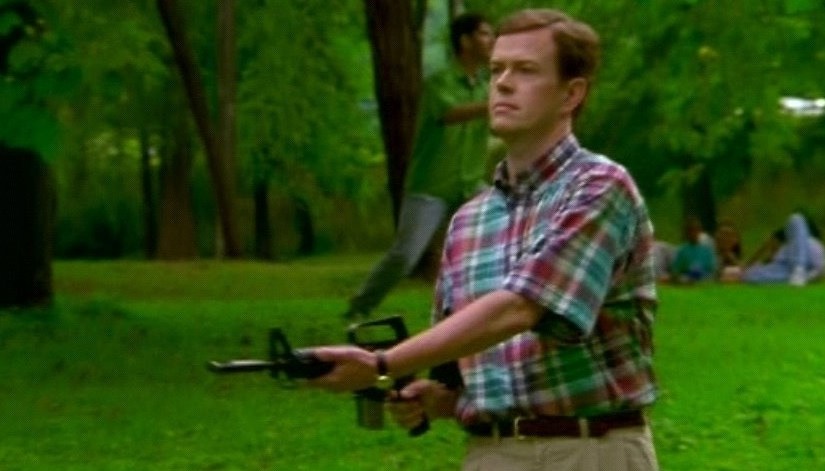
Cynthia’s husband, Bill, has a dark secret, one which I will not divulge here, but it’s revealed fairly early in the film.  He is a man so desperately in search of happiness that his efforts to fulfill his desires dance on the edge of farce.  He is so compelled to be happy (or at least what passes for happy in his mind) that he is, at one point, reduced to, um, “interfering with himself” in the backseat of his own car in broad daylight, risking discovery at every second by passers-by.

I haven’t even mentioned the part where he drugs the tuna fish sandwich.  Or ditches the PTA meeting for an impromptu “rendezvous.”  Or has a conversation with his 11-year-old son about why length doesn’t matter.  But enough about Bill for now.

Helen, the author, feels like a faker because she was, in fact, never raped as a child, so her happiness and success is built on lies.  She wishes her work could have more immediacy or legitimacy.  Then she could be REALLY happy.  And she might have a way: Daryl (Philip Seymour Hoffman), her next-door neighbor, is so obsessed with her that he finds it impossible to talk to her in person.  So he starts making obscene phone calls to her while he’s at work.  He gets the shock of his life when, after one call, she star-69s him and says, “I want to see you.”

And Joy…poor, ironically-named Joy.  Her trials and tribulations in the movie are more relatable than the others I’ve mentioned previously, so I’ll leave them alone for now.

Now, the subject matter of the movie has sparked controversy, as I mentioned earlier.  Are we, as an audience, expected to empathize with these characters?  Speaking as a guy who has had his fair share of heartbreaking crushes, I’ve gotta say I did empathize a bit with Daryl, the phone pervert.  I certainly don’t condone his behavior, but I was achingly aware of his thought processes as he stood in the elevator next to the object of his desire, desperate to talk to her, certain that she represents true happiness, but eternally unable to do anything about it.

I also identified a little with Kristina, played by Camryn Manheim.  She lives a couple of doors down from Daryl and is always knocking on his door to deliver tidbits of news.  (“Our doorman was found bludgeoned to death in his apartment this morning…supposedly his penis was missing.”)  She is clearly crushing on Daryl, but Daryl is oblivious in the face of his own crush.  Their relationship, or lack thereof, pays off in a scene set in a diner during which a secret is revealed that sees the Marvin scene from Pulp Fiction and raises.

But what about Bill, Cynthia’s husband with the dark secret?  While I can relate to characters like Kristina and Daryl and Joy, what is this distasteful nonsense doing in this movie?  Let’s make no bones about it: Bill is a monster, enslaved to desires he can’t understand; he can only bend to their will.  Does that make him an object of sympathy?  SHOULD that make him an object of sympathy?  There’s an excruciating scene where Bill’s son asks him very, VERY specific questions about his compulsion, and to our amazement, instead of shying away from them, Bill tearfully answers them honestly and directly, including that last question that I had completely forgotten was in the movie.  Does this honesty make Bill honorable?  Previous scenes have shown that Bill is always honest with his son, and he makes the decision not to break that streak, even when the answers are shameful and, probably for some, gag-inducing.

My take: Bill’s crimes and desires have made him irredeemable, in my book.  But…BUT…he did the right thing by being honest with his son.  In that ONE sense, I have to give the character props.  If I were in his place, I’m not sure I would have done the same thing.

Geez, I just realized I haven’t even mentioned another subplot about the parents of the three sisters who have relocated to Florida and are undergoing a separation (NOT a divorce!), even though they’re still living in the same house.  Eh, I’ll leave that one alone, too.

So anyway.  Whenever I read a review that gets this long-winded, I always find myself asking the question, “Yeah, but is it any GOOD?”

Yes, it is.  It’s literate, compelling, and funny, but you may hate yourself for laughing afterwards.  That’s the genius of the movie.  It creates these situations that you laugh at, but when you try to describe the scene to your friends, they just stare at you in abject horror.

(I give it an 8 instead of a higher score just on the basis of the “icky” feeling I get when watching some of the scenes.  You’ve been warned.)