DON’T SAY GOOD LUCK

By Marc S. Sanders

Adam Sandler’s production company, Happy Madison, has released a new film for his daughter, Sunny Sandler, to star in, and like her their previous collaboration, You Are So Not Invited To My Bat Mitzvah, it’s an engaging, comedically emotional hit.  Don’t Say Good Luck is not as strong as the family dramas that are built on blocks of biting sarcasm like Terms Of Endearment and Steel Magnolias, but the cast and writing devote at least the same level of emotional maturity to the product.  

You might argue that Sunny Sandler falls under the category of a “Hollywood nepo-baby,” but the actress’ talent in performance, accompanied by show stopping singing, demonstrates that she deserves to be on stage and/or in front of a camera.  She’s a dynamo that I find far more appealing than I ever gave her comedic father credit for.

Laura Hankin wrote this screenplay based on her experience as an eighth grader who was cast in the school play while dealing with a terminally sick relative at home.  Sandler portrays Sophie who only hopes to get cast as the supporting role in the school’s upcoming production of Waitress: The Musical.  Following call backs, Sophie learns that she’ll be playing the lead.  It’s exciting, unexpected and certainly challenging, especially because she’ll romantically be playing opposite the cute boy in school and they’ll have to kiss on stage.  Yet, it’s also bittersweet because she has to accept her best friend Carolyn (Scarlett Estevez) has dropped out of the show while not being entirely forthright with Sophie, and Carolyn’s new friendship with Erin.  

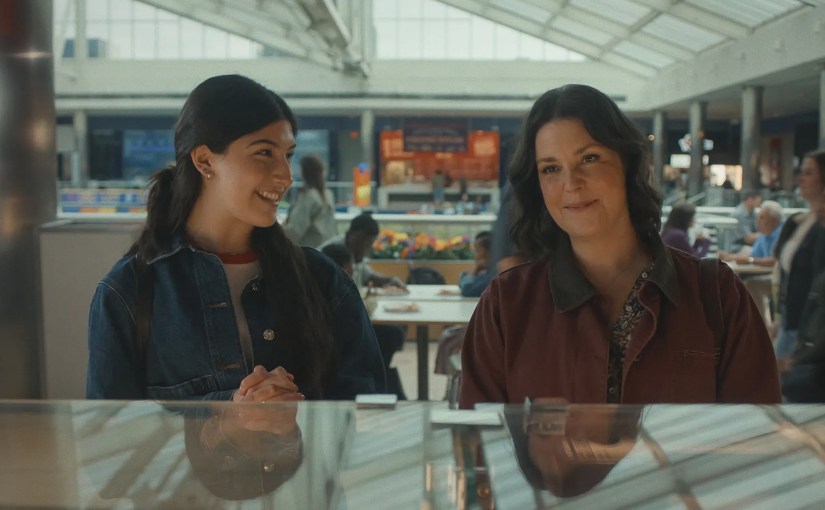
Sophie’s happy home life is also compromised because mom’s cancer has returned and the forecast for survival is not likely.  Mom is Elizabeth, played with beautiful sensitivity by Melanie Lynskey.  Lynskey and Sandler make a perfect mother/daughter pair with outstanding chemistry.  Their pace is marvelous either when they are putting on southern belle acts for strangers in the mall or struggling with Elizabeth’s decline.  They make you laugh and cry.  I’m bold enough to declare that Sunny is much more entertaining than her successful father Adam, who I’ve never been that drawn to. Lynskey’s performance is contained with an energy to remain as an active mom. She relies on the convincing makeup to gradually show her decline while not crutching upon a weakened voice or droopy body language. That happens too often. This portrayal is welcome and convincing as one of those people who say “I’m gonna fight this.”

Don’t Say Good Luck is a refreshing coming of age comedy-drama that treats its young actors with authentic respect.  Following …Bat Mitzvah and now this film, I gratefully believe that Adam Sandler seeks out these scripts because they are not exclusive to just the two or three leads.  Hankin’s screenplay fleshes out the other kids in the musical’s cast.  Every actor with at least one line of dialogue appears to serve a meaningful purpose to this film. With so many active participants in the cast the setting’s community is on a solid foundation. There’s life within this high school where the kids go through the theatre games followed by musical choreography and vocal warmups. Even the quirky musical director, who has few lines, has a characterization that is relatable. This is rarely seen, and hard to accomplish in most movies, especially with a brisk running time of only ninety minutes.

Claire Scavone stands out as the enthusiastic actor freshman with the big smile, big glasses and BIG VOICE who absolutely loves theater and the kids she performs with.  She’s an outstanding escape from the heavier moments of the film.  The typical, blond popular girl (Elyse Bell) who always gets the leads is not the staple enemy of the picture. She’s got the privileged ego at first sight, but then there’s a quick reveal to how she relates to Sophie. Don’t Say Good Luck is not that movie where the snob gets her comeuppance. None of us should love to hate a kid. Sandler’s production knows this.

Adam’s friend Steve Buscemi has reached the stage of playing a grandfather and paired with Bebe Neuwirth as his wife who comes home to help their daughter with family tasks.  Buscemi is not trying to steal any scenes.  Neuwirth is the mother who oversteps her offers to help but rattles the discomfort that comes when cancer is killing a loved one.

Stephanie Beatriz does more with the theater teacher role than you’d find in typical Nickelodeon or Disney fare.  She emulates what is rewarding about teaching with encouragement and respect for her class.  As a community theater actor/director/producer, I related to every issue that comes her way from tech issues to sets coming apart and especially to instilling confidence in her student actors.  My daughter missed out on this experience in her high school productions.  This film reminds me of what I absorbed when I took up theater in school.  I also appreciate that the kids are not heightened to be smarter than standard dimwit adults that so many other films rely on.  

Max Greenfield as dad might have been worthy of a more expansive role.  The guy who runs the sandwich shop with Jon Lovitz, while balancing taking care of his terminally ill wife and a pair of rambunctious twin boys.  However, like Endearment and Magnolias, this film hinges on the mother/daughter perspective.  So, I can forgive this shortcoming.

Don’t Say Good Luck is schmaltzy with the inevitable sappiness found in tear jerkers, but the dialogue does not appear wasted, and director Julia Hart finds those perfect beats with her ensemble of mostly young actors and extras.  She also captures heart wrenching close ups of Sunny Sandler whose dynamic performance must respond to first love, friendship challenges, domestic drama, exciting opportunities and a likely potential for loss.  If you are not completely engaged in her closing song performance that wraps up this piece, you left behind several pieces of both your heart and soul somewhere. She belongs on the charts.

Don’t Say Good Luck pulls Sunny Sandler out of Adam’s large shadow.  She gives an emotionally strong, breakthrough performance that might earn her at least a Golden Globe award in the Comedy/Musical category, as well as trophies in the young actor awards ceremonies.  

Don’t Say Good Luck is now streaming on Netflix.
FARGO

By Marc S. Sanders

The seeds of a crime begin in the dead of winter, in a saloon, located in Fargo, North Dakota.  A car salesman requests two thugs kidnap his wife so that they can demand an eighty-thousand-dollar ransom from his wealthy father-in-law.  The salesman will split the monies with the crooks and all will be well.  Hold on there!  It’s not as simple as it looks.

The Coen Brothers (Joel and Ethan) completed some of their most legendary work when they opted to “adapt” a supposedly true story that sheds blood over the snow-covered plains of northern Minnesota when all of the characters involved choose not to cooperate with one another.  The unpredictable is what keeps their film Fargo so engaging.  With each passing scene, you ask yourself “What next????”

Jerry Lundegaard (William H Macy, in my favorite role of many good ones from him) is the salesman who gets in over his head.  This cockamamie scheme of his stems from a need to land a get rich quick investment, but he doesn’t have the money and his father-in-law Wade Gustafson (Harve Presnell) certainly won’t lend it to him.  Steve Buscemi and Peter Stormare are the hired criminals, Carl and Gaere.  As quick as the agreement is made, Jerry wants to call off the arrangement, but things are already set in motion.  The kidnapping occurs, albeit sloppily, and a late-night pullover on a dark, snow covered back road leads to the bloody shootings of three people. 

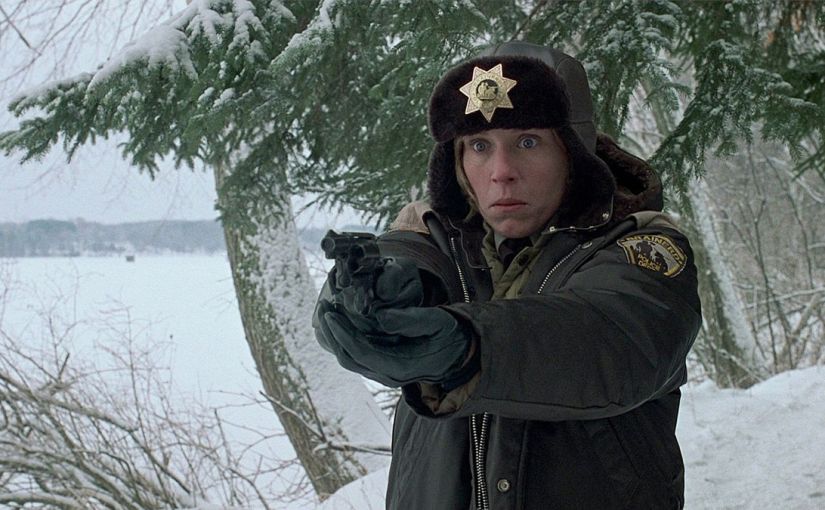
Marge Gunderson (Frances McDormand, in her first Oscar winning role) is awoken early in the morning.  Her sweet husband makes her a quick breakfast and she’s off in a jiff to inspect the crime scene of the three murders.  She is seven months pregnant, but she’s got a job to do.

Murder, kidnapping, fraud, and embezzlement piece together the Coens’ Oscar winning script.  What makes Fargo special though is how out of frame it all seems among these odd and quirky characters.  The Minnesotan dialects and vernacular (“You betcha!!” “You’re darn tootin’!” “Oh, for Pete’s sake!!!”) from Marge and Jerry do not seem standard in a story like this.  Even their names – Lundegaard and Gunderson – seem totally out of place here.  However, the pregnant, sweet natured police officer should not be underestimated, and the puppet master behind this plot should have known better.  In fact, other than Marge, no one should be doing what they’re doing, and yet that’s exactly what spins everything off the rails.

The Coens humanize the characters of their film.  Marge must stop inspecting the grisly crime scene because her morning sickness is about to overtake her.  “No, I think I’m gonna barf!” It is not the blood or the cold winter that’s holding her back.  Natural pregnancy gets in the way.  When clues lead her to Minneapolis for an overnight stay, she takes advantage of meeting with a high school friend.  Their meet-up has nothing to do with the central plot, but the writers insist on showing Marge during her off hours.  It’s a hilarious scene and Frances McDormand’s timing is naturally comedic with a guy who just has an overenthusiastic way about himself.  Marge is not just a smart cop.  She’s got a life outside of her career as a loving wife, friend and soon to be mother.

As well, Jerry insists to Wade not to contact the police and let him deal directly with the kidnappers when they call.  Wade isn’t just going to sit by for long though.  He got to the top of his powerful pyramid by taking things head on.  Jerry just doesn’t have the instinct to realize this is how the cards will fall.  Wade was not to be involved, under any circumstances.  Yet, that’s exactly what is happening.  This is not good Jerry.

Carl and Gaere (These names!!!!  I’m telling ya.), as crooked hoods, have no honor among themselves.  One might betray the other and that could lead to another gory, very gory, yet inventive moment. 

Other than Marge, either no one is particularly smart in Fargo, or they are just not seeing the possible outcomes all the way through.  Still, even the dumbest of folk can make a turn of events gone awry so fascinating.  When one tiny detail gets out of place, then the players improvise. That only twists several other expectations to go off kilter and the dominoes begin to tumble.  Very quickly, as everything has unraveled, it is any wonder how this all began in the first place. 

Fargo demonstrates that crime is hardly committed with a perfect plan.  Fortunately, the imperfections are at least as entertainingly curious as the perfections found in so many other films.  Oh, you betcha!!!!! 

RESERVOIR DOGS

By Marc S. Sanders

The first time I saw Quentin Tarantino’s Reservoir Dogs, I was flabbergasted by the inventiveness of the twists present within the simplicity of its low budget filmmaking.  As a community theatre actor, I could see there were many moments that were executed as if they were stage performances.  Tarantino just happened to record it all live on camera. Amid the bloody gore, there were some surprises to the script that I never saw coming even if they were plain as day.  Much like The Usual Suspects or The Shawshank Redemption where the unexpected is offered, and it is seemingly obvious despite no signs of early detection, I was entertained.  However, thirty years later, my values have evolved since the release of Tarantino’s first film.  You gotta show me more than just circumstances and contrived set pieces.

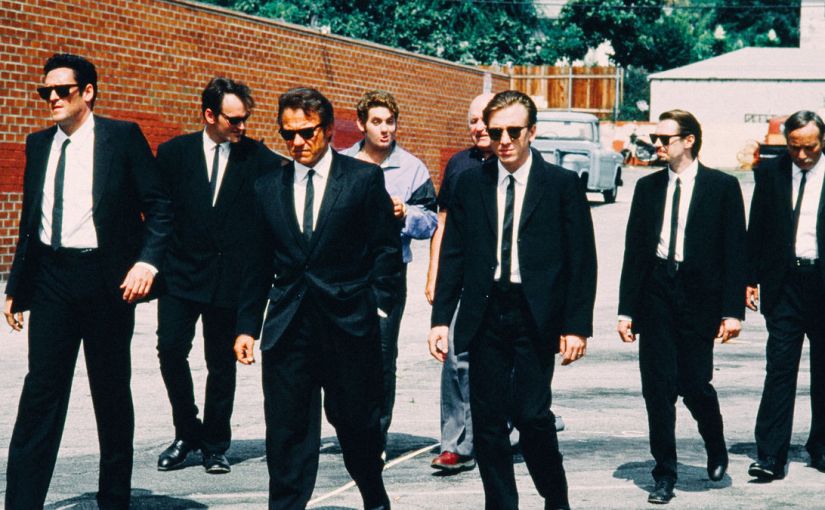
As director and writer of the movie, Tarantino plays puppet master to a collection of criminals.  Six of them are dressed uniformly in black suits and ties and they only know one another by a moniker nickname of “Mister” followed by a color.  These are no ordinary criminals though.  Unlike other films, they don’t just talk about the stretch they had in prison or a heist they pulled off at one time.  These guys debate the artistic merits of Madonna’s Like A Virgin and if she went down hill following her True Blue album.  One of them, even has an opinion contrary to the others about tipping a waitress at a diner.  He doesn’t believe in it.  United, the others try to tell him how wrong he is, but he has higher standards for excellence in table service.  It’s deliberately ridiculous!  Clint Eastwood never talked about any of this.  Not even Newman or Redford.  Lee Marvin?  Charles Bronson?  Forget it!  (Jack Nicholson may be the exception in Five Easy Pieces, but that character wasn’t a criminal.) Quentin Tarantino, however, believes that even low-level hoods have a viewpoint on anything from pop culture to societal expectations.

These six guys have been assembled by a kingpin named Joe (Lawrence Tierney) and his husky, bruiser son Nice Guy Eddie (Chris Penn) to carry out a diamond robbery.  The film opens with these conversations over breakfast and then jumps to the aftermath where Mr. Orange (Tim Roth) is bleeding to death in the back seat while Mr. White (Harvey Keitel) is high tailing it away.  When they get to their rendezvous warehouse, eventually Mr. Pink (Steve Buscemi) and Mr. Blonde (Michael Madsen) arrive and the strangers among themselves contemplate if they were set up by one of their own since the police were already waiting for the robbery to take place.  Is one of them a cop or a rat?  Occasionally, Tarantino cuts away from this one warehouse setting to flashback to how some of these guys came to be recruited for the heist.

The scenario of Reservoir Dogs is creative.  It demonstrates that there is no honor among thieves.  Much like Tarantino’s films to come afterwards, his characters are thin and two dimensional.  That works in pictures like Inglorious Basterds and Django Unchained.  Here, I didn’t embrace that aspect.  Reservoir Dogs seems to move in a direction of the Clue board game.  I know nothing about Professor Plum or Colonel Mustard’s history.  I just need to determine if one of them did it with the candlestick in the Billiard Room.  In Tarantino’s film, I just need to put a blindfold on and take a shot in the dark of who the rat among the gang is.  That’s all.  It’s just circumstantial. 

I appreciate how unique these criminals are with their mundane conversations and their cool swagger, but there’s nothing much beyond that.  Tarantino might have known that too.  He only has one question to answer before the end of the movie.  In between, to fatten up the length of the film, he incorporates a savage torture scene on a cop that Mr. Blonde takes hostage.  It’s memorable, but what does the scene really serve?  What do I take away from watching Michael Madsen’s cool, strutted character hacking off a man’s ear and dousing him in gasoline, while Stealer Wheel’s Stuck In The Middle With You plays on the radio?

The seeds of Tarantino’s brand were definitely showing in his first film, an independent project that luckily Harvey Keitel had enough faith in to help finance its shoestring budget.  The black suits became usual for Tarantino’s films along with pop rock of the seventies for a soundtrack.  Action scenes of a Lethal Weapon flavor have never been the director’s choice.  Rather, quick shots of gunfire followed by cutaway edits to the next talking scenes are his narrative.   It all shows here.  It just wasn’t as well rounded as it came to be in his seminal film, Pulp Fiction

The best acting comes from Tim Roth as Mr. Orange.  The character is given a flashback moment for how he’s brought into the gang. It is intriguing enough to be a movie of its own.  I wanted more from this guy’s story, because of Roth’s performance.  As well, for most of the film he’s bleeding his guts out from a gunshot wound in the stomach.  His hysteria is contrary to most other bad guys who get shot in the movies.  Mr. Orange suddenly doesn’t look so tough.  He’s crying like a baby and begs his closest teammate, Mr. White, to drop him off at the hospital.  He even tells Mr. White “God bless you for what you’re doing for me.”  Lee Marvin or Jimmy Cagney would never say that.  For a tough guy low level hood, this is not a cliché gangster who laughs at the face of death.  It’s imagination that thinks outside the box.  Forgive the intended pun, but Mr. Orange may be one of Tarantino’s most colorful characters.  I just wanted more from the guy.

These guys may be intentionally corny in their conversations. They may be super cool with their sunglasses and curse word laced dialogue.  However, that only goes so far before it looks like an ad for the Gap in the 1990s.  Beyond what the film shows with the Mr. Orange character, there had to be more depth.  

What Reservoir Dogs lacks turns me towards a mixed review for the film.  Still, I saw the movie before Pulp Fiction ever came out and I recall way back then that this Quentin Tarantino fellow has got something special brewing.  I couldn’t wait to see what was coming next, and I wasn’t disappointed.