
By Marc S. Sanders
I’m grateful for those brave filmmakers who defy what is so glaringly oppressive in order to uphold a truth. Steven Spielberg accomplished this with Saving Private Ryan and especially Schindler’s List. I own both films on 4K, but I’ve only watched them each a handful of times. I recently completed my second watch of Steve McQueen’s 12 Years A Slave. While Schindler may feel more personal to me as a Jewish person who has met several Holocaust survivors, McQueen’s movie is uncompromising in its cruelty to black people , recklessly referred to as n!gg@rs, being held as property within the southern antebellum confines of slavery during the mid 1800s just ahead of the Civil War. It’s one thing to read about lynchings and whippings. It’s another to see it visualized; to see the life being breathlessly taken from a human being. Not a slave. A human being.
From such an ugly period in American history, the isolated story of this film follows the North Eastern free black man Solomon Northrup (Chiwetel Ejiofor, giving the performance of his career – heartbreaking, smart, emotional, fearful and brave at the same time). He is a happily married father of two who earns an honest trade as an entertaining violinist in a well to do upstate New York Community. When his family leaves town for a few weeks, Solomon is approached by two happy, colorfully dressed charmers with top hats (Scoot McNairy, Taran Killam). Solomon believes he is being recruited to perform for some events across state lines for a significant sum of money. He’s wined and dined by the men for a few weeks. However, following a lavish dinner among the three, he awakens to find himself in southern Georgia, chain shackled at his four limbs.
Despite his protests, insisting he is a legal free man, he is slapped, screamed at and trudged along to Louisiana and sold to a wealthy Plantation owner (Benedict Cumberbatch), who is comparatively kinder than his property keeper (Paul Dano). Dano especially stood out to me this time as I reflected on Quentin Tarantino’s regard for the character actor. I question if the director, infamous for tossing the n-word around in nearly all of his films, has even seen 12 Years A Slave and had an opportunity to observe Paul Dano’s appearance. Dano’s character is genuinely mean spirited and hateful with that southern redneck naive racism for the black man. It’s what is demanded of this piece. His performance cruelly teases the black slaves with a song that sounds like a nursery rhyme but chants like a horror film while his screams insist they clap along. McQueen is wise enough to edit Dano’s voiceover singing as the slaves are getting accustomed to the new property, they are forced to tend to and live upon. Later, Dano and Ejiofor will conflict with one another, and the scene is terrifying of what it implies will arrive. So, there’s my two cents on actor Paul Dano (also known for There Will Be Blood, The Batman, and Prisoners). I’ll throw two more cents around and ask Mr. Tarantino to go reflect on his meritless position on this fine actor.
This picture also features Paul Giamatti headlining a horrible scene, working like a car salesman as he slaps the naked physiques of Solomon and other black people. His purpose is to demonstrate the value and endurance of these “properties” for potential buyers. The novelty of used car salesman tactics seemed to originate here. With no regret, black children are torn away from a helpless, anguished mother. McQueen with John Ridley’s Oscar winning adapted screenplay includes this scene to show how quickly a transition into slavehood occurs. Solomon and many of these other folk were free moments ago. Now, they are delivered off a boat and are being sold like cattle, to be used not just for work but for sexual appetites and playthings.
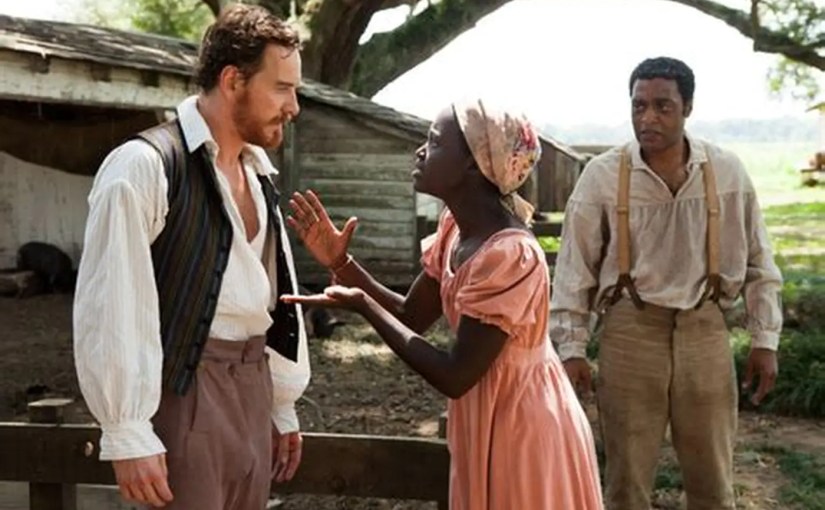
The second half of the story finds Solomon as a sold property slave of the viciously harsh Edwin Epps. Michael Fassbender has never been more terrifying with intense rage that hides any other memorable performance in his impressive career. He more than serves the antagonism of this film the same way that Ralph Fiennes did for Schindler’s List. This is a monstrous individual. Strong, oppressive, with no way to be endeared. If he’s mad, for whatever reason, he’s going to be mad at his faultless slave workers who do nothing out of line and work solely to satisfy Edwin’s demands.
As the title implies, Solomon’s captivity carries on for twelve years with no access to his family or proper legal authority. He also dare not reveal he can read or write, lest he will come up as a threat to those that violated his legal rights as a free northerner. Solomon Northrup was always to remain trapped. Even his talents with the violin are compromised as he’s awakened in the middle of the night to marshal the entertainment for Edwin as he compels his property to dance naked among themselves in his drawing room.
As horrific as Solomon Northrup’s story is, later accounted for in his published book, it’s a fast paced and engrossing tale. McQueen assures an understanding of how harsh it was to live within the dense, stale heat while picking pounds of cotton for the slave owners and their wives. The whispers of flies and mosquitoes, along with tall grass and dragonflies often found in the south bring an awareness to the mundane and exhausting life of picking cotton from sunup to sundown.
The work was never the worst though. The younger black girls were groomed to be continually raped. A telling moment occurs when Edwin prances around the property in just a loose, sweaty shirt (no pants) with a child holding his hand. It is easy to grasp what’s to become of this girl, especially considering how Edwin treats Patsey, a teenage slave, who is repeatedly raped and beaten by him while infuriating the jealously of the Mistress Epps (Sarah Paulson).
Lupita Nyong’o is Patsey, in an Oscar winning performance. Nyong’o’s anguish matches Fassbender’s rage in equal fashion. (He was Oscar nominated too.) Ahead of shooting days, the actors maintained rigid exercises together to preserve a direct trust during the abusive scenes. Though thoroughly convincing in their dialects and performances of tears and brutal anger and screams, I cannot imagine it would be healthy for either actor to go full method here. Had they actually done so, I’d argue they’d never return to a sense of acceptable balance, mentality and perception between one another. What they do together, just like this whole cast, is hard, brutal work. Just look at how red faced Fassbender gets. See how glossy Nyong’o’s complexion gets behind the screams and tears. Not all of this is just makeup spray water.
Steve McQueen takes large sections of his two-hour film to demonstrate the carryover of time. I’m not necessarily talking about twelve years. Rather, minutes and hours. One section has Solomon strung up from a tree by the neck. The only thing keeping him from crushing his windpipe is to continually tip toe on the wet mud beneath his feet. Morning turns into sweltering afternoon and into night. McQueen does not rush this moment. He wants the audience to realize that black slaves were regularly hung from oak trees. It’s one kind of understanding to endure the hanging with literally no aid or sympathy to rely on. What’s worse? A quick hanging that ends in blacked out death, or the kind that only dangles a person to the absolute brink of death?
The hardest sequence is an unbroken four and a half minute shot. The director’s camera circles around Patsey’s scarred, bound, naked body, as she gets bloodier and bloodier by the unending whippings from Edwin’s unreasonable rage. When the taskmaster forces Solomon to take over, a sad irony is that Patsey begs Solomon to resume the whipping. She’d rather take her punishment from him, than the slave owner.
Paulson is in the background of this scene too. She never flinches, always looks justified in permitting this action to carry on seemingly like a Lady MacBeth. Nyong’o allows herself to be weakened to nothingness with horrifying screams. Fassbender seems to never tire of flinching his arm with the whip in hand. Ejiofor does not rush into what is forced upon him but once he begins, he’s out of breath with terrible suffering for what he is compelled to bestow upon this helplessly tied up woman. Again, McQueen never breaks this into quick edits. It is all one shot, as you see mists of sweat, blood and body heat emanate from Nyong’o’s back with every swiftly delivered lash. It is so unfair. That’s a terrible understatement, but it’s what comes to the forefront of my mind. What person ever deserves this kind of treatment? What reason could there ever be to whip a person into a bloody, stinging, charred up pulp? This is never, ever fair.
The scene is so harrowing that I have yet to discover how it was safely put together for filming purposes. What these actors went through. It’s uncanny how real it looks.
None of what you see in 12 Years A Slave is ever forgivable. Long after these doers of evil are dead as well as their offspring and their offsprings, it remains as never excused and should never be offered repentance. Some would actually say “Well you have to understand, that’s what it was like at the time.” To hell with that. Today, moments like these are actually being dismissed and erased from our institutions as attempts are made to “make America great again.” There are places in this world where this kind of treatment still occurs. It’s fascinating that generations have not learned from the sins of ancestors.
McQueen’s film is assembled with amazing craftsmanship. John Ridley’s screenplay contains a dialogue that performs with intellect, even if there are characters that we presume were denied formal educations. Brad Pitt offers a cameo as a white man with a conscious devoid of prejudice. Listen to his dialogue against that of Fassbender’s. On a sweltering summer day on the plantation, these two sides of the slave ownership argument operate like a congressional debate. Ridley incorporates vocabulary that lend to another time, long outdated, but telling of the limits that some people will never adopt. Ejiofor, as an educated Solomon, has been diminished to look like a censored man, but even his shredded, dirty slave wear does not prevent him from realizing there is a hope for common sense and good nature, even in this unseen corner of the world.
The antebellum plantations are vast and isolated from a civilization with architecture of tall posts on white porches. These areas look like contained miniature empires; maybe adapted from grand landmarks of ancient Rome or Greece. The costumes deliver a wide contrast of social status. The cast of slave actors perform scenes nude in dirty field settings, broken sheds and dark, smelly cattle barns. The white aristocrats are dressed in the finest fabrics. 12 Years A Slave does not just describe. More importantly, as a very well-done film, it shows how wide a berth these people are separated from one another.
This is a necessary, monumental biography to watch and explore. In social media I continuously remind people that the Holocaust happened less than ninety years ago, and it could easily happen again. The same is equally true for slave history. If the acceptance of this mentality can be taught, it will be learned and then it will be executed. It can happen so easily and so swiftly.
History is unclear of what became of Solomon Northrup after he wrote his book, ahead of his death, but his story will never be forgotten. It’s fortunate that McQueen’s picture was bestowed an enormous number of accolades including winning the Oscar for Best Picture. An Academy Award is not simply recognition for artistic greatness. Its reputation allows a piece of filmmaking to constantly be recalled for years to come among an elite collection of accomplished achievements. If anything, that should ensure the terrible chapters of American slavery are never, ever forgotten.

