12 YEARS A SLAVE

By Marc S. Sanders

I’m grateful for those brave filmmakers who defy what is so glaringly oppressive in order to uphold a truth.  Steven Spielberg accomplished this with Saving Private Ryan and especially Schindler’s List.  I own both films on 4K, but I’ve only watched them each a handful of times.  I recently completed my second watch of Steve McQueen’s 12 Years A Slave.  While Schindler may feel more personal to me as a Jewish person who has met several Holocaust survivors, McQueen’s movie is uncompromising in its cruelty to black people , recklessly referred to as n!gg@rs, being held as property within the southern antebellum confines of slavery during the mid 1800s just ahead of the Civil War.  It’s one thing to read about lynchings and whippings.  It’s another to see it visualized; to see the life being breathlessly taken from a human being.  Not a slave.  A human being.

From such an ugly period in American history, the isolated story of this film follows the North Eastern free black man Solomon Northrup (Chiwetel Ejiofor, giving the performance of his career – heartbreaking, smart, emotional, fearful and brave at the same time).  He is a happily married father of two who earns an honest trade as an entertaining violinist in a well to do upstate New York Community.  When his family leaves town for a few weeks, Solomon is approached by two happy, colorfully dressed charmers with top hats (Scoot McNairy, Taran Killam).  Solomon believes he is being recruited to perform for some events across state lines for a significant sum of money.  He’s wined and dined by the men for a few weeks.  However, following a lavish dinner among the three, he awakens to find himself in southern Georgia, chain shackled at his four limbs.  

Despite his protests, insisting he is a legal free man, he is slapped, screamed at and trudged along to Louisiana and sold to a wealthy Plantation owner (Benedict Cumberbatch), who is comparatively kinder than his property keeper (Paul Dano).  Dano especially stood out to me this time as I reflected on Quentin Tarantino’s regard for the character actor. I question if the director, infamous for tossing the n-word around in nearly all of his films, has even seen 12 Years A Slave and had an opportunity to observe Paul Dano’s appearance. Dano’s character is genuinely mean spirited and hateful with that southern redneck naive racism for the black man. It’s what is demanded of this piece. His performance cruelly teases the black slaves with a song that sounds like a nursery rhyme but chants like a horror film while his screams insist they clap along. McQueen is wise enough to edit Dano’s voiceover singing as the slaves are getting accustomed to the new property, they are forced to tend to and live upon. Later, Dano and Ejiofor will conflict with one another, and the scene is terrifying of what it implies will arrive. So, there’s my two cents on actor Paul Dano (also known for There Will Be Blood, The Batman, and Prisoners). I’ll throw two more cents around and ask Mr. Tarantino to go reflect on his meritless position on this fine actor.

This picture also features Paul Giamatti headlining a horrible scene, working like a car salesman as he slaps the naked physiques of Solomon and other black people. His purpose is to demonstrate the value and endurance of these “properties” for potential buyers.  The novelty of used car salesman tactics seemed to originate here.  With no regret, black children are torn away from a helpless, anguished mother.  McQueen with John Ridley’s Oscar winning adapted screenplay includes this scene to show how quickly a transition into slavehood occurs.  Solomon and many of these other folk were free moments ago.  Now, they are delivered off a boat and are being sold like cattle, to be used not just for work but for sexual appetites and playthings.

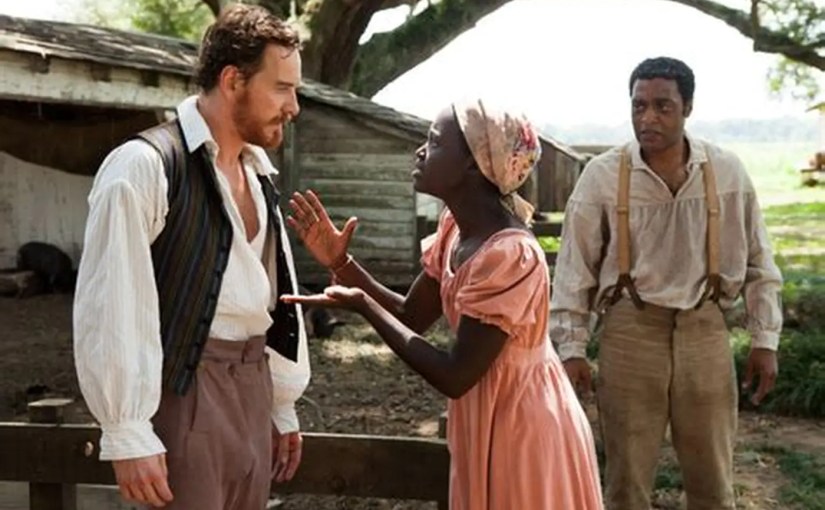
The second half of the story finds Solomon as a sold property slave of the viciously harsh Edwin Epps.  Michael Fassbender has never been more terrifying with intense rage that hides any other memorable performance in his impressive career.  He more than serves the antagonism of this film the same way that Ralph Fiennes did for Schindler’s List.  This is a monstrous individual.  Strong, oppressive, with no way to be endeared.  If he’s mad, for whatever reason, he’s going to be mad at his faultless slave workers who do nothing out of line and work solely to satisfy Edwin’s demands.

As the title implies, Solomon’s captivity carries on for twelve years with no access to his family or proper legal authority.  He also dare not reveal he can read or write, lest he will come up as a threat to those that violated his legal rights as a free northerner.  Solomon Northrup was always to remain trapped.  Even his talents with the violin are compromised as he’s awakened in the middle of the night to marshal the entertainment for Edwin as he compels his property to dance naked among themselves in his drawing room.  

As horrific as Solomon Northrup’s story is, later accounted for in his published book, it’s a fast paced and engrossing tale.  McQueen assures an understanding of how harsh it was to live within the dense, stale heat while picking pounds of cotton for the slave owners and their wives.  The whispers of flies and mosquitoes, along with tall grass and dragonflies often found in the south bring an awareness to the mundane and exhausting life of picking cotton from sunup to sundown.

The work was never the worst though.  The younger black girls were groomed to be continually raped.  A telling moment occurs when Edwin prances around the property in just a loose, sweaty shirt (no pants) with a child holding his hand. It is easy to grasp what’s to become of this girl, especially considering how Edwin treats Patsey, a teenage slave, who is repeatedly raped and beaten by him while infuriating the jealously of the Mistress Epps (Sarah Paulson).  

Lupita Nyong’o is Patsey, in an Oscar winning performance.  Nyong’o’s anguish matches Fassbender’s rage in equal fashion.  (He was Oscar nominated too.) Ahead of shooting days, the actors maintained rigid exercises together to preserve a direct trust during the abusive scenes.  Though thoroughly convincing in their dialects and performances of tears and brutal anger and screams, I cannot imagine it would be healthy for either actor to go full method here.  Had they actually done so, I’d argue they’d never return to a sense of acceptable balance, mentality and perception between one another.  What they do together, just like this whole cast, is hard, brutal work. Just look at how red faced Fassbender gets. See how glossy Nyong’o’s complexion gets behind the screams and tears. Not all of this is just makeup spray water.

Steve McQueen takes large sections of his two-hour film to demonstrate the carryover of time.  I’m not necessarily talking about twelve years.  Rather, minutes and hours.  One section has Solomon strung up from a tree by the neck.  The only thing keeping him from crushing his windpipe is to continually tip toe on the wet mud beneath his feet.  Morning turns into sweltering afternoon and into night.  McQueen does not rush this moment.  He wants the audience to realize that black slaves were regularly hung from oak trees.  It’s one kind of understanding to endure the hanging with literally no aid or sympathy to rely on.  What’s worse? A quick hanging that ends in blacked out death, or the kind that only dangles a person to the absolute brink of death?

The hardest sequence is an unbroken four and a half minute shot.  The director’s camera circles around Patsey’s scarred, bound, naked body, as she gets bloodier and bloodier by the unending whippings from Edwin’s unreasonable rage. When the taskmaster forces Solomon to take over, a sad irony is that Patsey begs Solomon to resume the whipping.  She’d rather take her punishment from him, than the slave owner.  

Paulson is in the background of this scene too.  She never flinches, always looks justified in permitting this action to carry on seemingly like a Lady MacBeth.  Nyong’o allows herself to be weakened to nothingness with horrifying screams.  Fassbender seems to never tire of flinching his arm with the whip in hand.  Ejiofor does not rush into what is forced upon him but once he begins, he’s out of breath with terrible suffering for what he is compelled to bestow upon this helplessly tied up woman.  Again, McQueen never breaks this into quick edits.  It is all one shot, as you see mists of sweat, blood and body heat emanate from Nyong’o’s back with every swiftly delivered lash.  It is so unfair.  That’s a terrible understatement, but it’s what comes to the forefront of my mind.  What person ever deserves this kind of treatment?  What reason could there ever be to whip a person into a bloody, stinging, charred up pulp?  This is never, ever fair.  

The scene is so harrowing that I have yet to discover how it was safely put together for filming purposes.  What these actors went through. It’s uncanny how real it looks.

None of what you see in 12 Years A Slave is ever forgivable. Long after these doers of evil are dead as well as their offspring and their offsprings, it remains as never excused and should never be offered repentance.  Some would actually say “Well you have to understand, that’s what it was like at the time.” To hell with that. Today, moments like these are actually being dismissed and erased from our institutions as attempts are made to “make America great again.” There are places in this world where this kind of treatment still occurs.  It’s fascinating that generations have not learned from the sins of ancestors.

McQueen’s film is assembled with amazing craftsmanship.  John Ridley’s screenplay contains a dialogue that performs with intellect, even if there are characters that we presume were denied formal educations.  Brad Pitt offers a cameo as a white man with a conscious devoid of prejudice.  Listen to his dialogue against that of Fassbender’s.  On a sweltering summer day on the plantation, these two sides of the slave ownership argument operate like a congressional debate.  Ridley incorporates vocabulary that lend to another time, long outdated, but telling of the limits that some people will never adopt. Ejiofor, as an educated Solomon, has been diminished to look like a censored man, but even his shredded, dirty slave wear does not prevent him from realizing there is a hope for common sense and good nature, even in this unseen corner of the world.

The antebellum plantations are vast and isolated from a civilization with architecture of tall posts on white porches.  These areas look like contained miniature empires; maybe adapted from grand landmarks of ancient Rome or Greece. The costumes deliver a wide contrast of social status.  The cast of slave actors perform scenes nude in dirty field settings, broken sheds and dark, smelly cattle barns. The white aristocrats are dressed in the finest fabrics.  12 Years A Slave does not just describe. More importantly, as a very well-done film, it shows how wide a berth these people are separated from one another.

This is a necessary, monumental biography to watch and explore.  In social media I continuously remind people that the Holocaust happened less than ninety years ago, and it could easily happen again.  The same is equally true for slave history.  If the acceptance of this mentality can be taught, it will be learned and then it will be executed.  It can happen so easily and so swiftly.

History is unclear of what became of Solomon Northrup after he wrote his book, ahead of his death, but his story will never be forgotten.  It’s fortunate that McQueen’s picture was bestowed an enormous number of accolades including winning the Oscar for Best Picture.  An Academy Award is not simply recognition for artistic greatness.  Its reputation allows a piece of filmmaking to constantly be recalled for years to come among an elite collection of accomplished achievements.  If anything, that should ensure the terrible chapters of American slavery are never, ever forgotten.


AMERICAN GANGSTER

By Marc S. Sanders

My favorite kind of crime dramas are the ones that tackle the grit.  The screenwriters and directors go for where the itty-bitty stuff scrounges up into something bigger for either the career criminal or the low-level cop.  These guys start out as butterflies flapping their wings and before you know it their legacies and pursuits are as big as hurricanes.  Movies like The French Connection or Heat operate on these trajectories.  How did we get from there to HERE?

Ridley Scott went in an unconventional direction away from his science fiction eye and ancient history recollections when he directed American Gangster with a screenplay by Steve Zallian based on the true stories of Harlem drug kingpin Frank Lucas (Denzel Washington) and narcotics detective Richie Roberts (Russell Crowe).

These two sensational actors don’t share one scene together until the epilogue of this always interesting three-hour opus.  Yet, in their second film together their pairing is as classic as DeNiro and Pacino or Newman and Redford.  I hope before they retire, these men pair up for at least one more film.  

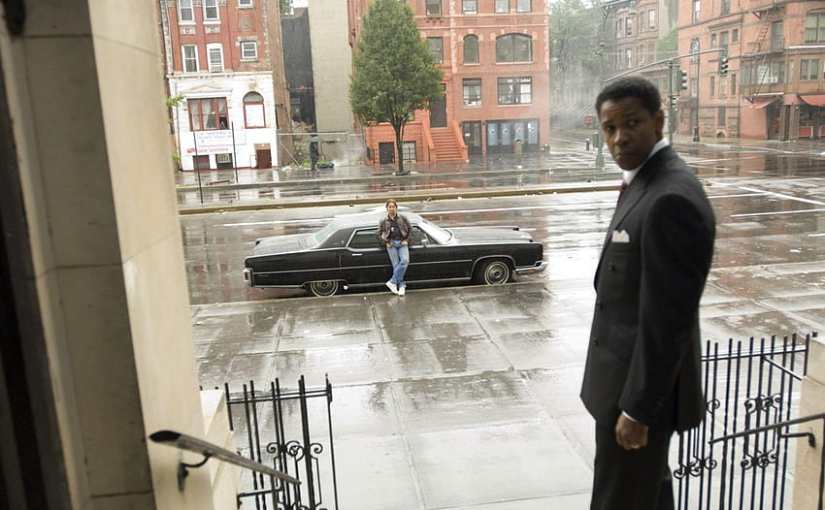
Ridley Scott and his nominated art directors, Arthur Max and Beth A Rubino, capture a gritty urban, crime ridden Harlem of the 1960s/70s.  The streets are filthily here, as well as in the five New York boroughs and all the way across the bridge into New Jersey.  Frank’s markets carry a very wide berth. The buildings are distressed and cracked.  The clothes are of the hippie era with polyester suits.  This is where Frank Lucas moves his imported contraband, white powder heroin, labeled exclusively as “Blue Magic.”  The film provides a convincing source locale deep within the jungles of Vietnam where thousands of kilos are shipped to Frank for sale on the street.  The purity of the drug is beyond compare.  Scott and his art designers place you directly in this time period of dingy grime and among the sweaty Viet Cong and rivers to finally arrive at the crop Frank purchases his products from.

Once he finds his footing by eliminating the competition and recruiting his brothers and cousins to run his business, Frank invests in creature comforts with a furnished penthouse apartment for himself and a beautiful mansion for his mother (Ruby Dee in an Oscar nominated performance that comes off so naturally; you’d think she’s sitting at the Thanksgiving table with you).  He marries a beautiful Puerto Rican wife that he treats like a princess. Frank is smart.  He stays under the radar by wearing conservative suits and not making many waves like going out at nights and showing himself around the social scene.  He knows famous athletes like boxer Joe Lewis or the staff on the New York Yankees that could give his nephew a shot at being a pitcher. Still, his profile manages to stay low. Like his mentor, he just operates a business with a viable commodity.  He tells his younger brother (Chiwetel Ejiofor) that the loudest one in the room is the dumbest and the most likely to get caught.  So, mind how you carry yourself, how you dress yourself and how you flaunt yourself.

A separate story has no business intersecting with Frank’s plight until something gives.  Richie Roberts is a good, honest cop. Though he’s also a lousy husband and father. He has been assigned to head up a task force that will bust the top of the assorted drug empires.  He needs those rare breed cops who are not on the take and follow a strict policy of law enforcement ethics.  His team will not bust a common street hustler.  They will be looking for the kingpins with unquestionable evidence to put them away for good.

American Gangster follows two separate stories for most of its running time.  At least during the first two acts of the film, Frank and Richie are unaware of one another.  It’s only through some gradual surveillance that the cop finally gets a whiff of an idea and starts to move methodically towards a conclusion. The methods are the fascinating parts the movie.

When Denzel Washington plays a villain it’s always memorable and contrary to popular opinion, Frank Lucas is my favorite of his antagonists, especially compared to his Oscar winning work in Training Day.  Watch how he walks or sits on a sofa and broods over how his family and his business are functioning.  He’s the only African American actor I can see playing this guy because I’m always convinced that whoever Denzel Washington portrays, it’s a character who will never be intimidated.  This guy faced down Gene Hackman during a threat of nuclear holocaust. Not many other actors can do that so authentically.

Russell Crowe works like that hero who doesn’t want to wear the cape.  Richie Roberts succeeds on so many levels where his peers surrender to their inhibitions.  This cop passes the bar exam while fighting for custody of his kid on top of going after the empirical criminals who litter the streets in drugs and murder.  I’m reminded of his role in The Insider, where he used a similar American accent.  Richie is not as temperamental or hard wired as that guy, but he is at least as focused on doing what’s right regardless of threat or distraction.  Russell Crowe has a way of getting audiences to admire the concentration needed for many of his complicated characters.  You have as much tunnel vision as he wants the men he’s portraying to have. You are zoned in with what his characters live by.  You only trust their standards.

There are signature staples within the construct of this true story adaptation.  There are gunfights.  Punches are thrown.  The guy at the top beats up one of his cronies when he gets out order.  Yet, what stands this material apart from others is that now I’m watching how Denzel Washington and Russell Crowe handle everything.

The truth behind the story of a black gangster defying the dirty cops and the Italian mobsters who were thought to run the metropolitan undergrounds is amazing.  It’s so interesting to see how novel Frank is with smuggling the product from one side of the world to the other. Then, you see how he uses his family members to distribute to the consumers and collect the monies. Ridley Scott provides all the breadcrumbs in an easy-to-understand fashion.  

Painted against the landscape of an unwinnable Vietnam War that just won’t end, power is acquired and thus the best police officers are forced to change their approach.  So again, you see two different stories that start out small and undetected.  Frank and Richie are the most careful and meticulous of guys in their respective fields.  Therefore, it only makes sense that their paths don’t cross until their missions are nearly over.

There’s much to learn from American Gangster.  

You get an idea of how the harm of the war was not exclusive to just what was happening over in Vietnam.  There were more indirect effects to that crisis impacting the streets of New York and New Jersey.  

You see what subtleties an investigation will collect upon before pouncing on to a bigger stake.  You also learn how to handle a criminal empire with trust and dignity rather than announcing your immorality. You witness the sheer defiance of a righteous guy in what is supposed to be a law-abiding field. Steve Zaillian’s script is not just good guy vs bad guy. It’s each of these guys holding on to the top while trying to catch up with or stay away from each other.

American Gangster is a very thorough and well-planned biographical thriller.  

INSIDE MAN

By Marc S. Sanders

The abundance of Spike Lee’s films offer a message as quickly as the film begins.  Then they set out to demonstrate what Lee is talking about in the scripts he writes and/or directs and what is presented on screen for the next two or three hours.  BlacKKKlansman (a favorite of mine) and especially Do The Right Thing are perfect examples.  Lee is direct and hardly ever ambiguous.  Inside Man is an exception.  

This Spike Lee Joint is having a bit of fun with the director’s own take on the staple bank robbery found in so many films.  By the time the film is over, and all the cards are on the table, you realize the audacity of this caper is as unique as Sidney Lumet’s Dog Day Afternoon or Michael Mann’s Heat.  With a screenplay by Russel Gerwitz, Spike Lee is proudly vague until he finally reaches his conclusions during the third act of the piece.  It’s unusual.  It’s out there and it’s a stretch, but the math of the heist seems to add up.  Still, knowing what I know now, I do wish there was a little more focus on some characters that lend to the film’s twist. Then again, maybe that would have implied too much.

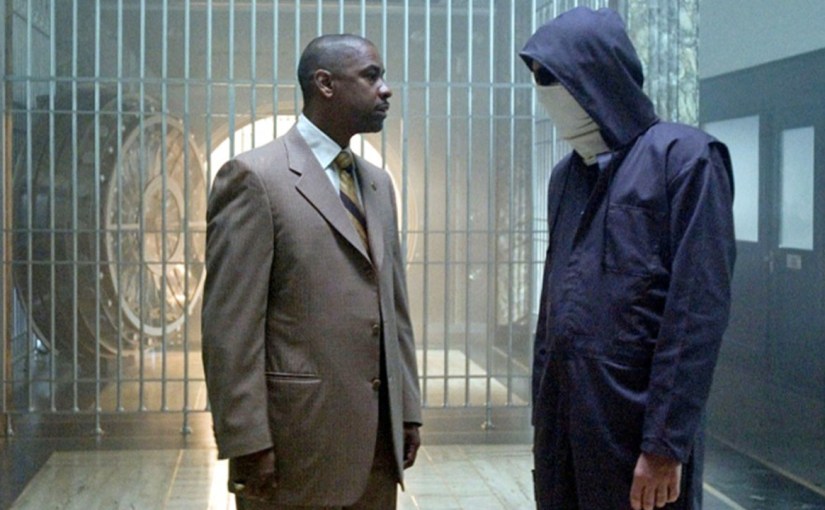
Four people wearing sunglasses, caps and painters’ uniforms take a well trafficked New York City bank branch hostage, complete with the entire staff and around thirty customers who are in the lobby.  The ringleader is played by a mostly concealed Clive Owen.  You might not see his face too often in the film, but you’ll be grateful he’s the bad guy in charge.

Denzel Washington is Detective Keith Frazier, and with his partner Bill Mitchell (Chewetel Ejiofor), they are on the scene attempting to diffuse the situation. The police captain right next to them is John Darius (Willem Dafoe).  Ejiofor and Dafoe are good as expected, though their roles are routine elements for these kinds of movies.  Washington has the kinetic pace that audiences are familiar with as he tries to outthink the bank robbers.  His character is labeled with a checkered reputation as he’s suspected of stealing drug money.  That element really goes nowhere.

Another party comes into the fold with Jodie Foster as a well-tailored and confident “fixer” hired by the bank’s president (Christopher Plummer).  To get these two actors together in a film along with Washington?  Well, that begs for repeat viewing.  Unfortunately, I didn’t see much point to the Foster character.  Upon hearing the news of the robbery, Plummer’s character clandestinely employs Foster to contain the situation so that a particular item in a safe deposit box remain untouched.  She arrives on the scene, exchanges dialogue with Washington that does not add up to much.  She surveys the hostages being held and then exits the story, until the epilogue.  As welcome as it is to see Jodie Foster, I can’t imagine what was gained from the context of her role, which does nothing to advance the story.

Inside Man always kept me interested and guessing.  The structure of Gerwitz’ script jumps ahead at times to show the detectives interrogating each hostage with suspicion after the incident is over.  So, I always wanted to know how it ever came to that shift in direction.  Plus, what happened to the bank robbers, and what precisely had Christopher Plummer so concerned about one particular branch robbery that he had to reach out for special services from Jodie Foster’s character? 

The answers arrive, and I can swallow the explanations.  Yet, the wrap up actually involves additional characters who hardly say a word or appear on screen earlier in the film.  Because they are briskly glossed over, it did not give me complete satisfaction.  I like the twist a lot.  It just needed a more solid foundation.

Inside Man is of those rare films that Spike Lee is invested simply for the fun.  The quick cuts and bustling New York atmosphere work well.  I love the opening credits to the movie; kind of his own spin on what Lumet did with Dog Day…  Lee has a good villain and appealing heroes. Other than few shortcomings, this is a solid crime drama.  

Often, Spike Lee positions himself on a platform that endorses a cause for the African American populace, or he brings attention to social wrongs in world history.  He is one of the best at what he does with his filmmaking approach.  Ironically, a message and a comeuppance arrive with Inside Man, but for a different demographic.  It might not be as hard hitting or thought provoking as other Spike Lee Joints, but it is appreciated.  

SECRET IN THEIR EYES (2015)

By Marc S. Sanders

So here is a movie I thought I had figured out; the twist, I mean. Yet it’s ending didn’t turn out to be that way at all.

So, what did I get from Secret In Their Eyes? Well, I guess the confidence that I am probably a better writer than the ones who doctored this crap.

This is another mystery thriller, where everybody working in the same law enforcement department must remain divided and have animosity towards each other because if they didn’t have conflict they’d only get along and solve a very basic murder case.

See, it has to be this way.

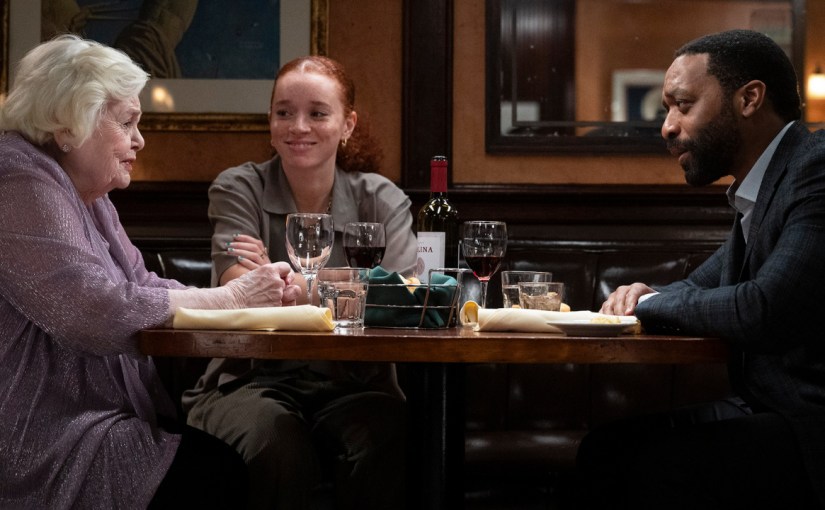
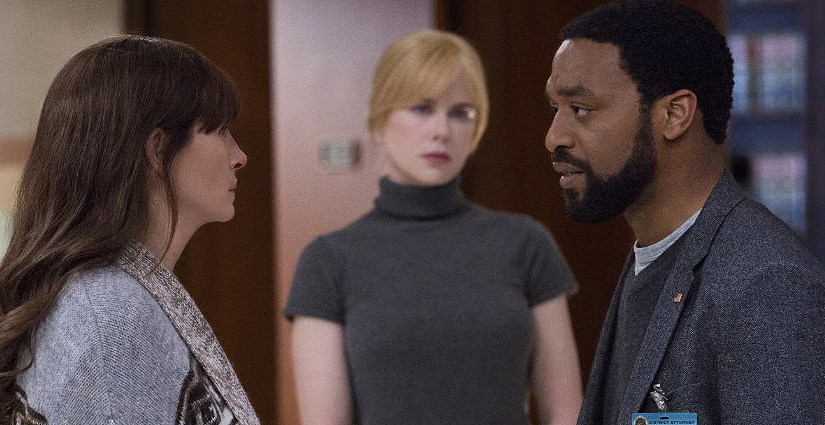
The main character played by Chiwetel Ejiofor must play the obsessive (13 years obsessed!!!) FBI investigator prone to making dumb and impulsive mistakes because if he didn’t there’d be no movie.

Julia Roberts, effectively departing her glamour roles, as the cop/mother of a murdered daughter will only conveniently appear to make things awkward for Ejiofor and DA Nicole Kidman who is unnecessarily, overtly sexy to drive a subplot for more awkwardness. Oh, hi Julia. Didn’t expect you to step on to the elevator. Well, look who showed up at the office just as I get into town; things like that.

Nothing that these characters do seem very wise or necessary but we are supposed to believe these are some of LA’s best legal minds; break in and steal evidence without a warrant, solve a murder by looking at a picture from company picnic, beat a confession out of a suspect, and presume you found the killer again because a guy made parole 13 years later and the ages match up. He might have had a nose job, but that’s gotta be the guy. Ejiofor says it is. So it must be true. Stop arguing with me. Ejiofor says he’s right and you’re wrong. Case closed. Shouldn’t these great legal minds look a little deeper before they make their conclusions? There’s more concrete evidence in a game of Clue than anything I found in Secret In Their Eyes.

I guess now that I’ve watched the film and see that my predicted ending never turned up, maybe I’ll keep it to myself, jot it down on paper and sell my own screenplay. If this crap could attract a Hollywood budget with top talents to fill the roles, how bad could I do?

DOCTOR STRANGE

By Marc S. Sanders

The first MCU movie that makes the biggest departure from any of the other installments in the franchise.

Doctor Strange operates on a level beyond punchy powers as Avengers director Joss Whedon noted. The film explores a very far, very fictional belief in the mystical arts and magic. So much so that sometimes characters like The Ancient One and Mordo speak in an English that is so foreign and so confusing. Still, I’m not complaining.

I enjoyed this film immensely. Benedict Cumberbatch is so right in the role of Stephen Strange. His character’s arrogance is not over the top, but necessary and evident. I really liked his transition from expert surgeon to a permanently damaged physical person and then onto The Sorcerer Supreme complete with the Cloak of Levitation, a better and more deserving way to describe it than just another cape.

The morphing of city landscapes and neighborhoods into arced and flipped and reverse mazes are really fun and change shape with crisp sound editing and music.

Good supporting work is also on display from Rachel McAdams, Chiwetel Ejiofor and especially Tilda Swinton. My one wish is that the villain played by the very capable Mads Mikkellsen was fleshed out more. He’s an actor who can handle heavy roles. Regretfully, I don’t think the script gives him enough to do here.

This Marvel chapter stands on its own with little reliance on the other films. However, the green infinity stone at play here is easier to understand now that I’ve seen Avengers: Infinity War. I’m talking about The Time Stone, of course!

Doctor Strange is a solid film; one that I would love to watch again a year from now and likely feel just as entertained.

NOTE: stay away from the 3D Blu Ray discs. Watch it in 2D. Having seen the 3D in theatres the first time, I clearly remember not enjoying the film very much. It was blurry and dark. At times the picture didn’t look crisp. The 3D effort was a nuisance and a terrible distraction. Less is more. Stick with 2D.

LOVE, ACTUALLY

By Marc S. Sanders

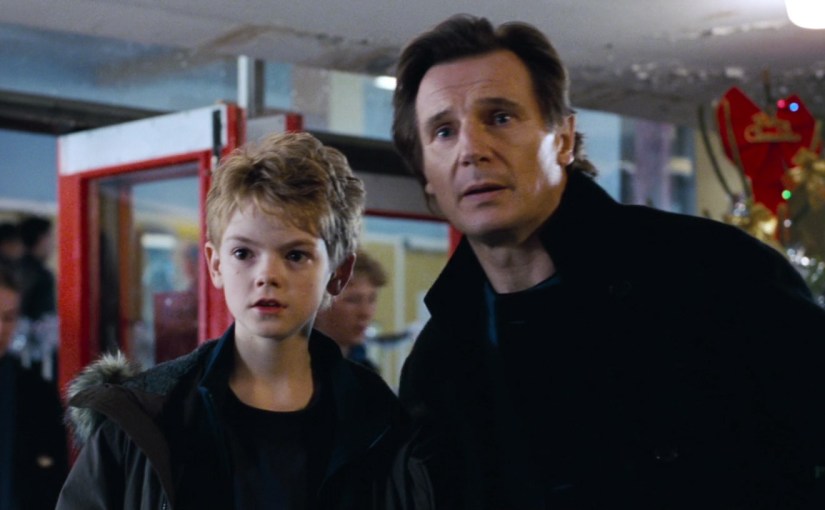
Love, Actually is like a warm favorite blanket to snuggle up in. Richard Curtis writes and directs a collection of the greatest British actors (along with American Laura Linney) in a kaleidoscope of love and relationships against the backdrop of beautiful London, England during the five weeks leading up to Christmas.

I won’t list my favorite characters or actors. In a film this treasured, this loved and this appreciated, that would be like picking your favorite child. It’s impossible when every single storyline is perfectly executed with thought and tenderness.

The stories of love uncovered, love that’s lost, love based in friendship, and love drowning in heartache beautifully jump from one to the next and then back again. Curtis is wise to not show all of the facets of each story early on. Some stories reveal more about themselves later that’ll leave you hurting for those that are not so merry and those that offer plenty of cheer.

I’m especially happy that Curtis did not compromise in the language or subject matter of his tales. Strong language at times makes for some memorable dialogue and nudity presents a normality to how we really are with those we have affections for.

It’s fair to say everyone in life experiences some variation of love. Yes! I mean everyone. Richard Curtis reminds you that love is a natural instinct, and so we can not focus on the easily recognized gloom of our world. To have these stories captured around Christmas time only enhances what we treasure, or what we wish we didn’t have to endure at times. Curtis’ blazing soundtrack helps along the way.

Love is hard. Love is challenging. Love will sweep you off your feet and love will destroy everything you thought you had. However, love will never leave you with complete regret. It’s never the love we have for someone that we regret. It’s only a wish to have it wholesome, healthy, happy and pure.

Love, Actually is all around.