
By Marc S. Sanders
In her directorial debut, Scarlett Johansson offers purpose and more to gain and learn about life even when you’re in your mid-90’s. She directs June Squibb as Eleanor Morgenstein, a widowed ninety-four-year-old Jewish mother who relocates from Florida back to New York City when her roommate of eleven years, Bessie (Rita Zohar), has passed away. Temporarily, she moves in with her preoccupied daughter Lisa (Jessica Hecht) and her twenty something son Max (Will Price), whose best friend is his cell phone. Lisa encourages Eleanor to move into an assisted living home, but the spunky, independent woman opts to visit the local Jewish Community Center (JCC) where she inadvertently comes upon a Holocaust survival group. She certainly doesn’t belong here as she never had to endure that dark period, nor did any of her family. Yet, before she can excuse herself, she is recounting Bessie’s personal experience of surviving the concentration camps while losing her brother to the Nazis. It’s Bessie’s story, not Eleanor’s.
Nina is a student at NYU who’s been welcomed to observe this meeting to complete a journalism assignment. She is a quiet, young girl played with stunning sensitivity by Erin Kellyman (Solo: A Star Wars Story, The Falcon And The Winter Soldier). The entire group of elders and Nina are completely taken with Eleanor’s anecdote and extend a loving hand of gratitude and support. When the meeting ends, Eleanor makes a quick exit, but Nina is determined to learn more about her ordeal.
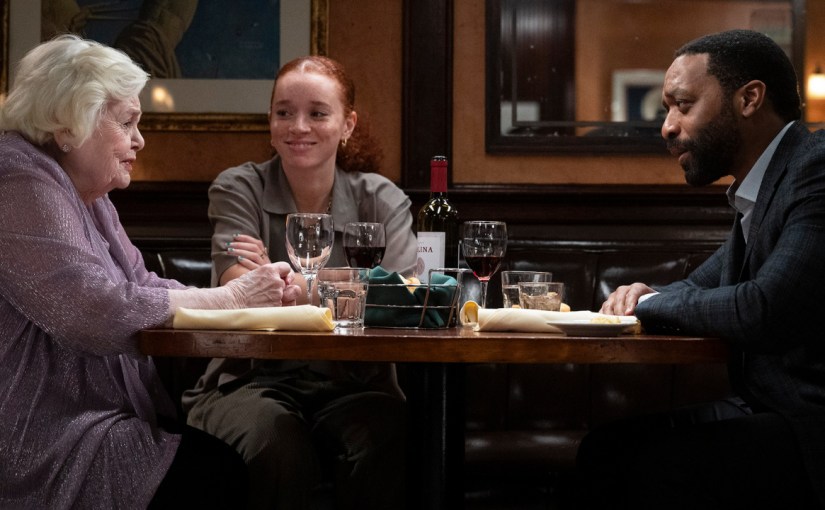
Nina is enduring an aftermath of grief following the sudden loss of her mother. Her father is Roger, a famous newscaster played by Chiwetel Ejiofor beautifully staying under the radar of the leading ladies. Roger hardly engages with Nina. Her world is empty and alone. Yet, when a bond forms with Eleanor the isolation dwindles. Eleanor doesn’t frown or judge Nina for being gay. She loves that she’s filled a void her daughter and grandson leave empty, especially around Shabbat. The two need one another.
It’s the lie that sets the women apart though. In addition, Eleanor’s story is catching on with the JCC community and Nina’s NYU professor and class. More importantly, her school project impresses Roger who sees potential for a televised story that will include the ladies’ newfound friendship, Eleanor’s upcoming bat mitzvah service, and her supposed survival through the Holocaust that never happened to her. The more this tale evolves among the populace, the harder it becomes for Eleanor to be honest.
Eleanor The Great hinges on the chemistry between two distant generations with very uncommon backgrounds. For the film to work June Squibb and Erin Kellyman had to be interesting both together and separately. Tory Kamen’s script explores their respective loneliness just as much as the times they share either in a surprise trip to Coney Island, over a Shabbat dinner, or when Eleanor gets up the nerve to be bat mitzvahed with Nina by her side.
Johansson’s film is not long and therefore not as expansive on dialogue. She finds scenes to detail the exposition of Kamen’s screenplay with impressive visual performances from Squibb, and especially Kellyman. We eventually learn how Nina’s Jewish mother passed, but we first learn that she died when Kellyman enters a room in the apartment she shares with Roger. Scarlett Johansson does not rush through this scene. There’s no verbiage. Only coverage with her camera and strong closeups on Kellyman and the decor and props that occupy the room. It’s enough to get the idea and feel strongly for the character.
The director takes a similar tactic with Eleanor. The prologue of the film presents an endearing relationship of daily routine between her and her best friend Bessie as they wake up with an energetic early start to their day comprised of breakfast, exercise, a visit to the market and a lively argument with another customer, followed by a sit down on a bench overlooking the Atlantic Ocean. When Bessie passes, Eleanor returns to these familiar locales only now we recognize the best friend’s absence. This is all completed in the first ten minutes. Superb, uncomplicated visual storytelling.
I have two shortcomings with the film, however. One concerns how the truth is finally revealed. It’s too contrived and the only time that this story doesn’t feel genuine. Yet, it does not capsize the movie either.
As well, a side storyline for Eleanor seems unfinished. Just one more scene was needed to complete the picture. It could have even been offered over the end credits. I’ll explain down below so as not to spoil anything. Perhaps, the budget on this small project wouldn’t allow it to be shot.
Eleanor The Great is a wonderful surprise for all ages. It teeters on getting schmaltzy without getting thick, and while you expect the big misunderstanding is going to reveal itself, you’re not eager to get there. You get taken up in this very special relationship. When all the cards are laid on the table, the film puts all the weight on Rita Zohar’s character for Bessie to recall her heartbreaking experience. The last thing that terrible encounter could ever be is weepy or schmaltzy. Zohar offers complete truth and transparency in a genuinely heartbreaking monologue. The budget likely wouldn’t allow a visual recap in history for this small film, but that’s a blessing. We’ve seen literal flashbacks far too often. Johansson goes for the acting and recollection of the character. She does not get over inventive with camera work and simply depends on Zohar’s skilled stage performance with Squibb next to her to listen and react. It’s utterly harrowing and brilliantly descriptive.
June Squibb is lovable but also tough, happy, sassy and suddenly complex, which Eleanor absolutely never wanted to be. This ninety something year old is not stressing about death like so many other characters in this category. Her conflict is stressed on holding on to her connection to a new friend.
Erin Kellyman is a young actress that needs a huge following. She has a unique natural beauty; an appearance that doesn’t invite glamour like so many others in Hollywood rely upon. Still, the camera loves her. She’s completely striking with her natural behavior. This is an actor ready for dimensional roles that are summed up over a two hour span, and not in the first five minutes. It would be a huge regret to overlook the promise of her instinctive talent in front of the camera. Scarlett Johansson lends every favor imaginable to enhance everything Kellyman can offer. This actress is this new director’s Jackson Pollack.
This small picture with so much to offer, Eleanor The Great, can be found on Netflix currently (May, 2026). It’s an absolute treasure not to be missed.
SPOILER ALERT: Eleanor was intent on having a Bat Mitzvah. We see her discussing her Torah portion with the Rabbi about the deception that Jacob does on his father Isaac, and we witness her practicing for the upcoming event. However, due to an inconvenient interruption, that service never gets completed. When all is resolved by the end of the film, we never get to see Eleanor’s bat mitzvah occur. It’s like Rocky missing the championship fight. It really had to be there, even if it was filmed with an orchestral score over the scene. Truly a glaring, regrettable omission.


