
SEND HELP

By Marc S. Sanders

The best way to get back at your boss?  I guess you could hope for the slim possibility of surviving a plane crash with him. Then he has no choice but to surrender to your survival instincts on a desert island off the coast of Thailand.  That might deliver a more effective act of vengeance than bad mouthing him online or deleting a promising report that could advance his Fortune 500 company into greater profitability.

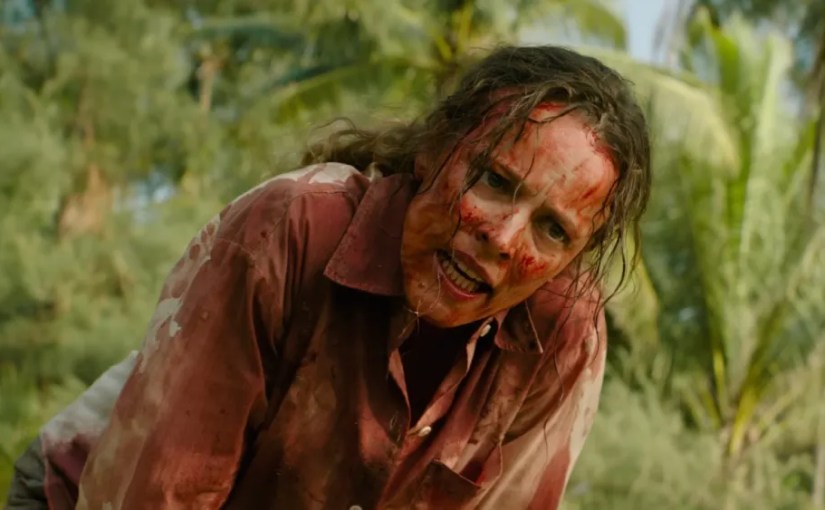
In Sam Raimi’s latest horror/slapstick adventure, it’s a blessing for the mousy computer nerd known as Linda Liddle (great name for Rachel McAdams’ character) that she didn’t end up in a skyscraper with twenty terrorists on Christmas Eve.  She likely would not have been as resourceful as she is within the dense jungles of an island populated by wild boar, bugs, and assorted feastings with conch and berries.  Linda is a huge fan of Survivor.  She even went as far as submitting an audition tape demonstrating her abilities to live off of the outdoor elements. She didn’t get on the show, but her efforts are about to pay off.

Bradley (Dylan O’Brien) is now her boss after inheriting the position from his deceased father.  He’s a chauvinistic and conniving jerk.  He disregards Linda and overlooks her for a deserved promotion following seven years of accomplished desk work under dad’s leadership.  The frat buddy who’s only been with the company for six months, and steals credit for Linda’s hard work, cuts in line.

A business trip aboard a private jet nosedives into the ocean leaving only Linda and Bradley as the washed up survivors.  He has a badly injured leg and no knowledge of working in the outdoors.  On the other hand, Linda quickly builds a fire and shelter while also rummaging for various sources of food and water, including a bloody hunt for wild boar.  

From this point, Sam Raimi has lots of fun with his signature scare jumps and zoom-ins to startle you, prompting screams of laughter like you did when you saw Evil Dead and Drag Me To Hell.  This thriller veers down paths least explored. A premise like this could never occur so conveniently in real life, but I had a blast watching Send Help, particularly because this bonkers script from Damian Shannon and Mark Swift can never, ever be trusted.   With Raimi as director, these guys rely on your expectations that stemmed from a million other pictures like The Blue Lagoon or Castaway.   Though I was surprised not to hear a single reference to Tarzan or Gilligan’s Island.  Standard romance and crazed killer material has hardly ever been served up like it is here. The creators of Send Help manipulate you with fresh and shocking ideas.

Bravo to Rachel McAdams, the marquee actress listed above the title, for braving a tremendous, completely unglamorous role. She is stunning at going against type.  She presents a clumsy, insecure outcast with no fashion sense and an ugly mop of a mess of hair.  She’s even got a hideous looking zit on her cheek.  Mean Girl Regina George would have a field day tormenting poor Linda.  This script gives the actress so much to do.  An incredible monologue at the midway point leans towards the twisty ending, but also allows for an illustrious recollection, on an intense level comparable to Quint’s USS Indianapolis anecdote from Jaws.  McAdams is truly one of the most unsung actresses working today.  Just a skilled performer with a wide berth of range and no two of her characters ever look the same.  In Send Help, she’s offering hard hitting drama and suspense as well as ridiculous comedy.  She goes to limits that Jack Nicholson and Gene Hackman provided during their careers. Rachel McAdams is the second coming of Kathy Bates from Misery

Dylan O’Brien is a new actor for me. He’s a perfect cad, with a silver spoon of privilege wedged deep down in his throat.  You hate this bastard he plays right from the start bringing what sounds like a ho hum script to alert life.  Against McAdams, there are echoes of Michael Douglas and Kathleen Turner in both Romancing The Stone and The War Of The Roses. This new couple go to both extremes of those opposite sides of a romantic face off.

Sam Raimi builds a playground for these pawns to roam around in where they get poisoned, vomited on, attacked, splattered with blood, and put in various stages of peril. He’s almost playing a board game as he uses Linda and Bradley to spell out the rules and boundaries that must be observed while they wait to be rescued. To win will mean they either work together or go against each other.  

Send Help veers in so many different directions that it’s nothing but outlandish fun where you ask what could possibly happen next.  You think you’ve seen this movie a dozen times before, but then it is daring enough to invent its own twists.  With only a cast of two you’re conflicted by who you should root for.  This story is completely expansive in imagination, and daring in execution.

Having recently seen Backrooms, I applauded the idea, but I frowned on a stapled conclusion that settles for the monster chasing the poor victim.  Send Help breaks conventions set up in the first half.  It was such a pleasure to not have everything figured out, where the filmmakers took me on a ride far beyond a merry go round.  The scenario is implausible, but the character instincts and circumstances are marvelously intelligent, compelling and totally surprising.

This might be on my top ten list for 2026. 

MEAN GIRLS

By Marc S. Sanders

I say it again, unless it is a Quentin Tarantino film, it’s all about the characters, people!!!!!

Take Lindsay Lohan’s character Cady, just returning from living in the wilds of Africa, only to arrive at a much more treacherous natural habitat, High School!!!! Cady quickly learns who belongs with what crowd but she is challenged to learn where she belongs, or who she’s welcome to be with, or how to respond, or who to trust. Tina Fey’s brilliant (should have been Oscar nominated) screenplay, Mean Girls, makes it all so confusing for our protagonist, as well as the clique known as “The Plastics,” and even the teaching staff. Tina Fey conveys important lessons in identity while never forgetting to laugh at the story’s agenda.

“We will stay here all night.”

“We have to dismiss them at 4.”

“We will stay here until 4.”

Great portrayals abound from Lacey Chabert as an insecure Plastics follower, Amanda Seyfried hilariously emoting stupidity in the best way possible (she’s psychic because her boobs can tell when it is raining), and especially Rachel McAdams who never compromises the coldness of Regina George, the MEANEST GIRL at school.

McAdams is great at any range from showing screaming fits with ease to completely owning the duplicity of Regina. She makes this mean girl dangerously intelligent and all together deceitful.

I recall declaring this film being one of the best pictures of 2004. I haven’t changed my mind on that observation. It’s hard to find a script thinking three steps ahead of itself. Cady makes a choice and the consequences won’t translate for another 30 minutes or so. Everything circles back on itself. No thread is left hanging and thus you are treated to a character arc – the spine of the best stories in any medium.

Bravo Tina Fey.

WEDDING CRASHERS

By Marc S. Sanders

Owen Wilson and Vince Vaughn make a perfect comedy pair close to the same vein as Bill Murray and Harold Ramis. Close, but not as legendary, and nowhere near the statures of Newman and Redford.

Wedding Crashers was the the first of their two collaborations to date. The movie works as it charges forth in its raunchiness and unabashed thrust to not hold back. Fortunately, a guy named David Dobkin directed a script from Steve Faber and Bob Fisher long before the age of “Me Too.” What a denial of a great idea we would have, had this film been made later. Reader, Wedding Crashers was never intended to be politically correct. If it even thought about it for a second, the entire production would have failed.

Just go with this. Wilson and Vaughn are John and Jeremy, practicing marital law mediators (I said go with it!), who relish in debauchery by crashing weddings as an opportunity to score one babe after another. Dobkin and crew assemble a fantastic early montage of various nuptials to show how well John and Jeremy play this field of formality. We get to see them in action in all of the different methods. At one time they are charming the parents. They are telling sob stories and crying false tears. They are making balloon animals for the youngsters as a means to catch the attention of a beautiful bridesmaid caught up in the sanctum of love. One after the other a braless gal pal is tossed onto a bed ready for John and/or Jeremy. Call it refreshing, but at least these players are equal opportunists; Jewish, Irish, Italian, Indian. Every kind of wedding ceremony imaginable is given attention. These guys are so fine-tuned at what they do that there is even a rule book, which you can reference on IMDB, or on the Blu Ray extra.

When Secretary Cleary’s (Christopher Walken with not nearly enough to do) daughter is getting married, one last hurrah before wedding season closes is upon them. John immediately becomes attracted to the bride’s sister, played spiritually by Rachel McAdams, while Jeremy oversteps himself with the youngest and overly clingy sister who makes sadomasochism seem G rated. She is played by Isla Fisher. To my surprise, following the success of this film, Fisher never really became more mainstream. She’s the scene stealer. When she begs Walken to let the men stay for the weekend at their New England island home, I lost it. I was dying at her antics. Fisher is so good. She had to have invented some of this material herself. An amazing comedienne. The stomping feet. The poutiness. This is comedy. Fisher never holds back in every scene she’s in and because of her, Vaughn as her lustful prey is all the better in his tormented state.

Another scene stealer is Bradley Cooper, playing McAdams bullying boyfriend. Cooper probably made this character bigger than the script intended. Again, I lost it as the family and guests warm up for a friendly game of flag football. Cooper is in his own element apart from the others as he goes through regiment drills of what equates to an unhinged Marine. He’s cruelly brutal but he’s terribly funny. Later in the film his part might get too sadistic though as he punches Wilson bare knuckled which truly sounds like a crack of his skull. There’s nothing really funny there. This is beyond a Three Stooges slap or eye poke. Sometimes less is more. Blame that on Dobkin.

Other parts are wasted though they start out promising like Jane Seymour as Walken’s wife and Fisher & McAdams mother, who serves as a sex craved Mrs. Robinson. She’s given a presence, though her story never really delivers. As well, there’s a resentful gay brother (Kier O’Donnell) who dresses in black and bears a striking resemblance to Gru from Despicable Me. The character makes a good entrance but is primarily there to further torment Vaughn in a quick bed hop scene. Then there’s not much else.

McAdams plays meet cute just fine with Wilson. Though with much interference from the rest of the characters during the course of the weekend you really don’t get a sense of how McAdams falls for Wilson as well as why Wilson goes against his Crasher Code and obsessively falls for her. Not much beyond dream like gazes at each other across the room. For the romance to really work, these characters have to talk with each other a whole lot more than just a token wave crashing beach scene.

The 3rd act is expected. The boy loses the girl. He takes lonely walks down the street, he becomes a slob and he makes one failed effort after another to win the girl back. For a raunchy comedy that was moving with lightning hilarity, this 3rd act really slows the movie down. It ran way too long.

Still, Wedding Crashers is a great comedy most especially thanks to the concept of taking advantage of what can typically happen at any wedding reception, and the uncompromising comedy of both Isla Fisher and most of Bradley Cooper’s material.

Put your morals aside and RSVP to the event.

DOCTOR STRANGE

By Marc S. Sanders

The first MCU movie that makes the biggest departure from any of the other installments in the franchise.

Doctor Strange operates on a level beyond punchy powers as Avengers director Joss Whedon noted. The film explores a very far, very fictional belief in the mystical arts and magic. So much so that sometimes characters like The Ancient One and Mordo speak in an English that is so foreign and so confusing. Still, I’m not complaining.

I enjoyed this film immensely. Benedict Cumberbatch is so right in the role of Stephen Strange. His character’s arrogance is not over the top, but necessary and evident. I really liked his transition from expert surgeon to a permanently damaged physical person and then onto The Sorcerer Supreme complete with the Cloak of Levitation, a better and more deserving way to describe it than just another cape.

The morphing of city landscapes and neighborhoods into arced and flipped and reverse mazes are really fun and change shape with crisp sound editing and music.

Good supporting work is also on display from Rachel McAdams, Chiwetel Ejiofor and especially Tilda Swinton. My one wish is that the villain played by the very capable Mads Mikkellsen was fleshed out more. He’s an actor who can handle heavy roles. Regretfully, I don’t think the script gives him enough to do here.

This Marvel chapter stands on its own with little reliance on the other films. However, the green infinity stone at play here is easier to understand now that I’ve seen Avengers: Infinity War. I’m talking about The Time Stone, of course!

Doctor Strange is a solid film; one that I would love to watch again a year from now and likely feel just as entertained.

NOTE: stay away from the 3D Blu Ray discs. Watch it in 2D. Having seen the 3D in theatres the first time, I clearly remember not enjoying the film very much. It was blurry and dark. At times the picture didn’t look crisp. The 3D effort was a nuisance and a terrible distraction. Less is more. Stick with 2D.

MIDNIGHT IN PARIS (2011)

by Miguel E. Rodriguez

Director: Woody Allen
Cast: Owen Wilson, Rachel McAdams, Marion Cotillard, Kathy Bates, Adrien Brody, Tom Hiddleston, Alison Pill, Léa Seydoux, Michael Sheen
My Rating: 10/10
Rotten Tomatometer: 93% Certified Fresh

PLOT: A nostalgic screenwriter travels with his fiancée’s family to Paris where, every night at midnight, he inexplicably finds himself going back in time to the 1920s.


The best of times is now / As for tomorrow, well, who knows?
La Cage Aux Folles

It’s currently 11:05 at night on a Sunday evening.  I’m getting older, so if I’m smart, I should get off to bed, owing to the fact I have to get up early tomorrow to get ready for work.

But I can’t.  I have just re-watched Woody Allen’s Midnight in Paris for only the second time in my life, and I have revised my original rating of 9 up to a 10.  And I am just bursting to write about how wonderful this movie is.  I’m hoping that I can reach someone who has not seen it before, so I can convince them that, even if they’ve never seen a Woody Allen movie before, this is the one they should start with.  Yes, even over Annie Hall or Manhattan or even Match Point.  In my mind, Midnight in Paris captures the voice of the artist as he is reaching a certain age and has something important to say about nostalgia, and how sometimes it’s not always what it’s cracked up to be.

Gil Pender (Owen Wilson) is a Hollywood screenwriter trying to complete his first novel.  He and his fiancée, Inez (Rachel McAdams), travel to Paris with her family so he can perhaps get inspired by one of the all-time great cities of the world.  He is immediately smitten with the atmosphere of the place; the movie opens with a wordless montage of static shots of Parisian cafés, streets, museums, statues, apartment buildings, and, of course, the Eiffel Tower.  The sequence sounds simple on paper, but the effect is – I don’t know how to describe it.  It captures the ineffable romance of the place.  More so than any other movie set in Paris, Midnight in Paris really, REALLY makes me want to go there.

Gil and Inez seem happy enough, but he is a little more antisocial than she is.  He is star-struck by Paris, but Inez is not incredibly fond of it.  They bump into an old friend of Inez’s, a pleasant enough man who turns out to be a bit pedantic; during a museum tour, he presumptuously corrects the tour guide on details of the life of Auguste Rodin.  This is not the kind of guy I would want to be stuck with on an elevator.

One night, Gil goes walking by himself on the Paris streets and gets a little lost.  Long story short, he inexplicably finds himself transported back to Paris of the 1920s, when the cafés were full of American expats and frequent visitors like Ernest Hemingway, F. Scott and Zelda Fitzgerald, Cole Porter, Gertrude Stein, T.S. Eliot, Pablo Picasso, Salvador Dalí, etcetera.  As a writer, Gil is over the moon; it just so happens his unfinished novel is about a man who runs a “nostalgia shop”, so this pleasant turn of events is a welcome tonic to his vaguely unhappy days back in the present.

Watching the scenes of Gil rapturously conversing with Hemingway, or goggling at Cole Porter playing the piano, I was swept away by the audaciousness of this movie.  It’s illogical and steeped in fantasy and seems to be begging not to be taken too seriously.  But it is a pure joy to watch.  I immediately identified with Gil.  I found myself imagining how I would respond if I were somehow transported back to a time and place when some of my own idols walked the Earth: Hollywood, the 1940s, walking around and conversing with Orson Welles, Alfred Hitchcock, Jimmy Stewart, Katharine Hepburn.  Or even not so far back: the 1970s, having lunch with young Spielberg and Coppola and Lucas, and Pacino and Streep and DeNiro, discussing film and life and getting insight into their inner workings.

From our perch in the present, it’s easy for us to look back at the past and say, well, those were the days.  Just earlier today, I was having an online discussion about the difference between CGI and practical effects in movies like Star Wars or The Lord of the Rings and even Honey, I Shrunk the Kids.  We tell each other that older movies felt more real because the effects were made with real props occupying real space, whether they were miniatures or matte paintings or what have you.  And we say, “Man, they just don’t make them like that anymore.  They knew what they were doing back then.”

That’s Gil.  He looks around at the shimmering jewel of Paris in the 1920s and he’s convinced that this is “where it’s at.”  What can today’s world offer in comparison to sitting in a café and discussing art with Salvador Dalí and Luis Buñuel?  Or the pleasure at hearing Ernest Hemingway tell you he’ll hate your book, even if it’s good, because that would make you a better author than him?  Or getting constructive notes on your novel from Gertrude Stein?

The story progresses.  Gil becomes infatuated with a beautiful woman from the past, Adriana (a luminous Marion Cotillard), and it becomes harder and harder for him to go back to his own present each night.  Inez’s father gets suspicious and hires a private detective to follow Gil during his midnight strolls.  You may ask how a private detective can follow someone who is traveling back in time.  Well, my friend, that is an EXCELLENT question, one which the movie answers in satisfying and gut-busting fashion in the final reel.

But the heart of the movie lies in the touching, revealing segment when Gil and Adriana go even further back in time, this time in a horse-and-carriage, back to the Belle Époque, the “Beautiful Age” of Paris, which lasted from about the 1870s to the 1910s.  Adriana, who lives — lived — in the ‘20s, is entranced with this even more bygone era.  She feels about the Belle Époque the way Gil feels about the ‘20s.  To her, the ‘20s are slow-paced, a drudge.  But, oh, to be back in the 1890s!  Dinner at Maxim’s, the Moulin Rouge, meeting Toulouse-Latrec and Gauguin and Degas!  How wonderful those days must have been compared to the Boring Twenties!

And there’s the message of the movie.  We can grouse and grumble about the modern world all we want.  The movies are dime-a-dozen.  The books even more so.  The music is crap.  Cell phones have turned us into tiny-screen junkies.  But, oh, to be back in the good old days of the 1980s, when the music was gnarly, and the movies were iconic, and the books were amazing, and everything was just better.

But we forget that, in the ‘80s, people were grousing and grumbling about THAT era, and they longed for the more sedate and rosy era of the 1950’s.  And in the ‘50s, people said the ‘30s were the BEST.  DECADE.  EVER.  And so on and so on.

It’s human nature for us not to realize what we’ve got going for us until it’s gone.  We are living in glorious times.  (Coronavirus and politics notwithstanding…gimme a break, I’m trying to make a point here.)  Look around.  Really SEE it.  Embrace it.  We don’t need a time machine to go back to our glory days.  We’re IN our glory days.  Just wait.  In 20 years, you’ll look back on the 2010s and say, “Man, wasn’t that a time?”

If you take nothing else away from the above review, remember this: Midnight in Paris is pure charm, is laugh-out-loud funny, and is the best Woody Allen film since Match Point.  So if you haven’t seen it, you really, really, REALLY need to make a point to do so.

SPOTLIGHT

By Marc S. Sanders

It’s tough to be a fair journalist when a higher power carries great influence over the what and how of honest reporting. In Tom McCarthy’s Best Picture Oscar winner, Spotlight, it’s not so much the crimes of child molestation by the hands of priests from the Boston Archdiocese that are so important. Rather, it is how the facts are suppressed and the pressure to contain the truth are so apparent. Maybe it finally took the will of a new editor, a Jewish editor from New York, named Marty Baron (Liev Schrieber), at the esteemed Boston Globe newspaper to get the special section crew known as Spotlight to work on how case after case of reported child molestation incidents were allowed to occur for decades under the eye of the highest powers in the church.

First, it’s important to note how easy it is for a priest to seduce a young boy. He welcomes the boy for special duties within the church. Then the priest and child may share a dirty joke together. Just their little secret. After that, touching occurs which leads to unimaginable and irreversible damage. Yet, the grown man once considered that special attention he received as a direct link to God himself. McCarthy deliberately repeats that viewpoint from more than one victim in the film; it was as if God had selected them for special attention and God was especially speaking to them. None of this could be more patterned.

Marty Baron counts on his team to not only collect the mounting number of cases. He tells them to uncover an even worse truth and that is the systemic response the church upheld where when a new case comes to light, a deal is worked with a pawn for an attorney to give settlement hush money while the priest in question will take sick leave or simply be reassigned to another church location free to do God’s will while also committing his own willing nature.

The Spotlight team consists of Mark Ruffalo and Rachel McAdams as well as Michael Keaton. All of their true to life characters were born and raised in Boston. Some under Catholic influence. So the conflict for them to do their jobs ethically and morally is challenging when faced with literally going up against the one institution that seems to own the city of Boston without it showing on paper necessarily. It also means coming to disheartening terms with their own upbringing.

To convincingly depict the grasp the church has on the politicians and newspapers in the area, McCarthy shoots a lot of his talking scenes outdoors on public benches and sidewalks. Therefore, you get an almost claustrophobic shadow of how close the Catholic Church is to the city’s residents. If a scene is at a dinner party or cocktail hour, a man of the cloth is nearby. A sidewalk stroll between a victim and a reporter seems to tread carefully. You never know if that cathedral on the corner is listening. Spotlight is primarily a journalism film of the highest standard. The pursuit for the truth is ripe with the obstacles of slamming doors when trying to get a statement or dealing with the unfair reveal of no records that legally are meant to be public. There’s a race to get the whole truth before a competing media outlet grabs it and misconstrues it. As well, what happens when a bigger story suddenly takes precedence and this story must be put on hold. I mean how do you not drop everything to report on 9/11?

Spotlight is another important film as it does not compromise in its true to life storytelling. It’s unfathomable to believe that men of God could use their positions to take advantage of the innocence of children and then refuse to accept responsibility for it. Even worse is the egregious actions taken to modify the authority of local law enforcement and judicial objectivity that should be there to protect the rights of these victims.

Tom McCarthy’s piece is excellent with a cast in top form. It would have to be as the screenplay is peppered with conversation after conversation. This is a newspaper film. So therefore it’s a talky piece. You get passionate monologues from Ruffalo who does not hold back his anger and disgust at what he uncovers with an acerbic but crusading attorney played beautifully by Stanley Tucci. This attorney has lost every battle he’s had with the church but he does not give up on his client victims either. He’s their only protector in an arena of powerful criminals who hide behind scripture.

You also have a real go-getter reporter in Rachel McAdams. McCarthy repeatedly shoots her from behind walking the streets of Boston with a pad and pen as she meets a victim or simply knocks on neighboring doors for some facts. Her challenge is seeking the truth while her grandmother holds an undying faith in religion of Catholicism by visiting the church at least three times a week. A crushing, albeit brief, scene occurs near the end of the film when the reporter’s grandmother reads her final story in the Spotlight section.

Michael Keaton is the Irish Bostonian rooted in tradition. He knows all the important people in the city. He knows Cardinal Law who runs the church and he holds on to his journalistic code of fact collecting for as long as he can muster.

The truth and web of lies and deceit could never really shock me in Spotlight. I’ve heard it all before. Instead, it’s the knowing acts of concealing horrifying sin. Ironically, those actions are committed by those that listen to the confessions of its sinful disciples. As I’m of an age where I question the validity and need for religion in our upbringing, I can’t help but wonder how these victims would have turned out had religion never became a factor in their lives. These children, now men, went on to commit suicide, become chemical dependent, and occasionally became child molesters themselves. It’s easy to argue that these conditions were never part of their chemical make up. It’s also easy to argue that the Catholic Church carelessly determined the destinies of these men without any regard for being accountable of the damaging results. Spotlight confidentially reaffirms both of these arguments.