12 YEARS A SLAVE

By Marc S. Sanders

I’m grateful for those brave filmmakers who defy what is so glaringly oppressive in order to uphold a truth.  Steven Spielberg accomplished this with Saving Private Ryan and especially Schindler’s List.  I own both films on 4K, but I’ve only watched them each a handful of times.  I recently completed my second watch of Steve McQueen’s 12 Years A Slave.  While Schindler may feel more personal to me as a Jewish person who has met several Holocaust survivors, McQueen’s movie is uncompromising in its cruelty to black people , recklessly referred to as n!gg@rs, being held as property within the southern antebellum confines of slavery during the mid 1800s just ahead of the Civil War.  It’s one thing to read about lynchings and whippings.  It’s another to see it visualized; to see the life being breathlessly taken from a human being.  Not a slave.  A human being.

From such an ugly period in American history, the isolated story of this film follows the North Eastern free black man Solomon Northrup (Chiwetel Ejiofor, giving the performance of his career – heartbreaking, smart, emotional, fearful and brave at the same time).  He is a happily married father of two who earns an honest trade as an entertaining violinist in a well to do upstate New York Community.  When his family leaves town for a few weeks, Solomon is approached by two happy, colorfully dressed charmers with top hats (Scoot McNairy, Taran Killam).  Solomon believes he is being recruited to perform for some events across state lines for a significant sum of money.  He’s wined and dined by the men for a few weeks.  However, following a lavish dinner among the three, he awakens to find himself in southern Georgia, chain shackled at his four limbs.  

Despite his protests, insisting he is a legal free man, he is slapped, screamed at and trudged along to Louisiana and sold to a wealthy Plantation owner (Benedict Cumberbatch), who is comparatively kinder than his property keeper (Paul Dano).  Dano especially stood out to me this time as I reflected on Quentin Tarantino’s regard for the character actor. I question if the director, infamous for tossing the n-word around in nearly all of his films, has even seen 12 Years A Slave and had an opportunity to observe Paul Dano’s appearance. Dano’s character is genuinely mean spirited and hateful with that southern redneck naive racism for the black man. It’s what is demanded of this piece. His performance cruelly teases the black slaves with a song that sounds like a nursery rhyme but chants like a horror film while his screams insist they clap along. McQueen is wise enough to edit Dano’s voiceover singing as the slaves are getting accustomed to the new property, they are forced to tend to and live upon. Later, Dano and Ejiofor will conflict with one another, and the scene is terrifying of what it implies will arrive. So, there’s my two cents on actor Paul Dano (also known for There Will Be Blood, The Batman, and Prisoners). I’ll throw two more cents around and ask Mr. Tarantino to go reflect on his meritless position on this fine actor.

This picture also features Paul Giamatti headlining a horrible scene, working like a car salesman as he slaps the naked physiques of Solomon and other black people. His purpose is to demonstrate the value and endurance of these “properties” for potential buyers.  The novelty of used car salesman tactics seemed to originate here.  With no regret, black children are torn away from a helpless, anguished mother.  McQueen with John Ridley’s Oscar winning adapted screenplay includes this scene to show how quickly a transition into slavehood occurs.  Solomon and many of these other folk were free moments ago.  Now, they are delivered off a boat and are being sold like cattle, to be used not just for work but for sexual appetites and playthings.

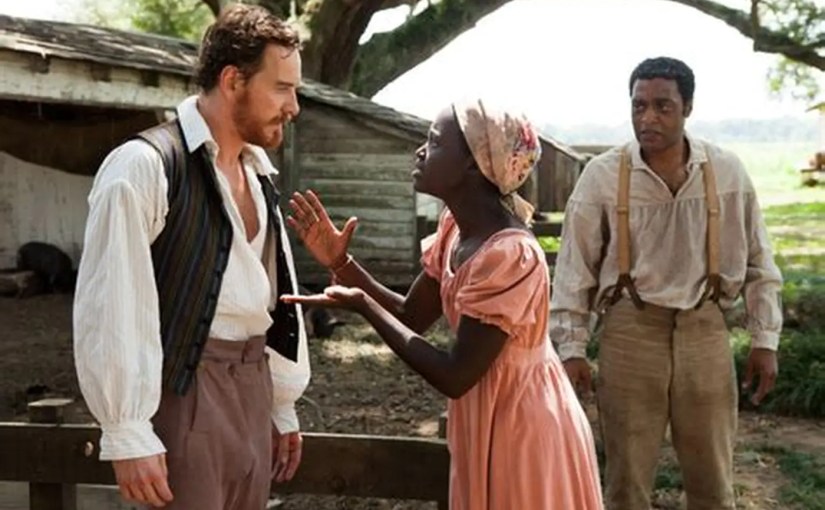
The second half of the story finds Solomon as a sold property slave of the viciously harsh Edwin Epps.  Michael Fassbender has never been more terrifying with intense rage that hides any other memorable performance in his impressive career.  He more than serves the antagonism of this film the same way that Ralph Fiennes did for Schindler’s List.  This is a monstrous individual.  Strong, oppressive, with no way to be endeared.  If he’s mad, for whatever reason, he’s going to be mad at his faultless slave workers who do nothing out of line and work solely to satisfy Edwin’s demands.

As the title implies, Solomon’s captivity carries on for twelve years with no access to his family or proper legal authority.  He also dare not reveal he can read or write, lest he will come up as a threat to those that violated his legal rights as a free northerner.  Solomon Northrup was always to remain trapped.  Even his talents with the violin are compromised as he’s awakened in the middle of the night to marshal the entertainment for Edwin as he compels his property to dance naked among themselves in his drawing room.  

As horrific as Solomon Northrup’s story is, later accounted for in his published book, it’s a fast paced and engrossing tale.  McQueen assures an understanding of how harsh it was to live within the dense, stale heat while picking pounds of cotton for the slave owners and their wives.  The whispers of flies and mosquitoes, along with tall grass and dragonflies often found in the south bring an awareness to the mundane and exhausting life of picking cotton from sunup to sundown.

The work was never the worst though.  The younger black girls were groomed to be continually raped.  A telling moment occurs when Edwin prances around the property in just a loose, sweaty shirt (no pants) with a child holding his hand. It is easy to grasp what’s to become of this girl, especially considering how Edwin treats Patsey, a teenage slave, who is repeatedly raped and beaten by him while infuriating the jealously of the Mistress Epps (Sarah Paulson).  

Lupita Nyong’o is Patsey, in an Oscar winning performance.  Nyong’o’s anguish matches Fassbender’s rage in equal fashion.  (He was Oscar nominated too.) Ahead of shooting days, the actors maintained rigid exercises together to preserve a direct trust during the abusive scenes.  Though thoroughly convincing in their dialects and performances of tears and brutal anger and screams, I cannot imagine it would be healthy for either actor to go full method here.  Had they actually done so, I’d argue they’d never return to a sense of acceptable balance, mentality and perception between one another.  What they do together, just like this whole cast, is hard, brutal work. Just look at how red faced Fassbender gets. See how glossy Nyong’o’s complexion gets behind the screams and tears. Not all of this is just makeup spray water.

Steve McQueen takes large sections of his two-hour film to demonstrate the carryover of time.  I’m not necessarily talking about twelve years.  Rather, minutes and hours.  One section has Solomon strung up from a tree by the neck.  The only thing keeping him from crushing his windpipe is to continually tip toe on the wet mud beneath his feet.  Morning turns into sweltering afternoon and into night.  McQueen does not rush this moment.  He wants the audience to realize that black slaves were regularly hung from oak trees.  It’s one kind of understanding to endure the hanging with literally no aid or sympathy to rely on.  What’s worse? A quick hanging that ends in blacked out death, or the kind that only dangles a person to the absolute brink of death?

The hardest sequence is an unbroken four and a half minute shot.  The director’s camera circles around Patsey’s scarred, bound, naked body, as she gets bloodier and bloodier by the unending whippings from Edwin’s unreasonable rage. When the taskmaster forces Solomon to take over, a sad irony is that Patsey begs Solomon to resume the whipping.  She’d rather take her punishment from him, than the slave owner.  

Paulson is in the background of this scene too.  She never flinches, always looks justified in permitting this action to carry on seemingly like a Lady MacBeth.  Nyong’o allows herself to be weakened to nothingness with horrifying screams.  Fassbender seems to never tire of flinching his arm with the whip in hand.  Ejiofor does not rush into what is forced upon him but once he begins, he’s out of breath with terrible suffering for what he is compelled to bestow upon this helplessly tied up woman.  Again, McQueen never breaks this into quick edits.  It is all one shot, as you see mists of sweat, blood and body heat emanate from Nyong’o’s back with every swiftly delivered lash.  It is so unfair.  That’s a terrible understatement, but it’s what comes to the forefront of my mind.  What person ever deserves this kind of treatment?  What reason could there ever be to whip a person into a bloody, stinging, charred up pulp?  This is never, ever fair.  

The scene is so harrowing that I have yet to discover how it was safely put together for filming purposes.  What these actors went through. It’s uncanny how real it looks.

None of what you see in 12 Years A Slave is ever forgivable. Long after these doers of evil are dead as well as their offspring and their offsprings, it remains as never excused and should never be offered repentance.  Some would actually say “Well you have to understand, that’s what it was like at the time.” To hell with that. Today, moments like these are actually being dismissed and erased from our institutions as attempts are made to “make America great again.” There are places in this world where this kind of treatment still occurs.  It’s fascinating that generations have not learned from the sins of ancestors.

McQueen’s film is assembled with amazing craftsmanship.  John Ridley’s screenplay contains a dialogue that performs with intellect, even if there are characters that we presume were denied formal educations.  Brad Pitt offers a cameo as a white man with a conscious devoid of prejudice.  Listen to his dialogue against that of Fassbender’s.  On a sweltering summer day on the plantation, these two sides of the slave ownership argument operate like a congressional debate.  Ridley incorporates vocabulary that lend to another time, long outdated, but telling of the limits that some people will never adopt. Ejiofor, as an educated Solomon, has been diminished to look like a censored man, but even his shredded, dirty slave wear does not prevent him from realizing there is a hope for common sense and good nature, even in this unseen corner of the world.

The antebellum plantations are vast and isolated from a civilization with architecture of tall posts on white porches.  These areas look like contained miniature empires; maybe adapted from grand landmarks of ancient Rome or Greece. The costumes deliver a wide contrast of social status.  The cast of slave actors perform scenes nude in dirty field settings, broken sheds and dark, smelly cattle barns. The white aristocrats are dressed in the finest fabrics.  12 Years A Slave does not just describe. More importantly, as a very well-done film, it shows how wide a berth these people are separated from one another.

This is a necessary, monumental biography to watch and explore.  In social media I continuously remind people that the Holocaust happened less than ninety years ago, and it could easily happen again.  The same is equally true for slave history.  If the acceptance of this mentality can be taught, it will be learned and then it will be executed.  It can happen so easily and so swiftly.

History is unclear of what became of Solomon Northrup after he wrote his book, ahead of his death, but his story will never be forgotten.  It’s fortunate that McQueen’s picture was bestowed an enormous number of accolades including winning the Oscar for Best Picture.  An Academy Award is not simply recognition for artistic greatness.  Its reputation allows a piece of filmmaking to constantly be recalled for years to come among an elite collection of accomplished achievements.  If anything, that should ensure the terrible chapters of American slavery are never, ever forgotten.
NIGHTBITCH (2024)

by Miguel E. Rodriguez

DIRECTOR: Marielle Heller
CAST: Amy Adams, Scoot McNairy, Jessica Harper
MY RATING: 7/10
ROTTEN TOMATOMETER: 59%

PLOT: A woman pauses her career as an artist to be a stay-at-home mom, but her domesticity takes a surreal turn.


[SPOILER ALERT…if you plan on seeing Nightbitch, avoid this review.  This movie, like most movies, works best on the viewer if they have no idea what’s happening or what’s about to happen.  Consider yourself Spoiler-warned.]

Nightbitch shoots out of the starting gate like a thoroughbred – or a greyhound, if you will – but about halfway through, it runs out of narrative steam.  I felt like a gambler watching a horse race, watching my horse lead the pack around the first turn, already spending the winnings in my head, and then my horse fades a bit, then a bit more, and by the time we get to the finish line, I’m tearing up my ticket in frustration.  I needed a WIN, not a PLACE.  There goes my trifecta.

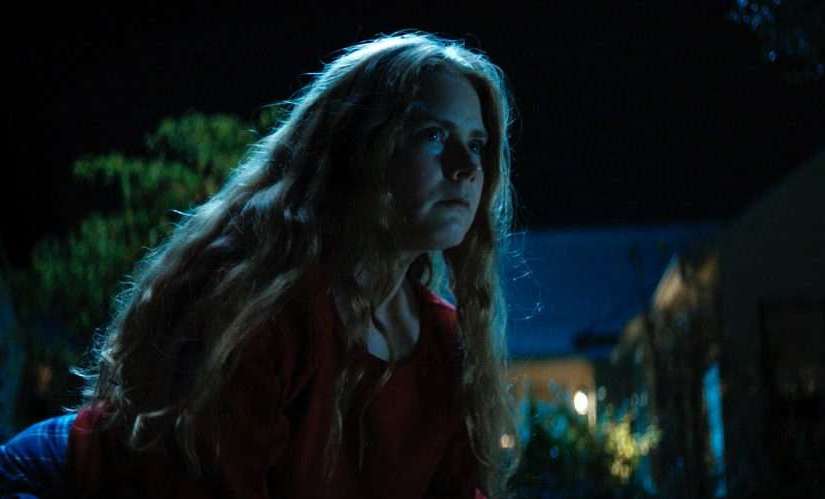
Amy Adams plays an unnamed Mother who has put her promising career as an artist on pause to be a stay-at-home mom while her also-unnamed Husband (Scoot McNairy) pursues his career as a…um…well, whatever it is, he has to travel a lot, leaving Mother at home with, you guessed it, Son (played by adorable twins Arleigh and Emmett Snowden).  Referred to throughout the movie as “my guy” and “sport” and “little buddy,” Son is a typical toddler in the throes of the terrible twos: cute for long stretches, maddeningly frustrating for longer stretches.  [Ed. Note: the author is not a father, has no plans on becoming a father, and will never possess the immense dedication it takes to rear a child, so don’t expect him to embrace the chaos of toddler-hood because it ain’t gonna happen.]

Mother is going through an identity crisis, set up in a brilliant opening scene where Sally, the woman who assumed Mother’s job at an art gallery, asks her, “Do you just love getting to be home with him [Son] all the time?”  Mother answers the question with a little more honesty than Sally or anyone had a right to expect, including this tidbit: “I am deeply afraid that I am never going to be smart, or happy, or thin ever again.”  I am a straight Hispanic cisgender male, so I’m here to tell you, I will never understand that mindset, but I am reasonably certain there are untold millions of moms out there who, if they listened to Mother’s opening statement, would say, “AMEN, sister.”

A little later, Mother delivers an internal monologue where she reflects that, as a mother, you can squeeze someone into the world “who will one day pee in your face without blinking.”  Again, I’m not a parent, but I know that’s truth in cinema right there.

After a few more establishing scenes of Mother interacting with Son, who absolutely REFUSES to go to sleep at night or eat anything for breakfast except, apparently, hash brown patties fried in butter, some odd things start to happen.  At the playground, some stray (?) dogs approach her as if she’s their best friend.  Mother notices her sense of smell has become much more acute.  Son helpfully points out that her back is hairy.  And, in a creepy Cronenberg-y moment, she notices a lump growing at the base of her spine just above her rump.  Curiosity gets the best of her.  She heats a needle, lances the lump, and…well, if you remember the title of the film, you have an idea of what pops out of that lump.

This was all wonderfully thrilling stuff as a movie lover.  I’m thinking, “My god, this is a Spike Jonze movie told from a woman’s perspective!  I’ve never seen anything like this!  This is gonna be GREAT!”  Mother starts to enjoy eating a lot of meat.  She starts to play “doggie” with Son, growling and barking at each other like two puppies.  The two of them eat their lunch at a deli with no silverware…or hands, to the consternation of other diners.  Son doesn’t sleep at night, so Mother, in a genius parenting move, buys a dog bed and gets Son to play “doggie” and sleep in the dog bed at night.  Presto, problem solved!

And more and more dogs start showing up at her door, at night, sometimes bringing gifts: small dead animals.  One night she walks outside, starts digging around, and an astonishing transformation takes place…

I know, I know, SPOILERS, I get it.  But it’s important to get across just how brilliantly original the first act of the film is, because the second act is, alas, all downhill.  I am not saying that the film’s message is unimportant, not at all.  I admire the film because of its message, and because it was being delivered in such an original way.  But then we get into conflict with Husband, who is desperately trying to understand why their 2-year-old is now sleeping in a dog bed on the floor, or why their cat suddenly turned up dead on the front porch, or why his wife suddenly wants a separation.  It must be said, Nightbitch is remarkably even-handed with the Husband’s dialogue.  He is not reduced to a 2-dimensional sitcom husband.  When she lays into him for not supporting her career, he fires back with a well-reasoned argument.  Their dialogue could be turned into a first-rate play.

But instead of exploring the surreal nature of Mother’s new condition, the movie settles into soap-opera territory, with only the occasional nod to the mystical incidents in the first act.  I distinctly remember, in the middle of the second act, feeling as if a balloon had deflated in the plot.  I imagine defenders of the film might say, “Well, the second act is where the weird stuff has to take a back seat to deal with the real issues at hand.”  Okay, maybe that’s true from a real-world perspective, but to me, it felt as if the filmmakers were on the verge of showing us something mindboggling, then backed away from the precipice at the last minute.

Does that make me guilty of critiquing a movie for what I wanted as opposed to what I got?  I guess it does, as much as I dislike that tendency in myself.  I feel there are so many different ways the movie could have gone in act two, could have leapt gleefully over the edge of convention and truly broken the mold with this movie.  When it became clear what they were doing instead, my elation evaporated.

I give Nightbitch a generally favorable score, though, based on the mad inventiveness of the first act and the plot in broad strokes, and also on the incredibly brave performance from Amy Adams, who maybe has two scenes in the entire film where she seems to be wearing any makeup.  She also appears to have to put on some weight for the role, which is not something I can ever recall seeing a female actor do.  Male actors have turned that kind of thing into a cottage industry, but when was the last time you saw a woman do it?  That took guts.  Watch Nightbitch for Amy Adams’ performance and for the story, even if the movie doesn’t follow its own plot to a satisfying conclusion.

A COMPLETE UNKNOWN

By Marc S. Sanders

A drifter hitches a ride into New York City with a guitar on his back looking for Woody Guthrie.  He only comes to realize that his musical idol is in a New Jersey hospital ward with a debilitating illness. The drifter just came from Jersey.

The young stranger eventually catches up with the legendary folk singer, and a friend named Pete Seegar.  He plays a song he wrote for the ill and mute Mr. Guthrie and the men are dazzled by this young man.  This is Bob Dylan, and he writes music and lyrics as quickly as he breathes.  But where did this wunderkind stem from?  To everyone that encounters Bob Dylan, he’s simply A Complete Unknown.

Timothée Chalamet delivers a blazingly convincing performance as Bob Dylan, surely a front runner for the Best Actor Oscar.  The appearance is easy to get used to. The dialect and expressions of what I’d like to think is the summit of what most of us know about the musician never falters from an apathetic expression or that mumbling hoarseness we all know.  Everything from the clothes to the shaggy brown hair to the sunglasses and motorcycle he confidently rides perfect this embodiment. In James Mangold’s latest musician biography (prior credits include the Johnny Cash bio Walk The Line), with Timothée Chalamet in this role, I was truly watching a Bob Dylan of the early to mid-1960’s.

Any movie has a conflict for its story to work around.  There’s more than one conflict in A Complete Unknown, but Bob Dylan would not know that.  He’s content with doing what he does and has not one care for what anyone else wants him to be or wants him to share.  Bob lacks much concern for the tumultuous times of the mid twentieth century either.  JFK and Malcolm X are assassinated.  The Vietnam War persists.  The Cuban Missile Crisis terrifies everyone.  Yet, Bob only focuses on his songwriting.  He’ll make connections with Pete Seegar (Edward Norton) and develop a sometimes-romantic tryst but mostly singing partnership with Joan Baez (Monica Barbaro).  He also gets involved with Sylvie Russo (Elle Fanning), one of his first fans.  However, no matter what they might expect of the performer, he’s only going to follow the path that drives him.  Therefore, that will be their own respective problems to contend with, not his.  Bob is only going to follow that path that he chooses.

Sylvie wants to know more about her live-in boyfriend who only tells tales of when he moved with a travelling carnival.  Joan wants to know where he learned to play guitar or even how he developed a knack for poetic lyricism.  Later, she’ll want to play the original numbers that solidified their friendship on stage despite his stubbornness not to agree.  It becomes curious when photo albums are delivered, addressed to a Robert Zimmerman.  Pete and his other peers want Bob, a now marquee name, to hold on to the grassroots of folk singing.  Bob will not acquiesce though.  Like other masterful musicians such as Prince or John Lennon and Elton John, Bob Dylan is going to continue to reinvent himself. 

In a matter of months, the signer becomes a nationwide superstar and he can’t walk the streets without getting bombarded; something he never wanted.  He performs with a passion for the music he’s written and he persists in making the next new thing with his talents as he transitions from acoustic to electric guitar and incorporates keyboards and drums to accompany his performances.  His friend Pete sees a berth becoming wider from the folk music he parades at annual festivals in Newport, Rhode Island and what Dylan insists on only playing.  Record producers (primarily represented by actor Dan Fogler) beg the singer to perform his older familiar tracks, but Bob Dylan only wants to move on to what is new and fresh. 

A Complete Unknown is full of such energy because it delivers what was produced by the guy who composed all of these magnificent and magnetic tracks from Song To Woodie to Blowin’ In The Wind to Like A Rolling Stone and to The Time’s They Are A Changing and A Hard Rain’s A-Gonna Fall.  You might not know or even understand all the verses by heart, but you quickly catch on to the choruses. To hear these newly composed songs pulled out of a dusty attic for an updated biography, performed by Timothée Chalamet in underground bars, at concert festivals or even in messy apartments is addicting.  You don’t want the actor to stop the song.  You don’t want the film to cut away from any of the numbers and you wish the concert would never end.  Like Joan Baez, Bob Dylan’s works stay with you.

I’ve become a huge admirer of James Mangold.  He’s a writer/director who does not criticize his subjects.  He empathizes with them and respects their boundaries.  We might find frustrations in people like Bob Dylan or Johnny Cash, but Mangold does not compromise the biography.  He finds reasons for you to like these men even while those who stand in their circles might not care for their attitudes. 

The director is also skillful at showing the history of the time.  Like the last Indiana Jones film he covered, the settings are so authentic.  New York City in A Complete Unknown is depicted down to the finest detail including the yellow street signs within the small boroughs of damp Brownstones and city streets that Bob Dylan navigates. The musty interiors of Woody Guthrie’s hospital room or Pete Seegar’s cabin home are shot with a hazy photography.  The Newport music festival, full of concert spectator extras feels like it was pulled from a documentary; what maybe a calm and relaxing Woodstock might have looked like.

Beyond Timothée Chalamet, the cast of this film is superb.  Elle Fanning need not say a word as James Mangold provides an assortment of close ups depicting her pain of wanting to love Bob Dylan but knowing she just can’t.  Her complexion turns into a weeping pink without one tear shed.  Monica Barbaro is on the cusp of becoming a marquee name in films.  The actress who was recently in action material with Tom Cruise and Arnold Schwarzenegger hides so well under the folk appearance of Joan Baez and she carries an immense stage presence. Scoot McNairy is Woody Guthrie who never speaks and only stares straight ahead during visits from Bob and Pete. Yet, the silent performance offers the only character who truly understood the value of an enigmatic Bob Dylan. Edward Norton has given a new range as a liberal and calm Pete Seegar who uses folk music as an escape from the turmoil of the times and not as a harbor to protest or fight an authority with aggression and violence.  He might wish for his friend Bob Dylan to uphold the value of folk music, but he knows he can’t keep a bird caged in one place either.  Norton’s introductory scene in a courthouse with a banjo in hand is unforgettable.  The casting is simply perfect in A Complete Unknown.

Since I saw this film on Christmas Day, I have not stopped thinking about it, and I think I want to see it again in a theater with a speaker system that amplifies the power of Bob Dylan’s guitar and mumbly vocals.  Right now, nothing sounds better.

A Complete Unknown is one of the best films of the year.

KILLING THEM SOFTLY

By Marc S. Sanders

What did I just watch? A mob movie, or a 2008 Presidential debate where the candidates are no shows, and their respective commercials are aired in their place? Andrew Dominik directs Killing Them Softly, with Brad Pitt who also produces.

Reader, I don’t get the appeal. Maybe it’s the outstanding cast which includes Pitt, as well as James Gandolfini, Ben Mehndelson, Richard Jenkins, Scoot McNairy and Ray Liotta. Sadly, these guys are given next to nothing do of any consequence.

After it is revealed that Liotta’s character, Marky, ripped off his own mob poker game a few years back, an idea is presented to two street addicts played McNairy & Mendehelson to do the same thing because, heck, they’d never be suspected and logic dictates that Liotta must have done it again. So, he’ll be the one to blame and get whacked. The game is robbed and now Brad Pitt’s hitman character is on the job. Simple enough story, almost like a Guy Ritchie picture.

Killing Them Softly is an adaptation of a 1974 novel by George V Higgins. I never read the book, but I’m curious if it contains any kind of relation to Andrew Dominik’s idea of editing recurring speeches and ads, compliments of Obama, McCain and Bush 45. Truly, what was the point of this recurring theme? A two-sentence piece of dialogue finally acknowledges this in the final minute of the film, but I’m still lost on the significance. Somehow Dominik made a dirty, cold, rain-soaked picture that has an omnipotent viewpoint from our most prominent politicians, and I don’t know what one thing has to do with another.

As well, Gandolfini arrives in the story and I never could gather what was his purpose. I think he is a hitman who is washed up, never getting his ass up to carry out the job and just monologues about nothing like the hooker he pays off; topics that Quentin Tarantino might’ve thrown in the editing trash bin.

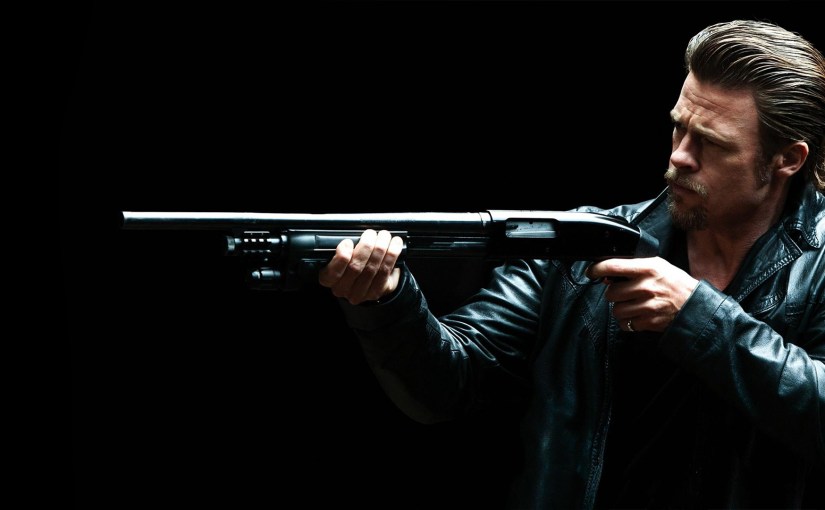
Mendelsohn looks incredibly convincing as an addict living off the streets, yet his storyline has no end. He’s arrested. Then what happens? What does that mean for everyone else? Liotta has a long drawn out sequence of getting the shit kicked out of him by two mob foot soldiers. The scene goes on and on and on. His face cracks and bleeds, and bleeds some more. Brad Pitt? Well, he’s the hitman who just looks cool. Yeah, the black leather jacket he wears looks very cool on him. That’s about it.

There’s no development to Killing Them Softly. No surprise or twist. The guys you expect to get killed, get killed, and there’s no good dialogue.

This film is just an empty void of poorly, uninteresting violence.

BATMAN V. SUPERMAN: DAWN OF JUSTICE

By Marc S. Sanders

Zack Snyder may have been indulging in too many cookies from the jar when he made Batman v Superman: Dawn Of Justice.  I can not deny how ambitious this film is, but did it ever need to be this ambitious?  There are too many storylines, too many characters, and not enough thought provoking dialogue to really make any sense of the gobblety gook that’s splattered all over the screen.

Reader, my favorite super hero of all time is Batman.  Nearly any variation of Batman (including moments from the dreadful Joel Schumacher films) contains an element that I just love about the character.  Ben Affleck is cast as The Dark Knight here.  He’s fine in the role.  I knew since he had done Daredevil, that he could pull off this part.  He might be too long in the tooth, and too busy an actor/director, for a new series of super hero films, but I digress.  That being said, the movies have gone into overkill on the Batman character.  It’s time the Gotham crusader hide in his cave for a little while and let some of the other super heroes out to play.  Snyder’s film proves my theory.  After all, the true highlight is neither title character in this movie.  

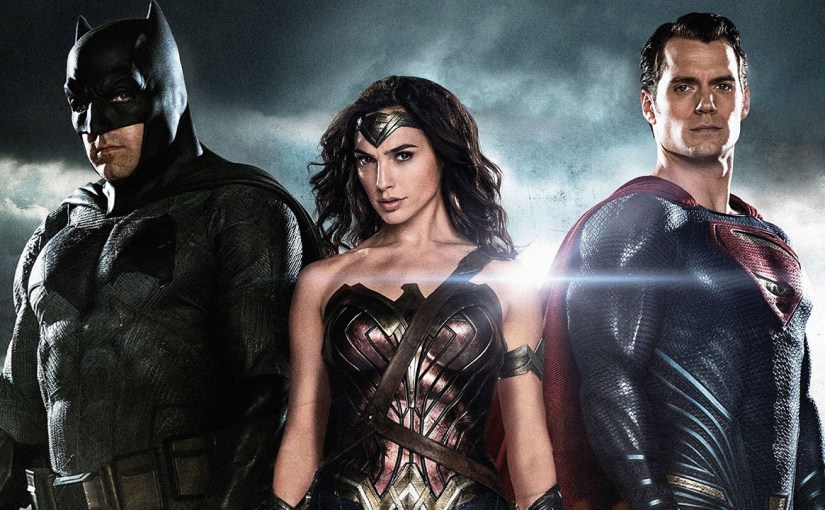
Actually Wonder Woman (Gal Godot) making her big screen debut is the draw above anything else here.  Even that is problematic, though.  I’ve seen this film twice now.  Can anyone tell me why Wonder Woman aka Diana Prince even makes an appearance in this film?  From a story perspective, what justifies Diana creeping into this film, other than to plaster her picture on DVD covers and merchandise a new action figure?

Events begin right after Snyder’s stellar Superman film, Man Of Steel.  An older and experienced Bruce Wayne is dubious of the benefits that Superman (Henry Cavill) can serve on Earth.  After all, his bout with the Krypton villain, General Zod, practically leveled Metropolis.  Heaven forbid if one day this powerful alien with the red cape goes out of control.  Bruce, as well as politicians led by Holly Hunter, ask a wise question.  Who on earth could ever stop him?  So Bruce, with assistance from Alfred (Jeremy Irons playing the well known sidekick more as a strategist, than a polite butler) begin preparing for a seemingly inevitable battle to eliminate the Kryptonian. 

Meanwhile, a young, brainy Lex Luthor (Jesse Eisenberg) is planning for his own undoing of both of these super heroes by living up to the film’s title; pitting the Bat of Gotham against the God of Metropolis; mano y mano.  Like most iterations, Luthor plays with defying the odds of nature.  In this case, he is experimenting with a green element sourced from Krypton which we all know is Kryptonite, as well as extracting blood from the corpse of Zod to create his own monster movie.  That last part feels like a side gig for the supposedly genius villain.

In addition, a mysteriously exotic and beautiful woman is turning up on various occasions.  Somehow, only Bruce seems to take notice of her.  Why?  I don’t know.  There’s really no purpose for him to scope out this person amid a sea of other extras attending a Luthor gala. 

There’s also Lois Lane (Amy Adams) and Martha Kent (Diane Lane).  There’s a retread of Bruce Wayne’s origin story that we’ve seen countless times before.  There’s a bitter and disabled former employee of Wayne Enterprises.  There’s a dream sequence showing vague plague like foreshadowing to come.  There’s an arms dealer/terrorist sequence in the desert for Lois to investigate, and another figure for Bruce to track.  There’s the eventual gladiator battle between the two heroes, and then there’s another battle thereafter for the two guys to team up with the the woman who carries a magic lasso to defeat a Doomsday monster; likely rejected sketches from the Harry Potter and Star Wars franchises.  Oh yeah.  There’s also some teaser material for what’s yet to come in the DC cinematic universe.

Do you see where I am going with all of this?  There’s just too much stuff here.  Eventually it all gets tedious.  A laundry list of storylines with little to no connection with one another feels burdensome.  I wish the screenwriters, Chris Terrio and David S Goyer, finished writing a script before starting another script.  As lengthy as all of these stories feel, they also seem unfinished, and, I can’t understand why.  

Forgive me.  It’s easy to compare the DC Comics film adaptations to the Marvel Comics films that Disney now owns.  The latter franchise seems well structured and outlined.  The former franchise helmed by Snyder seems rushed to catch up to everything that Marvel has already accomplished.  If the intent was to have a huge franchise of films, then why smash all of your material together in one sitting?

That gets back to my viewpoint on Batman.  Why Batman, all over again?  Snyder and the producers really aced it with the casting of Gal Godot.  She is Wonder Woman.  Snyder also struck gold on Man Of Steel with Cavill as Superman.  I wanted more exploration of that guy.  So why make this a Superman and Batman film?  We’ve seen enough Batman through the last thirty years.  Let’s give someone else a chance.  Much could have been accomplished had this installment been a Superman and Wonder Woman team up with maybe a teaser ending of a new Batman yet to come.  This Batman shows me nothing I hadn’t already seen.  There’s a new car and gadgets and cables to swing from.  It’s all been done before.  Lemme see some of what this Wonder Woman can do.  As well, if Wonder Woman is here, then tell me why she is here.  Again, she just comes out of nowhere and never explains why she’s there.  My wife and daughter tried to explain it to me.  Apparently, she wants to acquire a photograph of her with her war comrades from the first World War, and Lex Luthor is in possession of it.  Really?  That’s it?  She just needs to get a sentimental photograph back?  By the way, why does Lex have this photo, and how did she know he has it anyway?

Good stories always answer questions with more questions until it’s eventually tied off at the end.  Moments in Batman v Superman: Dawn Of Justice seem to begin in the middle of their stories with questions that did not answer questions that likely came before, and by the end of the picture, there’s no ending or answers in sight.

I had already reviewed Wonder Woman, and in that column I specifically noted that DC films with Warner Bros always seems to come close, but never gets it completely right.  This film boasts an impressive cast, and all are good in their respective roles.  My approach to this Lex Luthor from Eisenberg might have been different if I were in charge; make him more like a Steve Jobs kinda guy rather than a slight variation of the actor’s other famous role as Mark Zuckerberg.  Still, it’s not good enough and it’s hardly forgivable for what the filmmakers churned out with this picture.  The writers have an infinite wealth of source material to select from.  Pick up a comic book, guys!!!!  They have the funds and opportunity to divide up the best moments of these outstanding characters for the next ten years of film installments.  Nevertheless, they don’t take the time to think strategically, and flesh out the environments and the characters that inhabit these settings.  

Batman v Superman: Dawn Of Justice is just a sloppy mountain of peas, carrots, corn and green beans, with lumpy mashed potatoes and covered in lots of over seasoned gravy.