INTERSTELLAR

By Marc S. Sanders

On a rewatch of Christopher Nolan’s Interstellar it is no wonder he eventually went on to adapt Homer’s The Odyssey into a fully realized film.  The classic sci-fi picture, which draws inspiration from Stanely Kubrick’s work while likely springboarding off of Arthur C Clarke’s and Isaac Asimov’s ideas, is an ambitious undertaking.  It’s not Star Wars with lasers and aliens, but it is slightly Star Trek with missions bent on discovery. Its fiction is rooted in true science and that’s precisely why it should be taken seriously; never taken for granted. 

Like The Odyssey, the story from Nolan with his writing partner and brother Jonathan, sets out on a far off journey that will take travelers decades into the future of a fictional future with an uncertainty of survival or a return back to Earth.  Loved ones back home remain in wait and worry.  The Nolans had to be thinking of Homer’s poetic opus while undertaking Interstellar.  The parallels are just so clear, welcoming fresh perspectives for both films.

Matthew McConaughey is Cooper, a former astronaut, now corn crop farmer and widower.  He is raising his son Tom (Timothée Chalamet) and daughter Murphy (Mackenzie Foy) who is choosing to follow in her father’s footsteps of accurate science and astronomy.  His father-in-law (John Lithgow) is tending to the family at the home and likely be default because Cooper was never meant to be a homemaker.  He was meant to live among the stars.

The children’s school serves to prep them for farming and deny even the simplest theories of science, especially when Murph opts to write reports that back up such conjecture.  Cooper is on her side.  Yet, the school faculty deny any of the historic Apollo missions of the twentieth century and college is not a primary goal for students. Preparation for farm life is what’s needed. Wild legends that propagandize technological competitions in races to space with the Soviet Union lend no use or value to surviving on an Earth stricken with food shortages. Farming is what is the world has to focus on.

Interstellar reveals that an interruption in Earth’s gravity is causing punishing sandstorms, more familiarly reminiscent of the dustbowl era from the 1930s. Technology is not cooperative, nor is it tolerable for the government. Even military service is no longer needed. Therefore, farming has become the most necessary industry to rely upon. The world these characters occupy is plagued with an extreme shortage of food.  For example, as the film begins the last crops of okra have run out for the entire planet Earth.  Wheat is also in short supply. Corn is becoming the standard on a planet that gets globally bombarded with punishing sandstorms. 

Through odd circumstances, Cooper and Murph meet up with the last remaining folks at a classified NASA facility, operating from a clandestine nowhere locale, led by leading science expert Professor Brand (Michael Caine) with assistance from his daughter, Amelia (Anne Hathaway).  They urge Cooper to pilot a ship into deep space, passed Saturn, beyond the reaches of a black hole, and into another galaxy to locate a new planet that the remaining survivors of Earth can inhabit. That’s Plan A.

Should all else fail, Plan B is prepared with embryos to cargo thereby establishing new generations of mankind to indefinitely prolong the human race.  Specific destinations include attempting to catch up with NASA explorers who left many years before but never returned or provided updates on their progress.  Those astronauts only had the means to search individually and separate from one another. Cooper and Amelia would attempt to rendezvous with those that left before and surmise if they discovered anything that can be habitable. This mission serves the need to leave Earth, not to save it.

Murph resents her dad’s commitment to this new mission, but he sees no other choice.  Personally, Cooper has always been a pilot and astronaut. Farming is not in his blood. He, Amelia, along with two other crew members, Romilly and Doyle (David Gyasi, Wes Bentley), will age slower than those they leave behind on Earth.  Cooper is hoping to at least return by the time Murph’s age matches up to his.  

Accompanying the crew are two robots that possess the personalities of accurate science, with a bit of programable sarcasm mixed in.  Clearly the design of TARS and CASE (Bill Irwin, Josh Stewart) are drawn from Kubrick’s monolith image, but the stand-up rectangles can sectionally move to allow leg and arm use for utility operations.  Very clever fictional engineering work going on here. Irwin is especially impressive as TARS as he put his skills with mime work and body flexibility to work. He’s actually in a box functionally performing as TARS.

Christopher Nolan is filmmaker who knows how to make the exposition of his pictures magnetically curious.  First off, he works best when assembles his stories with a circular narration. Little details are disclosed and then left behind to reveal information about another subject and then another. Nothing may appear connected. However, often his movies will later go back to what’s only been hinted out and uncover an important purpose. Books falling off a shelf in the upstairs bedroom do not say much until you realize that there’s a message there. Dust particles descending in an organized pattern lend to environment but may also serve a clue. On a first watch, and maybe even on the second and third view, it’s at least a welcome challenge to decipher the time period of the story and why even some of the most minute details serve so importantly. Christopher Nolan prefers to work with some brainy stuff.

Interstellar never feels like a chore even when you try to comprehend the complex debates among its characters.  Hathaway and McCaughey haggle over which planet to visit next.  Their resources far into this new galaxy will not enable them to visit both locations.  So, how important and powerful is love, bent on a personal desire, when the future of mankind is at stake? Should romanticism tip the scale of the crew’s decision? The travels through space offer unusual challenges that hardly mimic anything I’ve ever seen on a Star Trek episode.  

Back on earth, the children grow into adults played by Casey Affleck and Jessica Chastain, both very good at being disagreeable siblings living on a world that is quickly deteriorating while mounting dirt exposure affects the family’s health.  Affleck’s portrayal of Tom is focused on upholding crop supplies to defy worldwide starvation. Chastain’s portrayal of Murph works with Caine’s character, continuing his research that is expected to resolve the last variables of seeking a new planet to relocate the residents of Earth.  Contrary to Tom, Murph is working ahead of an inevitable loss by applying her knowledge of science to pioneer a more sensible solution.

A side story dating back to Murph’s youth revolves around a “ghost” who resides behind the bookshelf upstairs.  Out of nowhere, one book after another will topple off a shelf.  (A nice detail by Nolan is to have Stephen King’s dystopian novel The Stand propped up.) Are Murph and Cooper really willing to accept supernatural phenomena over what can only realistically occur? I mean we are talking about the hard truths of science here. Tom is happy to tease his little sister with the weirdness of a ghost living behind that bookshelf.

Interstellar never allows anything to be easy. Jonathan and Christopher Nolan’s script works harder at offering the unsolvable than what can lead to rescue and resolution. Science of any kind never makes anything easy. Even humanity can unexpectedly betray its best intentions. Things go awry in space and on Earth causing more setbacks and distance apart and therefore presenting less likelihood of success.  Yet, what’s effective is that Christopher Nolan treats his picture like a documentary.  Peppered through the first forty minutes of the film are elderly people offering up interview recollections of what it’s been like to live with meteorological dirt storms that intrude upon their homes and outer environments.  They have to turn their dishes upside down to keep them as clean as possible.  They need to wear masks and goggles. Seven years after this movie came out, ideas like this hardly seem exaggerated. The elderly folks who are being interviewed were real folks who experienced those dirt storms from the early twentieth century and participated in some of Ken Burns’ documentaries. Christopher Nolan operates on science fiction that is anything but far-fetched.

On paper, all of this would likely be the most exciting issue of Popular Science magazine ever published.  Sadly, it would never be read and rest on the coffee table in the lobby of our dentist or primary care physician. Thankfully, Nolan finds a way to thrill us through scenarios. Like 2001: A Space Odyssey (there’s that word, again), the Nolans offer first person, interior window perspectives of looking out over the wing of the space crafts.  You hardly ever get an idea of the whole dimensions of the model ships with only a select few omniscient, external views.  They want you to live within the confines of the space crafts.  Outer exhausts are emitted but when Nolan cuts in footage from the outside, the fumes are not accompanied by sound effects.  The same goes with various collisions or explosions in space.  Planet Earth may be depicted as an unlivable dust bowl, but the constructs of outer space remain unchanged.  Sound never exists in the vacuum of space.  So please have a seat Mr. Spock.

Though I wish his signature whispered twang was a little more enunciated, Matthew McConaughey is touching throughout the entire three-hour film.  Nolan captures an exceptional moment of sadness as he is able to catch up with video feeds submitted by Tom and Murph.  Try to fathom visiting a planet for the equivalent of three hours, measured on Earth, but when you return to the ship, over twenty-three years have gone by.  People back home have passed away.  Babies have been born.  Children have embarked on careers.  You might respond like Cooper does and become a mess of tears and homesickness.  It’s a one take sensational moment, beyond compare.  An absolute highlight of the actor’s career.  

Anne Hathaway is not the central character here, but she works well as a continuous counterpoint to the hypotheticals proposed by Cooper. As a contrast to Cooper, Amelia operates on exact science and though she’ll share a enclosed tin can of a spaceship with three men, she does not want to entertain the luxury of becoming friends. They might have endless amounts of time, journeying to Saturn and then on to another galaxy light years away, but there’s a lot of new science to uncover.   

Following Batman Begins, the director took his team back to Iceland which serves as destinations into the far reaches of outer space.  Nolan’s cameras sweep on and on and overhead to tell us there’s much to look for in these places left mostly untraveled.

Possibilities beyond imagination are treated like realistic outcomes, including ideas like communications traveling back in time by means of gravitational pulls. Things like this I completely buy but could never explain how it connects or operates.  

The Nolans accomplish what so many other pictures neglect or fail to factor including engineering, biology, astrophysics and necessary needs of survival accompanied by the philosophical natures of love.  It might sound romantic, but it’s been a long while since humanity grew out of the slime of the earth.  Love had something to do with us still breathing this air, allowing us to go see the director’s Batman movies, for example.  

Christopher Nolan challenges us to find entertainment and wonder while he speaks on higher plains of intelligence than other standard summer blockbusters.  He’s at the other end of a wide spectrum where he’d never consider nuking an asteroid in space to save the Earth.  Something less glamorous and more overwhelming would take us out in his universe.  It would require his heroes to make bigger sacrifices than what another filmmaker might propose for Bruce Willis.  Nolan is the storyteller who is adamant that we can do better by use of scientific awareness and realistic possibilities.  

Who knows?  Incessant dust clouds might overcome the planet, accelerating its demise and forcing some of us to do things that a man like Cooper would declare “necessary.” When the glaciers finally melt away, I would not be surprised if the scientists at the time reference what Christopher Nolan considered in one of his pictures.

Nothing here feels so otherworldly or foolhardy, anymore.

Interstellar may be that sci-fi flick that’ll become required textbook studying for our children’s children’s children who live beyond the black holes of space and time.
A COMPLETE UNKNOWN (2024)

by Miguel E. Rodriguez

DIRECTOR: James Mangold
CAST: Timothée Chalamet, Edward Norton, Elle Fanning, Monica Barbaro, Boyd Holbrook
MY RATING: 9/10
ROTTEN TOMATOMETER: 79% Certified Fresh

PLOT: In 1961, Bob Dylan arrives in NYC for the first time.  Four years later, his groundbreaking performance in Newport changed the music world forever.


The 1994 documentary Hoop Dreams began as a small-scale, 30-minute project concentrating on two inner-city boys who dreamed of making it to the NBA.  It was supposed to cover only a few months in their lives, but as their stories progressed, the filmmakers just continued filming, and the sprawling documentary eventually covered five years and became an absorbing three-hour odyssey.

In a weird way, that’s how I felt about James Mangold’s Dylan biopic A Complete Unknown.  The movie opens with no backstory, no flashbacks, just a disheveled young Bobby Dylan (Timothée Chalamet) arriving in 1961 New York City with his guitar, determined to meet his idol, legendary folk singer Woody Guthrie, hospitalized at the time with Huntington’s disease and no longer able to sing or speak.  In Guthrie’s hospital room, Dylan also meets another folk legend, Pete Seeger (Edward Norton), in what must count as one of the greatest musical summit conferences of all time.

The way this scene is shot, it almost feels like, after it’s over, it could be the end of a marvelous short film about three legends bumping into each other.  But, like Hoop Dreams, this biopic remains focused on the unknown Bobby Dylan, with his nasal whine and preternatural gift for lyrics, for five years.  He eventually gets more and more exposure and cuts his first album.  Along the way, he meets two women who will be his emotional touchstones during the film: the celebrated Joan Baez (Monica Barbaro), whom Dylan accuses of being and singing “too pretty,” and Sylvie Russo (Elle Fanning), who becomes his girlfriend despite his flirtations with Ms. Baez.

But throughout the film – and this is one of the reasons I enjoyed it more than I thought I would – we remain focused almost exclusively on Dylan, the man and his music.  We are treated to countless scenes of Dylan performing live, Dylan recording in a studio, Dylan scratching out a new song note for note and word for word.  If a soundtrack album were ever compiled of the full-length versions of all the songs we hear in A Complete Unknown, I have to believe it would be between two to three hours long, if not more.

Why did I react so favorably to this kind of treatment?  My two favorite musical biopics of all time are Ray [2004] and Amadeus [1984].  Amadeus certainly contains a LOT of music, much like A Complete Unknown, but we are given a lot of background information into Mozart’s life, his relationship with his father, his childhood years, and so on, whereas the Dylan film presents him as a blank slate without a single flashback to his younger years.  Ray is much more in the vein of your “traditional” musical biopics like Walk the Line [2005, also directed by Mangold] or Bohemian Rhapsody [2018], containing the standard story beats of struggles in their personal lives, a haunting past, liberal-to-moderate use of flashbacks, you get the idea.

I suppose part of my enjoyment of A Complete Unknown stems from the fact that, even though I’m not a Dylan fan, or Fan with a capital F, I appreciate the songs themselves, with their intricate lyrics and folksy rhythms, so I thoroughly enjoyed the myriad musical breaks.  I also liked the way the movie did not spoon-feed me chunks of information it felt I needed to know.  Instead of the movie telling me how I should feel about a scene or a moment with clunky dialogue or exposition, it simply presents a situation and kind of stands back from it, allowing me to form my own emotional reactions to the material.  That’s a tricky storytelling method; one false step and you’re left with a story with no heart, no meat in the middle.  But A Complete Unknown pulls it off extremely well.  I’m sure there’s a way to explain how they did it, but I’m not the one to try.  I just know that it works, and that’s enough for me.

Any discussion of this movie must necessarily include Timothée Chalamet’s magnetic performance as Bob Dylan.  It is destined for an Oscar nomination.  I am reliably informed that Chalamet did all the singing himself (as did Norton and Barbaro as Seeger and Baez, and Boyd Holbrook as Johnny Cash), and he went to great lengths to mimic Dylan’s trademark sound.  Combined with the pitch-perfect hair and makeup, it really feels like the real Dylan onscreen, especially when the movie jumps forward to the Newport Music Festivals of ‘64 and ‘65.  Of course, I wasn’t alive back then, but I have seen pictures and documentary footage of the man himself, and Chalamet is utterly convincing.  Even if you’re not a Dylan fan, this movie is worth watching just to see Chalamet’s performance…he’s that good.

My colleague, Marc Sanders, mentions in his review how the production design of the film went to great lengths to recreate early-1960s New York City, and I second that statement.  It’s as utterly convincing as Chalamet himself, especially when it comes to the various “underground” music clubs Dylan performs in, clubs where the folk music revolution was born.  I get the feeling that anyone who watches this movie, who was also alive at the time, will be easily transported back to that era when Kennedy’s Camelot was in full swing, as was the hippie movement, the folk movement, the civil rights movement, the Cold War, the Beatles.  There are aspects of this film that I may never fully appreciate since I was born in the early ‘70s, but I get the gist.

I feel compelled to rebut a specific argument from my girlfriend, who did not like the movie because it did not give us any real background information about who Bob Dylan really is.  (We only get a single tantalizing glimpse when someone leafs through one of his old scrapbooks that had been delivered to a “Mr. Zimmerman.”)  All the movie does, so her argument goes, is present us with a performer singing his music, culminating in a pivotal big concert, of which the same could be said of many other biopics that came before.  A Complete Unknown could just as well have been about Richie Havens, or Jerry Lee Lewis, or Janis Joplin, or anyone else.  There is no real personal conflict presented in the film.

To which I have to say…that’s not quite true.  I acknowledge the absence of background story and flashbacks, but for me, as I said, that’s a strength, not a weakness.  It follows the theme set up by the film’s title, after all.  Also, there is a real conflict in the story, as Dylan, after becoming the figurehead for the folk music movement in America, takes the unprecedented step of recording an album and performing live songs that are (gasp!) non-acoustic.  He complains that his fans want him to sing “Blowin’ in the Wind” for the rest of his life. This generates shockwaves throughout the folk community, and at one of his concerts where he performs an electric set, the crowd jeers, throws trash at him, and even calls him “Judas.”  That pretty much counts as “conflict,” in my opinion.

A Complete Unknown goes down as one of the best films of 2024 that I’ve seen.  For Dylan fans, it is an absolute must-see.  For fans of great acting, it’s also a must-see.  If you’re not a Dylan fan at all, well, it’s not likely to change your mind, but do yourself a favor and give it a chance.  Not many musical biopics, or films of ANY kind, are made this well and with as much loving care as A Complete Unknown.

A COMPLETE UNKNOWN

By Marc S. Sanders

A drifter hitches a ride into New York City with a guitar on his back looking for Woody Guthrie.  He only comes to realize that his musical idol is in a New Jersey hospital ward with a debilitating illness. The drifter just came from Jersey.

The young stranger eventually catches up with the legendary folk singer, and a friend named Pete Seegar.  He plays a song he wrote for the ill and mute Mr. Guthrie and the men are dazzled by this young man.  This is Bob Dylan, and he writes music and lyrics as quickly as he breathes.  But where did this wunderkind stem from?  To everyone that encounters Bob Dylan, he’s simply A Complete Unknown.

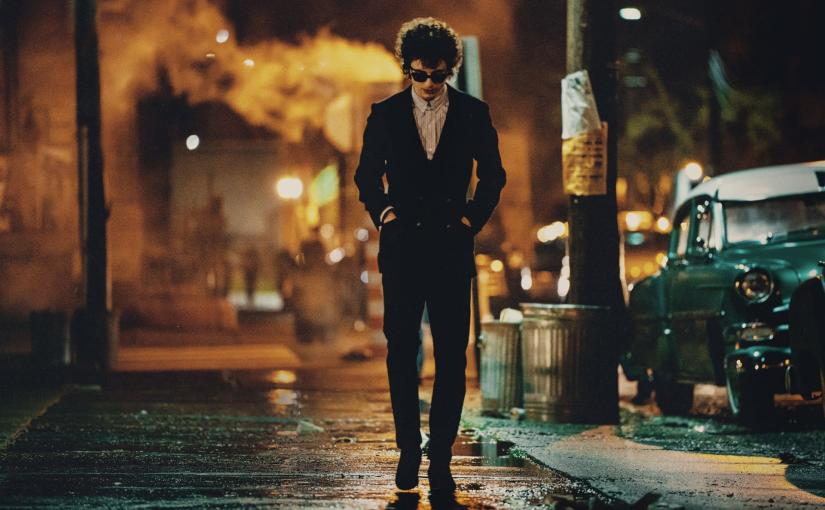
Timothée Chalamet delivers a blazingly convincing performance as Bob Dylan, surely a front runner for the Best Actor Oscar.  The appearance is easy to get used to. The dialect and expressions of what I’d like to think is the summit of what most of us know about the musician never falters from an apathetic expression or that mumbling hoarseness we all know.  Everything from the clothes to the shaggy brown hair to the sunglasses and motorcycle he confidently rides perfect this embodiment. In James Mangold’s latest musician biography (prior credits include the Johnny Cash bio Walk The Line), with Timothée Chalamet in this role, I was truly watching a Bob Dylan of the early to mid-1960’s.

Any movie has a conflict for its story to work around.  There’s more than one conflict in A Complete Unknown, but Bob Dylan would not know that.  He’s content with doing what he does and has not one care for what anyone else wants him to be or wants him to share.  Bob lacks much concern for the tumultuous times of the mid twentieth century either.  JFK and Malcolm X are assassinated.  The Vietnam War persists.  The Cuban Missile Crisis terrifies everyone.  Yet, Bob only focuses on his songwriting.  He’ll make connections with Pete Seegar (Edward Norton) and develop a sometimes-romantic tryst but mostly singing partnership with Joan Baez (Monica Barbaro).  He also gets involved with Sylvie Russo (Elle Fanning), one of his first fans.  However, no matter what they might expect of the performer, he’s only going to follow the path that drives him.  Therefore, that will be their own respective problems to contend with, not his.  Bob is only going to follow that path that he chooses.

Sylvie wants to know more about her live-in boyfriend who only tells tales of when he moved with a travelling carnival.  Joan wants to know where he learned to play guitar or even how he developed a knack for poetic lyricism.  Later, she’ll want to play the original numbers that solidified their friendship on stage despite his stubbornness not to agree.  It becomes curious when photo albums are delivered, addressed to a Robert Zimmerman.  Pete and his other peers want Bob, a now marquee name, to hold on to the grassroots of folk singing.  Bob will not acquiesce though.  Like other masterful musicians such as Prince or John Lennon and Elton John, Bob Dylan is going to continue to reinvent himself. 

In a matter of months, the signer becomes a nationwide superstar and he can’t walk the streets without getting bombarded; something he never wanted.  He performs with a passion for the music he’s written and he persists in making the next new thing with his talents as he transitions from acoustic to electric guitar and incorporates keyboards and drums to accompany his performances.  His friend Pete sees a berth becoming wider from the folk music he parades at annual festivals in Newport, Rhode Island and what Dylan insists on only playing.  Record producers (primarily represented by actor Dan Fogler) beg the singer to perform his older familiar tracks, but Bob Dylan only wants to move on to what is new and fresh. 

A Complete Unknown is full of such energy because it delivers what was produced by the guy who composed all of these magnificent and magnetic tracks from Song To Woodie to Blowin’ In The Wind to Like A Rolling Stone and to The Time’s They Are A Changing and A Hard Rain’s A-Gonna Fall.  You might not know or even understand all the verses by heart, but you quickly catch on to the choruses. To hear these newly composed songs pulled out of a dusty attic for an updated biography, performed by Timothée Chalamet in underground bars, at concert festivals or even in messy apartments is addicting.  You don’t want the actor to stop the song.  You don’t want the film to cut away from any of the numbers and you wish the concert would never end.  Like Joan Baez, Bob Dylan’s works stay with you.

I’ve become a huge admirer of James Mangold.  He’s a writer/director who does not criticize his subjects.  He empathizes with them and respects their boundaries.  We might find frustrations in people like Bob Dylan or Johnny Cash, but Mangold does not compromise the biography.  He finds reasons for you to like these men even while those who stand in their circles might not care for their attitudes. 

The director is also skillful at showing the history of the time.  Like the last Indiana Jones film he covered, the settings are so authentic.  New York City in A Complete Unknown is depicted down to the finest detail including the yellow street signs within the small boroughs of damp Brownstones and city streets that Bob Dylan navigates. The musty interiors of Woody Guthrie’s hospital room or Pete Seegar’s cabin home are shot with a hazy photography.  The Newport music festival, full of concert spectator extras feels like it was pulled from a documentary; what maybe a calm and relaxing Woodstock might have looked like.

Beyond Timothée Chalamet, the cast of this film is superb.  Elle Fanning need not say a word as James Mangold provides an assortment of close ups depicting her pain of wanting to love Bob Dylan but knowing she just can’t.  Her complexion turns into a weeping pink without one tear shed.  Monica Barbaro is on the cusp of becoming a marquee name in films.  The actress who was recently in action material with Tom Cruise and Arnold Schwarzenegger hides so well under the folk appearance of Joan Baez and she carries an immense stage presence. Scoot McNairy is Woody Guthrie who never speaks and only stares straight ahead during visits from Bob and Pete. Yet, the silent performance offers the only character who truly understood the value of an enigmatic Bob Dylan. Edward Norton has given a new range as a liberal and calm Pete Seegar who uses folk music as an escape from the turmoil of the times and not as a harbor to protest or fight an authority with aggression and violence.  He might wish for his friend Bob Dylan to uphold the value of folk music, but he knows he can’t keep a bird caged in one place either.  Norton’s introductory scene in a courthouse with a banjo in hand is unforgettable.  The casting is simply perfect in A Complete Unknown.

Since I saw this film on Christmas Day, I have not stopped thinking about it, and I think I want to see it again in a theater with a speaker system that amplifies the power of Bob Dylan’s guitar and mumbly vocals.  Right now, nothing sounds better.

A Complete Unknown is one of the best films of the year.

CALL ME BY YOUR NAME (Italy, 2017)

by Miguel E. Rodriguez

DIRECTOR: Luca Guadagnino
CAST: Armie Hammer, Timothée Chalamet, Michael Stuhlbarg
MY RATING: 10/10
ROTTEN TOMATOMETER: 94% Certified Fresh

PLOT: In 1980s Italy, romance blossoms between a seventeen-year-old student and the older man hired as his father’s research assistant.


Call Me by Your Name is remarkable because it tells a heartbreaking first-love story that could have easily devolved into cheap melodrama.  I mean, look at the plot description above.  It has “soap opera” written all over it.  But because director Luca Guadagnino (Bones and All, the 2018 remake of Suspiria) applies restraint, and because the screenplay by James Ivory (of Merchant Ivory fame) sticks to realism as opposed to predictable scripted nonsense, and because of the fearlessness of the film’s two leads, Call Me by Your Name becomes one of the best films about the thrill and heartbreak of first love I’ve ever seen.

The story takes place in the summer of 1983, in Italy.  The Perlmans are on vacation at their villa in the Italian countryside.  Mr. Perlman (Michael Stuhlbarg) has hired an American, Oliver (Armie Hammer), to assist him with research over the holiday.  Elio (Timothée Chalamet), Mr. Perlman’s 17-year-old son, appears to take an instant dislike to Oliver, but we later see this is a maneuver designed to disguise his real, and scary, crush on Oliver.

…but I don’t want to write a full synopsis of the story, because I guarantee it would read like someone’s Twilight fan-fiction or something similar.  What happens is reasonably predictable and has been seen in countless movies from Douglas Sirk to Nora Ephron.  What makes this movie special is how it happens.

There is not a single scene or shot in the movie that feels routine.  Or, not “routine”, that’s not the right word.  The whole movie feels authentic.  Nobody talks in screenplay-ese (except for a sensational speech from Mr. Perlman near the end, which I will forgive because it works).  Whatever happens, whenever it happens, feels spontaneous and precisely observed.

Here is at least one moment that captures what I mean.  Elio’s crush on Oliver has gotten deeper, but he’s kept it to himself.  One night, the two of them and a bunch of Elio’s friends visit a local bar with an outdoor dance floor.  Oliver starts dancing with a pretty girl.  Elio’s friends get up to dance, but Elio stays behind, eyeing Oliver and the girl, and you can almost hear the gears turning over in Elio’s head.  He finally does get up to dance, but watch his movements carefully: he starts dancing with a girl, but surreptitiously moves closer to Oliver for a moment.  Oliver turns to Elio, and Elio abruptly turns away and pulls a little move and slide, pretending not to notice Oliver while also trying to impress him a little.  Elio turns back, sees that Oliver is no longer looking, and quickly moves back towards him.  This kind of behavior is so specific, and yet universally recognizable.  There was no dialogue, but I knew everything going through Elio’s head in every second of that scene.

I also admired the scene, done in one take, where Elio finally reveals his feelings to Oliver, but it’s all done in this marvelous code, where Elio never actually says precisely what he’s talking about, but Oliver is smart enough to decipher the code.  (“Are you saying what I think you’re saying?”)  I’ve seen so many films where the Oliver character is written as an otherwise adult person but has to be incredibly dumb in order to prolong the “idiot plot.”  How refreshing to be confronted with characters with working brains.

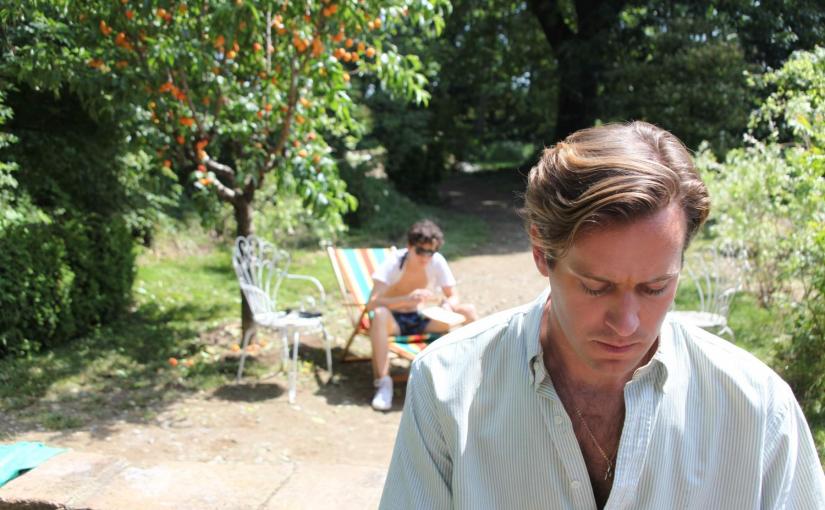
Guadagnino also appears to be a great fan of Japanese films, particularly those of Yasujiro Ozu.  Throughout the movie, there are many scenes that are divided, almost like chapter headings, by a series of stationary shots, held for several seconds, of ordinary items: a window, or a staircase, or the still waters of a lake, or an apricot tree.  Ozu was known for doing the same thing in his films; they were called “pillow shots,” because Japanese poetry utilizes the same device, using words instead of shots, to separate thoughts or ideas.  These “pillow shots” lend a sense of poetry or…I don’t know what, exactly, to the film.  It may look (and sound) a little pretentious, but trust me, it works.  It made the movie feel as if there were great currents of significance rumbling below the surface.

Alert readers may notice I haven’t even mentioned the sex scenes yet.  Going into this movie, I remembered that there was some hoopla about the graphic nature of those scenes, but I get the feeling they’re like the ear scene in Reservoir Dogs: everyone thinks they remember seeing the ear actually getting cut off, but we don’t.  Tarantino tactfully moves the camera up and away and leaves the dismemberment off-camera.  Same thing here.  Guadagnino leaves no doubt as to what is about to happen, but then moves the camera away, or cuts to the next scene, or expertly positions the camera so the naughtiest actions are never actually seen.

This is shrewd filmmaking.  If the film had been filled with NC-17-worthy content, the message would have been lost.  It would have become a movie about the sex instead of being about the turmoil and ecstasy of being in love with someone who loves you back, even if it’s only for a short time.

I should also mention the roles of Elio’s parents.  I can see how some people might watch the movie and imagine that his parents are far too forgiving, especially given their religious upbringing.  However, this was another welcome departure from the realms of unnecessary melodrama.  Instead of scenes where the furious parents make unreasonable demands or deliver intolerant lectures, we are given a father and mother who know enough about parenting, and about their son, to realize when it’s time to lecture and when it’s time to just let things happen.  I’m not suggesting they would ever willingly allow their son to go into harm’s way.  But they’re smart enough to know how important it is that Oliver and Elio take a little sabbatical together before Oliver’s final departure.

(They also know when a small lie is sometimes necessary at the appropriate moment.  After Mr. Perlman’s wonderful speech at the end of the film, Elio asks him, “Does mother know?”  Mr. Perlman hesitates, then delivers a very tactful answer.  To me, this was his way of protecting his son at a time when he desperately needed comfort.  I suppose it could be interpreted either way, but since Mr. Perlman knows his wife, I believe it was a perfectly timed lie.  Just a small one.  It’s a magnificent button to the scene.)

Call Me by Your Name deservedly won the Academy Award for Best Adapted Screenplay that year.  It’s a masterpiece of storytelling by osmosis, without using signal flags or hokey dialogue.  It recalls with perfect precision how it feels to be uplifted and crushed emotionally, and how one must decide how to deal with those feelings.  I was never the 17-year-old son of a professor with romantic feelings for his assistant, but I understood and identified with Elio nearly every step of the way during the movie.  I would imagine many others can, too.