INTERSTELLAR

By Marc S. Sanders

On a rewatch of Christopher Nolan’s Interstellar it is no wonder he eventually went on to adapt Homer’s The Odyssey into a fully realized film.  The classic sci-fi picture, which draws inspiration from Stanely Kubrick’s work while likely springboarding off of Arthur C Clarke’s and Isaac Asimov’s ideas, is an ambitious undertaking.  It’s not Star Wars with lasers and aliens, but it is slightly Star Trek with missions bent on discovery. Its fiction is rooted in true science and that’s precisely why it should be taken seriously; never taken for granted. 

Like The Odyssey, the story from Nolan with his writing partner and brother Jonathan, sets out on a far off journey that will take travelers decades into the future of a fictional future with an uncertainty of survival or a return back to Earth.  Loved ones back home remain in wait and worry.  The Nolans had to be thinking of Homer’s poetic opus while undertaking Interstellar.  The parallels are just so clear, welcoming fresh perspectives for both films.

Matthew McConaughey is Cooper, a former astronaut, now corn crop farmer and widower.  He is raising his son Tom (Timothée Chalamet) and daughter Murphy (Mackenzie Foy) who is choosing to follow in her father’s footsteps of accurate science and astronomy.  His father-in-law (John Lithgow) is tending to the family at the home and likely by default because Cooper was never meant to be a homemaker.  He was meant to soar among the stars.

The children’s school serves to prep them for farming and deny even the simplest theories of science, especially when Murph opts to write reports that back up such conjecture.  Cooper is on her side.  Yet, the school faculty deny any of the historic Apollo missions of the twentieth century and college is not a primary goal for students. Preparation for farm life is what’s needed. Wild legends that propagandize technological competitions in races to space with the Soviet Union lend no use or value to surviving on an Earth stricken with food shortages. Farming is what the world has to focus on.

Interstellar reveals that an interruption in Earth’s gravity is causing punishing sandstorms, more familiarly reminiscent of the dustbowl era from the 1930s. Technology is not cooperative, nor is it tolerable for the government. Even military service is no longer needed. Therefore, farming has become the most necessary industry to rely upon. The world these characters occupy is plagued with an extreme shortage of food while nitrogen is expected to replace the availability of oxygen. If the people of Earth don’t starve, they’ll suffocate.  For example, as the film begins the last crops of okra have run out for the entire planet Earth.  Wheat is also in short supply. Corn is becoming the standard on a planet that gets globally bombarded with punishing sandstorms. 

Through odd circumstances, Cooper and Murph meet up with the last remaining folks at a classified NASA facility, operating from a clandestine nowhere locale, led by leading science expert Professor Brand (Michael Caine) with assistance from his daughter, Amelia (Anne Hathaway).  They urge Cooper to pilot a ship into deep space, past Saturn, beyond the reaches of a black hole, and into another galaxy to locate a new planet that the remaining survivors of Earth can inhabit. That’s Plan A.

Should all else fail, Plan B is prepared with embryos to cargo thereby establishing new generations of mankind to indefinitely prolong the human race.  Specific destinations include attempting to catch up with NASA explorers who left many years before but never returned or provided updates on their progress.  Those astronauts only had the means to search individually and separate from one another. Cooper and Amelia would attempt to rendezvous with those that left before and surmise if they discovered anything that can be habitable. This mission serves the need to leave Earth, not to save it.

Murph resents her dad’s commitment to this new mission, but he sees no other choice.  Personally, Cooper has always been a pilot and astronaut. Farming is not in his blood. He, Amelia, along with two other crew members, Romilly and Doyle (David Gyasi, Wes Bentley), will age slower than those they leave behind on Earth.  Cooper is hoping to at least return by the time Murph’s age matches up to his.  

Accompanying the crew are two robots that possess the personalities of accurate science, with a bit of programable sarcasm mixed in.  Clearly the design of TARS and CASE (Bill Irwin, Josh Stewart) are drawn from Kubrick’s monolith image, but the stand-up rectangles can sectionally move to allow leg and arm use for utility operations.  Very clever fictional engineering work going on here. Irwin is especially impressive as TARS as he put his skills with mime work and body flexibility to work. He’s actually on set, encased in a box, functionally performing as TARS.

Christopher Nolan is filmmaker who knows how to make the exposition of his pictures magnetically curious.  First off, he works best when assembles his stories with a circular narration. Little details are disclosed and then left behind to reveal information about another subject and then another. Nothing may appear connected. However, often his movies will later go back to what’s only been hinted out and uncover an important purpose. Books falling off a shelf in the upstairs bedroom do not say much until you realize that there’s a message there. Dust particles descending in an organized pattern lend to an environment but may also serve a clue. On a first watch, and maybe even on the second and third view, it’s at least a welcome challenge to decipher the time period of the story and why even some of the most minute details serve so importantly. Christopher Nolan prefers to work with some brainy stuff.

Interstellar never feels like a chore even when you try to comprehend the complex debates among its characters.  Hathaway and McConaughey haggle over which planet to visit next.  Their resources far into this new galaxy will not enable them to visit both locations.  So, how important and powerful is love, bent on a personal desire, when the future of mankind is at stake? Should romanticism tip the scale of the crew’s decision? The travels through space offer unusual challenges that hardly mimic anything I’ve ever seen on a Star Trek episode.  

Back on earth, the children grow into adults played by Casey Affleck and Jessica Chastain, both very good at being disagreeable siblings living on a world that is quickly deteriorating while mounting dirt exposure affects the family’s health.  Affleck’s portrayal of Tom is focused on upholding crop supplies to defy worldwide starvation. Chastain’s portrayal of Murph works with Caine’s character, continuing his research that is expected to resolve the last variables of seeking a new planet to relocate the residents of Earth.  Contrary to Tom, Murph is working ahead of an inevitable loss by applying her knowledge of science to pioneer a more sensible solution.

A side story dating back to Murph’s youth revolves around a “ghost” who resides behind the bookshelf upstairs.  Out of nowhere, one book after another will topple off a shelf.  (A nice detail by Nolan is to have Stephen King’s dystopian novel The Stand propped up.) Are Murph and Cooper really willing to accept supernatural phenomena over what can only realistically occur? I mean we are talking about the hard truths of science here. Tom is happy to tease his little sister with the weirdness of a ghost living behind that bookshelf.

Interstellar never allows anything to be easy. Jonathan and Christopher Nolan’s script works harder at offering the unsolvable than what can lead to rescue and resolution. Science of any kind never makes anything easy. Even humanity can unexpectedly betray its best intentions. Things go awry in space and on Earth causing more setbacks and distance apart and therefore presenting less likelihood of success.  Yet, what’s effective is that Christopher Nolan treats his picture like a documentary.  Peppered through the first forty minutes of the film are elderly people offering up interview recollections of what it’s been like to live with meteorological dirt storms that intrude upon their homes and outer environments.  They have to turn their dishes upside down to keep them as clean as possible.  They need to wear masks and goggles. Seven years after this movie came out, ideas like this hardly seem exaggerated. The elderly folks who are being interviewed were real folks who experienced those dirt storms from the early twentieth century and participated in some of Ken Burns’ documentaries. Christopher Nolan operates on science fiction that is anything but far-fetched.

On paper, all of this would likely be the most exciting issue of Popular Science magazine ever published.  Sadly, it would never be read and rest on the coffee table in the lobby of our dentist or primary care physician. Thankfully, Nolan finds a way to thrill us through scenarios. Like 2001: A Space Odyssey (there’s that word, again), the Nolans offer first person, interior window perspectives of looking out over the wing of the space crafts.  You hardly ever get an idea of the whole dimensions of the model ships with only a select few omniscient, external views.  They want you to live within the confines of the space crafts.  Outer exhausts are emitted but when Nolan cuts in footage from the outside, the fumes are not accompanied by sound effects.  The same goes with various collisions or explosions in space.  Planet Earth may be depicted as an unlivable dust bowl, but the constructs of outer space remain unchanged.  Sound never exists in the vacuum of space.  So please have a seat Mr. Spock.

Though I wish his signature whispered twang was a little more enunciated, Matthew McConaughey is touching throughout the entire three-hour film.  Nolan captures an exceptional moment of sadness as he is able to catch up with video feeds submitted by Tom and Murph.  Try to fathom visiting a planet for the equivalent of three hours, measured on Earth, but when you return to the ship, over twenty-three years have gone by.  People back home have passed away.  Babies have been born.  Children have embarked on careers.  You might respond like Cooper does and become a mess of tears and homesickness.  It’s a one take sensational moment, beyond compare.  An absolute highlight of the actor’s career.  

Anne Hathaway is not the central character here, but she works well as a continuous counterpoint to the hypotheticals proposed by Cooper. As a contrast to Cooper the pilot, Amelia operates on exact science and though she’ll reside in an enclosed tin can of a spaceship with three men, she does not want to entertain the luxury of becoming friends. They might have endless amounts of time, journeying to Saturn and then on to another galaxy light years away, but there’s a lot of new science to uncover.   

Following Batman Begins, the director took his team back to Iceland which serves as destinations into the far reaches of outer space.  Nolan’s cameras sweep on and on and overhead to tell us there’s much to look for in these places left mostly untraveled.

Possibilities beyond imagination are treated like realistic outcomes, including ideas like communications traveling back in time by means of gravitational pulls. Things like this I completely buy but could never explain how it connects or operates.  

The Nolans accomplish what so many other pictures neglect or fail to factor including engineering, biology, astrophysics and necessary needs of survival accompanied by the philosophical natures of love.  It might sound romantic, but it’s been a long while since humanity grew out of the slime of the earth.  Love had something to do with us still breathing this air and allowing us to go see the director’s Batman movies.  

Christopher Nolan challenges us to find entertainment and wonder while he speaks on higher plains of intelligence than other standard summer blockbusters.  He’s at the other end of a wide spectrum where he’d never consider nuking an asteroid in space to save the Earth.  Something less glamorous and more overwhelming would take us out in his universe.  It would require his heroes to make bigger sacrifices than what another filmmaker might propose for Bruce Willis.  Nolan is the storyteller who is adamant that we can do better by use of scientific awareness and realistic possibilities.  

Who knows?  Incessant dust clouds might overcome the planet, accelerating its demise and forcing some of us to do things that a man like Cooper would declare “necessary.” When the glaciers finally melt away, I would not be surprised if the scientists at the time reference what Christopher Nolan considered in one of his pictures.

Nothing here feels so otherworldly or foolhardy, anymore.

Interstellar may be that sci-fi flick that’ll become required textbook studying for our children’s children’s children who live beyond the black holes of space and time.
LUCY

By Marc S. Sanders

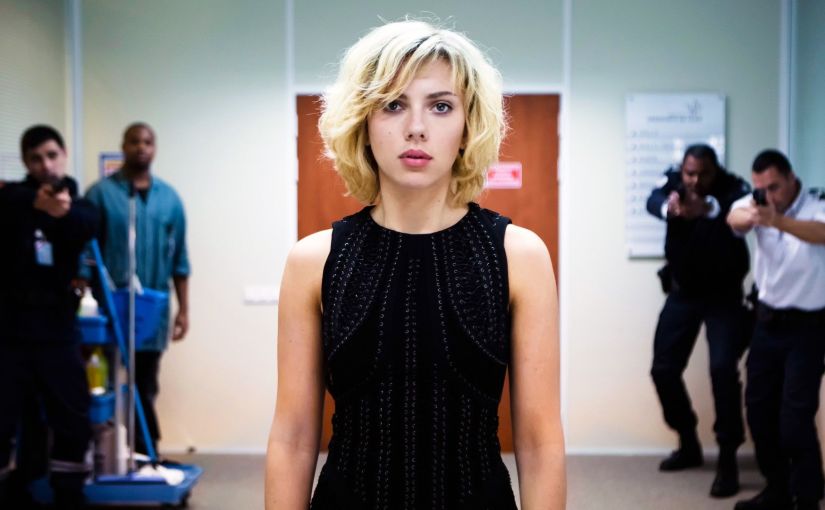
Only the headlining actors’ names appear before the title of the film, Lucy, but ten minutes into it I should have known I was watching a Luc Besson actioner.  It’s over the top and proudly exaggerated in its fiction like Leon: The Professional or The Fifth Element.  Because this one has Scarlett Johansson and Morgan Freeman talking about science fiction silliness in a brainy kind of way, Lucy is a lot of fun and likely better than those other two Besson flicks.  Just don’t try to comprehend the tech it preaches.  It’s important to remember that Luc Besson wrote it.  So why try in the first place?

Spliced within the first ten minutes of this hour and a half is nature documentary footage of wildlife in the open and nucleus cells splitting apart and coming together and whatever else cells do.  Most memorable is a cheetah pursuing a losing gazelle.  The story however focuses on young Lucy (Johansson), with her blonde crop topped hair suggestively hiding her left eye with a leopard print jacket hanging on her shoulders.  I got the impression that Lucy is a woman of the night in whatever Asian metropolitan city we are in.  I think Taiwan, but the bad guys speak Korean.  

A cad named Frank coaxes Lucy against her will into delivering a locked, aluminum briefcase to a high-rise apartment.  What’s in the case?  Well, isn’t that the go to starting point of so many movies these days? Whatever it is, it gets Frank killed right in front of Lucy.

But wait!!!! We actually get to see what’s in the case, this time.  Four bags of drugs that look like purple pop rock candies.  

A Korean mobster and his army of black suit/black tie cronies (surprised?) force Lucy and three men to be mules for the drugs and make deliveries.  I wasn’t clear on who the buyers are supposed to be.  It doesn’t matter, because poor, helpless Lucy gets to the airport only to get beaten up, forcing the bag of drugs to rupture and leak within her stomach.  

Besson initially showed us the figure of 10%.  Now, throughout the course of the picture that number will climb because Lucy’s brain capabilities are increasing rapidly as she is mobilized with cerebral powers that normal humans could never accomplish.  Apparently these chemicals are byproducts of the hormones that a pre-born embryo experiences allowing it to grow and develop into a fully functional human.  See, we’ve all gotten what Lucy’s gotten, but we’ve never gotten as much as what Lucy’s gotten.  So look out everyone.  Lucy is not coming to The Matrix.  The Matrix is coming to her.  

Morgan Freeman is the renowned Professor Norman, the world’s leading expert on brain activity.  He’s in Paris delivering a lecture on the theory that humans only use a fraction of their brain power to function.  In fact he claims that the sonar capabilities found in dolphins makes them much more advanced than any of us.  I nominate Flipper for President. We couldn’t get much worse.

With the Korean mob on her tail, Lucy goes after the other three mules located in Rome, Paris and Berlin, and recruits a French detective (Amr Waked) to assist her.  He doesn’t do much though.  

Lucy also makes contact with Professor Norman.  Sure she uses the phone to dial him up, but that’s not the only way she talks to him.  Just wait’ll you see.  And wait til you see how she takes on the mob who carry an armory of machine guns and an endless supply of ammo.  Let’s just say the Avengers and the X-Men don’t stand a chance against Lucy.

Morgan Freeman is not doing anything new here.  The script simply demands a wizened expert to intelligently deliver sci fi gibberish like it came out of Johns Hopkins.  Scarlett Johansson is an action star, no doubt.  At least, Lucy’s quick adaptations to her super powers stand apart from her Black Widow invincibility.  I like how she’s a lovey dovey airhead in the prologue of Besson’s movie and then evolves into a kind of walking bad ass super computer once the drugs kick in gradually doing more of their magic on her.

The ending gets really out there.  I never gave up on the movie, but I didn’t care to think through everything I was looking at.  Judging by Morgan Freeman’s face, neither was he.  He just wore the doctor’s coat.  Besson goes all over the place with wrapping up this short story, designed to be a graphic manga novel. 

The cuts and edits are exhilarating and thankfully Lucy spares us of just endless hand to hand combat stuff, like John Wick.  This movie relies more on superpower material trickery.  Still, it really gets out there.  Like out there to other places.  Like out there to other periods of time.

If Stanley Kubrick were to make an action movie…

Look, at least I bought into all of it because frankly if I’d used any more than 10% of my brain, I’d likely tear the whole movie apart.

WHIPLASH

By Marc S. Sanders

It’s impossible to find absolute perfection.  I don’t care if it’s in the field of medicine, law, mathematics, art or even music.  No one is THE ONE.  Yet, if you are determined to partake in that hunt, it’s likely you’ll scream with frustration.  You might think you’re on to something but still it’s not quite the one.  Maybe, however, you will force your search for the one if you throw a chair at your gifted student, scream some of the ugliest obscenities, impose threats, slap him, allow the tears to run, force a literal blood draw, or sweat them into numbing exhaustion.

Whiplash is the name of a piece of jazz music originally composed by Hank Levy.  It is also the title of Damien Chazelle’s brilliant first film, and the best to come out of 2014. Allegorically speaking, the term takes on a harsher connotation.   The word whiplash gives me an image of torn skin and hot, dripping blood.

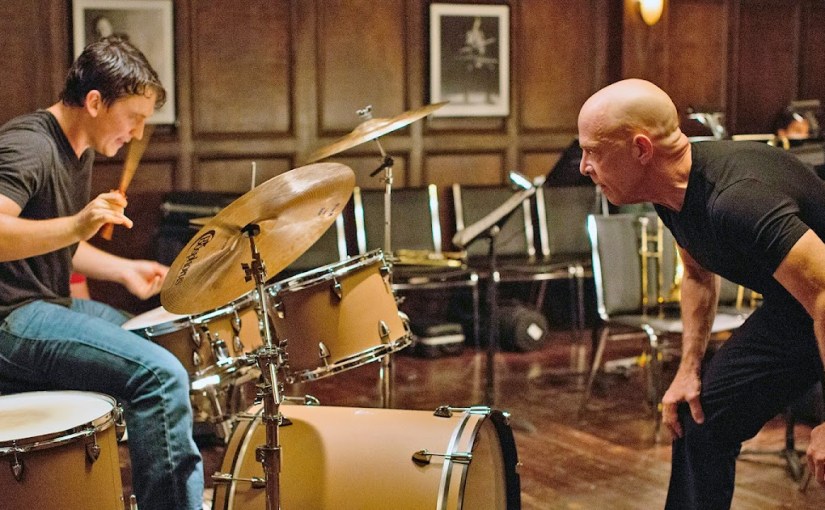
Andrew (Miles Teller) attends the Shafer Conservatory in New York.  He’s a jazz drummer who gets hand picked by the esteemed conductor Terence Fletcher (J.K. Simmons, in a well deserved Oscar winning role) to join his elite class.  Mr. Fletcher is cordial at first and a little instinctive as he’ll stop his musicians short of getting past one note before asking them to start again.  A hand gesture with a headshake and a wince.  Now go again.  Another gesture.  Go again.  One more gesture.  Again. Now an outburst of violent rage.

Individually, Andrew and Terence are determined with unhealthy mindsets to obtain levels of achievement that appear impossible to grasp.  The boy wants to get to where his drummer idol Buddy Rich plateaued.  The teacher wants to find the next Charlie “Bird” Parker.  These men of different generations are terribly talented.  Terribly I say because their passion for music is their self-imposed and cruel undoing.

Chazelle has much respect for the field of contemporary jazz.  I like jazz but I know nothing about how a piece is assembled so rhythmically among an assortment of instruments from the drums to the harp to the cello to the 88 keys and the various horns.  Put them all together, and there’s an atmospheric magic to what’s churned out.  It’s beautiful and bewildering.  Complicated, yet mesmerizing.  In Whiplash though, the music may be the worst antagonist because the frustrations that arrive with trying to become a master are unforgiving.

A late scene in the film shows Terence Fletcher, an altogether tyrant of a teacher, playing melodic nightclub piano in a bar.  He’s applauded and appreciatied as he presses down on the final key.  He thanks his audience with a nod.  Nevertheless, J.K. Simmons shows a different level of frustration.  Up to this point, the actor’s character has been a series of screaming eruptions.  In this moment, the man looks like he wants to cry.  No matter what he plays or how well loved he is, Terence Fletcher knows it could have been better.  So, if he lives with his suffering, then he will teach his best students to suffer through music as well.

Andrew is on the cusp of living his own life.  With a mother no longer in the picture, he still shares movie times with his father (Paul Reiser) perhaps so his father can still be a father, or maybe it is to remain a child to someone.  He’s starting a what could be a promising relationship with a girl named Nicole (Melissa Benoist), but his need to be a better drummer interfere and the only way he’ll know he’s at least as good as Buddy Rich is if he satisfies his teacher.  That’s the only sure sign.  

Does Terence turn Andrew into a monster, or is it the music?

This will always be one of Miles Teller’s best roles.  He’s got that innocent, quiet way about him, but as he gets “mentored” by this new composer, he changes.  He becomes devoid of care for Nicole and rebellious towards the lack of respect he receives from family and fellow students.  Like a chess champion, the art of drumming turns the drummer into an unloving creature soaked in blood and sweat.  This ongoing trajectory might make him a better musician but it will also bring him to an end result that matches his teacher.  

Beyond the energy of the music, Damien Chazelle steers a thrilling duo.  Simmons is an outstanding villain as a guy you can only hate until you see the motivations he’s only trapped himself into.  Only then you might just sympathize. Teller is circling the waters of a dangerous relationship with music.  Chazelle allows his picture to swim towards defiance with bloody and painful persistence. The epilogue of the film demonstrates precisely what these two men are searching for.  It’s only when you arrive at the end of Whiplash do you realize and empathize with the internal and physical pains these people choose to weigh on themselves.

To my ears, music is a beautiful, universal language.  

For the scribes, it’s an agony they choose to bear.

STILL ALICE

By Marc S. Sanders

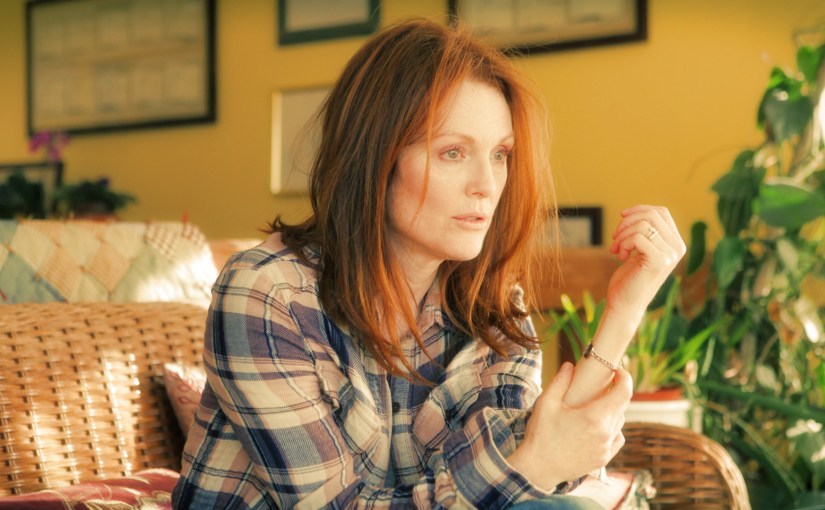
Still Alice is the observation of a woman whose mind gradually deteriorates from the symptoms of early onset Alzheimer’s disease.  Julianne Moore won an overdue slew of awards, particularly the Oscar, for the portrayal of the title character.  It’s a magnificently sensitive performance that will have you in tears following the first twenty minutes of the film.

Alice Howland is a revered Columbia professor of linguistics.  She has three grown children (Kristen Stewart, Kate Bosworth, Hunter Parrish) and John, her loving husband (Alec Baldwin).  The sad irony of Still Alice, adapted from Lisa Genova’s novel, is the fact that Alice specializes in teaching word origins and their formations, but she is stricken by the disease that will wipe her memory of the simplest vocabulary.  A highlighter becomes a “yellow thing.” 

The beginning of the film shows Alice functioning at her highest capacity following her fiftieth birthday.  She teaches her classes, does her daily jogs across campus, plays word games on her phone, travels across country delivering seminars and also tries to convince her youngest daughter, Lydia (Stewart) to abandon her dreams of becoming an actor and acquire a college degree.  Mixed in, however, are losses of train of thought, forgetting recipes, misplacing basic objects, forgetting appointments and getting lost during her jogs.  A quick glance over some visits with a neurologist (Stephen Kunken) set the wheels in motion of what we will witness Alice struggle with over the course of the film.  These doctor visits also teach the audience how one is examined for symptoms with simple memory tests and spelling questions. 

The film was directed by Richard Glatzer and Wash Westmoreland.  After I watched the movie, I learned that Glatzer could not speak while he was directing.  Due to his gradual deterioration from ALS, he had to resort to a computer monitor that would express his instructions to the cast and crew.  So now I’m that much more impressed.  To home in on the sensitivity of Still Alice, it only seems fitting that someone with Glatzer’s condition could co-direct this story. 

This is not a glamourous film.  Sometimes we may laugh at ourselves because we cannot think of a word or we forget a year or a name or we put our car keys in the refrigerator as soon as we come home and reach for a cold beverage.  However, when we see Alice discover that she puts a bottle of liquid soap in the fridge it says so much more.  Illnesses like Alzheimer’s and ALS strip people of the basics in living.  Having recently witnessed a friend slowly suffer and perish from ALS, I know that one disease brings you to this point with complete mental capacity while the other seems to tease you with how your mind gradually deteriorates.  Yet, like Richard Glatzer, my friend Joe did not stop functioning and co-wrote a play with me in his final year of life.  He couldn’t speak.  He couldn’t walk, but the man could write.

I have to credit the supporting cast behind Moore’s performance.  The film begins with the ease of conversations between the family members.  Before you know it, the exchange of dialogue shifts and becomes more one sided.  Julianne Moore most often shares scenes with Alec Baldwin and Kristen Stewart respectively.  She hides so well in her character’s mental incapacity that eventually, it looks like Alice Howland is not even applying the intelligence she’s collected and earned over her lifetime.  A scene in a yogurt shop towards the end of the film seems like Baldwin is the only one working.  He’s consuming his yogurt and reminding his wife of where she used to work while she sits beside him in an absolute haze of emptiness.  He simply says she is the smartest woman he’s ever known and by this point, I know exactly what he is talking about.  Moore is so heartbreaking in moments like this that I have to give credit to Alec Baldwin for maintaining his own performance against a scene partner who cannot offer much in return.

Alzheimer’s first affects the victim but also the family.  Still Alice allows time to explore the inconvenience of the illness.  There is the expected residual squabbling among the siblings.  Alice needs to be overlooked more and more as she gets sicker.  Who can be with her?  John still has to earn a living and has an opportunity for career advancement that he cannot afford to pass up.  A relocation is questioned because will it be okay for his wife.  Lydia is on the other side of the country trying to build her acting career.  Anna (Bosworth) is a pregnant, busy attorney, while Tom (Parrish) is in medical school. 

It’s also much more serious when the family learns that the gene Alice possesses has a one hundred percent chance of being passed down to the children.  This angle is touched upon for a brief moment, but then is hardly reflected as the film moves along.

Still Alice is a difficult film to stay with because it feels genuine in its account of living with Alzheimer’s.  Simple mistakes are just as heartbreaking as the big developments.  Leaving a potato in a purse is as hard to watch as seeing a mother speak to her daughter backstage, following a live acting performance. The daughter is now a stranger to the mother. 

Yes.  At times, the film feels like schmaltz you may find on the Lifetime channel, but then again you are seeing authentic, relatable performances from a cast who make up this family, especially the Oscar winner, Julianne Moore.  Alzheimer’s is an unfair and cruel disease that strips away everything a person builds for themselves in a lifetime.  Pardon the pun, but Still Alice makes sure you never forget that.

THE EQUALIZER

By Marc S. Sanders

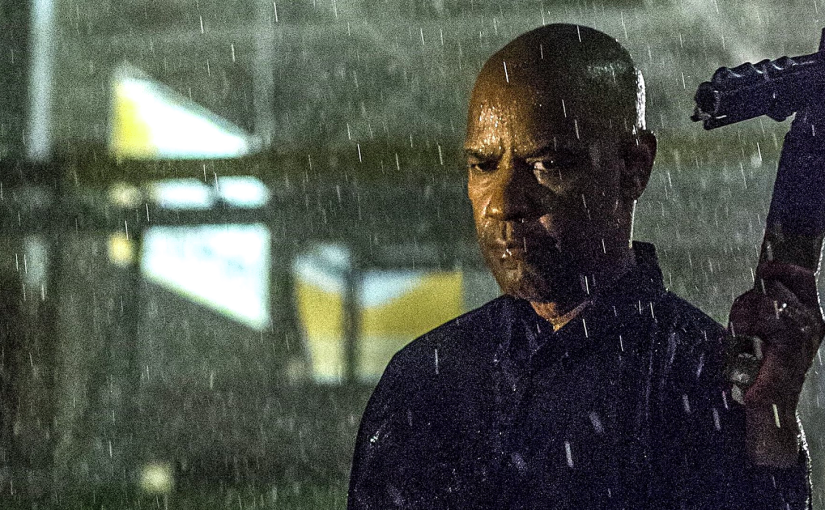
I guess Liam Neeson and Gerard Butler were unavailable when Antoine Fuqua and Denzel Washington collaborated to make the first installment of The Equalizer trilogy, based on the CBS television series that starred Edward Woodward.  This film is nothing special with a nothing special kind of script, a nothing special hero and a nothing special collection of Russian Mafia villains.  The kills are nothing special either.  The action is nothing special.  The explosions are nothing special, even when they are started by a trip wired microwave.

Robert McCall (Washington) lives a quiet life by himself, while working at a jumbo home improvement store (think Home Depot or Lowes – big places for lots of not so special action to take place at the conclusion of a not so special movie).  Turns out McCall, who also lives with OCD, is a retired special ops commando.  Robert uses his down time to read one of a hundred books that should be read before you die, while sitting quietly in a coffee shop each night.  He also volunteers his assistance with getting people to improve their lives.  A plump co-worker named Ralphie (the go to name for fat guys) played by Johnny Skortis is on Robert’s strict diet regimen to lose enough weight so that he can be promoted to the store’s security guard position.  Skortis occupies the best and most interesting character in The Equalizer.  During the final action sequence, it’s what Ralphie does that earned my one cheer during the course of the picture.

Robert also becomes acquainted with a young lady named Teri (Chloë Grace Moretz) who has aspirations of becoming a singer but is weighed down by her call girl commitments to members of the Russian mob.  When Robert sees that Teri has been beaten and is in serious trouble, he doesn’t wait to be asked for help.  He just does what is necessary to even the score.

That about does it for The Equalizer

No.  Seriously.  That’s all there is to it.  And so I’m very disappointed. 

First, Denzel Washington does not even look like he’s trying.  His demeanor to this character is no different than what he did in the lousy Man On Fire, directed by Tony Scott.  The script to this film is not challenging in the slightest.  Like Man On Fire, The Equalizer is simply a series of scenes where Robert torments his villains.  David Harbor is a corrupt Boston cop who gets trapped in his own car, while Robert runs a garden hose from the exhaust pipe to the inside with the engine running.  Where is the entertainment in this?  Washington sits in a chair while he mechanically opens and closes the car window and Harbor gasps for breath.  McCall is inventive with his methods but it does not lend to any story progression or character depth.  I guess Robert McCall is an artiste – one who specializes in torment, torture and death.

The climactic showdown, within the store, is a great set up for some tête-à-tête methodology to happen, but all of it is executed with little interest.  Here’s where I asked myself a question.  McCall nabs a guy in a makeshift kind of bear trap down aisle 10 (I guess).  The thug gets his neck caught in a barb wire noose and up he goes to the second level of pallet platforms for McCall to stare the guy down while the blood squirts out from his throat.  There’s four or five heavily armed other guys roaming the store, but McCall can take a break to stare this guy down for his last breaths.  If this trap works so well with this one guy, then why not set up six or seven more of these MacGyver contraptions and let each machine gun toting baddie go through the same routine?  I know.  I know.  Miguel would respond, “because then there would be no movie!”  Yet, what does that say about The Equalizer that my mind drifts to this idea?

Later in the sequence, McCall easily walks up to another thug from behind and delivers a power drill to the back of his head.  Then he puts the drill back on the shelf.  Again, if this worked so efficiently and covertly, why not just do it again? And what is so exciting about a power drill anyway if Jason Vorhees isn’t using it?

A nail gun is used a few minutes later and Fuqua opts to just have Washington shoot one nail after another into his opponent.  Bang – Nail – Cock! Bang – Nail – Cock!  There’s no pun or one liner.  There’s just a bad guy who falls to one knee, then an arm goes down.  The machine gun lets off a few rounds and drops to the floor. There goes the other knee and then he’s dead.  Washington just observes the guy die while the sprinkler system drenches him stylistically in slow motion. 

I look at The Equalizer and I think back to the ‘80s actioners from Schwarzenegger, Van Damme, Stallone (some of them), Jackie Chan and even Seagal.  The Rock had fun with a few of these action pieces too.  Go check out The Rundown.  There was a pizzaz to the hero’s methodologies back then.  It wasn’t just a brutal killing and bloodletting.  A one liner accompanied the kills.  It made you cheer and applaud.  Those pictures worked like symphonies of dialogue and ultra cool action that John Wayne never accomplished.  Robert McCall is boring.  Just boring.  An absolute bore.

The villain of this effortless piece is also boring.  Marton Csokas did not advance his career with the lack of anything beyond his Russian dialect and three-piece suits used in this picture. 

Antoine Fuqua has yet to wow me.  Though I know he’s an accomplished director, Training Day always feels like it comes up short with the three or four times I’ve watched it looking for its merits. The critically poor procedural of The Equalizer only lessens his promise for growth and potential.

Denzel Washington has resorted to uninspired characters a few times now. He still earns accolades with pictures like the recent The Tragedy Of Macbeth (a Best Actor nomination) and on stage (I was in the third-row orchestra when I saw him do a forty five minute monologue in The Iceman Cometh on Broadway.  Amazing!).  Still, he just recently completed the third installment of the Equalizer series. Ugh!  Why?  Why Denzel?  Why are you trying to be another past his prime, tired Liam Neeson in these cheapo action pictures?

What I wouldn’t give for another Crimson Tide kind of thriller.

AMERICAN SNIPER (2014)

by Miguel E. Rodriguez

DIRECTOR: Clint Eastwood
CAST: Bradley Cooper, Sienna Miller, Luke Grimes, Jake McDorman
MY RATING: 9/10
ROTTEN TOMATOMETER: 72% Certified Fresh

PLOT: Real-life Navy S.E.A.L. sniper Chris Kyle becomes the most lethal sniper in American history during four tours of duty in Iraq, but he finds it difficult to leave the war behind when he finally returns home.


I once called Katherine Bigelow’s award-winning The Hurt Locker the Deer Hunter for the Iraq War generation.  Having just seen Clint Eastwood’s masterful American Sniper for the first time, I must now amend my statement.  American Sniper presents its story concisely, almost tersely, states the facts of the matter, and leaves the audience to draw its own conclusions when the credits roll.  For myself, I was once again struck by the sacrifices of those men and women who have ever made, and will ever make, the choice to serve their country, for whatever reasons.

Chris Kyle’s reasons are made clear at the outset.  30-year-old Kyle (Bradley Cooper) is a skilled cowboy and rodeo rider when he decides to enlist in the military after seeing footage of the embassy bombings in 1998.  In a marvelously edited prologue (resembling a Scorsese film), we see Kyle’s father impress upon a school-age Kyle how people are either sheep, wolves, or sheepdogs.  Wolves attack the sheep, and the sheepdogs protect the sheep.  Kyle has lived his entire life with a sheepdog mentality and badly wants to do his part to protect his country against what he feels are the forces of evil.

Kyle enlists in the Navy S.E.A.L.s and, after a brutal training process, becomes a skilled sniper.  Shortly after graduation, he meets and falls in love with Taya (Sienna Miller).  The abbreviated exposition of their courtship and marriage contains little details that give a ring of authenticity that even The Deer Hunter lacks at times.  (After their first meeting in a bar, for example, Taya has to run outside and throw up after doing one too many shots.  Kyle follows and discreetly holds her hair back, as every gentleman should.  It’s the kind of scene you would normally see in a mid-level rom-com, but it feels as real as an autobiography.)

Kyle’s and Taya’s relationship at home is an important factor in the film, but the bulk of the story shows us Kyle putting his unique skills to use in Iraq, where he is sent shortly after the 9/11 attacks.  These scenes belong in some kind of war movie Hall of Fame.  Kyle’s first kills occur when he has to make a command decision whether or not to shoot a young Iraqi boy holding a grenade and running towards a US convoy.  The scene takes on an even more horrific dimension when the mother tries to pick up where her young son failed.  This horror is echoed in triplicate in a later scene when an even younger boy approaches an abandoned rocket launcher and appears ready to fire it at American troops.

Kyle goes on to much more “conventional” warfare later on (including a virtual duel between himself and another similarly skilled enemy sniper), but it’s scenes like the ones I mention above that elevate American Sniper into a masterpiece.  Watching them, I could not help but remember that this movie is based on a real person who went to real war zones during his lifetime.  I have no idea whether Kyle really did make those choices in real life, but the idea remains: whether Kyle did or not, it’s a foregone conclusion that someone had to make similar decisions at one time or another, not just in the Iraq War, but in other wars, many wars, ALL wars.  (I was perversely reminded of another superior war film, also based on fact, Jarhead, where the main character is also a sniper, except he never gets to fire his weapon in combat.  My respect for that character is no less profound.)

Speaking for myself, I don’t know if I have it in me to make that kind of call.  I have nothing but admiration and respect for those people who are making those calls every day in wartime, who are asked to put their lives and mental health on the line and do their duty no matter what.

Kyle’s compulsion to be a protector leads to his decision to become part of the teams “clearing” houses on the ground, as opposed to being the “overwatch” who protects them from the rooftops.  He sees too many squads being cut down by enemy soldiers inside the houses where he can’t see them from above.  “If I can’t see them, I can’t shoot them.”  One of his comrades disagrees with this decision.

“All these guys?  They know your name, and they feel invincible with you up there.”
“They’re not.”
“They are if they think they are.”

His decision puts him in even greater danger than before, but he can’t help himself.  Every death that he feels he could have prevented haunts him.  In another echo of another shattering war film, I was reminded of Oskar Schindler’s last scene in Schindler’s List when he breaks down thinking of how many more Jews he could have saved, instead of focusing on the ones he did save.  It’s impossible to say exactly how many lives Chris Kyle may have saved with his actions in Iraq, but in his mind, he was just doing the right thing, not the heroic thing, so he never felt comfortable accepting the title bestowed upon him by his grateful comrades: “The Legend.”

American Sniper is also very careful to depict the cost Kyle faced as the result of his job.  For one, the Iraqi insurgents put a $180,000 bounty on his head, making his job even more dangerous than it already was.  For another, he witnesses some things firsthand that would give Quentin Tarantino nightmares.  At one point, he tracks down an Iraqi enforcer nicknamed “The Butcher” who uses a drill to punish anyone who collaborates with American soldiers.  When Kyle raids his compound, he finds a freezer full of the Butcher’s “souvenirs.”  This is all on top of the various times he sees his teammates cut down by enemy fire, sometimes right in front of him.

The other cost comes during the brief periods at home between tours.  He loves his wife and children, but he finds it impossible to share the details of what happened to him in Iraq.  This reticence threatens his marriage to the point where Taya tells him flat out: “If you leave again [for another tour of duty], I don’t think we’ll be here when you get back.”  This kind of plot point is hardly new, but again, there is a ring of truth to it in this movie that makes it much more poignant than it normally is.  Kyle’s internal code can’t allow him to let someone else go to a war zone and do a job that he is eminently more qualified than anyone else to do.  “I have to serve my country.”  And that’s that.

(The film does have one drawback that compels me to score it as a “9” instead of a “10.”  There are scenes later in the film depicting more of Kyle’s troubles at home and as he speaks to a psychiatrist who recommends he go down to the VA and meet with disabled veterans as a way of “saving” soldiers without being in combat.  While these scenes are invaluable in terms of shedding even more light on Kyle’s character, even this late in the film, I did feel like there could have been a little more time spent with Kyle and those veterans so we could flesh that issue out just a little more.  There’s much more to it than could possibly be explored in just the last fifteen minutes of a movie.  I’m not saying it should have become Coming Home, but…that’s my opinion.)

In the event you don’t know Chris Kyle’s ultimate fate, I won’t spoil it here.  I had forgotten about it, and when the movie sprung it on me, it was as surprising as any other plot twist I can think of.  American Sniper proved to me, as if it needed proving again, that the people in our armed forces, especially those in combat zones, face unthinkable decisions, sometimes on a daily basis.  The morality of those decisions can, and will, be debated from now until such time (God willing) that armed forces are no longer necessary in this world.  This movie doesn’t pass that kind of judgement.  It merely says, “Here is what happened.  What do you think about it?”  How you answer that question is what the movie was really about.

A MOST VIOLENT YEAR

By Marc S. Sanders

If Michael Corleone had kept his promise to Kay to go strictly legitimate, he’d probably have become Abel Morales, the protagonist of A Most Violent Year, played exceedingly well by underrated Oscar Isaac.

Writer/Director J.C. Chandor sets his story in winter 1981, on record statistically recognized as what the film’s title literary suggests.  Therefore, it is a challenge for Morales to successfully bring his heating oil enterprise to a capital success when his competitors don’t play by the rules and hijack his product while threatening his able staff of truckers and salespeople. Then there is the stigma Morales must endure by being married to a reputed mob boss’ daughter, searingly played by Jessica Chastain, ready at a moment’s notice to call on her own family for help or to just pull a trigger herself.  Morales tried his hardest to keep her in check.  Furthermore, the industry he’s chosen is riddled with suspicion of fraud, embezzlement, racketeering, and underhanded tricks. All this warrants the DA to bring an endless array of indictments against Morales and his business, despite all the cooperation and legal activities that have been accomplished so far.

So why go through with this at all?  A lifetime has been invested.  Time of money and work to fight for an opportunity.  Abel knows this more than anything, and he will not surrender to deals from the DA or the mob.  He will not compromise despite the challenges.

Chandor’s film is well done.  It had been on my radar to watch since its release and yet it was not what I expected.  I was waiting for Abel’s widely seen beautiful camel overcoat to end up soaked in blood.  It never came to be.  That observation only suggests that A Most Violent Year does not promise on its descriptiveness.  On the contrary, it offers the setting so that we understand Abel’s conflict.  

A good story piles on one problem after another to keep a viewer compelled. Maybe one primary problem is wrapped up a little too neatly here, but no matter.  I also would have preferred better camera positioning from Chandor on occasion. Some characters who are being introduced for the first time are heard speaking off camera only to then be shown a close up of them with no more to say.  Happened more than twice and I can’t understand why.  I’m sure Chandor artistically intended it to be that way.  Yet, I didn’t like it.

Oscar Isaac and Jessica Chastain are great.  These are two actors rarely seen in the gossip rags.  So, they are more well known for selecting smart roles and stretching their flexibility for the parts they agree to take.  It’s refreshing. It’s why A Most Violent Year can be capably made with a great script (better than the film) amid all of the tentpole blockbuster sequels.  

It’s worth it to check out.

GONE GIRL

By Marc S. Sanders

David Fincher is best when he builds tension in dark cinematography. It’s eerie and moody, but it all seems to make appropriate sense.

A skilled director like him proves that even with Lifetime television soap opera material, if delivered with care for detail and with genuine acting he can hold on to the attention of a scrupulous movie going audience. Haunting filmmaking, like Fincher is known for with movies like Seven or Panic Room, can also work in sensational material that at first might draw the attention of lonely housewives pigging out on Rocky Road ice cream while watching hours upon hours of scorned victim gossip material on the WE Channel. Gone Girl adapted from the best-selling novel by Gillian Flynn, who also wrote the screenplay, is a thrilling cinematic piece even if the story’s ending is a little disappointing.

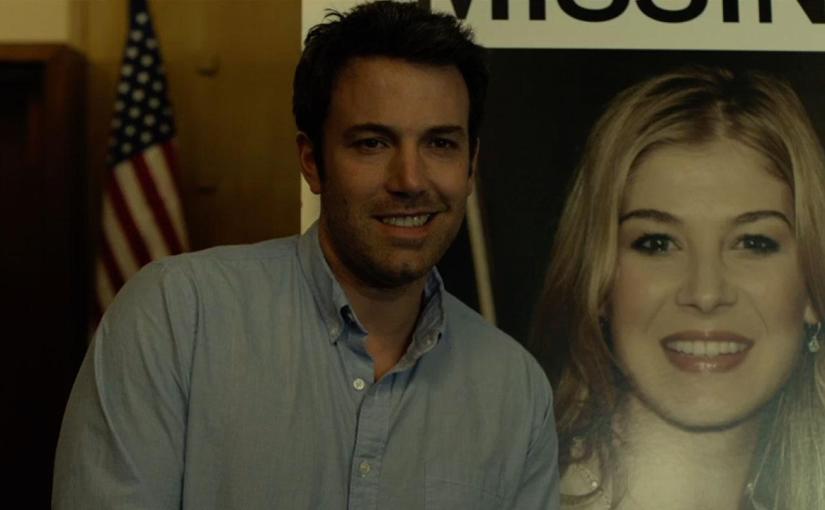
Ben Affleck plays Nick Lowe who discovers a broken glass coffee table in his home and realizes his wife of 5 years is missing. Rosumund Pike is Amy, who seemingly vanished without a trace.

Fincher closely shoots Flynn’s story with developments you might expect or have experienced with various news stories and documented investigations by sensational legal journalists like Nancy Grace. Nick, with Amy’s parents (Lisa Banes, David Clennon), initially form a united front for the press but that falls apart when it’s uncovered that Nick has had an affair. Amy had a close neighbor who expresses tearful concern that cameras latch on to for ratings. The cops (Kim Dickens, Patrick Fugit) grow more and more suspicious of Nick. Nick eventually hires a high-priced lawyer (Tyler Perry). Nick is eventually considered to be an abusive husband as well. It all adds up.

These are the steps you’d expect from a missing persons case. You might also suspect murder, but no one can claim that out loud if there’s no body to be found. So, toe the line carefully detectives, journalists, & gossip mongers!

What is not expected in Gone Girl are the surprises that open up midway through the picture, and the book. Flynn is a really inventive storyteller, and Fincher as director gives ample opportunity to answer for every surprise up the writer’s sleeve. Gone Girl plays with a lot of internal character thought to process its details.

I had read the novel long before the movie was even cast, and I couldn’t put it down. That being said, I was frustrated when the conclusion arrived. I can say the same for the faithful film adaptation. It’s an ending that could happen but, wow, is it a long shot.

Rosamund Pike was Oscar nominated as Amy, the complicated wife in this marriage. She’s good at occupying the complexity of her past shown in flashback. She’s likable in many moments, but then Amy is also a character that we are reluctant to trust based on her relationship to Nick, as well as her own parents.

Affleck remains a good actor with this picture. I think it takes an honest actor, writer and director to accurately show a man who might not be responding to this crisis like a general public expects. I think much of Affleck’s personal issues of infidelity and alcoholism in the public eye lend credence to how genuine he makes Nick out to be. Could this guy be handsome enough to think he could harm or actually murder a woman as beautiful as Amy; the “Amazing Amy” as she’s widely known in her mother’s series of best-selling children’s books? Is Nick that good at hiding his evil side? On the other hand, is Nick simply innocent, despite all the skeletons that are gradually uncovered? That’s a fair question as well.

Again, Gone Girl is superb in its delivery. It’s ending, though, is the setback. At least I felt that way. For every reader, like me who considers it dubious, I’m sure there are readers who applaud the inventiveness of Gillian Flynn’s gripping and modern mystery.

I guess if a good story prompts a group discussion on a Saturday night, then a really good novel or a great movie has achieved its purpose. At the very least, I consider that a great compliment for an outstanding cast, director and writer.

MALIFICENT

By Marc S. Sanders

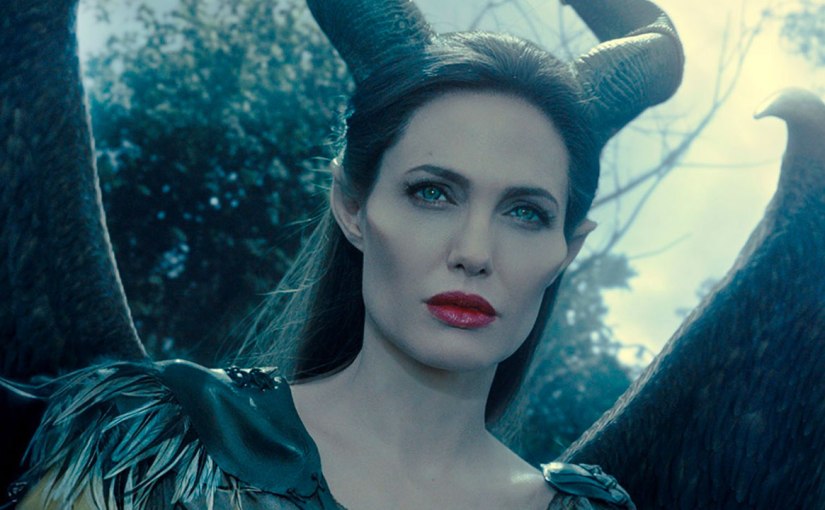
The wagon train of live action adaptations of Disney animated classics reached its pinnacle with 2014’s Maleficent. Much credit going towards Angelina Jolie’s portrayal of the title character. However, the visuals cannot be dismissed either. It’s a gorgeous film directed by Robert Stromberg.

Stromberg brings his wealth of experience in visual effects (Avatar and Master And Commander: The Far Side Of The World) to his directorial debut. The fantasy world of Maleficent’s forest, as well as the looming castle on its outskirts are dressed in gorgeous colors and vast dimension of pathways and caverns. The magical spells wafting in greens, golds, blues and reds, wielded by the characters, including the three protective fairies (led by a strong Imelda Staunton) is hypnotic and blends beautifully with the live actors’ performances. It’s as bold in the visual department as anything cropped up by Peter Jackson or James Cameron.

What makes this brisk 90 minute film special is a different point of view from the classic film Sleeping Beauty. Is there justification to a villain’s actions? Stromberg and Jolie certainly make a case for it. It’s a reminder that there are two sides to every story. Anyone ever consider that maybe Maleficent might have been betrayed at one point? I’ll be damned. At least that’s what I thought, after watching this film.

No one in life is born evil. I like to think people are made evil or perceived as evil. This film is a great example of that, much like the musical Wicked or the recent hit film Joker.

Jolie offers up the frightening aspects of the fairy dressed in black that we’ve been familiar with all these years. However, she’s fortunate that the capable script from Linda Woolverton offers up opportune moments to consider her soft, sensitive side. There are moments of no dialogue as Maleficent observes Princess Aurora (Sleeping Beauty) grow, and she develops a reluctant (it’s hard to resist calling her “Beasty”) affection for the child. Maleficent will even participate in a playful mud fight. There are more than just evil machinations going on here.

Unlike the other Disney live action iterations, Maleficent shows something new and unexpected. It harbors my appreciation for the film whereas Beauty And The Beast or Aladdin did not because they just churned out the same old thing.

If Stromberg’s film suffers from one weakness I’d say it could have used a stronger performance from Sharlto Copley (The A Team film adaptation) as the antagonist, Aurora’s father and Maleficent’s first love; the eventual king. There was not much threat from this guy. He was no match in character much less performance against Jolie.

Still, Maleficent is a great character film with lots of fun, whimsical visuals to explore.

WILD TALES

By Marc S. Sanders

Humans were meant to be distressed.  It just goes with the territory.  It’s in our nature to distress one another and respond with another layer of distress.  It’s also a cosmic element of practically any environment we find ourselves in.  Within our journeys of life, when we are striving to be better as a spouse, a parent or worker, it takes an acceptance of stress to get to where we want to be.  It’s only when we die that we can truly rest in peace.  Wedding planning or road rage or airline travel can be overly taxing. Your car could get towed, a person from your past could turn up or you can even become unreasonably extorted when faced with extenuating circumstances.  It all seems so unfair or inconvenient or intrusive.  So, I find it interesting that director Damián Szifron would provide the credits of the cast and crew for his film Wild Tales against a backdrop of wildlife animals.  Humans may be the dominant species, but even they have animal instincts that can spiral wildly out of control.

With writer, Germán Servidio, Szifron offers up six different short stories in this Argentinian film that was nominated for Best Foreign Language Film at the 2014 Oscars.  Each story focuses on an opportunity for revenge or an experience of high stress where people come in contact with other people.  Granted, some of the stories are so outrageous in circumstance, response and outcome that I’d find them hard to believe they truly happened if someone vouched for it.  For example, you likely never saw a wedding reception like the one staged in this film.  I don’t care who you are.  YOU NEVER SAW A WEDDING LIKE THIS!!!!  Still, this is a very entertaining film that left me curious with how each story was going to play out.

A truly engaging airline experience prologues the credits when a beautiful model strikes up a conversation with the elderly gentlemen across the aisle.  When a woman in the next row can’t help but eavesdrop on their exchange, a most unexpected event occurs.  Doom awaits!!!  More importantly, though, why does it await?  It’s a brilliant opening, likely never to occur in real life, but altogether unexpected and humorously shocking.

Following the credits, a question of morality and revenge plays out in an after-hours diner when someone from a waitress’ past enters for a late night meal.  This is the most incomplete vignette of the bunch, but the narrative remains interesting. 

Listed below the airline tale, my next favorite tale involves a road rage incident between the driver of a beautiful black Audi and someone who drives an old jalopy of a car.  Likely, it is the most relatable of all the stories.  We’ve all either experienced some form of road rage, or read about it, or have committed or been tempted to engage.  There’s a strong lesson to be learned from this story and it is rather incredible how this encounter between two descends into madness.

Stories of extortion and unfair city policies fill out the other slots, before finally closing on a wedding from hell.

What’s interesting is that while the stories may rely somewhat on their dialogue, I believe I could watch Wild Tales without knowing much of what is being said.  The cast is phenomenal in expression and response.  Szifron quickly sets up the scene and then has his various token characters react to what faces them.  We see the extremes a bride goes to when an unexpected guest appears at her reception.  We are the lone witness to how a driver will seize an opportunity when another driver is stranded on a lonesome highway with a flat tire.  We can understand the persistence a man will uphold in order to prove he did not commit a parking violation.  Wild Tales does not depend on crackling dialogue.  Instead, the visuals and the performances do a lot of the work.

Too often, I hear that people will not watch films with subtitles.  They cannot stand to “read” a film.  Come on!!!!  You have to allow yourself the opportunity to uncover amazing documents of cinematic escapism beyond the American fare.  No film hinges on the subtitles that flash across the bottom of the screen.  Like any movie, the primary element is the photography of the piece.  Since I am not much of a traveler, domestic or international, it is so refreshing when I’m reminded that cultures, behaviors and customs outside my comfort zone of the United States, are not any different from me or the people I surround myself with.  We are all capable of love, drama, humor, sacrifice, crime and an innate possibility of flying off the handle in very, very extreme ways, whether we are justified or not. 

I am not familiar with many foreign pictures.  Honestly, I don’t get motivated enough to seek them out.  I need to lighten my reluctance.  It is fortunate that my colleague, Miguel E Rodriguez, provided this entertaining, mischievously fun collection of devilish short thrillers to our Cinephile movie group for a Sunday viewing.  Damián Szifron has crafted a film that you can’t take your eyes off.  The photography is striking with amazing camera angles such as a point of view from inside an airplane luggage compartment or from the sidewalk ground level where an automobile owner discovers that his car has been wrongfully possessed.  Miguel says moments like these are Tarantino inspired.  Maybe.  I like to think I’m watching a film by Damián Szifron, an insightful and skilled director at the top of his game.