
THE ODYSSEY

By Marc S. Sanders

It seems that Christopher Nolan is left challenged by one thing – himself.  In less than thirty years this director/producer/writer has moved from the simplest of filmmaking with limited funds (FollowingMemento) to enormous heights in bonanza showmanship like The Odyssey, the first movie to be completely shot with IMAX cameras.  These devices are expensive and according to Nolan, they are also heavy and overbearingly noisy.  Yet, IMAX accommodated the filmmaker with specialized boxes to contain their equipment and muffle the sound interference.  As such, The Odyssey is a wonder to the eye.  Frankly, as impressed as I was with the film, on the most ideal IMAX screen available, I still didn’t see anything that felt any grander than the latest Dune offerings.  I mean how far are my pair of 20/15 LASIK eyes supposed to decipher?  Don’t get me wrong.  I am impressed.  However, was I as impressed as I was supposed to be? Should I be nitpicking pixels here?

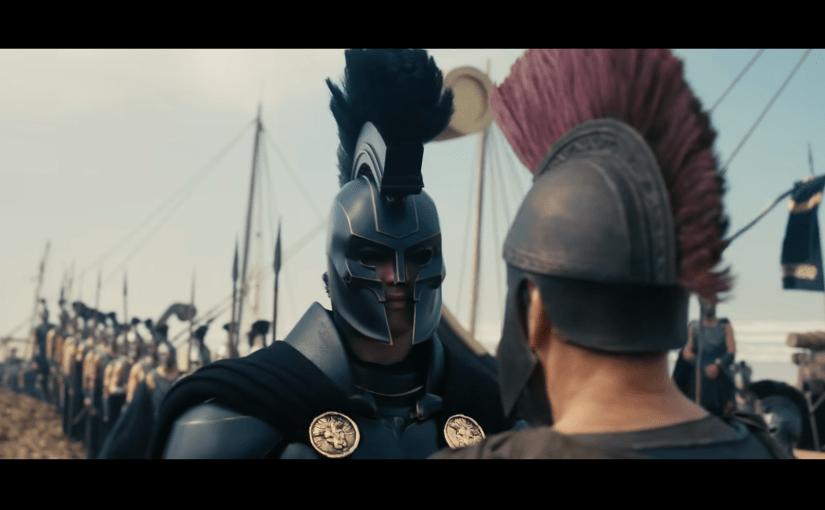
IMAX says it all though.  The landscapes of open desert plains and vast open waters are brilliantly captured.  I could never tell you of any inconsistencies or shortcomings.  Costumes serve just as any sword and sandal picture that came before.  The sound, especially in an IMAX theater, is immersive and deafening as expected. Tidal waves within blinding rainstorms demonstrate this wholeheartedly.  The cast is stacked with some of the best talent available. The Odyssey has everything it demands of its legacy and what’s expected of a Christopher Nolan film.  Yet, I was never emotionally invested in the picture.  Understand that Christopher Nolan knows how to reach an audience on a primordial level of emotions. Think back to Matthew McConaughey’s tearful moment in Interstellar or how he shares scenes with young Mackenzie Foy. Look at Christian Bale’s anguish during the middle section of The Dark Knight. Hugh Jackman and Bale compete for moments of deep rage and sadness within The Prestige.

Nolan wrote his adaptation of Homer’s poetically romantic adventure.  I recall reading it in high school.  The fat, floppy, black paperback that weighed down my book bag has never been forgotten.  The highlights of the story remain in my consciousness from the Trojan Horse to Helen Of Troy (the face that launched a thousand ships), and of course the central plot of having the famed Odysseus making his long awaited journey home.  It’s all here, and then there’s more including the towering Cyclops and Circe, the witch who can turn men into pigs.  Nolan’s film goes from chapter to chapter, beat by beat.  This easily could have been a ten-episode miniseries on HBO MAX, and people would eagerly watch every Sunday night.

I favor Nolan’s choice to rely on modern dialogue, without rooted domestic accents or dialects. It’s a wise choice when delivering a poetic opus to the screen. This movie is a story. It likely would not relate to audiences on a poetic level structured in stanzas. Homer’s work does not lend to dialogue like Shakespeare or Mamet. A friend took issue with referring to Odysseus and Penelope as “mom” and “dad.” I get it. Nolan’s picture is much bigger than Harry Potter. However, the characters are bonded as family. So, it’s a pick your preference kind of situation. You either embrace or it takes you out of the story on occasion.

I’m not sure what I can say that this beast of a film says for itself.  If you’re not dazzled by simply one shred of a moment in this picture, then you are impossible to satisfy. Consider me wowed, but I was not moved.  The same way that I was never absorbed with Homer’s piece.  It was a homework assignment that spanned a long month of my junior year.  As a film lover, it’s inevitable that I see this picture. If it’s the first complete IMAX picture from beginning to end, then yeah, I’m spending the extra money to see it that way.  Am I going to watch it on repeat, on home video 4K? Probably never on a whim.  It’s a chore.

First, the picture seems to presume the viewers have prior knowledge of elements like the battle of Troy and why the war took place before we see how the famed Trojan Horse led to Odysseus’ (Matt Damon) victory with his army.  I don’t recall all that merited the action, but Nolan’s footage is astounding, especially that enormous horse on its hind legs.  On screen, the figure is as towering as the Statue of Liberty. No wonder the thing is being sold as a popcorn bucket.  

As complex as Christopher Nolan’s films can be (InterstellarInception), I always thought he was great at spelling out his unique brands of formula.  It took me a good hour or more to pencil down who everyone is playing and what purpose they serve in The Odyssey.  It boasts a big cast of celebrities who are all given their moments to shine.  I was especially taken with Samantha Morton’s Circe, introduced as a helpless woman grotesquely ready to reveal something more.  Robert Pattinson is Antoninus, a bratty and cowardly adversary ready to assume rule now that Odysseus has not returned.  He truly owns the picture when the focus turns back to him amid the rest of the cast and extras that occupy the room.

Anne Hathaway as Odysseus’ wife Penelope demonstrates nice range away from her Prada films and warm-hug kinds of pictures.  She looks quite unfamiliar while leaning into what you’d expect from Cate Blanchett.  Tom Holland drops the adolescent mischief of Spider-Man to play Telemachus, the son who takes it upon himself to uncover where his father could be after being gone for two decades.

Lupita Nyong’o may not look like she belongs in a story originated in Greek fiction, but she serves her small but significant role(s) with fierceness.  I’m not petty enough to let the appearance or history of an actor diminish my experience of seeing a sensational performance.  The same goes for Elliot Page in a crucial cameo.  As an aside, knock it off with the woke protests. Theatre is theatre and this is centered in mythology with a Cyclops of all things. If the Romans of Gladiator can speak with English accents, then in the fiction of Hollywoodland, casting has no limits.

I do not think the finished product The Odyssey is a new kind of novelty for filmmaking.  Christopher Nolan is taking advantage of the latest advancements that Peter Jackson did with his Lord Of The Rings and Hobbit trilogies.  If Nolan didn’t make this movie, Jackson would likely step up.  The swordplay and battles are as similar as most anything else that’s sent out each year.  Nolan has not reinvented the wheel in that aspect.  Likely he’s done it with how he made this picture.  That’s a blessing and a curse.  

The Odyssey is seamless, but how am I to recognize what’s done better here than what Jackson or Denis Villanelle has accomplished with their works?  I guess I had to be on set.  Matt Damon, Anne Hathaway and company testify to how astounding the experience has been.  I choose to believe them though I can’t compound what was embarked. For example, the actors enthusiastically celebrate the director’s idea to have then perform speaking to the mirror image of their scene partners. The mirror was mounted next to the IMAX lens and thus reduced time and cost for reshoots with the bulky and expensive equipment. Something like that. See, I do not see the advantage of this technique when I’m sitting in the theatre. There it is, though. Amazing! Incredible! It can be the greatest hot dog I’ve ever savored. Yet, I never went to the sausage factory.

I know my enthusiasm does not measure up to what so many others are saying.  The Odyssey is just an overwhelming picture.  The storytelling seems all too familiar, and yet not everything feels completely clear and decipherable.  Visually, it will always be stunning, even on a 55-inch flat screen. I wish Nolan offered more definition to the giant Cyclops (played by the master of mime and body manipulation, famed Ringling performer Bill Irwin who was TARS in Interstellar).  The movie will easily sweep all the technical awards while only earning acting nominations for Morton and maybe Hathaway.  Matt Damon earns recognition for exerting himself like never before in muscle mass. He’s only improved what he’s physically done in the Bourne films, for example.

This is a major hurdle that Christopher Nolan has elevated to, and a new bar has been set at a taller height.  Still, this picture never stayed with me like his Dark Knight trilogy that covered everything from sensational action to questions of morality. His brainy science fiction challenged protagonists to extend themselves towards sheer impossibilities of comprehension like InceptionInterstellar, or The Prestige.  Even a biographical story like Oppenheimer left me more emotionally consumed than The Odyssey, because the title character served as a puppeteered villain to everyone else, including himself internally.  Odysseus leans on Athena for solace, played by Zendaya, serving as an imaginary friend to the hero. He’s marooned with Calypso (Charlize Theron) serving as a sounding board while Odysseus struggles to recollect the memories of his adventures. All the parts are here like a grocery shopping list, but the connections just don’t feel as warm as they were in Nolan’s other pieces.

That’s okay though.  We all have our favorite flavors of ice cream. Just like we all have our favorite efforts of Christopher Nolan.

What’s this guy gonna do next? I cannot wait to find out because it’s never simplistic and always challenging with a sense of thrill and knowledge.

INTERSTELLAR

By Marc S. Sanders

On a rewatch of Christopher Nolan’s Interstellar it is no wonder he eventually went on to adapt Homer’s The Odyssey into a fully realized film.  The classic sci-fi picture, which draws inspiration from Stanely Kubrick’s work while likely springboarding off of Arthur C Clarke’s and Isaac Asimov’s ideas, is an ambitious undertaking.  It’s not Star Wars with lasers and aliens, but it is slightly Star Trek with missions bent on discovery. Its fiction is rooted in true science and that’s precisely why it should be taken seriously; never taken for granted. 

Like The Odyssey, the story from Nolan with his writing partner and brother Jonathan, sets out on a far off journey that will take travelers decades into the future of a fictional future with an uncertainty of survival or a return back to Earth.  Loved ones back home remain in wait and worry.  The Nolans had to be thinking of Homer’s poetic opus while undertaking Interstellar.  The parallels are just so clear, welcoming fresh perspectives for both films.

Matthew McConaughey is Cooper, a former astronaut, now corn crop farmer and widower.  He is raising his son Tom (Timothée Chalamet) and daughter Murphy (Mackenzie Foy) who is choosing to follow in her father’s footsteps of accurate science and astronomy.  His father-in-law (John Lithgow) is tending to the family at the home and likely by default because Cooper was never meant to be a homemaker.  He was meant to soar among the stars.

The children’s school serves to prep them for farming and deny even the simplest theories of science, especially when Murph opts to write reports that back up such conjecture.  Cooper is on her side.  Yet, the school faculty deny any of the historic Apollo missions of the twentieth century and college is not a primary goal for students. Preparation for farm life is what’s needed. Wild legends that propagandize technological competitions in races to space with the Soviet Union lend no use or value to surviving on an Earth stricken with food shortages. Farming is what the world has to focus on.

Interstellar reveals that an interruption in Earth’s gravity is causing punishing sandstorms, more familiarly reminiscent of the dustbowl era from the 1930s. Technology is not cooperative, nor is it tolerable for the government. Even military service is no longer needed. Therefore, farming has become the most necessary industry to rely upon. The world these characters occupy is plagued with an extreme shortage of food while nitrogen is expected to replace the availability of oxygen. If the people of Earth don’t starve, they’ll suffocate.  For example, as the film begins the last crops of okra have run out for the entire planet Earth.  Wheat is also in short supply. Corn is becoming the standard on a planet that gets globally bombarded with punishing sandstorms. 

Through odd circumstances, Cooper and Murph meet up with the last remaining folks at a classified NASA facility, operating from a clandestine nowhere locale, led by leading science expert Professor Brand (Michael Caine) with assistance from his daughter, Amelia (Anne Hathaway).  They urge Cooper to pilot a ship into deep space, past Saturn, beyond the reaches of a black hole, and into another galaxy to locate a new planet that the remaining survivors of Earth can inhabit. That’s Plan A.

Should all else fail, Plan B is prepared with embryos to cargo thereby establishing new generations of mankind to indefinitely prolong the human race.  Specific destinations include attempting to catch up with NASA explorers who left many years before but never returned or provided updates on their progress.  Those astronauts only had the means to search individually and separate from one another. Cooper and Amelia would attempt to rendezvous with those that left before and surmise if they discovered anything that can be habitable. This mission serves the need to leave Earth, not to save it.

Murph resents her dad’s commitment to this new mission, but he sees no other choice.  Personally, Cooper has always been a pilot and astronaut. Farming is not in his blood. He, Amelia, along with two other crew members, Romilly and Doyle (David Gyasi, Wes Bentley), will age slower than those they leave behind on Earth.  Cooper is hoping to at least return by the time Murph’s age matches up to his.  

Accompanying the crew are two robots that possess the personalities of accurate science, with a bit of programable sarcasm mixed in.  Clearly the design of TARS and CASE (Bill Irwin, Josh Stewart) are drawn from Kubrick’s monolith image, but the stand-up rectangles can sectionally move to allow leg and arm use for utility operations.  Very clever fictional engineering work going on here. Irwin is especially impressive as TARS as he put his skills with mime work and body flexibility to work. He’s actually on set, encased in a box, functionally performing as TARS.

Christopher Nolan is filmmaker who knows how to make the exposition of his pictures magnetically curious.  First off, he works best when assembles his stories with a circular narration. Little details are disclosed and then left behind to reveal information about another subject and then another. Nothing may appear connected. However, often his movies will later go back to what’s only been hinted out and uncover an important purpose. Books falling off a shelf in the upstairs bedroom do not say much until you realize that there’s a message there. Dust particles descending in an organized pattern lend to an environment but may also serve a clue. On a first watch, and maybe even on the second and third view, it’s at least a welcome challenge to decipher the time period of the story and why even some of the most minute details serve so importantly. Christopher Nolan prefers to work with some brainy stuff.

Interstellar never feels like a chore even when you try to comprehend the complex debates among its characters.  Hathaway and McConaughey haggle over which planet to visit next.  Their resources far into this new galaxy will not enable them to visit both locations.  So, how important and powerful is love, bent on a personal desire, when the future of mankind is at stake? Should romanticism tip the scale of the crew’s decision? The travels through space offer unusual challenges that hardly mimic anything I’ve ever seen on a Star Trek episode.  

Back on earth, the children grow into adults played by Casey Affleck and Jessica Chastain, both very good at being disagreeable siblings living on a world that is quickly deteriorating while mounting dirt exposure affects the family’s health.  Affleck’s portrayal of Tom is focused on upholding crop supplies to defy worldwide starvation. Chastain’s portrayal of Murph works with Caine’s character, continuing his research that is expected to resolve the last variables of seeking a new planet to relocate the residents of Earth.  Contrary to Tom, Murph is working ahead of an inevitable loss by applying her knowledge of science to pioneer a more sensible solution.

A side story dating back to Murph’s youth revolves around a “ghost” who resides behind the bookshelf upstairs.  Out of nowhere, one book after another will topple off a shelf.  (A nice detail by Nolan is to have Stephen King’s dystopian novel The Stand propped up.) Are Murph and Cooper really willing to accept supernatural phenomena over what can only realistically occur? I mean we are talking about the hard truths of science here. Tom is happy to tease his little sister with the weirdness of a ghost living behind that bookshelf.

Interstellar never allows anything to be easy. Jonathan and Christopher Nolan’s script works harder at offering the unsolvable than what can lead to rescue and resolution. Science of any kind never makes anything easy. Even humanity can unexpectedly betray its best intentions. Things go awry in space and on Earth causing more setbacks and distance apart and therefore presenting less likelihood of success.  Yet, what’s effective is that Christopher Nolan treats his picture like a documentary.  Peppered through the first forty minutes of the film are elderly people offering up interview recollections of what it’s been like to live with meteorological dirt storms that intrude upon their homes and outer environments.  They have to turn their dishes upside down to keep them as clean as possible.  They need to wear masks and goggles. Seven years after this movie came out, ideas like this hardly seem exaggerated. The elderly folks who are being interviewed were real folks who experienced those dirt storms from the early twentieth century and participated in some of Ken Burns’ documentaries. Christopher Nolan operates on science fiction that is anything but far-fetched.

On paper, all of this would likely be the most exciting issue of Popular Science magazine ever published.  Sadly, it would never be read and rest on the coffee table in the lobby of our dentist or primary care physician. Thankfully, Nolan finds a way to thrill us through scenarios. Like 2001: A Space Odyssey (there’s that word, again), the Nolans offer first person, interior window perspectives of looking out over the wing of the space crafts.  You hardly ever get an idea of the whole dimensions of the model ships with only a select few omniscient, external views.  They want you to live within the confines of the space crafts.  Outer exhausts are emitted but when Nolan cuts in footage from the outside, the fumes are not accompanied by sound effects.  The same goes with various collisions or explosions in space.  Planet Earth may be depicted as an unlivable dust bowl, but the constructs of outer space remain unchanged.  Sound never exists in the vacuum of space.  So please have a seat Mr. Spock.

Though I wish his signature whispered twang was a little more enunciated, Matthew McConaughey is touching throughout the entire three-hour film.  Nolan captures an exceptional moment of sadness as he is able to catch up with video feeds submitted by Tom and Murph.  Try to fathom visiting a planet for the equivalent of three hours, measured on Earth, but when you return to the ship, over twenty-three years have gone by.  People back home have passed away.  Babies have been born.  Children have embarked on careers.  You might respond like Cooper does and become a mess of tears and homesickness.  It’s a one take sensational moment, beyond compare.  An absolute highlight of the actor’s career.  

Anne Hathaway is not the central character here, but she works well as a continuous counterpoint to the hypotheticals proposed by Cooper. As a contrast to Cooper the pilot, Amelia operates on exact science and though she’ll reside in an enclosed tin can of a spaceship with three men, she does not want to entertain the luxury of becoming friends. They might have endless amounts of time, journeying to Saturn and then on to another galaxy light years away, but there’s a lot of new science to uncover.   

Following Batman Begins, the director took his team back to Iceland which serves as destinations into the far reaches of outer space.  Nolan’s cameras sweep on and on and overhead to tell us there’s much to look for in these places left mostly untraveled.

Possibilities beyond imagination are treated like realistic outcomes, including ideas like communications traveling back in time by means of gravitational pulls. Things like this I completely buy but could never explain how it connects or operates.  

The Nolans accomplish what so many other pictures neglect or fail to factor including engineering, biology, astrophysics and necessary needs of survival accompanied by the philosophical natures of love.  It might sound romantic, but it’s been a long while since humanity grew out of the slime of the earth.  Love had something to do with us still breathing this air and allowing us to go see the director’s Batman movies.  

Christopher Nolan challenges us to find entertainment and wonder while he speaks on higher plains of intelligence than other standard summer blockbusters.  He’s at the other end of a wide spectrum where he’d never consider nuking an asteroid in space to save the Earth.  Something less glamorous and more overwhelming would take us out in his universe.  It would require his heroes to make bigger sacrifices than what another filmmaker might propose for Bruce Willis.  Nolan is the storyteller who is adamant that we can do better by use of scientific awareness and realistic possibilities.  

Who knows?  Incessant dust clouds might overcome the planet, accelerating its demise and forcing some of us to do things that a man like Cooper would declare “necessary.” When the glaciers finally melt away, I would not be surprised if the scientists at the time reference what Christopher Nolan considered in one of his pictures.

Nothing here feels so otherworldly or foolhardy, anymore.

Interstellar may be that sci-fi flick that’ll become required textbook studying for our children’s children’s children who live beyond the black holes of space and time.