
By Marc S. Sanders
There’s a moment in Bigfoot Woods where a character describes Paul (Rich Sommer) as just a science teacher, not a scientist. It’s clear that Paul is more than irked by the regard, especially because this person is a believer in the legend of Bigfoot – a Sasquatch fur covered, monstrous figure who’s never been proven to exist beyond its never ending myth. Paul is a scientist though. He studied the principles of science. He researched evidence that describes all the various natures of science. He’s a high school teacher in the small town of Steamer, Minnesota, but he’s most definitely a certified scientist. It’s therefore unfortunate his identity is not taken seriously.
This occurs midway through Elizabeth Chatelain’s film. Paul is already roiling with Bridget, his conflicted fourteen year old daughter (Ambrose Velasco Jenkins). They are realizing that they are not in fact non-binary. Bridget is coming to the conclusion that they/them are not the appropriate pronouns. Going forward, Bridget is certain of being addressed as he/him, and is unequivocally ready to be identified as Jonah. Paul, and his wife Taylor (Tristen MacDonald) realize they’ll have to adjust.
It’s not even a question of options. Paul and Taylor love their child. It’s still a struggle, but that’s okay. A new job or school or living situation can also require time and patience while adapting.
Chatelain’s film is smart because while Jenkins’ character occupies the most screen time, Bridget/Jonah is not the only one affected by this transition. How does mom and dad feel about this? What about friends? Actually, how does the whole town of Steamer respond when there is primarily a unified mantra in believing in the Christian values that come with the influence of the church and an ultra conservative mindset of what Jesus Christ stands for?
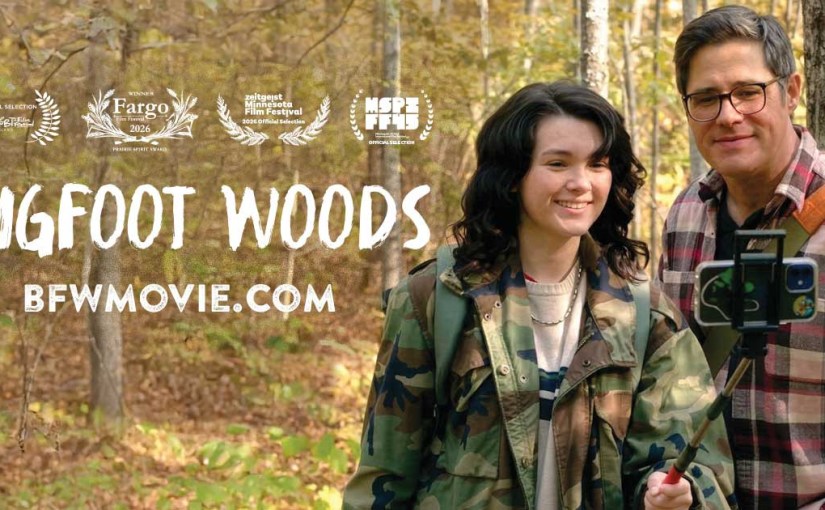
Steamer, Minnesota is hardly found on a map. At best, it’s known for being a possible resting place for Bigfoot. Paul and Bridget have father/child time together by roaming the woods and documenting discoveries in nature. At best, maybe fifty people watch their series of You Tube videos. However, that number explodes into the thousands when someone notices a rustling in the trees that could very likely be Bigfoot. At last, certifiable evidence may exist in Bridget’s footage and attract a wider scope that’ll bring welcome recognition to town. The folks are giddy over this discovery.
However, Bridget does not stop at what they share with Paul. Bridget is making a new declaration of self identity when Jonah is introduced, but many folks in Steamer are quick to change their tune.
Bigfoot Woods is simple in its cinematography and editing. It may operate like an Afterschool Special but that may also be its greatest achievement. The script by father and trans-son Bruce and Abel Pavalon brings a transparent honesty to trans youth who are developing into who they really are and how family and environment responds. Despite talent or accomplishments, some will overlook all of that when a trait feels unacceptable. Others will not get up in arms over how someone chooses to live and will simply welcome the change. It’ll justifiably become concerning, but they’ll need time. The script covers a wide range with a small cast and a condensed script.
Bridget/Jonah also suffers from a habitual side effect of cutting. I’m not here to minimize the character’s physical and mental ordeals. However, at only a running time of an hour and twenty minutes, I did not think there was ample material to address this ingredient of the story. Cutting is a very real symptom that needs serious attention. Either more could have been expounded on that, or it should have been excised from the final product.
One factor I’m grateful for is that Paul, the scientist, does his research on trans topics. He discovers the anatomical studies that upholds the need for transitioning down to how XX or XY chromosomes operate when another gene comes into play with a person’s DNA. A majority of those opposed to the idea of transitioning fail to do the research and neither uncover validity or the material that could repute it. People just make up their minds like it’s an opinion. Bigfoot Woods hinges on facts found in science, not instinctual prejudice.
In all fairness, I’ve done no research on the topic. Still I trust what’s included in Chatelain’s film. It’d be foolishly bold of her and the Pavalons to deliver a story that champions transition with unproven or false material.
The performance from Ambrose Velasco Jenkins is winning because there are multiple dimensions to the role. I didn’t really care for Bridget who was not connecting with their loving parents. Bridget is off putting and insensitive to mom and dad. Jonah is very likable though. It has to come down to an internal peace that Jenkins eventually delivers. Very good work.
I also really felt for Rich Sommer’s interpretation of a dad who’s a good, well educated father but also confused and lacking the confidence to deal with a change in his family’s dynamic. Too often men are expected to have all the answers. This man doesn’t. Yet, he will not cry about it or give up. He applies skills that will aid him into deciding for himself with confidence.
Tristen MacDonald offers another kind of identity struggle. A breast cancer survivor who opted for a double mastectomy. I recall stories where women feel less of themselves once they have gone through this kind of trauma. Bigfoot Woods tackles a wide berth of identity struggle. It’s not exclusive to members of the LGBTQ+ community. MacDonald only has a few lines that address her character’s background but she’s impactful enough to demonstrate self-identity does not stop with gender identity. It’s a mindset that depends on various factors and situations.
Bigfoot Woods is smart and insightful. It’s a straightforward account of a teenager ready to recognize internal thoughts beyond outside influence while figuring out who they want to be. With a curious story of the Bigfoot legend wrapped around it, there’s an intriguing aspect to this collection of three characters who are accepted by some while dismissed by others. A perfect button on the picture is a nice wink and nod that crosses the last caption before the credits arrive. I was smiling by the end.

