ANNIHILATION

By Marc S. Sanders

Science Fiction/Horror for the thinking viewer is the best way to describe this film.

Director Alex Garland has found a way to make a viewer’s eyes pop, not just with fear but with the unimaginable. This is as good an effort or better than his other well known film, Ex Machina. I foresee it will not be long before Garland is recognized among the ranks of today’s most notable and popular directors like Del Toro and Nolan.

This is not a run of the mill monster movie. This is fictionalized science that seems foreign and strange, yet makes complete sense by the time the credits roll. All questions are thankfully summed up despite a hanging thread or two to relish in deep thought long after the film has ended.

Natalie Portman strongly leads a nearly all female cast to uncover the purpose and functionality of “The Shimmer.” She does so, but at what expense? She’s great and believable in her role with lots of dimension by way of her career as a Johns Hopkins professor/former army infantry soldier and through periodic dreams of sin she feels guilty over.

Jennifer Jason Leigh does her best no nonsense disturbing creep. Gina Rodriguez makes good transitions in levels of sanity.

Like Black Panther, I’d argue this is also a front runner for art direction as an encapsulated swamp is overrun with strange pastel plant life, mixed up animal life and cinematic lens flare. Yes, here the lens flares serve a narrative purpose which is why the cinematography should also be given some recognition.

I’m looking forward to seeing this again to uncover what I missed the first time.

Annihilation turned out to be one of the biggest surprises of 2018.

LET THE RIGHT ONE IN (2008, Sweden)

by Miguel E. Rodriguez

Director: Tomas Alfredson
Cast: Kåre Hedebrant, Lena Leandersson
My Rating: 9/10
Rotten Tomatometer: 98% Certified Fresh

PLOT: A bullied schoolboy makes friends with the new neighbor, a girl about his age who doesn’t leave her apartment during the day and has some alarming eating habits…


A little while ago, I reviewed a movie called Klaus, a film that took an age-old pop culture trope (the origins of Santa Claus) and turned it on its ear.  I wasn’t sure when I would find another movie that would be able to do that so effectively.

Well…here it is.  Let the Right One In, a Swedish film from 2008, made huge waves at the time of its release.  Critics called it a film with “magnificent emotional resonance.”  “One of the great horror films of recent years.”  “One of the real finds of 2008.”  “A spectacularly moving and elegant movie…a remarkable film.”

Too good to be true, right?  Well, I’ve just finished watching it earlier tonight, and I can tell you, the hype is real.  While the very ending brought up more questions than it answers (where is the train going?  where are the parents?), the ride getting there was phenomenally good.  Calling it simply a “vampire movie” is almost insultingly reductive.  It poses questions about vampire lore that I had never really thought about, and it provides immensely satisfying answers.

For example, one of the most well-known rules about vampires is they cannot enter your home unless you invite them inside.  At one point in the film, a vampire hesitates at a doorway because she hasn’t been invited, and the boy asks her, “Well, what happens if you come in anyway?  Is there something in the air?”  So, she goes inside without being invited.  What happened next was totally unexpected, and it made perfect sense.  I remember thinking, “So THAT’S what they’re afraid of…”

But I’m jumping ahead.  Let the Right One In tells the story of a bullied pre-teen schoolboy, Oskar, who fantasizes about knifing his tormentors.  One day, new neighbors move into the apartment next door, an older gentleman and a preteen girl.  He meets the girl one evening out on the snowy playground in front of their apartment building.  (Her first appearance is one of the great entrances in cinema.)  She tells him her name is Eli (pronounced “Elly” in Sweden).  He says she smells funny.  She tells him they cannot be friends, even though she seems eager to make friends with Oskar.  Her eyes seem to be abnormally large, almost like a character in a Miyazaki anime.

We’ve already seen the older gentleman who moves in with her botch a food-gathering run, so it’s obvious from the get-go what exactly Eli is, and what she needs to survive.  This is all done within the film’s first fifteen minutes or so, so I promise I’m not giving anything away.

What happens after those establishing moments, I’ll leave for you to discover.  You may already be remembering countless other vampire films like Fright Night or Interview with the Vampire and thinking, “I’ve seen all this before.”  But I can assure you, you haven’t.  Not like this.

The relationship between Oskar and Eli never gets sexual (they’re both too young for that…well, Oskar is), and is handled with remarkable sensitivity and keen observation.  At one point, he buys her a snack from a vendor.  She refuses it.  He feels hurt.  So she takes one anyway and eats it.  Seconds later, she’s sick to her stomach.  What does Oskar think about this?  He’s surprised, but he takes it in stride and apologizes.  There’s something so clever about this approach, about making it between an old soul and a child, that feels fresh and new to me.  Oskar knows the term “vampire,” but clearly hasn’t seen enough movies to recognize the signs of one standing right in front of him.

Eli is forced to make a kill periodically to survive.  These attacks are done with a minimum of gore but are incredibly effective and horrifying.  There’s something instinctively creepy about seeing a little girl jump – or drop – from the shadows, clamber onto the back of her victims, and latch onto their necks with an animalistic growl.  The fact these attacks are stitched together with quiet moments, like Oskar teaching Eli morse code, creates a unique atmosphere that is impossible for me to describe satisfactorily.

(Another detail: when Eli is hungry, it’s not depicted as it is in other vampire movies, where the overpowering urge to feed makes her go mad and wide-eyed.  Her stomach rumbles.  True, it’s a little louder than when it happens to a normal person, but it feels…right.  Of course her stomach rumbles…she’s hungry.)

There is more to the story, of course, about Oskar’s bullies and Eli’s incompetent roommate and the suspicious bar regular whose friend was killed, and so on.  Better to leave the rest as a surprise.  And there are LOTS of cool surprises here.  This feels like the kind of movie Guillermo del Toro might have made if he had gotten there first.  (Oh, wait, he did make Cronos…I stand corrected.)

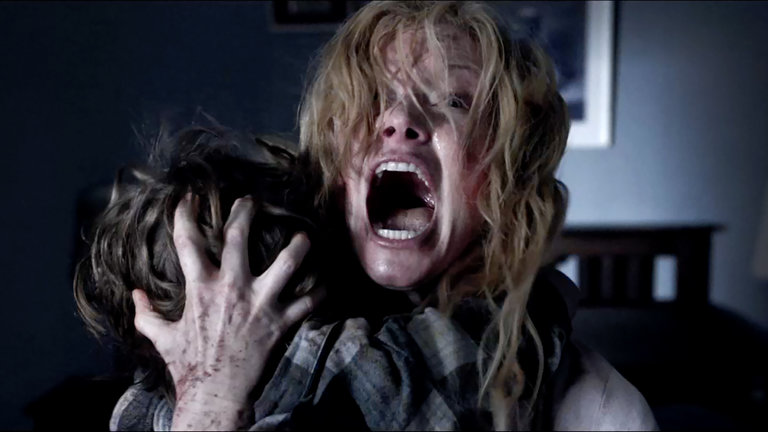
THE BABADOOK (2014)

by Miguel E. Rodriguez

Director: Jennifer Kent
Cast: Essie Davis, Noah Wiseman
My Rating: 10/10
Rotten Tomatometer: 98% Certified Fresh

PLOT: A widowed mother and her precocious but troubled young son experience some strange goings-on at home after reading a disturbing pop-up book about a malevolent spirit called The Babadook.


All due respect to the classics of the ‘70s and ‘80s, but some of the greatest and scariest horror movies have been released in the 21st century.  Paranormal Activity, The Descent, Hereditary, A Quiet Place, The Cell, It, and many, many others, including, of course, The Babadook.

However, The Babadook stands out because, not only does it achieve its scares with an ingenious less-is-more approach, but it’s actually about something.  Only the best horror films can say that.  And it’s not about some corny love-conquers-all theme.  It’s very specifically about people who have experienced a great personal loss, what that loss does to those people, and how a healing process can hopefully begin.

Amelia (Essie Davis) is a struggling single mother who was widowed on the day her son, Samuel (Noah Wiseman), was born.  Samuel is now six.  He loves his mother, but he does a lot of acting out…the kind of acting out that earns judgmental stares from other parents.  He builds crude but working weapons, including a catapult he can wear on his back.  (Assuming he lives to see college, this kid’s going to be an engineer.)

Amelia appears to be hovering on the edge of a breakdown.  She loves Samuel, but she’s painfully aware that his behavior, and her inability to control it, is causing problems at school and with other family and friends.

One night, he chooses a book to read as a bedtime story.  Amelia doesn’t recognize the book – where did it come from?  It’s a pop-up book about a nightmarish creature called The Babadook.  (For the record, the last syllable of “babadook” rhymes with “book.”)  In the annals of film history, few books are creepier and more disturbing than this freaking book.  I want one.

After reading the book, the mother starts hearing noises in the house.  Sam believes The Babadook is real.  He has nightmares.  Amelia tears the book to pieces and throws it in the garbage outside.  The next morning, there’s a knock at the door…and the book is sitting on her doorstep.  The pages have been re-assembled and pasted together…except now there are new passages at the end that include some troubling visuals of her, her son, and their dog.

Even without the subtext I mentioned earlier, this is some seriously scary s**t.  If the movie had been stripped of all its intelligence and insight, this would still be a horror classic.

The performance by Essie Davis as Amelia is as horrifying and memorable as Jack Nicholson’s in The Shining.  She’s that good.  She convincingly portrays a woman slowly descending into madness, faced with making impossible decisions while trying to shut away the crippling grief she still feels over the death of her husband.  In her mind, the best way to move on with her life is to pack all of her husband’s belongings, pictures, and clothes into the basement and keep it all locked up.  One interesting clue to her true mindset is that Samuel is not allowed to celebrate his birthday on his actual birthday, since his father died that same day.

Things get worse.  Amelia finds shards of glass in her porridge.  She discovers a hole behind her fridge with…things coming out of it.  Samuel becomes so terrified that he has a fit.  Amelia starts to see quick glimpses of what may or may not be the Babadook itself.  After one particularly horrific encounter, Samuel becomes afraid of his mother.  She seems to be changing…

It all comes together in a final sequence that includes some of the most terrifying scenes I’ve seen since The Exorcist.  (Fair warning: it’s not graphic, but some violence is perpetrated on a four-legged animal.)

What elevates The Babadook is the aforementioned underlying message of the story.  It provides a glimmer of hope for anyone who has suffered the kind of loss Amelia has suffered.  It reminded me of a famous poem by Stephen Crane, “In the Desert.”

          In the desert
I saw a creature, naked, bestial,
Who, squatting upon the ground,
Held his heart in his hands,
And ate of it.
I said, “Is it good, friend?”
“It is bitter—bitter,” he answered;
“But I like it
“Because it is bitter,
“And because it is my heart.”

At this point, everything else I want to say about The Babadook would involve giving too much away about the climax.  I am just amazed at how well this movie combines genuinely frightening material with an insightful look into correcting destructive human behavior, and not just in some general way, but very, very specifically.  It’s a modern masterpiece.

UNDER THE SKIN (2013)

by Miguel E. Rodriguez

Director: Jonathan Glazer
Cast: Scarlett Johansson
My Rating: 9/10
Rotten Tomatometer: 84% Certified Fresh

PLOT: A beautiful, mysterious young woman seduces lonely men in Scotland and takes them to her home, where something very strange indeed happens to them…


Under the Skin captivated me in a way that I did not expect.  It is a sci-fi mystery that stubbornly refuses to supply neat and tidy answers, and yet is spellbinding to watch. How director Jonathan Glazer accomplished this is no less mysterious to me than the origins of the movie’s main character, a solitary young woman played by Scarlett Johansson in a bravura performance that must have required a great deal of courage and trust in her director.

After a cryptic opening sequence involving some trippy visuals accompanied by an eerie musical score, Johansson’s character (listed only as “The Female” in the credits) gets down to business.  With the help of a mute motorcyclist (???), she acquires a van and trolls the streets of Scotland for young men on their own in the city.  She lures them into her van with pleasant conversation and a smile, which is easy enough to do when you look like Scarlett Johansson.  She then takes the men back to a deserted house in the country where I wouldn’t DREAM of revealing what happens.

The appeal of this movie is not the story, although that is obviously a big part of it.  It’s the storytelling.  Director Glazer works from a script that has the bare minimum of dialogue, usually when The Female is convincing men to get in her van.  Everything else depends on visuals.  It’s the kind of movie my friend Marc would enjoy, as it uses the camera to tell the story much more so than the soundtrack.  It shows us images and challenges the viewer to put two and two together to figure out what’s happening.

This visually-heavy strategy is a tightrope walk.  One false step and, instead of a mind-bending masterpiece, you get a head-scratcher that leaves you feeling cheated.  Under the Skin manages it.  There is one specific visual sequence that sealed the deal for me, a scene that provides a more detailed explanation of what happens to the men once they’re inside The Female’s house.  The real genius of the scene is that it provides information without fully answering the questions going through your head.  What is that black liquid?  Are the men hypnotized?  Their behavior would make it seem so.  And exactly how big is that house?

I’m being deliberately obscure because the delight of the film comes from discovering the thread of the story and following it along with The Female.  Her discoveries were just as interesting and scary to me as they were to her, because I felt really in tune with her character while I was watching the movie.  The closest I can get to describing it is…a long, LONG time ago, there was a computer game called Hacker that I got for my Commodore 64.  It came with literally no instructions beyond putting the disk in the drive and loading the game.  Then your screen went blank and it just displayed: “LOGON”.  And that was it.  As the gamer, it was up to you to figure out what to do in order to keep playing.  As you discovered more clues to the object of the game, you became more and more involved.

That’s how I felt watching Under the Skin.  Those opening visuals start you off thinking, “What the f@#k???”  Then the movie progresses, and the wheels start turning, and you realize what’s happening, and what The Female is attempting, and the discoveries she’s making about herself, and before you know it you’re as wrapped up in the story as she is.

I remember there was a lot of talk when this movie came out, but I never really hear anyone discuss it any more, outside of movie-centric blogs and Facebook pages.  If I can convince just one person who hasn’t seen it that this movie is worth their time, I will be happy.  Under the Skin deserves to be seen, discussed, and puzzled over.

P.S.  Under the Skin is, in fact, mildly famous because, yes, Scarlett Johansson gets naked.  But don’t get too excited.  Her nude scenes are utterly drained of any sexuality or eroticism whatsoever, due to their context.  You’ll see what I mean when you watch it.

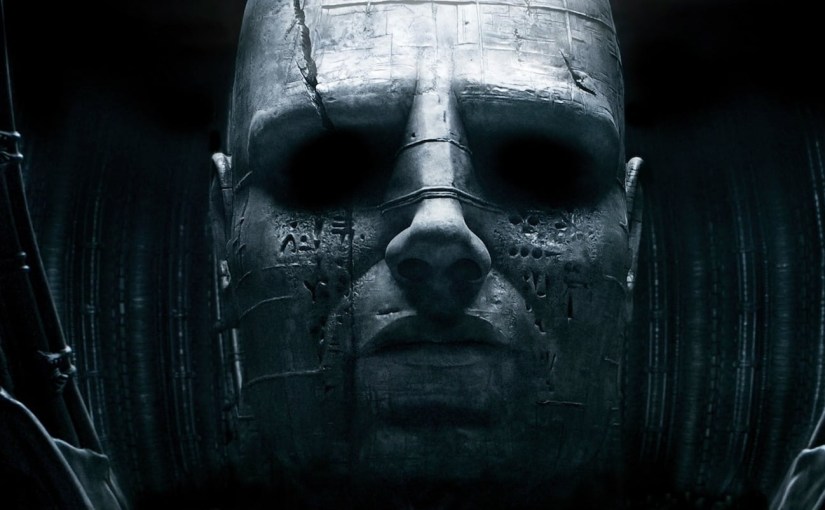
PROMETHEUS (2012)

by Miguel E. Rodriguez

Director: Ridley Scott
Cast: Noomi Rapace, Michael Fassbender, Charlize Theron, Idris Elba, Guy Pearce, Logan Marshall-Green
My Rating: 10/10
Rotten Tomatometer: 73%

PLOT: A deep-space research vessel arrives at a distant moon, searching for clues to the origins of mankind.  What they find instead threatens their lives and the lives of everyone back on Earth.


I am at a loss to explain the mediocre Tomatometer score for Prometheus, Ridley Scott’s long-awaited return to the universe he created in Alien [1979].  Intellectually, I can hear the arguments:

  • “Where’s the Xenomorph?”
  • “So did the ‘Engineers’ create humans or what?”
  • “Is that planet at the beginning supposed to be Earth?”
  • “Where’s the Xenomorph?”
  • “Why did that idiot scientist approach the snake-looking creature?”
  • “How is the android able to break almost all of Asimov’s Laws of Robotics?”
  • “What’s with the open-ended ending that provides no resolution?”
  • “WHERE’S THE XENOMORPH???”

I get it.  You hear Ridley Scott is making a prequel to Alien and you build up a lot of expectations, especially after watching some of the sorrier sequels that piled up after Aliens [1986].  When you go into a movie expecting one thing and get another, people get hacked off.  I feel you, bro.

But to those people who dismissed Prometheus because it didn’t deliver what they expected to get, all I can say is: your loss.  Because Prometheus is one of the greatest sci-fi movies of all time, in my humble opinion, and it’s mostly for the very same reasons that people disliked it in the first place.

After a brief prologue set in an unknown time in an unknown place, we jump to the year 2093, when a deep-space research vessel arrives at a far distant moon, searching for clues to the origin of mankind.  Dr. Elizabeth Shaw (Noomi Rapace) says they were led to this specific moon by “Engineers”, humanoid beings who are visible in ancient cave drawings from across the globe.  She believes the Engineers can provide an answer, THE Answer, to Life, the Universe and Everything. (Apologies to Douglas Adams.)

Instead of Engineers, Dr. Shaw and her expedition discover miles of underground caverns and a room full of canisters that turn out to contain a horrifying contagion that attack the body at a cellular and/or genetic level, creating painful mutations that, if they don’t kill the host outright, turns them incredibly violent.  We also get a glimpse of the famous “space jockey”, the fossilized alien creature seated in some kind of contraption inside the spaceship in Alien.  So at LAST we’re in familiar territory.

But still no Xenomorph.

The story progresses, the shipboard android turns out to be less than trustworthy, people die in creative and horrifying ways, an Engineer actually turns up, we get a couple more visually spectacular tie-ins to the first Alien…but by the time we get to the end, what gives?  The movie’s obviously over, but we haven’t gotten any answers to the burning questions: Who are the Engineers?  If that was an Engineer in the prologue, was that supposed to be Earth?  If it WASN’T Earth, why even HAVE that prologue?  And don’t try to tell me that was a Xenomorph at the end…

Well, here’s my two cents.

First, of all, expectations are tricky.  They can color and compromise your entire movie-watching experience.  When I went to see Prometheus, I did have my own set of expectations, but as the movie settled in and it became clear that the movie had other designs, I had to consciously shake myself loose of my expectations and embrace what was being presented to me.

Second of all, the visuals are stunning.  I happened to see this in 3-D, and it’s one of a handful of movies where the technology was used PERFECTLY.  No gimmicky shots of spears or harpoons or whatever being pointed out of the screen.  It was used as it should always be used: as a tool to further immerse you into the world of the film without overloading you or being ridiculously obvious.  The gorgeous landscapes during the prologue and during our heroes’ descent to the surface are awe-inspiring.

And then, the story.  I was completely okay with the open-ended nature of the story, and I’ll tell you why.

There are some films out there that play Prometheus’s game of asking questions and not answering them.  One of the most famous examples is Stanley Kubrick’s adaptation of 2001: A Space Odyssey [1968].  If you’ve never read the book, I defy you to provide a concise explanation of the last thirty minutes of that movie.  But that didn’t bother people, because the goal was to get the viewer to ask questions, to provoke discussions about the movie that would eventually get around to some of the same questions asked in Prometheus: Why are we here?  What is our purpose?

And then there are other films that play that open-ended game and fail.  The one that comes immediately to mind is Darren Aronofsky’s The Fountain [2006].  By the end of that movie, my head was locked in a tilted position like a cocker spaniel hearing a strange noise.  If I had been a cartoon character, the word balloon over my head would have been all question marks.  I once read a full description of what was really going on in that film, but to the degree that I understood it, I simply didn’t care.  If I have to go that much work to “get” a movie, the movie didn’t do its job.

There are those who say that’s what Prometheus did, throwing us in the deep end and making us do some mental heavy lifting with no payoff.  But I disagree.

I think, for me, it has to do with the very nature of the questions Prometheus is asking.  “If we could discover the answers to the riddles of our existence, to what lengths would we go, or should we go, to get those answers?  And do we even want to know the answers?  Are we better off NOT knowing?”  These are questions that, almost by definition, can’t be answered in any satisfying way.  So Prometheus presents a possible answer, but then teases it away so there is still some mystery in the story.  If the characters in Prometheus had discovered some kind of document that laid out the Engineers’ plans in detail, I would have felt cheated.  It would have been woefully anticlimactic.  I liked it better that the biggest questions went unanswered, so I could formulate my OWN theories about the Engineers, their plans, their methods, their history, their future, etcetera.  It’s much more stimulating to let my imagination run riot.

(Granted, some of those questions are answered in Alien: Covenant [2017], but that movie still had the guts to leave some things to the imagination by the end.)

Prometheus couches deep philosophical riddles about our very existence within a crackling good thriller with spectacular visuals from beginning to end.  It stands tall as one of the best prequels ever made…Xenomorph or no Xenomorph.

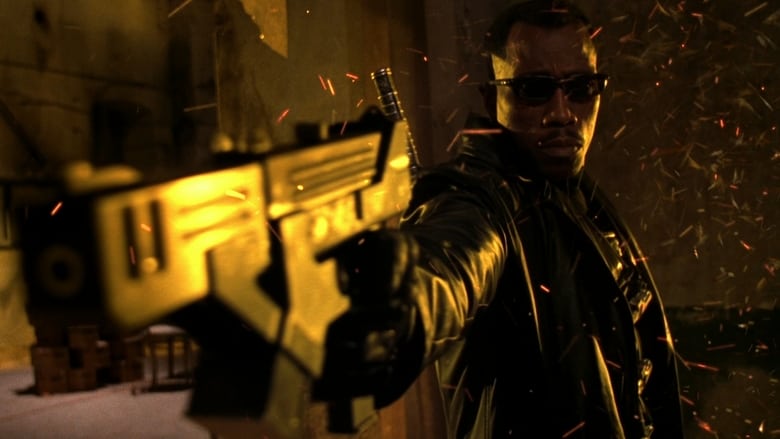
BLADE II (2002)

by Miguel E. Rodriguez

Director: Guillermo del Toro
Cast: Wesley Snipes, Kris Kristofferson, Ron Perlman, Norman Reedus, Donnie Yen
My Rating: 9/10
Rotten Tomatometer: 57%

PLOT: Blade, half human/half vampire, forms an uneasy alliance with the vampire nation in order to combat a new breed of monster, the Reapers, who are feeding on vampires and humans alike.


Why don’t more people like this movie?  It’s like someone took the best fight scenes from The Matrix, removed the pretentious plotting, added a crapload of gore, and created one of the best villains in the history of vampire movies: the Reaper, an evil-looking creature whose lower jaw splits wide down the middle to reveal a blood-sucking appendage that might even give the Xenomorph nightmares.

Blade II is lean and mean.  Director Guillermo del Toro has gone on record as saying this was not exactly the movie he intended to make, as it doesn’t keep precisely to the Blade “canon” (in case you didn’t know, Blade is a lesser-known Marvel comics character who is scheduled to eventually make an appearance in the Marvel Cinematic Universe).  However, despite his misgivings about this film, del Toro nevertheless created an action-horror masterpiece.

If you’re a fan of action films, what do you like?  Because it’s all here.  There are five great fight scenes, including a doozy in Blade’s own lair between Blade and two vampire ninjas wearing elaborate headgear that makes them look like humanoid bugs.  You like a great villain?  Here’s Jared Nomak, the vampire who carries the Reaper virus, whose wounds heal by themselves almost instantly, and who carries a dark secret.  His fighting skills are equal to those of Blade himself, who must learn to use more than brute force if he’s going to defeat Nomak.  (And let’s not overlook the cameo by Asian superstar Donnie Yen.)

You like a good story?  We got that, too.  Blade’s sworn enemies, the vampire nation, are forced to approach Blade for help when it becomes apparent they are no match for the Reapers.  Blade HAS to help, because who will the Reapers go after once they dispatch all the vampires?  Humans.  So you have the whole “uneasy alliance” going on, with no one more uneasy than Reinhardt, a vampire played by a deliciously malevolent Ron Perlman.  Reinhardt goes along with the plan, but can’t resist poking the tiger by asking Blade, “…can you blush?”  Blade’s response gives a whole new meaning to the term “kill switch.”  Game, set, match.

This is also a horror film, let’s not forget.  You like scares?  How about the part where a Reaper gets pinned to a wall with a ninja sword through its stomach…but escapes by crawling backwards up the wall, forcing the sword to slice through his body as he skitters away, unfazed by the damage?  YIKES.  We got gore, too.  Blade and company perform an autopsy on a dead Reaper.  I haven’t seen that much detailed gore since the autopsy in John Carpenter’s The Thing.

I mean, seriously.  This movie has everything I want in an action movie that’s also a horror film.  It covers ALL the bases.  (I could’ve done without the quasi-love-story, but it’s not dwelt on too much, so I can live with it.)  What more could anyone ask for?

(Also, it’s great to listen to on a bad-ass audio system…BOOMING bass and sound effects.  Great stuff.)

DRAG ME TO HELL (2009)

by Miguel E. Rodriguez

Director: Sam Raimi
Cast: Alison Lohman, Justin Long, Dileep Rao, David Paymer
My Rating: 8/10
Rotten Tomatometer: 92% Certified Fresh

PLOT: Christine Brown has a good job, a great boyfriend, and a bright future. But in three days, she’s going to hell.


Re-read that plot description above.  That’s pretty much the movie in a nutshell.  And it was directed by Sam Raimi getting back into his grindhouse-y horror zone after five years of hobnobbing with Columbia Pictures and their Spider-Man franchise.

In other words, it’s a movie showcasing a director getting back to what he does best.  And it is nothing if not effective.

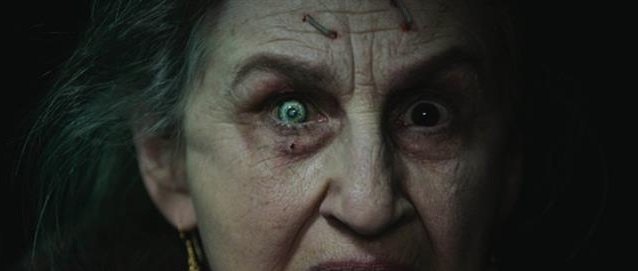
Christine Brown (Alison Lohman), a loan officer at a bank, tries to impress her boss by refusing to extend the home loan of an elderly woman, Sylvia Ganush, who is facing eviction.  Later that night, Mrs. Ganush accosts Christine in a parking garage (one of the movie’s many exceptionally effective scare sequences).  As revenge for rejecting her loan extension, Mrs. Ganush bestows a curse upon Christine: in three days, a demonic spirit will come for Christine’s soul, and there’s nothing she can do to stop it.

(We have already received a glimpse of what potentially awaits Christine during a horrifying prologue…and it is not good.  Helpful Tip for a Longer Life: Never piss off an old woman with a glass eye.)

Drag Me to Hell is not really trying to be “great”.  It’s a D-list story filmed by an A-list director.  It’s not concerned with the thematic dichotomy of good versus evil, or anything like that.  It is simply a delivery device for scares intended to jolt people out of their chairs every 5 or 10 minutes.

And, MAN, does it deliver.  There are sequences of poor Christine alone in her house, while something sinister prowls around outside, and eventually gets into the house…and I haven’t been that scared since I saw John Carpenter’s Halloween on VHS for the very first time.

There’s a creepy scene involving a single fly buzzing around Christine’s head while she sleeps, and then it alights on her face and crawls INSIDE HER NOSTRIL and then OUT THE OTHER ONE.  <shudder>  But then it moves towards her lips and starts to force its way INTO HER MOUTH…and it just makes your skin crawl in a way that’s hard to describe.  Accomplished with no blood or gore, just…eeyuck.

Mrs. Ganush herself makes a few encore appearances, just to keep things interesting, and then there’s a climactic séance at the house of a celebrated medium who once battled this particular evil spirit before.  This will certainly go down in movie history as one of the scariest/most gonzo séances EVER.  Without going into too many details, let me just say this: I could tell you the scene involves, at one point, a talking goat, and you might laugh, because what’s funnier than a talking goat, and it IS funny for the first couple of seconds…but that laughter will fade as soon as you see what happens next.  The word “bizarre” was invented for the séance in Drag Me to Hell.

That right there sort of encapsulates the general mood of this movie.  In all of his horror films, Sam Raimi’s sense of humor was always evident, most especially in Evil Dead 2 [1987] and Army of Darkness [1992].  In returning to the genre that started his career, he retains that gleeful, mischievous tone.  As horrifying as Drag Me to Hell is, it’s also pretty damn funny, even while we’re getting the bejeebers scared out of us.  (It’s hard to explain without getting into spoilers, but you’ll see what I mean when you watch it.)

So there you go.  It’s a horror movie that will make you laugh and shriek at the same time.  I thoroughly enjoyed it.

…but I would advise checking your doors are locked before starting it. Just saying.

DOCTOR SLEEP (2019)

by Miguel E. Rodriguez

Director: Mike Flanagan
Cast: Ewan McGregor, Rebecca Ferguson, Kyliegh Curran
My Rating: 9/10
Rotten Tomatometer: 76% Certified Fresh

PLOT: Nearly forty years after the events of The Shining, an adult Danny Torrance makes contact with someone else who can “shine”, and is soon drawn into a war with a band of people who hunt gifted people like himself.


If you had asked me a year ago to list movies will never get a sequel, Stanley Kubrick’s 1980 adaptation of The Shining would have been near the top of that list.  As adaptations go, it has its share of fans and detractors, but as a stand-alone horror movie, it’s a stone-cold masterpiece that has never been equaled.  When I heard that they were actually making a sequel based on Stephen King’s own sequel to The Shining, I was extremely skeptical.  The last time someone made a follow-up to a Kubrick film was 2010 (1984), and while that film was a decent sci-fi flick, it didn’t come close to the spectacle of Kubrick’s 2001: A Space Odyssey (1968).  So my expectations were, as they say, tempered.

After watching Doctor Sleep earlier tonight, I can say, unequivocally, that while the film is not perfect, I could not have asked for a better sequel to The Shining.  It’s a treasure trove for fans of the original, and also for fans of the extended universe that King has created for his novels, starting with the Dark Tower series forward.  (For those particular fans, you’ll be glad to see a very specific two-digit number making a conspicuous cameo…)

To begin with, the story is classic King.  Danny Torrance has grown into an irresponsible adult with a drinking problem, marking an unfortunate parallel with his father, Jack.  He hits bottom and takes up residence in a sleepy New Jersey town, joins AA, and works as an orderly at a local hospice.  Up to now, he has done everything in his power to keep his “shine” in check, but he finds a pragmatic use for his gift working with terminal patients, with the help of an inscrutable cat who can sniff out which patient is going to die next.

Eventually he comes into contact with a young girl named Abra, who lives in another part of New Jersey, but who can “shine” like he can.  And then there’s this nomadic group of people, calling themselves The True Knot, who are apparently hunting down other people with the “shine” for their own nefarious purposes.

It all wraps and weaves into a thrilling tale that skillfully retains the feel of Kubrick’s film.  Doctor Sleep works on its own merits, but the more you know about The Shining, the more thoroughly you’ll enjoy this new film.  Sharp-eyed cinephiles will be amazed at how many times, and in how many different ways, Kubrick’s style is echoed and referenced in this sequel.  These include liberal use of fade transitions, lots of static shots, Steadicam shots, use of natural lighting, those shots with the axe (!), even the aspect ratio that the film was shot in.  I got a giddy little swoop every time I saw how carefully the director, Mike Flanagan, was working the master’s craft into his film.  It was like watching a very subtle Kubrickian version of Ready Player One.  And it never comes off as plagiarism…it’s definitely homage, not theft.

Another aspect I really enjoyed was how the movie doesn’t rush through anything.  It’s two-and-a-half hours long, longer than average these days, which is yet another echo of The Shining.  When it works, that kind of pacing and running time gives the viewer the luxury of settling into the rhythm of the characters, makes them feel more like real people instead of cardboard cutouts hurrying from one milestone to the next.  For example, there’s a scene where one character performs a kind of astral projection to find someone.  There is a rather long series of shots showing her traveling through space that I can easily imagine would have been truncated in a lesser film.  Doctor Sleep, instead, gives us a good long look at her journey, to really feel the distance involved.  It’s quite a beautiful sequence, in fact.

This was a much better movie than I anticipated, which is good, because I never believed it was necessary.  It’s a relief to see that the continuation of Danny Torrance’s story has been handled in such a respectful manner, both towards the first film nearly 40 years ago and towards the viewers and fans.  It’s not perfect (I could pick nits about one particular aspect of the finale if I wanted to), but it’s a worthy successor to Kubrick’s masterpiece.  This belongs on the list of the best Stephen King adaptations along with It (2017), The Green Mile, and The Shawshank Redemption.

P.S. The blu-ray edition of Doctor Sleep contains a director’s cut that extends the running time by thirty minutes, adds more details about Abra’s powers, among other things, and inserts “chapter breaks” that almost make it feel like a miniseries.

SCARY STORIES TO TELL IN THE DARK (2019)

by Miguel E. Rodriguez

Director: André Øvredal
Cast: Zoe Margaret Colletti, Michael Garza, Gabriel Rush
My Rating: 3/10
Rotten Tomatometer: 80% Certified Fresh

PLOT: In order to save their lives, a group of kids face their fears as manifested by a haunted book of stories that write themselves.


I learn from Wikipedia that Scary Stories to Tell in the Dark is based on a popular series of horror stories from the ‘80s, written for a young-adult audience, much like the Goosebumps books, I would imagine.  (I have to imagine, because I have never read a single Goosebumps book.)  If the stories are anything like the trilogy of so-called terror presented in the film, they must be scary indeed.  At least on paper.

The plot: a group of teenagers in 1968 – why that year, specifically?  No idea – discover a book in a local haunted house, a REAL haunted house, that is supposedly filled with stories that a crazy woman would read to local kids through the walls of her basement where she was kept prisoner by her family.  They unwisely take the book from the house and should therefore be unsurprised when the stories in the book start to play out for real.

As a film, Scary Stories delivers occasional shocks without suspense.  You know what I’m talking about, right?  The scene where something jumps at the screen and the soundtrack goes DA-DUM!!!  …and it’s just a cat.  The entire movie is like that.  There are attempts to build suspense, but they fail to do so.

Ironically for a film with “Stories” in its title, I think the problem lies with the storytelling.  The stories on their own are fairly creepy, and seem like they could provide material for a much scarier film.  A scarecrow that comes to life?  A creepy-looking woman who just keeps walking closer and closer to you no matter what you do?  An animated corpse wondering who stole its big toe?  (Okay, maybe not that last one, but you get the idea.)  These would indeed be great stories to tell in the dark, preferably around a campfire or at a slumber party with the lights out and the doors and windows unlocked.

But the film stumbles, and it’s hard for me to pinpoint exactly what happened.  Maybe it rushes through the “in-between” material, the filler between the episodes of terror.  By rushing through those scenes, we really don’t get to know enough about the children who wind up in peril, and consequently we don’t care when they’re being stalked by monsters, etc.

Maybe it’s the fact that these stories, scary as they are on their own, are re-treads of classic horror tropes that we’ve seen over and over and OVER again.  But it can’t be that because, honestly, I have no beef with old tropes, as long as you tell the story well.  (Some might call that “putting old wine in a new bottle”, but if it’s a snazzy enough bottle, I’ll give it a pass… Avatar, anyone?)

So it has to be the storytelling.  The shocks were only periodically effective, and there are some disturbing visuals.  (My favorite involves the creepy-looking woman who keeps getting closer and close, which reminded me of a better film, It Follows.  For that matter, if you want a GREAT horror movie centered on a book, beg, borrow, or steal (not really) The Babadook.  Now THERE’S a scary story.  But I digress.)

There are some disturbing visuals, but the film just felt like it was keeping everyone at arm’s length.  Instead of getting sucked into the stories, I felt like I was watching it from inside the concession stand at a drive-in.  I was a distant observer.

You wanna know what the best part of the movie was?  The full trailer for Zombieland: Double Tap before the movie even started.  Not a great sign.

MIDSOMMAR (2019)

by Miguel E. Rodriguez

Director: Ari Aster
Cast: Florence Pugh, Jack Reynor, Vilhelm Blomgren
My Rating: 6/10
Rotten Tomatometer: 82% Certified Fresh

PLOT: A couple travels to Sweden to visit a rural hometown’s fabled mid-summer festival, but what begins as an idyllic retreat quickly devolves into a series of increasingly bizarre rituals at the hands of a pagan cult.


There is a lot to like in Midsommar, the second film from Ari Aster, director of last year’s masterful Hereditary.  It clocks in at 2 ½ hours, and the vast majority of that running time is devoted to creating and maintaining an atmosphere of unsettling oddness, where I was constantly asking myself, “Okay, what the hell is going on here?”  That’s a tricky task, because if you get it wrong, you wind up boring your audience.  And I was never bored during Midsommar.  So there’s that.

The plot: a young woman, Dani, suffers a terrible tragedy and turns for comfort to her boyfriend, Christian, who, truth be told, had been looking for an excuse to end things with Dani before the aforementioned tragedy struck.  But he stays with her more out of duty than real love, and they wind up going to Sweden with a bunch of friends on the recommendation of a college classmate of theirs who tells them of a marvelous nine-day solstice celebration held in his hometown, a quaint country village in the middle of nowhere that doesn’t seem to have or need electricity.

This place is…strange.  In scenes of ordinary behavior that nevertheless manage to somehow give you goosebumps, we observe the villagers performing tasks that would be at home in Amish country: folding clothes, preparing meals, gathering flowers, and the like.  Everything is brightly lit due to the perpetual sunlight at that time of year in that part of Sweden, and all that light somehow, instead of draining the scenes of suspense, actually increases it.  It’s very hard to describe accurately.  (Even the architecture contributes to this sense of unease, with a couple of buildings built with the kind of angles that would have been at home in a Tim Burton film.)

The film takes its time establishing this bright, passive weirdness.  One of the college friends asks the purpose of one of the strange buildings and is told it’s a temple…but no one is allowed there.  There are plainly crops in a field…but it’s difficult if not impossible to tell what’s being grown.  There’s a large bear in a wooden cage that the villagers seem not to notice or care about.   Some of the young village women openly admire Dani’s strapping boyfriend, much to Dani’s annoyance.

Then there’s a bizarre ceremony that starts out with a ritualized dinner, and then two of the older villagers are taken to a high cliff on the edge of the village, and…

Well, that’s when things REALLY start to get weird.  And bloody.  And even more trippy.  I think that’s where I have to stop describing events in the movie.

So.  Like I said, the film does a great job at creating this superbly unsettling atmosphere and maintaining it.  I couldn’t wait to see what was coming up next. But then the movie reached a point where it became obvious how it was going to end…

SPOILER ALERT, SPOILER ALERT, I SAY AGAIN, SPOILER ALERT.

When it became clear that this was NOT going to have a Hollywood ending, I didn’t mind at first.  I mean, Hereditary doesn’t end happily, and I thought it was brilliant.  (Well, I didn’t at first, but I do now.)  But…ugh.  In the last five minutes or so before the credits, instead of sucking in my breath at the audacity of this ending, I was instead shaking my head, saying to myself, “What the f***…?”  And not in a good way.  Midsommar ends with a whimper, not with a bang.

Which is so disappointing.  For 135 minutes, I was breathless with anticipation for the next scene.  And they lost me in the last five.  I HATE it when that happens.

I’m sure there are levels to Midsommar that make it more than just a horror movie.  No doubt there are all sorts of psychological – psychiatric? – parallels between the rituals of the village and the relationship between Dani and her boyfriend.  No doubt.  But when a movie loses me that badly at the end, all the poetic symbolism in the world won’t make me change my opinion.

Midsommar is a long ride for a short day at the beach. A crowded beach with no lifeguard and lots of seaweed.