by Miguel E. Rodriguez
Director: Luca Guadagnino
Cast: Dakota Johnson, Tilda Swinton, Chloë Grace Moretz
My Rating: 8/10
Rotten Tomatometer: 66%
PLOT: Berlin, 1977 – A young American woman (Johnson) joins an elite ballet troupe run by Madame Blanc (Swinton), but sinister events occur that lead her to believe that not all is as it seems…
[SOME SPOILERS FOLLOW – CONSIDER YOURSELF WARNED]
In 1977, Italian director Dario Argento released a horror film called Suspiria. I have never seen it, but I am aware of its place in film history. A brief scan of Wikipedia provides these tidbits:
- It’s #18 on Entertainment Weekly’s list of the 25 scariest films ever.
- One website called it “the closest a filmmaker has come to capturing a nightmare on film.”
- It is frequently cited for its use of vibrant colors, particularly when it comes to the copious amounts of blood present.
- It is director Argento’s highest-grossing film in the U.S.
I mention all this to reassure readers that, even though I have NOT seen the original, I am aware of its legacy. I also want to stress that I do not believe a thorough knowledge of the original is necessary for enjoyment, because this was one of the most supremely disturbing horror films I’ve ever sat through. I don’t know how closely it follows the original, but who cares?
The movie is entertainment, but portions of it are so grotesque that I found myself wondering, “Should I be enjoying this? What’s wrong with me if I am enjoying this?” I have a couple of issues with the ending, which I can’t discuss without spoiling some key plot developments, but aside from that, this was a riveting film…but, again, a very disturbing one.
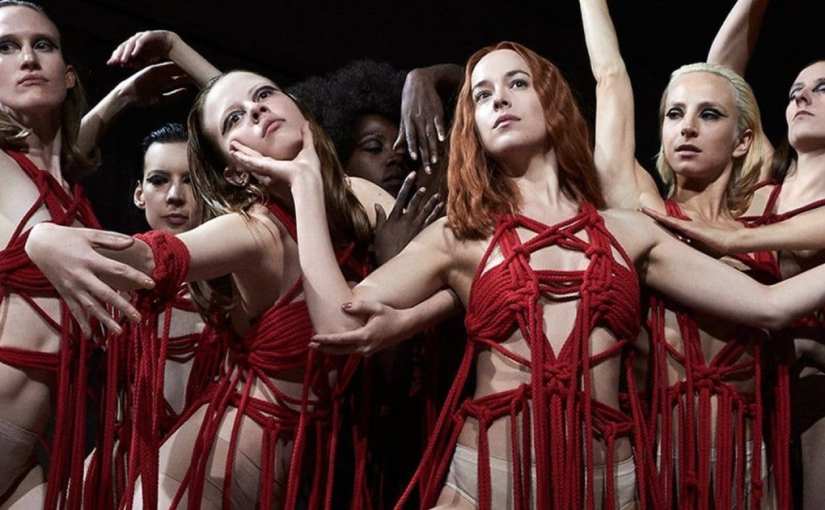
The plot: A young woman, Susie, travels from Ohio to join an elite ballet troupe in Berlin, run with an iron hand by the imposing Madame Blanc, played by the shape-shifting Tilda Swinton. Susie thoroughly impresses Swinton at the audition, and is hired almost immediately and shown to her dorm room (all the dancers and instructors live under one roof). The next day, a fellow dancer, Olga, storms out of a rehearsal after expressing concern about Patricia, another dancer who has gone missing, and suggests Madame Blanc had something to do with her disappearance.
This sets up the first of several intensely disturbing sequences in the movie. Olga tries to leave the dormitory, but gets turned around and winds up trapped in a small rehearsal space, one floor below the main rehearsal space. Blanc asks the new girl, Susie, to dance a particularly demanding routine. As Susie throws herself into the dance (with some striking choreography), Olga, one floor below, suddenly finds herself flung through the air by unseen forces, apparently in concert with Susie’s movements above. She gets tossed around like a life-size voodoo doll, from one wall to the other, down to the floor and up again, and I found myself thinking of poor Chrissy Watkins from Jaws as she was shaken from side to side before being eaten alive.
I haven’t even mentioned the grotesque things that start happening to her limbs. Or how the dance instructors use meat hooks for clean-up afterwards.
And that’s just in the first two acts of the movie.
A sense of foreboding suffuses nearly every shot of Suspiria. It’s a stress sandwich that doesn’t have the kind of cathartic scream moments one might expect from the horror genre. With Suspiria, it’s all about the slow burn, followed by moments of revelatory horror and eye-popping imagery, particularly when it comes to Susie’s dream sequences and the final revelation of what happened to Olga and Patricia.
But I STILL haven’t mentioned the climax. [AGAIN…SPOILER ALERT.]
All of the quease-inducing tension and visuals are nothing, NOTHING, I say, when compared to the finale, a grand guignol nightmare of blood, violent death, disembowelment, and gratuitous female nudity. It was at that point that I realized: this is one of those films that you dare each other to watch, just to see how long the other will last before turning it off or throwing up. The first couple of minutes of the climax involve more blood and off-putting makeup than any two Saw movies. And then, just when you think it’s over, the REALLY bloody part begins.
(There is a key question to which I did not get a satisfactory answer, thus my rating of 8 instead of 10.)
I honestly don’t know who to recommend this to. Horror aficionados, obviously, though many of them may be purists with no desire to see a 40-year-old masterpiece of the genre get the modern treatment. I stress again that I don’t believe knowledge of the original is necessary to enjoy (if that’s the right word) this movie. If it were made in a vacuum, with no original from 1977, I believe Suspiria would be able to stand alone as a new horror classic.
Just don’t eat anything before watching it.